
You turn the page.
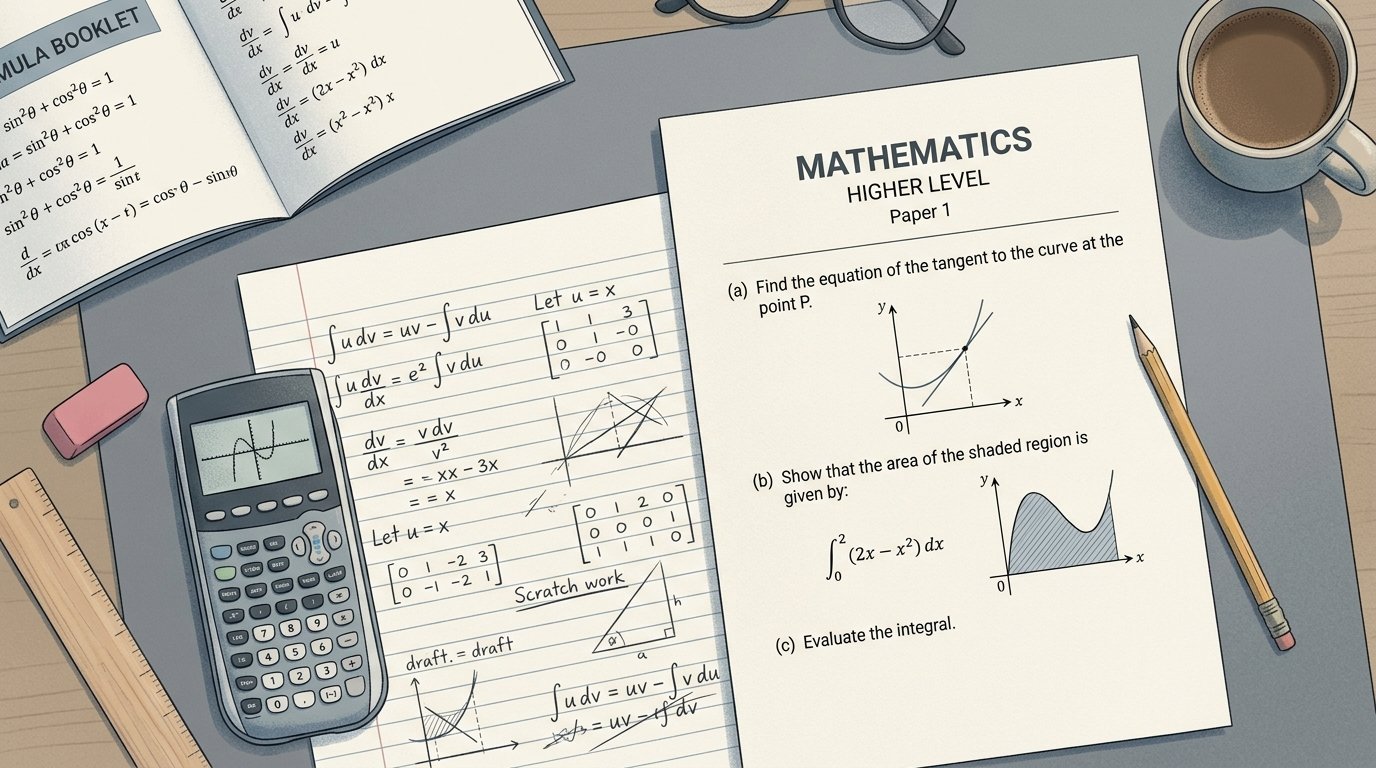
You read the IB Math question once.
Then again.
You understand the words individually, but you have no idea what to do next.
You look at the numbers.
You look at your calculator.
You look at the clock.
Nothing.
This is one of the most stressful moments in an IB Math exam.
And it’s easy to conclude:
“I don’t know this topic.”
But sometimes that’s not the real problem.
You may know the mathematics you need. The difficulty is recognising how to use it in an unfamiliar situation.
That distinction matters.
The IB Mathematics courses expect students to apply mathematical knowledge and skills to problem solving, including unfamiliar contexts. The assessment framework also includes communication, interpretation, reasoning, and appropriate use of technology.
So becoming better at unfamiliar questions isn’t about memorising hundreds of different solution patterns.
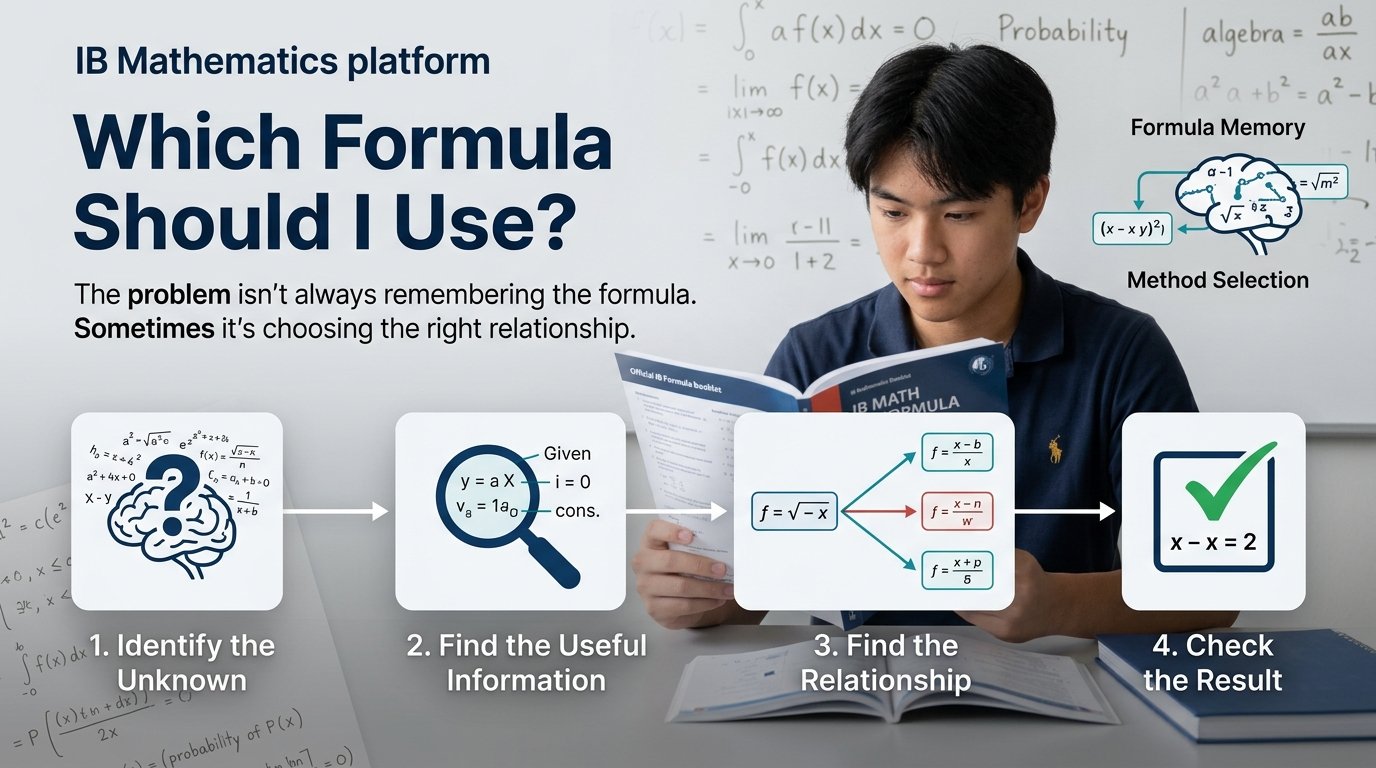
It’s about developing a reliable process for getting started.
This guide gives you one.
Table of Contents
What Makes an IB Math Question “Unfamiliar”?
An unfamiliar question doesn’t necessarily contain unfamiliar mathematics.
Often, the mathematical ideas are things you’ve already studied.
What changes is the way the mathematics is presented.
For example, you may have practised:
Find the maximum value of this function.
Then an exam question might describe a real situation involving revenue, area, distance, or volume and ask you to determine the maximum possible value.
The underlying mathematics could still involve differentiation.
But the question doesn’t tell you:
“Differentiate this function.”
You have to recognise that yourself.
An unfamiliar question might:
- combine two topics
- use an unusual context
- present information in a different form
- require several steps
- hide the relevant mathematical relationship
- require you to interpret a result
- provide more information than you need
- require you to decide which information matters
This is why solving unfamiliar questions is a separate skill from simply completing topic exercises.
Why Students Freeze on Unfamiliar Questions

There are several common reasons.
1. You Expect the Method to Be Obvious
When practising by topic, you usually know what you’re working on.
If you’re doing calculus questions, you already know calculus is involved.
If you’re practising probability, you expect a probability method.
An exam doesn’t necessarily give you that information.
You need to identify the mathematics yourself.
2. You Think You Need to See the Whole Solution
Some students believe that if they can’t immediately see the complete solution, they don’t know how to solve the question.
That’s not how mathematical problem solving works.
You often discover the solution one step at a time.
The goal isn’t:
“Can I see the entire solution?”
Instead ask:
“What is one useful thing I can establish?”
That question is much easier to answer.
3. You Start With the Calculator
A calculator can be extremely useful.
But when you’re completely stuck, randomly trying calculations usually doesn’t solve the underlying problem.
Before calculating, determine:
- What do I know?
- What do I need?
- What relationships might connect them?
Then use your calculator as a tool.
4. You Don’t Know Which Topic Is Being Tested
Sometimes an unfamiliar question appears difficult because you haven’t identified the mathematical area involved.
The first task is therefore classification.
It doesn’t need to be perfect.
You might think:
“This looks like functions and calculus.”
That’s enough to start exploring.
The 7 Step Method for Unfamiliar IB Math Questions
When you’re stuck, use this process:
Read → Extract → Identify → Connect → Start → Check → Continue
Let’s look at each step.
Step 1: Read the Question Slowly
Don’t start calculating immediately.
Read the entire question.
Then ask:
What is this question actually asking me to find?
Look at the final instruction carefully.
Words such as:
- calculate
- determine
- show
- explain
- justify
- estimate
- find
- hence
- interpret
can tell you what kind of response is expected.
Don’t focus only on the numbers.
The wording often contains important mathematical information.
Step 2: Extract the Information
Write down the information that matters.
For example, imagine a problem gives you a function: f(x)=x³−6x²+9x+4
and asks you to investigate a maximum or minimum.
You already have something useful: f(x)=x³−6x²+9x+4
You don’t need to know the entire solution yet.
You simply need to identify what information you’ve been given.
For a word problem, you might extract:
- known values
- variables
- equations
- conditions
- restrictions
- units
- relationships
This turns a large paragraph into smaller pieces.
Step 3: Identify What You Need to Find
Now focus on the target.
Ask:
What exactly is the question asking for?
Is it asking for:
- a value?
- an equation?
- a probability?
- a maximum?
- a minimum?
- a gradient?
- an area?
- a volume?
- a parameter?
- a proof?
- an interpretation?
Sometimes students get stuck because they haven’t clearly identified the destination.
Once you know the destination, you can start looking for a route.
Step 4: Identify Possible Mathematical Ideas
Now ask:
What mathematics could connect the information I have to what I need?
Don’t commit immediately.
Generate possibilities.
For example:
If you need a gradient
Think about:
- differentiation
- gradient functions
- coordinates
- tangent lines
If you need a maximum or minimum
Think about:
- differentiation
- stationary points
- second derivative
- endpoints
- graphing
If you need a probability
Think about:
- probability rules
- conditional probability
- distributions
- expected value
- counting methods
If you need an area
Think about:
- geometry
- integration
- decomposition into shapes
If you need to model change
Think about:
- functions
- sequences
- differential equations
- exponential models
- rates of change
You aren’t solving the question yet.
You’re narrowing the possibilities.
Step 5: Find the First Useful Line
This is perhaps the most important skill in this entire article.
When you don’t know how to solve a question, don’t ask:
“What is the final answer?”
Ask:
“What is the first mathematically useful statement I can write?”
For example, suppose the question asks you to find the stationary points of: f(x)=x³−6x²+9x+4
You might not know the entire solution immediately.
But you know that stationary points occur where f′(x)=0.
So write: f′(x)=3x²−12x+9
Then: 3x²−12x+9=0
Now you’re moving.
The important thing is that you didn’t need to see the complete solution before starting.
Step 6: Check Whether Your First Step Makes Sense
Once you’ve written something, stop for a moment.
Ask:
Does this connect the information given to what I’m trying to find?
If yes, continue.
If not, reconsider.
This prevents you from producing a page of calculations based on the wrong assumption.
For example, if you’re trying to find an area and you immediately start solving an unrelated equation, pause.
Ask:
Why am I doing this?
If you can’t explain why the step helps answer the question, it may not be the right direction.
Step 7: Build the Solution One Step at a Time
Once you’ve found a useful starting point, don’t worry about the entire question.
Ask:
What does this give me?
Then:
What can I do with that result?
Then:
What does the question need next?
This creates a chain:
Information → Mathematical relationship → Result → New information → Next step
That’s how many unfamiliar problems become manageable.
Example 1: An Unfamiliar Calculus Question
Imagine an exam question describes the height of an object using a function.
You are asked to determine when the object reaches its greatest height.
The question doesn’t explicitly say:
“Use differentiation.”
What should you do?
First: Identify the target
You need the greatest height.
Second: Identify the mathematical idea
Maximum value suggests a maximum point.
Third: Ask what mathematics finds a maximum
Differentiation may be relevant.
Fourth: Find the first useful step
If the height is h(t),
Consider: h′(t)=0
Now you have started.
The rest of the problem can develop from there.
Notice what happened.
You didn’t memorise the exact question.
You recognised the relationship between:
maximum → stationary point → derivative
That’s mathematical problem solving.
Example 2: An Unfamiliar Probability Question
Imagine a question describes students taking two tests.
You are given information about the number who passed each test and the number who passed both.
Then you’re asked about the probability that a student passed one test given that they passed another.
The question may not announce:
“This is conditional probability.”
But the wording gives you a clue.
The phrase:
“given that”
should immediately make you consider conditional probability.
You can write: P(A∣B)=P(B)P(A∩B)
Now you’ve converted the wording into mathematics.
Again, the key skill isn’t memorising the formula alone.
It’s recognising when the situation calls for it.
Example 3: A Geometry Problem That Doesn’t Look Like Geometry
Suppose a question describes a cable running between two points and asks you to determine its length.
The diagram may not immediately look like a standard geometry exercise.
But ask:
What quantities do I know?
What shape is involved?
Is there a right angled triangle?
If so, you might recognise: a2+b2=c2
The question may look unfamiliar.
The underlying mathematical relationship isn’t.
This is why you should practise recognising structures rather than memorising surface appearances.
Use Diagrams When You Feel Stuck
A diagram can turn a paragraph into something much easier to understand.
This is particularly useful for:
- geometry
- vectors
- functions
- transformations
- optimisation
- modelling
- rates of change
You don’t need artistic drawing skills.
A rough diagram can be enough.
Label:
- known quantities
- unknown quantities
- relevant angles
- lengths
- coordinates
- directions
- relationships
The act of drawing can reveal information you didn’t notice while reading.
Translate Words Into Mathematics
Another powerful skill is translation.
Look for phrases that suggest mathematical relationships.
“The rate of change”
Think: dxdy
“The gradient”
Think: dxdy
or the gradient formula, depending on the situation.
“At least”
Think about inequalities or complementary probabilities.
“Given that”
Think about conditional probability.
“Maximum”
Think about optimisation.
“Minimum”
Think about optimisation.
“The area under the curve”
Think about integration.
“The average rate”
Think about change divided by time or the relevant interval.
“Independent events”
Think about: P(A∩B)=P(A)P(B)
The exact method depends on the question, but recognising these relationships can help you get started.
Don’t Ignore the Diagram or Graph
Sometimes the most useful information isn’t in the paragraph.
It’s in the diagram.
Check:
- axes
- scales
- labels
- intercepts
- gradients
- marked angles
- coordinates
- asymptotes
- intersections
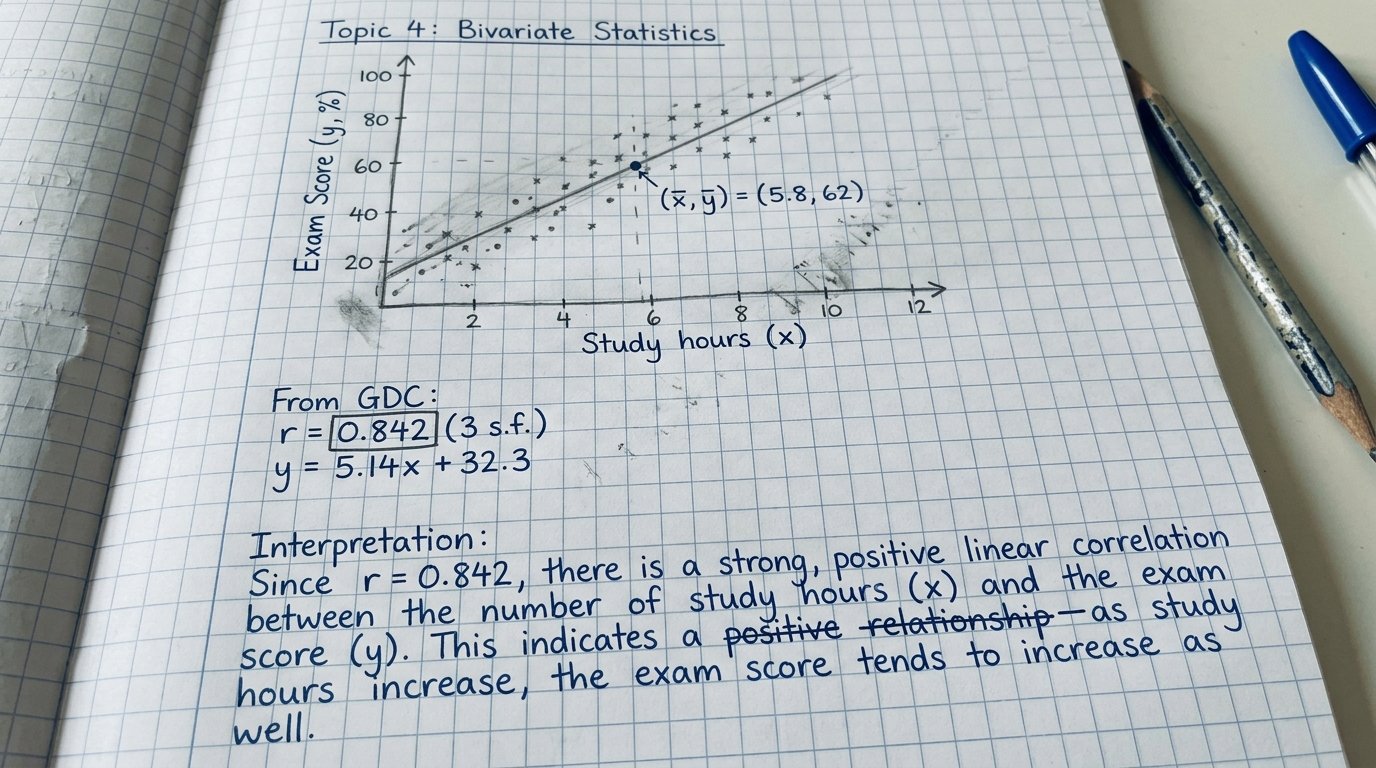
- shaded regions
If there’s a graph, ask:
What does this graph tell me that the text doesn’t?
A graph may reveal a relationship that is difficult to see from the written description alone.
What If You Still Can’t Identify the Topic?
Sometimes you genuinely can’t tell.
That’s okay.
Try a broader classification.
Ask:
Is this mainly algebra?
Look for equations, unknowns, rearrangement, simultaneous equations, or algebraic relationships.
Is this mainly functions?
Look for mappings, transformations, domains, ranges, inverses, or function composition.
Is this calculus?
Look for rates of change, gradients, optimisation, areas, accumulation, or differential equations.
Is this statistics?
Look for data, distributions, correlation, regression, hypothesis testing, or interpretation.
Is this probability?
Look for events, outcomes, conditional information, independence, or expected values.
Is this geometry or vectors?
Look for coordinates, angles, distances, directions, lines, planes, or vector relationships.
You don’t need to identify the exact subtopic immediately.
You only need to narrow the field.
What Not to Do When You’re Stuck
Don’t immediately look at the solution
Give your brain time to work.
If you look at the answer too quickly, you may recognise the solution without learning how to produce it.
Don’t randomly try formulas
Formula dumping isn’t problem solving.
Ask why a formula might apply.
Don’t repeatedly press calculator buttons
A calculator cannot decide what mathematical problem you’re trying to solve.
Don’t panic because the question looks different
An unfamiliar appearance doesn’t necessarily mean unfamiliar mathematics.
Don’t spend ten minutes doing nothing
If you’re genuinely stuck after making a serious attempt, move on when appropriate.
You can return later with a fresh perspective.
How to Practise Starting Difficult Questions
This skill can be trained.
You don’t always need to complete the entire question.
Take a set of unfamiliar questions and practise only the first stage.
For each question, write:
1. What is given?
2. What is required?
3. What topic or mathematical ideas might be relevant?
4. What is my first useful line?
Then compare your starting approach with the solution.
This isolates problem initiation as a skill.
That’s valuable because many students don’t struggle with the final calculations.
They struggle with getting started.
Try the “First Three Lines” Exercise.
Here’s a useful revision technique.
Take an unfamiliar question.
Give yourself a few minutes.
Your goal isn’t to finish it.
Your goal is to write the first three mathematically useful lines.
For example: f(x)=… f′(x)=… f′(x)=0
Or: P(A∣B)=P(B)P(A∩B)
followed by the relevant substitutions.
Or: a²+b²=c²
followed by the known values.
Then ask:
Did those first lines move me closer to the answer?
If yes, you’ve successfully started.
Repeat this with different questions.
Eventually, beginning unfamiliar problems becomes less intimidating.
How to Use Mark Schemes When You’re Stuck
Don’t use the mark scheme only to discover the answer.
Use it to study how the solution begins.
Ask:
What was the first mathematical decision?
Then:
What information did the student or mark scheme use?
Then:
What relationship connected that information to the next step?
This helps you learn the structure of mathematical reasoning.
A mark scheme is primarily designed for marking, not for providing a full teaching explanation.
So if a mark scheme contains a short line such as: f′(x)=0
don’t just memorise it.
Ask:
Why did they set the derivative equal to zero?
That turns a marking instruction into mathematical understanding.
How Feedback on Your Working Helps
When you get stuck on an unfamiliar question, the most useful feedback isn’t always:
“The answer is 14.6.”
You need to know whether your approach was reasonable.
For example:
- Did you identify the correct topic?
- Did you extract the right information?
- Did your first equation make sense?
- Did you choose an appropriate method?
- Did you make a correct connection?
- Where did your reasoning stop working?
This is why reviewing actual working is more informative than checking final answers alone.
Mathzem’s practice workflow is built around this idea:
Choose a question → Solve it → Upload your working → Receive examiner style feedback → Identify mistakes → Decide what to practise next
You can explore Mathzem IB Practice to use this practice and feedback cycle.
If you’re not sure which skills are causing your difficulties, Math Skill Scanner can help identify areas to focus on.
A Practical Exam Strategy for When You Are Completely Stuck
If you’re sitting an exam and nothing seems to work, use this checklist.
First
Read the question again.
Second
Underline or identify the important information.
Third
Write down what you’re being asked to find.
Fourth
Identify the likely mathematical area.
Fifth
Write a relevant formula, definition, equation, diagram, or relationship.
Sixth
Substitute the information you know.
Seventh
Look at what your new result tells you.
Eighth
Continue from there.
If you still can’t progress, mark the question and return later.
The important thing is to avoid turning one difficult question into a problem with your entire exam timing.
How to Build Unfamiliar Question Practice Into Your Revision
Don’t wait until the day before the exam.
Use a progression.
Early preparation
Spend most of your time building topic understanding.
Middle preparation
Introduce mixed questions.
Later preparation
Increase unfamiliar application questions.
Final preparation
Use unfamiliar questions under timed conditions.
A simple weekly structure might be:
| Practice type | Suggested role |
|---|---|
| Topic questions | Build and repair skills |
| Similar questions | Develop fluency |
| Mixed questions | Practise method selection |
| Unfamiliar questions | Develop problem solving |
| Timed questions | Develop exam performance |
You need all five.
The Most Important Question to Ask When You’re Stuck
When an IB Math question looks impossible, don’t ask:
“How do I solve this?”
That question is often too big.
Break it down.
Ask:
What do I know?
Then:
What do I need?
Then:
What mathematical relationship connects them?
Then:
What is the first useful line I can write?
That sequence makes the problem smaller.
And smaller problems are easier to solve.
Common Mistakes When Tackling Unfamiliar IB Math Questions
Trying to identify the exact topic immediately
Sometimes several topics are involved.
Better: Identify the broad mathematical ideas first.
Searching for a memorised question pattern
An unfamiliar question may deliberately avoid looking like your practice questions.
Better: Look for mathematical relationships.
Starting with calculations
This can send you down the wrong path.
Better: Understand the target before calculating.
Giving up because you don’t see the full solution
You don’t need the entire solution at once.
Better: Find one useful first step.
Looking at the answer too soon
This creates recognition rather than independent problem solving.
Better: Make a genuine attempt first.
Practising only questions that look familiar
This creates false confidence.
Better: Gradually increase unfamiliar practice.
FAQs About Unfamiliar IB Math Question
How do I start an IB Math question when I don’t know what to do?
Start by identifying what information is given and what the question asks you to find. Then identify possible mathematical relationships and write the first useful equation, formula, diagram, or definition you can justify.
Why do IB Math questions sometimes feel harder than classroom questions?
Classroom exercises are often organised by topic, so you already know which method you’re expected to practise. Exam questions may combine topics or present familiar mathematics in an unfamiliar context.
Should I use my calculator when I’m stuck?
Not as your first step. First determine what you need to calculate and why. Then use the calculator to carry out the appropriate mathematical operation.
How can I get better at unfamiliar IB Math questions?
Practise a progression from familiar questions to similar questions, mixed questions, unfamiliar applications, and timed exam questions. Review how you started each difficult question, not only whether you eventually got the answer.
What should I do if I can’t identify the topic?
Look at the information and required result. Consider whether the question involves algebra, functions, calculus, statistics, probability, geometry, or vectors. You don’t need to identify the exact topic immediately.
Is it okay to skip a question in an IB Math exam?
If you’ve made a genuine attempt and cannot progress, it can be sensible to move on and return later, particularly when time is limited. Before leaving it, write down any relevant mathematical work you can justify.
Conclusion: You Don’t Need to See the Whole Solution
An unfamiliar IB Math question can make you feel as if you’ve forgotten everything.
Usually, that isn’t true.
You may simply be facing a question that doesn’t tell you which method to use.
The solution is to slow down and make the problem smaller.
Read the question.
Extract the information.
Identify the target.
Think about possible mathematical relationships.
Write the first useful line.
Check your direction.
Build the solution one step at a time.
The goal isn’t to recognise every question immediately.
The goal is to become comfortable making a useful first move when you don’t.
That is a skill you can practise.
And the more you practise it, the less intimidating unfamiliar IB Math questions become.
Quick Takeaway
When you’re completely stuck, remember:
Given → Required → Relationship → First useful line → Next step
Don’t wait for the entire solution to appear in your head.
Start with what you know.



One Response