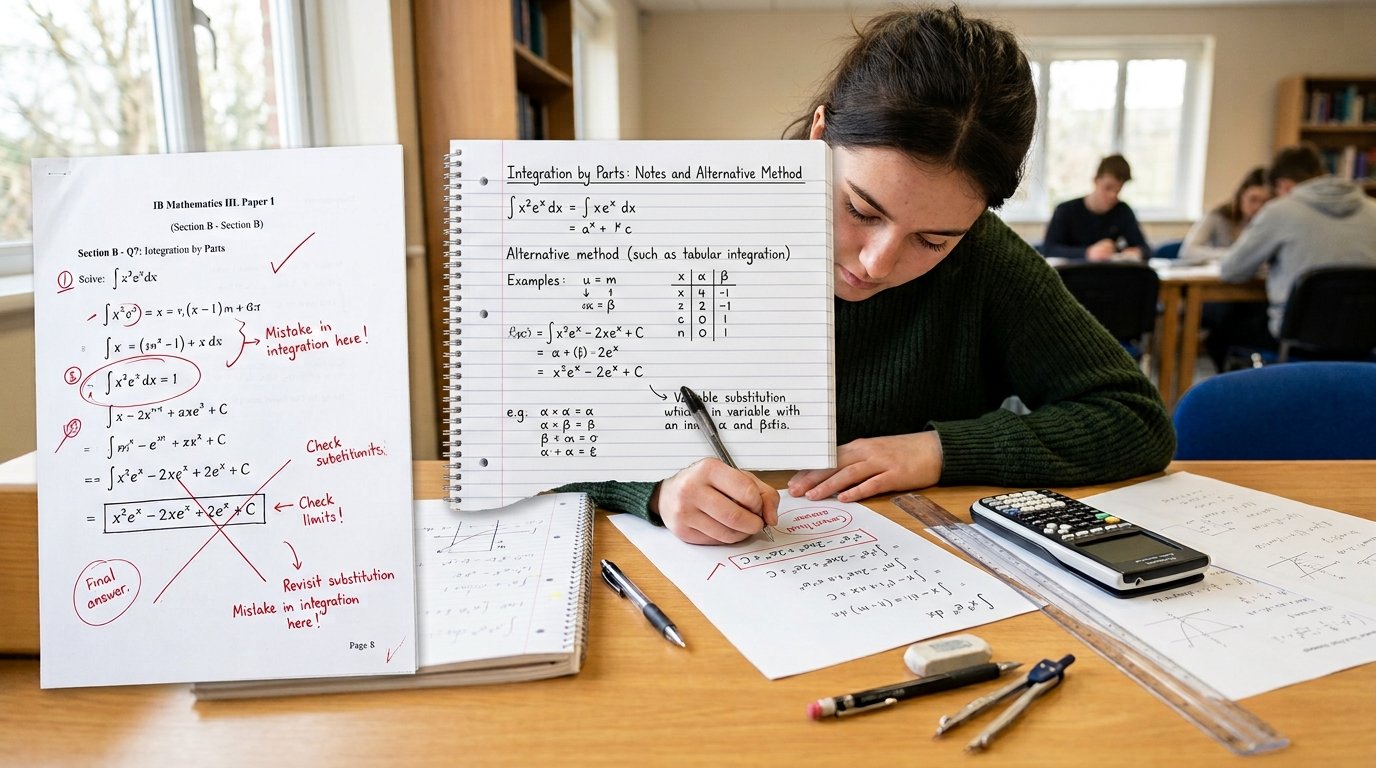
You get your IB Math test into a revision plan back.
You see the grade.
Maybe it is lower than you expected.
So you write:
Revise maths.
Then you start doing more questions.
That sounds reasonable, but it leaves out the most useful information in the paper.
Your test already contains evidence about why you lost marks.
The question is whether you use that evidence.
A 58% score does not tell two students to revise the same things. One student may have strong mathematical knowledge but lose marks through algebra and incomplete working. Another may have genuine gaps in several topics. A third may be accurate on familiar questions but struggle when the method is not obvious.
The revision plan should therefore come after analysing the test, not before.
Table of Contents
Quick answer
To turn an IB Math test into a useful revision plan, do not start with the topics you scored lowest in.
Start with the questions where you lost marks.
Review your actual working and classify each problem. Was it a knowledge gap, method selection problem, calculation error, interpretation issue, communication issue, or difficulty applying familiar mathematics in an unfamiliar context?
Then look for repeated patterns.
Those patterns should determine what you practise next.
This approach is consistent with the way the IB describes its mathematics courses, which aim to develop mathematical knowledge alongside problem solving, logical thinking, application and appropriate use of technology.
Your test score is a starting point, not a diagnosis
Suppose you receive 60%.
It is tempting to conclude:
“I need to revise 40% of the course.”
You do not.
The percentage does not tell you which mathematical skills caused the lost marks.
Consider three students who all score 60%.
Student A
They understand most of the mathematics but make repeated algebra errors.
Student B
They know the procedures but struggle to identify which method to use.
Student C
They have genuine gaps in several topics.
All three have the same percentage.
They should not have the same revision plan.
This is why analysing the paper matters more than simply recording the grade.
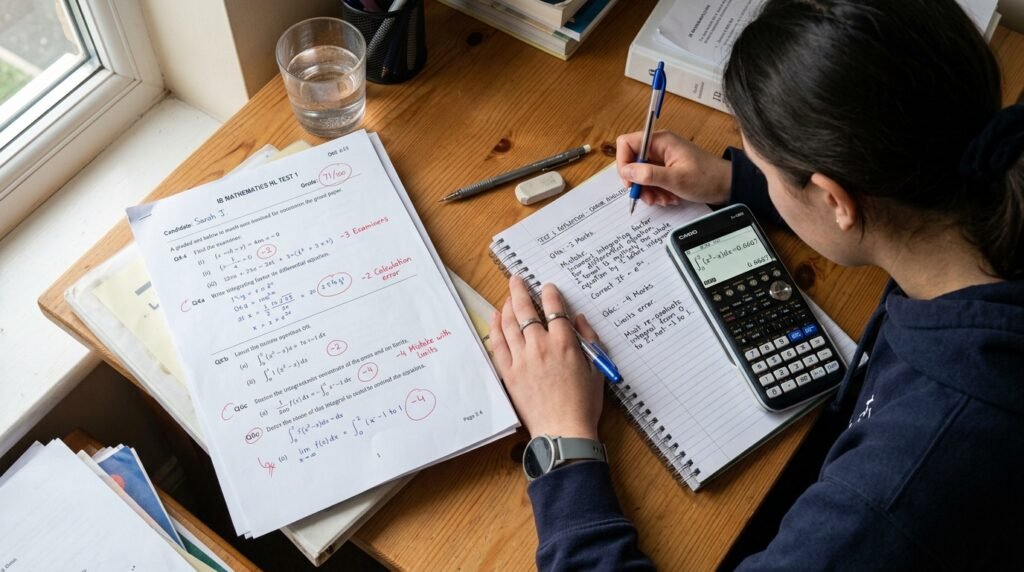
Step 1: Go through every lost mark
Start with the questions where you lost marks.
Do not immediately read the complete solution.
Look at your own working first.
For each question, ask:
What was the first thing that went wrong?
That question is important.
Suppose you are solving a calculus problem.
You correctly differentiate the function.
You correctly set the derivative equal to zero.
Then you make an algebra error while solving the resulting equation.
Your final answer is wrong.
But that does not necessarily mean your calculus understanding is weak.
The first meaningful problem was algebraic manipulation.
That should affect your revision plan.
This is one reason Mathzem’s approach focuses on the student’s actual working rather than only the final answer. The current product documentation describes handwritten working review, mistake analysis, method feedback, weak areas and next step guidance as core capabilities.
Step 2: Classify the reason you lost the mark
You do not need a complicated system.
A simple classification is enough.
1. Knowledge problem
You did not know the relevant mathematical concept, formula, relationship or procedure.
Revision response: Review the concept, then practise straightforward applications.
2. Method selection problem
You knew several relevant ideas but could not identify which one applied.
Revision response: Practise mixed questions where the topic or method is not stated.
3. Execution problem
You knew what to do but made an error while carrying it out.
Examples include:
Algebra mistakes.
Sign errors.
Incorrect substitution.
Calculator input errors.
Early rounding.
Revision response: Practise the specific execution skill.
4. Interpretation problem
You completed the mathematics but did not correctly explain what the result meant.
Revision response: Practise questions that require conclusions or interpretation in context.
5. Communication problem
Your mathematical thinking may have been reasonable, but your working did not make the method or reasoning sufficiently clear.
Revision response: Practise complete solutions and make the important mathematical steps visible.
6. Application problem
You knew the mathematics but struggled when the question presented it in an unfamiliar way.
Revision response: Move beyond familiar exercises into mixed and unfamiliar exam style questions.
These categories are not official IB labels for every student error. They are a practical way to analyse your own practice.
The exact marks available and how they are awarded depend on the individual question and official mark scheme.
Step 3: Separate topic weakness from skill weakness
This is where test analysis becomes much more interesting.
Imagine you lost marks in:
Calculus.
Functions.
Probability.
Statistics.
You might decide:
“I am weak in four topics.”
But look again.
Suppose your errors were:
Calculus: algebra manipulation.
Functions: algebra manipulation.
Probability: incorrect notation.
Statistics: algebra manipulation.
Now the pattern looks different.
You may not have four separate topic problems.
You may have one recurring algebra issue and one notation issue appearing across different topics.
That changes the revision plan.
Instead of revising four entire units, you can target the underlying skills.
This is also why Mathzem customer research identifies a recurring student problem as the gap between understanding a topic and being able to perform successfully in an exam. Students often report that they understand classroom explanations but still lose marks, do not know which formula or method to use, or keep making the same mistake.
Step 4: Look at the questions you got right too
This is easy to overlook.
A correct answer is not always evidence of complete understanding.
Suppose you correctly solve a standard integration question.
Ask:
Did I know why I chose that method?
Could I solve it without the example beside me?
Would I recognise the same mathematical idea if the question were worded differently?
Did I rely heavily on my calculator?
Was my working clear?
If you answered yes confidently, that is useful evidence.
If you got the answer right but needed substantial help, that is different.
A test therefore contains more information than:
Correct / Incorrect
There is also:
Independent / Helped
Familiar / Unfamiliar
Clear method / Unclear method
Reliable / Error prone
That information can improve your revision plan.
Step 5: Identify the questions that exposed your biggest weakness
Not every lost mark deserves equal attention.
Suppose you lost one mark because you accidentally copied a number incorrectly.
You also lost six marks because you could not start two unfamiliar questions.
Those problems should not necessarily receive equal revision time.
Look for weaknesses that are:
Repeated.
Significant.
Relevant to the type of questions you need to handle.
Still present when you attempt new problems.
This does not mean ignoring small errors.
It means allocating practice according to evidence.
Step 6: Build the revision plan around skills, not just chapters
A weak revision plan might say:
Monday: Calculus
Tuesday: Probability
Wednesday: Functions
Thursday: Statistics
That can be fine for syllabus coverage.
But it may not address why you lost marks.
A more useful plan might say:
Monday: Algebra accuracy in multi step questions
Tuesday: Mixed questions requiring method selection
Wednesday: Calculus applications
Thursday: Probability interpretation and notation
Friday: Unfamiliar mixed practice
Now every session has a purpose.
The difference is diagnosis.
Step 7: Choose the right difficulty
Your revision question should match the weakness.
Suppose you do not understand a basic probability concept.
Jumping directly into a difficult multi topic question may make diagnosis harder.
Start with a simpler question.
Once the concept is reliable, increase the complexity.
A useful progression is:
Understand → Apply → Mix → Challenge
Understand
Can you perform the mathematical skill in a clear, straightforward example?
Apply
Can you use it in a slightly different situation?
Mix
Can you recognise when the skill is needed without being told?
Challenge
Can you apply it to an unfamiliar or multi step problem?
This matters because IB Mathematics requires students to apply mathematical knowledge and skills to problem solving, rather than only reproduce isolated procedures. The IB describes problem solving and the development of logical, critical and creative thinking among the aims of its DP mathematics courses.
Step 8: Retest the weakness
This is the step students often skip.
They identify the problem.
They revise it.
They feel that they understand it.
Then they move on.
Instead, retest it.
Suppose your test showed that you repeatedly choose the wrong method in calculus applications.
After revision, complete a new calculus application question.
Do not use the same question from your test.
Use a different one.
Ask:
Can I recognise the relevant mathematics?
Can I choose a suitable method?
Can I explain why?
Can I carry it out accurately?
Can I interpret the answer?
If you can do that independently, you have stronger evidence that the revision helped.
It does not prove mastery from one question.
It simply gives you better evidence than rereading notes.
Step 9: Use mixed practice before the next test
Topic practice has a purpose.
It helps build and repair specific skills.
But eventually you need to remove the labels.
An exam does not always tell you:
This is a calculus question.
Use this formula.
Apply this method.
You have to decide.
That is why mixed practice matters.
Suppose your revision has focused on:
Differentiation.
Integration.
Functions.
Probability.
Now create a mixed set.
Do not label the questions.
Your task is to identify what mathematics is relevant.
That tests method selection as well as mathematical execution.
Step 10: Use the next test as a measurement point
Your next test should not simply give you another grade.
It should give you new evidence.
Compare the two tests.
Did the same algebra errors appear?
Did you make fewer method selection errors?
Did you start unfamiliar questions more confidently?
Did your working become clearer?
Did you finish more questions?
Did a weakness disappear?
Did another weakness become visible?
This is a much better way to think about progress.
Your revision plan is not permanent.
It should change as your evidence changes.
A worked example
Imagine a student receives a test result of 64%.
They review the paper.
They find:
Question 2: Lost 1 mark through an arithmetic error.
Question 4: Lost 2 marks because the method was not appropriate.
Question 7: Lost 3 marks after making an algebra error.
Question 9: Lost 4 marks because they could not interpret the result.
Question 11: Lost 2 marks because they did not know how to start.
At first, this looks like five separate problems.
But the student can group them.
Accuracy
Question 2 and Question 7.
Method selection
Question 4.
Interpretation
Question 9.
Unfamiliar problem solving
Question 11.
Now the revision plan could become:
Session 1: Algebra and calculation accuracy.
Session 2: Mixed method selection questions.
Session 3: Interpretation and written conclusions.
Session 4: Unfamiliar application questions.
Session 5: Mixed retest.
That is much more specific than:
“Revise everything.”
Where Mathzem can fit
This kind of analysis is difficult when all you have is a final score.
Mathzem’s current workflow is designed around giving the student more information from each practice attempt.
A student selects an IB Mathematics course and topic, solves an exam style question, uploads their working, and receives AI Examiner feedback. The current feature set includes examiner style mark estimates, mistake analysis, method feedback, weak areas and suggested next steps.
The Student Dashboard also records practice history, topic performance, feedback history, weak areas and progress information.
That can make it easier to move from:
“I got this question wrong.”
to:
“This type of error keeps appearing.”
And then:
“This is what I should practise next.”
Mathzem should not replace your teacher or the official IB materials. The product playbook specifically requires careful language around AI assessment and recommends using official IB mark schemes and teachers as authoritative references where appropriate.
What an evidence based IB Math revision plan looks like
A useful plan should answer four questions.
What am I weak at?
Use recent test and practice evidence.
Why am I weak at it?
Separate knowledge, method, execution, interpretation and application problems.
What should I practise?
Choose questions that target the actual weakness.
How will I know it improved?
Retest the skill using new questions.
That gives you a simple loop:
Test → Analyse → Target → Practise → Retest
The plan changes when the evidence changes.
What not to do after getting a low score
Do not revise every topic equally
Your score does not prove that every topic is equally weak.
Do not immediately repeat the entire paper
You may simply reproduce the same mistakes.
Do not only read the mark scheme
A mark scheme can show the expected solution, but it may not explain the cause of your own mistake. Official IB sample examination materials and mark schemes are useful references, but they serve an assessment purpose rather than functioning as a complete personal diagnosis.
Do not assume every wrong answer is a knowledge gap
Sometimes the mathematics is known and the problem is method selection, accuracy, interpretation or application.
Do not create a plan and never revisit it
Your next practice results should influence what you do next.
A simple IB Math test review template
After your next test, make a table like this:
| Question | Marks lost | What went wrong? | Underlying skill | Next action |
|---|---|---|---|---|
| Q2 | 1 | Sign error | Algebra accuracy | Targeted algebra |
| Q4 | 2 | Wrong method | Method selection | Mixed practice |
| Q7 | 3 | Early rounding | Accuracy | Calculation practice |
| Q9 | 4 | Weak interpretation | Communication | Context questions |
| Q11 | 2 | Could not start | Application | Unfamiliar questions |
You do not need complicated software.
The important thing is to turn marks into decisions.
FAQs About IB Math Test Into a Revision Plan
Should I revise the topics where I scored the lowest?
Not automatically.
First inspect the errors. A low topic score may come from a specific skill such as algebra, interpretation or method selection rather than a complete lack of topic knowledge.
How often should I analyse an IB Math test?
Analyse every important test or substantial practice paper. The closer you are to an exam, the more useful it becomes to turn each paper into a targeted list of weaknesses rather than simply recording the score.
What if I lost marks for many different reasons?
Group the errors by underlying skill. Several different topics may reveal the same underlying problem, such as algebra accuracy or method selection.
Should I redo questions I got wrong?
Yes, but do not rely only on repeating the original question. Correct the underlying issue, then use new questions to test whether you can apply the correction independently.
Should I use official IB mark schemes?
Yes. Official IB materials are important references for understanding assessment and marking. The IB publishes sample examination papers and mark schemes, and its mathematics pages provide current course and assessment information.
Can Mathzem tell me exactly what grade I will get?
No. Mathzem should not be treated as a guaranteed grade predictor. Its current feedback is examiner style and estimated, while repeated practice provides evidence about weaknesses and progress.
Final takeaway
Your IB Math test is more than a grade.
It is a record of how you performed on different mathematical tasks.
Use it.
Find the questions where you lost marks.
Look at your actual working.
Identify the first meaningful problem.
Classify the cause.
Look for repeated patterns.
Then build your revision plan around those patterns.
Most importantly, retest the skills later.
A useful revision plan should not simply tell you:
“Study Mathematics for two hours.”
It should tell you:
“This is the problem I found, this is why it happened, this is what I am going to practise, and this is how I will check whether it improved.”
That is a much more useful way to turn one test into better preparation for the next one.