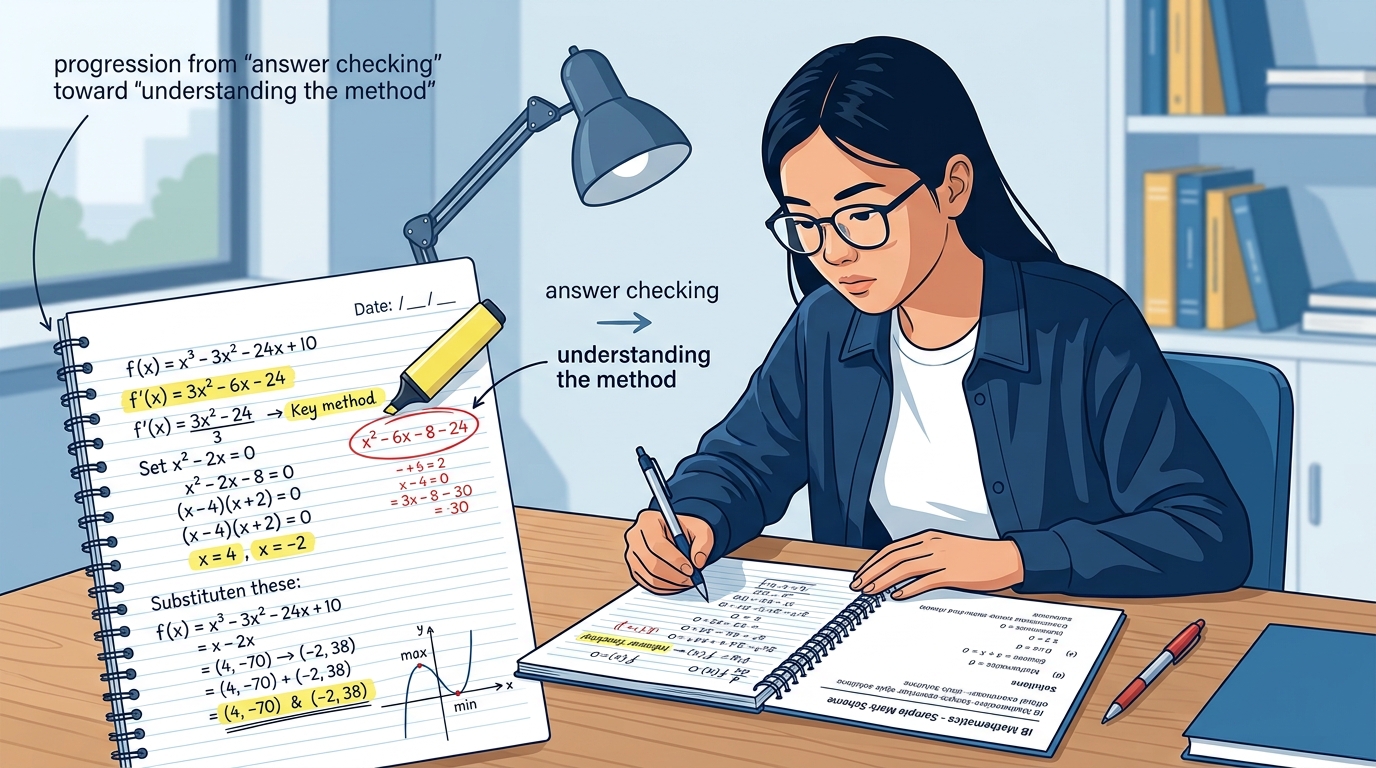
You finish an IB Math question, check the mark scheme, and find something like this: f′(x)=0 x=2.5 M1A1
That’s it.
You stare at the solution and think:
“How am I supposed to learn from this?”
This is a common problem with IB Math mark schemes. Students often expect a mark scheme to explain the mathematics in the same way a teacher, textbook, or tutor would. But a mark scheme has a different purpose.
It is designed to help examiners award marks consistently. It is not primarily designed to teach a student an entire mathematical concept from scratch.
The International Baccalaureate explains that its assessment measures students against defined standards and includes skills such as understanding concepts, applying standard methods, analysing information, and solving problems.
That distinction changes how you should use a mark scheme.
Instead of asking:
“What is the answer?”
You should ask:
“What mathematical evidence did the mark scheme want to see, and what can I learn from that?”
Once you start reading mark schemes this way, they become much more useful.
Table of Contents
What Is an IB Math Mark Scheme?
An IB Math mark scheme is the document used to indicate how marks should be awarded for a particular examination question.
It usually contains the expected mathematical approach, acceptable answers, and notation that helps examiners determine which marks a student’s response earns.
The exact format can vary between papers and questions, but you will often see abbreviations such as M, A, and R.
These letters can be confusing when you first encounter them.
In broad terms, an M mark is associated with a method or approach, while an A mark is generally associated with an accuracy or answer mark that depends on the relevant method. R marks can be associated with reasoning or related requirements depending on the specific mark scheme.
The important point is that these symbols are part of a marking system. They aren’t intended to read like a fully worked solution written for a student.
That is why copying a mark scheme line by line isn’t the best way to revise.
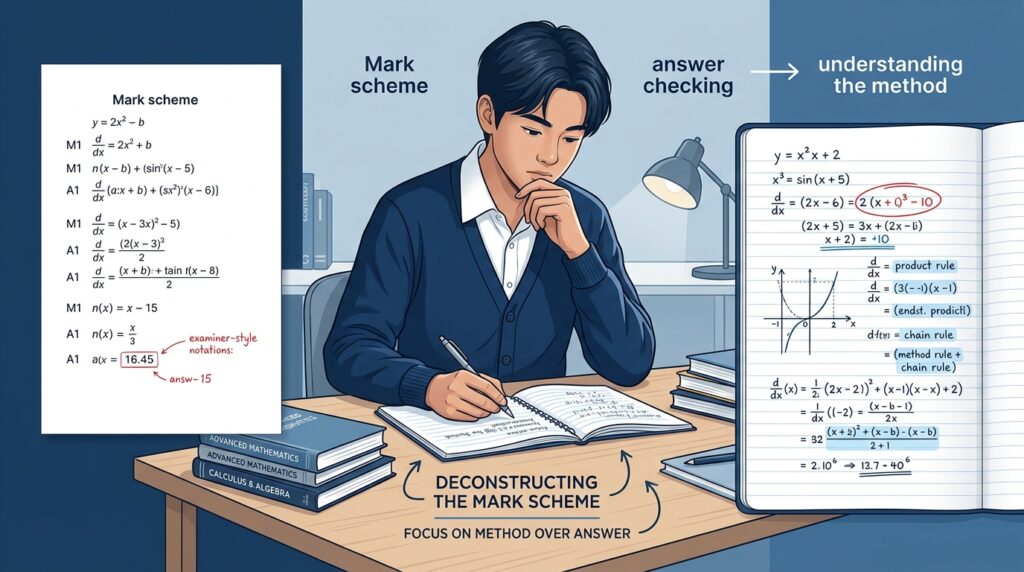
Why IB Math Mark Schemes Feel So Brief
Imagine you’re learning how to solve an unfamiliar calculus problem.
A teacher might explain why differentiation is relevant, show how to identify the important information, explain the connection between stationary points and derivatives, work through the algebra, and then interpret the answer.
A mark scheme may simply show f′(x)=0.
followed by the relevant values.
Why?
Because the examiner already knows the mathematics.
The mark scheme isn’t trying to teach the examiner what differentiation is. It is showing the examiner what evidence in a student’s response corresponds to the available marks.
The IB’s assessment framework makes this distinction particularly important because mathematics assessment involves more than simply obtaining a numerical answer. The current AA guide identifies problem solving, communication and interpretation, technology, reasoning, and inquiry alongside knowledge and understanding.
So your job as a student is to take the compact marking information and expand it back into understandable mathematical reasoning.
A Mark Scheme Is Not a Textbook
This is probably the most important idea in this article.
A textbook answers:
“How do I understand this mathematics?”
A teacher answers:
“How do I learn this mathematics?”
A worked solution answers:
“How can I solve this particular problem?”
A mark scheme answers:
“What evidence earns the available marks?”
Those are different purposes.
If you treat a mark scheme like a textbook, it can feel frustratingly incomplete.
If you treat it as a map of examiner expectations, it becomes much more useful.
What Do the Marks Actually Tell You?
Suppose a question asks you to solve an equation and the mark scheme shows several steps.
Don’t only compare your final answer.
Look at where the marks appear.
If the question has several method marks before the final answer, that’s a signal that the process matters.
For example, imagine the solution involves a given relationship.
then the equation
then algebraic manipulation
then x=4.27
If you only wrote x=4.27
You may have reached the correct number without showing enough of the mathematical process.
The lesson isn’t
“I should copy more lines.”
The lesson is:
“I need to communicate the mathematical method that leads to the answer.”
That distinction is important.
Method Marks Are About Mathematical Progress
One of the most useful things to understand when reading a mark scheme is that mathematical progress can matter even when the final answer is wrong.
Suppose you make an arithmetic error after setting up the correct equation.
Your final answer may be incorrect.
But your earlier mathematical work may still demonstrate a correct method.
This is one reason checking only the final answer is such a weak revision habit.
Imagine your working is 2x+5=17 2x=12 x=6
If you accidentally calculate the next stage incorrectly in a longer problem, that doesn’t necessarily mean everything before the error was worthless.
When reviewing your paper, identify the first point where your solution stopped being correct.
That is much more useful than simply writing:
“Wrong.”
How to Read a Mark Scheme Properly
The first thing you should do after checking a question is compare your approach, not your answer.
Ask yourself:
Did I start with the same mathematical idea?
If the answer is yes, continue.
Then ask:
Did my algebra or calculation remain correct?
Then:
Did I communicate the important steps?
Then:
Did I answer exactly what the question asked?
This turns a mark scheme into a diagnostic tool.
Example: Turning a Short Mark Scheme Into an Explanation
Suppose you’re working on a differentiation question.
The mark scheme shows f′(x)=6x²−12x 6x²−12x=0 x=0,2
A student might look at this and think:
“Okay, the answers are 0 and 2.”
That’s not enough.
Expand the reasoning.
If the question asks for stationary points, the underlying idea is that stationary points occur where the gradient is zero.
So you can reconstruct the reasoning:
First, differentiate the function to obtain the gradient function.
Then set the gradient equal to zero because stationary points occur where the gradient is zero.
Then solve the resulting equation to obtain the possible x coordinates.
Finally, substitute those values into the original function if the question requires the coordinates of the stationary points.
The mark scheme is short.
Your understanding shouldn’t be.
Learn the Meaning Behind the Symbols
When you see something like M1
Don’t simply think:
“One mark.”
Ask:
“What mathematical action is this mark rewarding?”
Maybe it rewards setting up the correct equation.
Maybe it rewards selecting an appropriate method.
Maybe it rewards using a particular relationship correctly.
Likewise, if you see an accuracy mark, ask:
“What correct result or calculation is this mark attached to?”
This changes your revision from memorising answers to understanding the structure of a solution.
Don’t Assume Every Line in the Mark Scheme Is Mandatory
Another common misunderstanding is:
“If the mark scheme has five lines, I must write exactly those five lines.”
Not necessarily.
Mathematics often allows more than one valid approach.
A student may use a different method and still demonstrate the required mathematics.
The important question is whether your method is mathematically valid and whether it provides the evidence needed to support the answer.
The IB’s mathematics assessment objectives emphasise selecting and using mathematical knowledge in familiar and unfamiliar contexts, solving problems, communicating methods and conclusions, and using appropriate notation and terminology.
So don’t turn the mark scheme into a script that you have to reproduce word for word.
Use it to understand what your solution needs to demonstrate.
What If Your Method Is Different?
This is where students can become unnecessarily worried.
Suppose the mark scheme uses one method, but your method produces the correct result.
Don’t automatically assume your method is wrong.
Ask whether your approach is mathematically valid.
For example, there may be several ways to solve an equation, simplify an expression, find a probability, or investigate a function.
If you’re unsure, this is where teacher or tutor feedback becomes particularly valuable.
A mark scheme can show you the expected route, but it may not fully explain every alternative approach.
Use the Mark Scheme to Find Your First Mistake
This is one of the best revision techniques you can develop.
Don’t start at the bottom.
Start at the top.
Compare your first step with the mark scheme.
Then compare the second.
Continue until you find the first meaningful difference.
That point is often much more useful than the final incorrect answer.
For example, imagine the mark scheme begins by defining: P(A∩B)
but you immediately use: P(A)+P(B)
Your problem may not be arithmetic.
It may be that you misunderstood the probability relationship.
That is a very different revision need.
The Difference Between a Knowledge Mistake and a Method Mistake
This distinction can dramatically improve your revision.
Imagine you see a question involving a normal distribution.
You don’t remember how to use the relevant distribution function.
That’s a knowledge or procedural gap.
But suppose you know the normal distribution perfectly and still use the wrong calculation because you misread what the question asked.
That’s an application or interpretation problem.
Those two students shouldn’t revise in exactly the same way.
The first student needs to revisit the mathematical concept or procedure.
The second needs more practice interpreting questions and selecting the appropriate method.
The mark scheme can help you distinguish between them.
Turn Mark Scheme Language Into Student Language
Mark schemes are often compressed.
Your revision notes shouldn’t be.
Suppose the mark scheme effectively says: dxdf(x)=0
Your notes might say:
“To find stationary points, differentiate the function and set the derivative equal to zero because the gradient is zero at a stationary point.”
That’s much more useful.
You’re taking the examiner’s compact notation and turning it into an explanation you can understand later.
This is particularly helpful when revising several weeks or months after learning the topic.
Create a “Why This Mark Was Lost” Note
After checking each incorrect question, write one sentence explaining why you lost the mark.
For example:
“I knew the formula but didn’t recognise that the question required conditional probability.”
Or:
“I differentiated correctly but didn’t use the given condition to determine the constant.”
Or:
“My numerical answer was reasonable, but I didn’t interpret it in context.”
Or:
“I rounded an intermediate value too early.”
These statements are much more useful than:
“Question 7 wrong.”
Over time, they reveal patterns.
Mark Schemes Can Show You What You Need to Communicate
The IB mathematics assessment framework explicitly includes communication and interpretation. Students are expected to record methods, solutions, and conclusions using appropriate notation and terminology.
This means your working should communicate your mathematical thinking.
That doesn’t mean writing paragraphs for every calculation.
Mathematical communication can be concise.
For example: P(A∣B)=P(B)P(A∩B)
followed by appropriate substitution may communicate the method clearly.
Similarly, if you’re solving an optimisation problem, writing: f′(x)=0
can be more informative than jumping straight to a calculator result.
The goal is clear mathematical evidence, not unnecessary writing.
Don’t Use Mark Schemes Before Attempting the Question
This is another common revision mistake.
A student opens the question and immediately looks at the mark scheme.
The solution seems obvious.
They think:
“I understand it.”
But recognition isn’t the same as independent problem solving.
If you want to improve your exam performance, attempt the question first.
Give yourself enough time to think.
Then use the mark scheme.
That way, the comparison gives you information about your own reasoning.
Use Three Levels of Review
A useful review process is to examine each question at three levels.
Level One: The final answer
Did I get the correct result?
Level Two: The method
Did I choose an appropriate mathematical approach?
Level Three: The reasoning
Did I communicate enough of the mathematics to justify my answer?
This third level is often neglected.
Students see the correct answer and move on.
But that’s exactly where many opportunities for improvement are lost.
How to Use Mark Schemes for Unfamiliar Questions
Mark schemes are particularly useful after unfamiliar questions.
Suppose you couldn’t start a question.
Don’t simply read the entire solution.
Look only at the first meaningful step.
Ask:
Why did the solution begin here?
Then look at the next step.
Ask:
What information made this step possible?
Continue until you understand the chain of reasoning.
This turns an unfamiliar question into a problem solving lesson.
The IB’s current mathematics framework places strong emphasis on selecting appropriate methods, solving problems, interpreting results, and investigating unfamiliar situations.
What Mark Schemes Cannot Tell You
A mark scheme can tell you a lot.
But it has limitations.
It may not tell you exactly why you misunderstood the question.
It may not explain the concept from first principles.
It may not diagnose why you made an algebra error.
It may not tell you which future questions you should practise.
It may not explain every alternative valid method.
This is why mark schemes work best as part of a larger feedback process.
You need:
Attempt → Compare → Diagnose → Correct → Practise → Retest
not simply:
Attempt → Check answer → Move on
Turn One Mark Scheme Into a Revision Session
Suppose you’ve just completed a past paper.
Instead of simply marking it, choose three questions where you lost marks.
For the first question, identify the first incorrect step and explain the underlying concept.
For the second, identify whether the problem was method selection, calculation, communication, or interpretation.
For the third, redo the entire question without looking at the solution.
Then find a similar question and attempt it.
Finally, revisit the original question later.
Now one past paper has generated an entire revision cycle.
That’s much more valuable than simply recording your percentage.
How Mathzem Can Add Feedback Beyond a Mark Scheme
A traditional mark scheme gives you a reference point.
Mathzem is designed to make the review process more interactive by focusing on the student’s actual working.
The workflow is simple: choose an IB Math practice question, solve it, upload your working, receive examiner style feedback, identify mistakes and weak areas, and use that information to decide what to practise next.
This is particularly useful when the problem isn’t simply:
“I got the answer wrong.”
The more important question may be:
“Why did my working lose marks?”
You can explore the Mathzem IB Practice workflow to practise this way.
Students who want to identify broader skill weaknesses can also use the Math Skill Scanner.
The aim isn’t to replace mark schemes.
It’s to help students get more information from their own working before moving to the next question.
How Tutors Can Use Mark Schemes More Effectively
Mark schemes aren’t only useful for students.
Tutors can use them to structure feedback.
Instead of saying:
“You need to show more working.”
A tutor can ask:
“Which mathematical step in the mark scheme corresponds to the reasoning you haven’t communicated?”
That creates more precise feedback.
A tutor can also compare a student’s solution with the mark scheme and identify whether the main issue is mathematical knowledge, method selection, accuracy, communication, or interpretation.
This makes revision more targeted.
A Better Way to Build Your Own Mark Scheme Notes
Don’t copy entire mark schemes into your notebook.
Instead, create three sections.
What the question tested explains the mathematical concept.
What the mark scheme rewarded explains the important mathematical steps.
What I need to remember explains the specific lesson you took from your mistake.
For example, your final note might say:
“When a question asks for the maximum value of a differentiable function, identify the relevant domain, find stationary points using f′(x)=0, check the relevant candidates, and interpret the result in context.”
That’s far more useful than copying a page of examiner abbreviations.
Common Mistakes When Using IB Math Mark Schemes
One common mistake is checking only the final answer. A correct answer can hide weak reasoning, while an incorrect answer can contain substantial correct work. Review the path as well as the destination.
Another mistake is copying the mark scheme. Your objective isn’t to reproduce the examiner’s wording. Your objective is to understand the mathematics and communicate it clearly.
Students also sometimes assume that every mark scheme line must appear exactly in their own solution. That’s too rigid. Focus on the mathematical requirements rather than memorising a particular sequence.
Another problem is checking the mark scheme too early. If you look at the solution before making a genuine attempt, you lose an opportunity to practise independent problem solving.
Finally, don’t treat every lost mark as a content weakness. Sometimes you understand the mathematics but misread the question, selected an unsuitable method, made an accuracy error, or failed to explain the result.
FAQs About IB Math Mark Schemes
Why are IB Math mark schemes so short?
Mark schemes are designed primarily to support consistent marking. They indicate the mathematical work or answers associated with marks rather than providing a full teaching explanation for every step.
What do M and A mean in IB Math mark schemes?
They are marking abbreviations used to identify different types of marks. In general, M refers to method and A refers to accuracy, although the precise application depends on the question and mark scheme.
Should I memorise IB Math mark schemes?
No. You should understand the mathematical reasoning represented by the mark scheme. Memorising isolated solution steps won’t prepare you well for questions that use the same mathematics in a different context.
Can I get marks if my final answer is wrong?
You may still earn marks for correct mathematical work leading toward the answer, depending on the question and the specific marking instructions. This is one reason you should always show appropriate working.
What should I do after checking a mark scheme?
Find the first meaningful point where your solution differs from the expected mathematics. Understand why the difference occurred, correct the question without looking at the solution, then practise a similar question and return to the original later.
Are mark schemes enough to learn IB Math?
No. They are useful revision tools, but they aren’t a replacement for teaching, worked explanations, practice, and feedback. Their main value comes from helping you understand what your solution demonstrated and where it fell short.
Conclusion: Don’t Just Check the Mark Scheme, Read It
An IB Math mark schemes can look frustratingly short when you’re trying to learn from it.
But that’s because you’re asking it to do a job it wasn’t designed to do.
A mark scheme isn’t a textbook.
It isn’t a tutor.
It isn’t a complete lesson.
It is a compact representation of the mathematical evidence used to award marks.
Your job is to expand that information.
When you see a method mark, ask what mathematical decision it represents.
When you see an accuracy mark, ask what calculation or result it depends on.
When your answer differs from the mark scheme, find the first meaningful point where your reasoning diverged.
When you lose a mark, write down why.
And when you’ve corrected the question, don’t stop there. Solve a similar problem and test whether you’ve actually fixed the underlying issue.
The IB expects students to apply mathematics in familiar and unfamiliar contexts, communicate mathematical thinking, reason logically, and interpret results.
That means the most valuable lesson in a mark scheme isn’t always the final number.
It is the mathematical reasoning that earned the marks.
Quick Takeaway
Don’t use an IB Math mark scheme simply to check whether your answer is right. Use it to understand what your working demonstrated, where your reasoning changed direction, and what you need to practise next.
That turns a short mark scheme into a much more powerful revision tool.




One Response