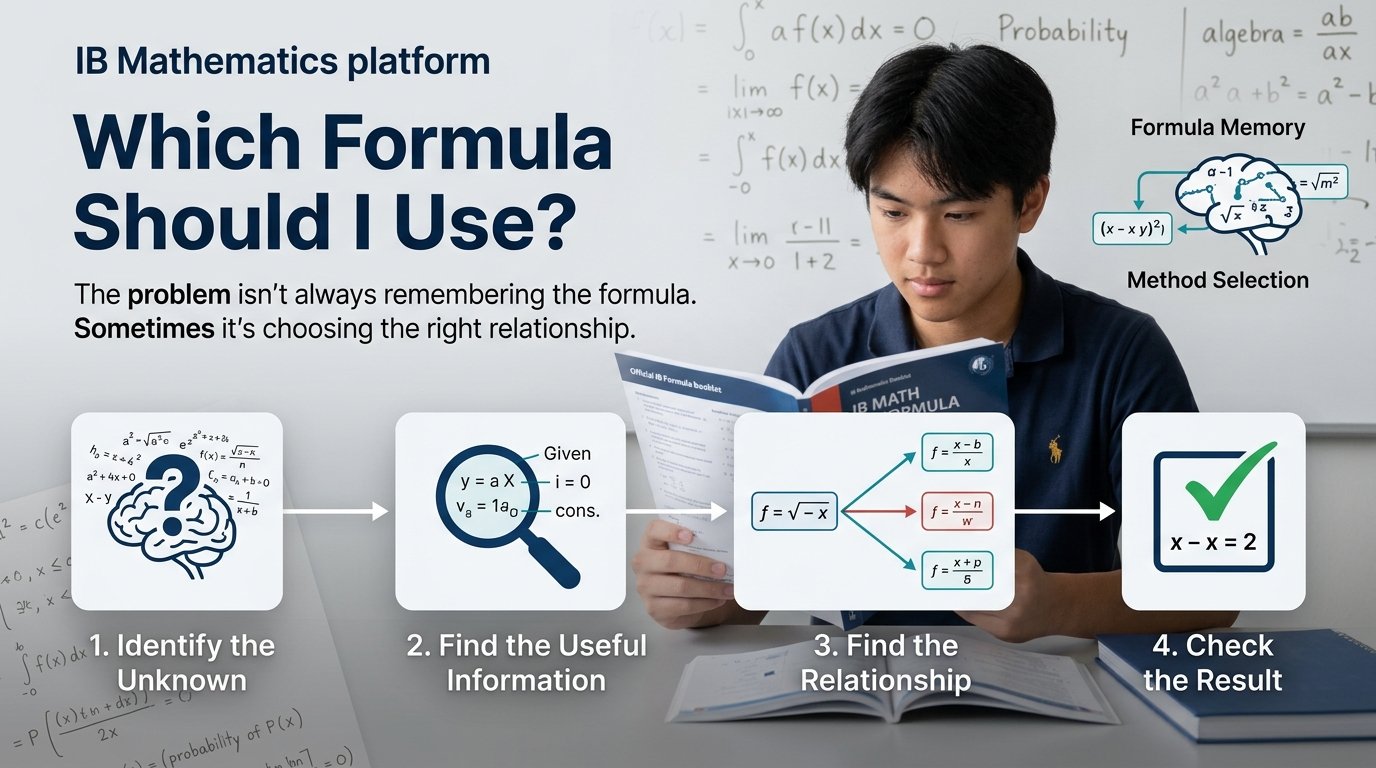
Preparing for IB Math is not simply about solving as many questions as possible.
You can spend hours solving questions and still feel unprepared for the exam.
The problem is often not the amount of Mathzem IB practice but how you choose what to practise, what you do after a wrong answer, and whether you return to the skill you struggled with.
A smarter approach is to make your practice targeted, repeatable, and tied to your actual weaknesses.
That is where a structured practice system can make a difference.
Table of Contents
Why random IB Math practice is not always effective
Imagine you sit down to revise mathematics and choose five completely random questions.
You solve one question on functions.
Then one on calculus.
Then statistics.
Then algebra.
Then another topic you already understand well.
You have completed five questions, but what have you actually improved?
Maybe very little.
Random practice can be useful when you are close to an exam and want to test whether you can switch between topics.
But earlier in your revision, you often need a more focused approach.
If you repeatedly struggle with a particular skill, practising unrelated questions will not directly address the problem.
Instead, ask:
What exactly am I trying to improve today?
That question changes how you practise.
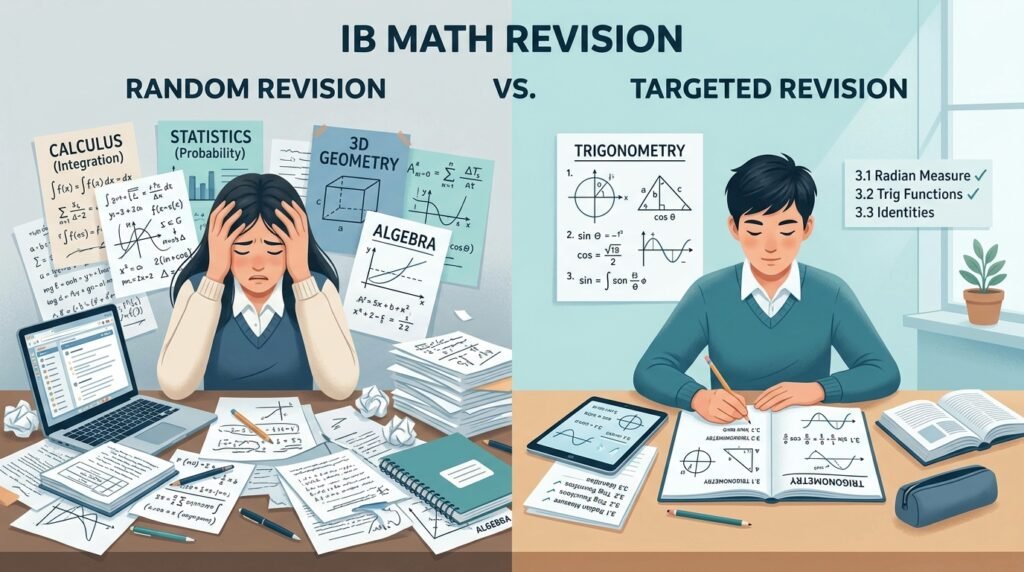
Start with your course, topic, and subtopic.
One of the most useful ways to make IB Math practice more focused is to narrow your target.
Instead of saying:
I need to practise IB Math.
Try saying:
I need to practise this topic.
Or even:
I need to practise this specific skill within the topic.
This gives your revision session a clear purpose.
For example, if you are struggling with a particular area of calculus, focus your practice there instead of jumping between unrelated questions.
Mathzem IB Practice is designed around this type of targeted practice. Questions can be organised by IB course, topic, and focus or subtopic, allowing you to narrow your practice to the area you want to work on.
Start targeted IB Math practice with Mathzem.
The five-step practice cycle
A strong revision session should not end when you reach an answer.
Use this cycle instead:
Choose → Attempt → Check → Understand → Repeat
Each stage matters.
1. Choose a specific target
Before starting, decide what you want to improve.
Your target might be:
A topic you consistently find difficult.
A subtopic where you make calculation errors.
A method you understand in theory but struggle to apply.
A type of question that takes you too long.
This prevents your practice session from becoming a collection of unrelated questions.
2. Attempt the question yourself
Give yourself time to think before looking for help.
Write your working.
Try the method you think is appropriate.
If you get stuck, identify exactly where you became stuck.
This is important because the attempt itself gives you information about your understanding.
If you immediately look at a complete solution, you may understand the answer without discovering what you could have done on your own.
3. Get the right amount of help
Getting stuck does not mean you should look at the entire solution straight away.
Sometimes you only need a small push.
You might need a hint.
You might need the next step.
You might need an explanation of the method.
Or you might need a full explanation because the underlying concept is unclear.
The goal is to use enough help to keep learning without giving up your own thinking too soon.
Mathzem AI Tutor stays with the question you are working on and provides different levels of help, from hints and explanations to next-step guidance, method support, and a full solution.
That makes the help more useful than searching for an unrelated answer to the same topic.
4. Find out what actually went wrong
Getting a question wrong is not the end of the practice session.
It is often the most useful part.
Ask yourself:
Did I misunderstand the question?
Did I choose the wrong method?
Did I make an algebra mistake?
Did I make a calculator error?
Did I understand the method but apply it incorrectly?
Did I stop before completing the required reasoning?
These are very different problems.
If you only record that the answer was wrong, you lose valuable information.
The important question is:
Why was it wrong?
That is the information you can use in your next practice session.
5. Repeat the skill
This is where many students stop too early.
They see the solution, understand it, and move on.
But understanding one solution does not necessarily mean you can solve a similar question on your own.
After reviewing your mistake, practise the same skill again.
Try another question.
Then check whether you can now apply the method without the same mistake.
This creates a much stronger learning loop:
Attempt → Feedback → Correction → Similar practice → Improvement
That is more useful than simply counting how many questions you completed.
When targeted practice is especially useful
Targeted practice can be especially valuable in several situations.
When you know a topic is weak
If you already know that a particular topic causes problems, focus your practice there.
Do not spend most of your revision time on questions you already find comfortable.
When you keep making the same mistake
One incorrect answer might be an isolated mistake.
Repeated mistakes are different.
If the same type of error keeps appearing, it deserves focused practice.
When you are learning a topic
When a topic is still unfamiliar, focused practice helps you build confidence before moving to mixed questions.
When an exam is approaching
As your exam gets closer, your practice can gradually become more mixed.
The goal is not to practise one topic forever.
It is to move from focused learning toward exam-style flexibility.
Do not stay in one topic forever.
Targeted practice is powerful, but it should be part of a larger revision strategy.
A useful progression is:
Early revision: Focus on individual topics and specific skills.
Middle revision: Combine related topics and revisit previous weaknesses.
Later revision: Use more mixed practice so you have to identify the appropriate method yourself.
This matters because an exam does not tell you which topic a question belongs to.
You need to recognise the problem’s mathematical structure and decide what to do.
Targeted practice builds the skill.
Mixed practice helps you apply it without being told what to use.
You need both.
A simple 30-minute IB Math practice session
You do not always need a two-hour revision session.
A focused 30-minute session can be useful if you use the time deliberately.
First 5 minutes
Choose one topic or specific skill.
Decide what you want to improve.
Next 15 minutes
Attempt several relevant questions.
Work independently before asking for help.
Next 5 minutes
Review your mistakes.
Identify the exact point where your reasoning changed from correct to incorrect.
Final 5 minutes
Try another question that uses the same skill.
Your goal is to see whether the correction changed what you can do.
This is much more informative than recording that you completed another five questions.
How Mathzem IB Practice fits into this approach
Mathzem is designed around a learning loop, rather than simply giving students answers.
You can start with a specific IB course, topic, or focus.
Then attempt an IB-style practice question.
If you need help, the AI Tutor can guide you through the question with different levels of support.
After your attempt, you can use feedback and your practice history to understand where you need more work.
Over time, this creates a more useful revision process:
Practise → Attempt → Get feedback → Understand the mistake → Practise the right thing next.
The purpose is not to replace your own mathematical thinking.
It is to make your practice more targeted and help you spend your revision time where it is most useful.
Try this today
Before your next revision session, do not start by choosing a random question.
Write down one specific target.
For example:
Today I am going to improve my ability to solve questions involving this particular skill.
Then complete a small set of questions focused on that target.
For every question you get wrong, write down why.
Finally, attempt another question involving the same skill.
If you can solve it correctly without repeating the original mistake, your practice session has achieved something meaningful.
The goal is not more questions.
More practice is not automatically better practice.
The real goal is to make every practice session useful.
Which skills are strong?
Which skills need work?
What mistakes keep appearing?
What should you practice next?
And can you solve the same type of problem more independently after reviewing your mistake?
That is the difference between doing IB Math questions and using them to improve. It is also why targeted practice, careful review, and repeated application matter most when you want real progress.
Start with one topic. Make one focused attempt. Learn from the mistake. Then practise the skill again to make each session more useful. Use that cycle to make each session more effective.
That is a smarter way to prepare for IB Math exams.