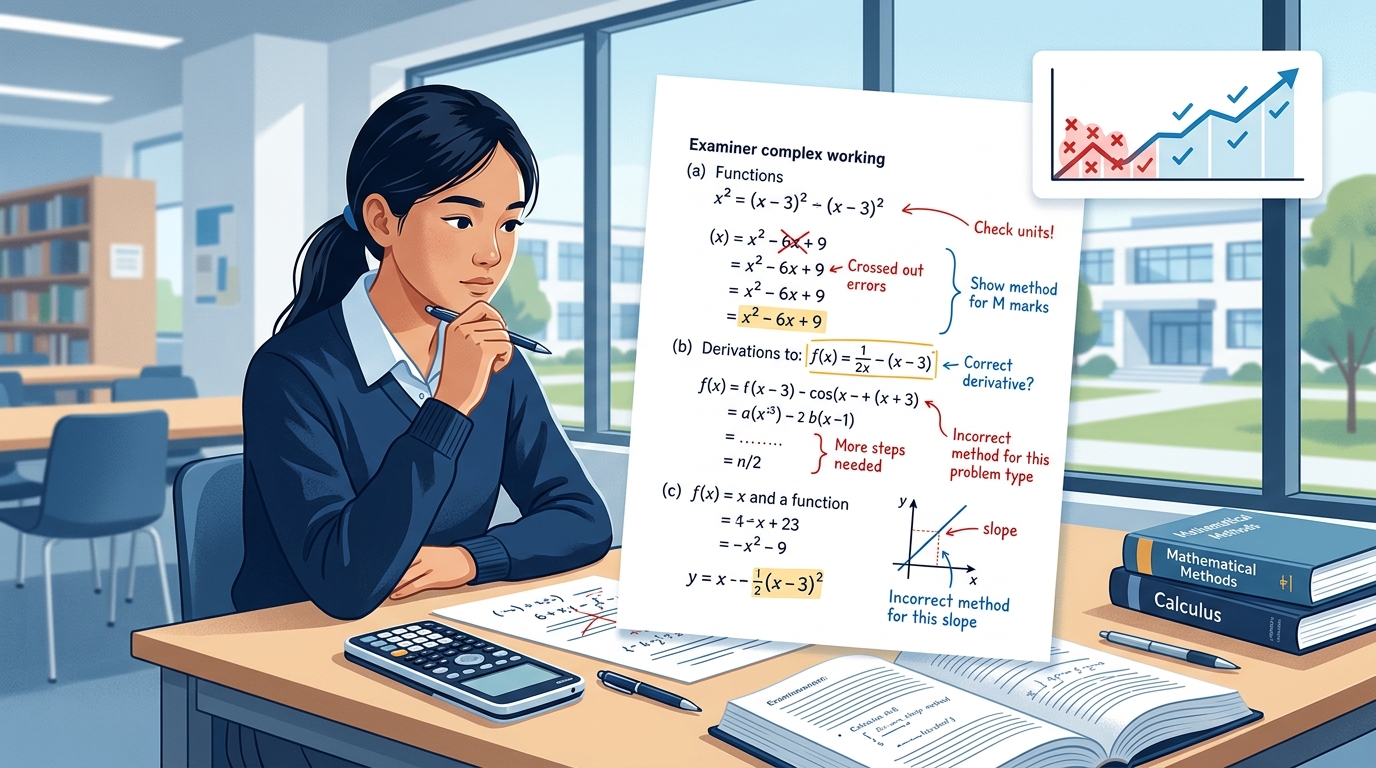
Why IB Math Students Understand the Topic but Still Lose Exam Marks
You study the topic.
You understand the examples.
You complete practice questions correctly.
Then you sit an IB Math exam marks, and your result is lower than expected.
You look at the questions afterwards and think:
“I actually knew how to do this.”
This is one of the most frustrating experiences in IB Mathematics.
The problem isn’t always a lack of mathematical knowledge.
Sometimes the gap is between knowing mathematics and using mathematics effectively in an examination.
The IB Mathematics assessment isn’t limited to recalling formulas or reproducing familiar procedures. The current Mathematics: Analysis and Approaches guide, for example, identifies knowledge and understanding, problem solving, communication and interpretation, technology, and reasoning among its assessment objectives.
The current AA subject brief also states that problem solving involves using mathematical skills and concepts in both familiar and unfamiliar contexts. It specifically includes communication, interpretation, reasoning, and appropriate use of technology.
That means a student can understand a mathematical topic but still lose marks because they:
- misunderstand the wording
- choose the wrong method
- skip important working
- make an avoidable algebra error
- round too early
- use their calculator incorrectly
- fail to justify an answer
- don’t interpret their result
- run out of time
- struggle when a familiar idea appears in an unfamiliar form
The good news is that these are skills you can practise.
The Difference Between Knowing and Performing
Consider two students.
Student A
Student A has studied differentiation.
They know the rules.
They can differentiate standard functions.
They can find stationary points when the question clearly asks them to.
Student B
Student B has similar mathematical knowledge.
But when given an unfamiliar problem, they:
- Read the question carefully.
- Identify what needs to be found.
- Translate the information into mathematics.
- Select an appropriate method.
- Show their reasoning.
- Check whether the result makes sense.
- Interpret the answer in context.
Both students may understand differentiation.
But Student B is better prepared for an exam.
Why?
Because exam performance requires more than topic recognition.
1. You Understand the Topic, But Not the Question
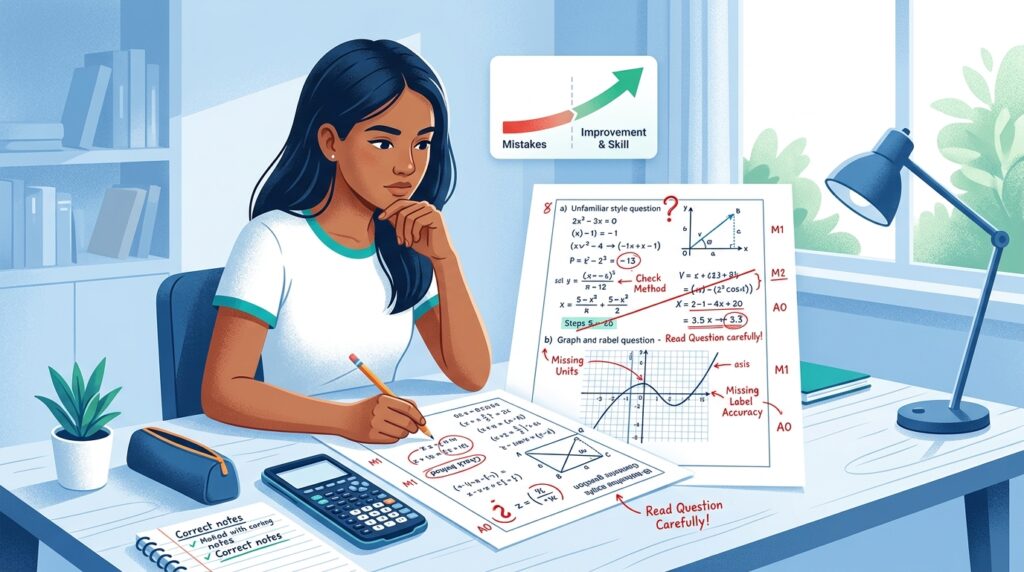
This is one of the most common problems.
Students often read a question looking for familiar mathematical words.
For example, they see:
“gradient”
and immediately think:
“Differentiate.”
Sometimes that’s correct.
But the question may require several steps before differentiation is useful.
Or the word “gradient” may appear as part of a larger modelling problem.
The mathematics isn’t necessarily the difficult part.
The difficulty is deciding what the question is actually asking you to do.
A better reading process
Before calculating, ask:
What information has been given?
What am I being asked to find?
What conditions or restrictions are included?
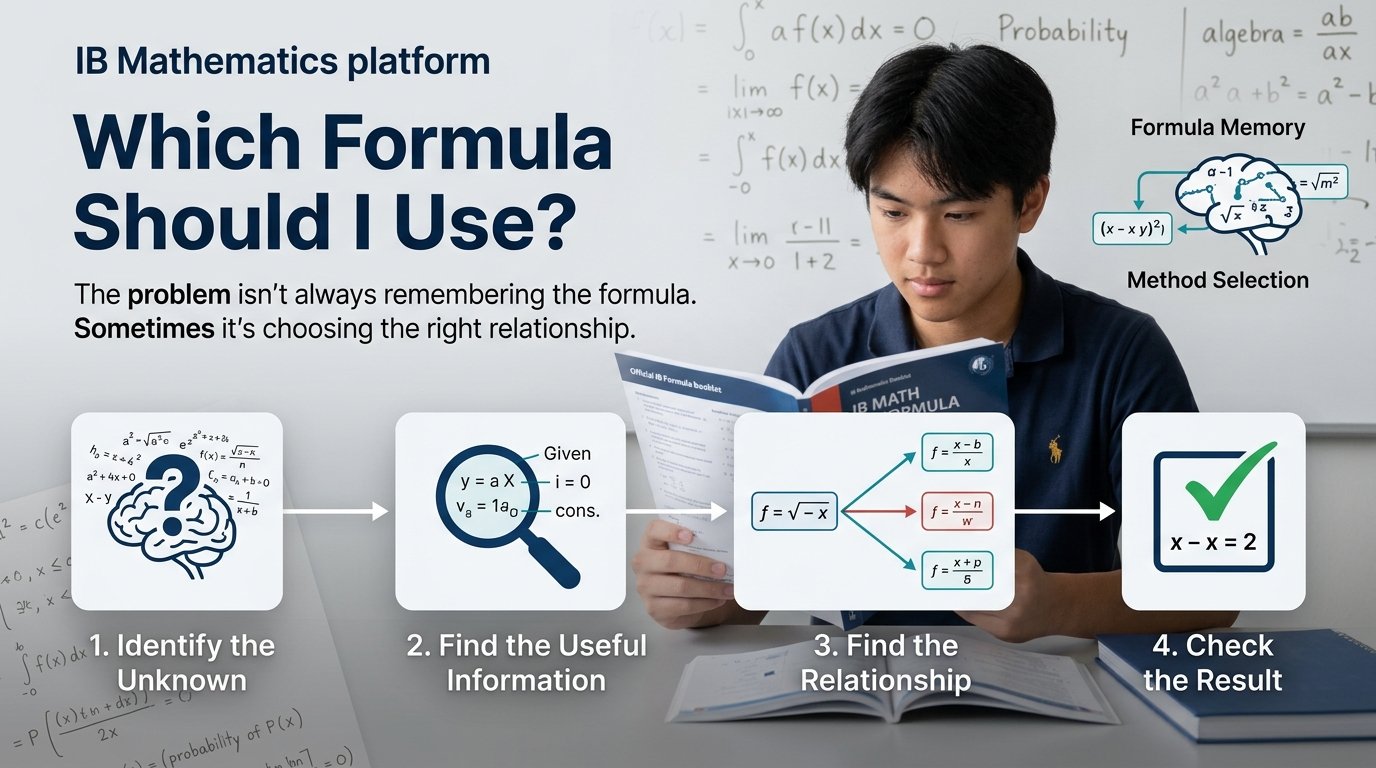
What mathematical relationships connect the information to the required answer?
Only then should you decide what method to use.
This takes a little longer at the beginning.
It can save much more time later.
2. You Know the Formula but Don’t Know When to Use It
Knowing formulas isn’t the same as knowing when they apply.
Suppose you remember a probability formula perfectly.
That doesn’t mean you’ll automatically recognise a situation where it should be used.
The same problem occurs throughout IB Math.
You may know:
- differentiation rules
- integration techniques
- probability formulas
- statistical tests
- geometric relationships
- vector methods
- logarithm rules
- trigonometric identities
But an exam question may not announce:
“Use this formula.”
You need to identify the mathematical structure yourself.
This is why mixed and unfamiliar practice is important.
The current IB Mathematics: Analysis and Approaches subject brief explicitly describes problem solving as applying knowledge and skills across familiar and unfamiliar contexts.
The solution
Don’t practise only questions grouped under obvious topic headings.
Once you understand a topic, start mixing it with other topics.
Instead of:
“Complete 10 differentiation questions.”
try:
“Complete 10 mixed calculus and functions questions without knowing the method in advance.”
You’re now practising method selection, not just execution.
3. You Get the Right Answer but Lose Marks Along the Way
A final answer is important.
But it isn’t always the whole story.
Suppose a question requires several stages.
You make an error in the middle but eventually arrive at the expected numerical result.
That doesn’t necessarily mean your solution demonstrates the correct mathematical reasoning.
Likewise, a student can produce an incorrect final answer while showing substantial correct working.
This is one reason your practice should involve reviewing the entire solution, not just checking the final number.
The IB’s mathematics assessment objectives include communication and interpretation, not just knowledge and understanding.
When reviewing your work, ask:
- Is every important step visible?
- Is my notation clear?
- Have I explained the required reasoning?
- Did I substitute values correctly?
- Did I use the correct method?
- Did I interpret the result?
- Did I answer the exact question?
4. You Skip Working Because the Calculator Gives the Answer
Technology is an important part of IB Mathematics.
The assessment objectives explicitly include the accurate, appropriate, and efficient use of technology.
But there is a difference between using technology effectively and letting the calculator replace mathematical communication.
Imagine a question asks you to find a parameter.
You enter a complicated expression into your calculator and obtain: a=4.728
You write the answer.
But your solution doesn’t make it clear:
- what equation you solved
- why that equation was appropriate
- what the numerical result represents
The calculator has produced a number.
It hasn’t necessarily demonstrated the mathematics behind that number.
Better approach
Use your calculator as a tool within your mathematical solution.
Write the mathematical setup first.
Then use technology where appropriate.
Finally, communicate the result clearly.
5. You Round Too Early
Early rounding is another small mistake that can create larger problems.
Suppose your calculator gives: 2.73649281
You immediately write: 2.74
Then you use 2.74 in several later calculations.
The difference might seem insignificant.
But repeated rounding can affect your final answer.
Better habit
Keep a sufficient number of digits in intermediate calculations.
Round at the end unless the question specifically requires otherwise.
Then check whether your final answer meets the required accuracy.
This is particularly important in longer questions where one approximation is used in several subsequent calculations.
6. You Don’t Answer the Question in Context
This happens frequently in applied mathematics.
A student calculates a value correctly but doesn’t explain what it means.
For example: t=6.4
What does 6.4 represent?
Seconds?
Metres?
People?
A probability?
A time?
A parameter?
A maximum?
The mathematical calculation may be complete, but the response may still need interpretation.
The IB identifies communication and interpretation as a specific assessment objective in both AA and AI mathematics.
Before moving on, ask:
“What does my final number actually mean?”
If the question is based on a real situation, state the result clearly in that context.
7. You Understand the Mathematics but Misread the Wording
IB Math questions can contain a lot of information.
A small word can change what you’re being asked to do.
Pay particular attention to terms such as:
- hence
- hence or otherwise
- hence find
- show that
- determine
- estimate
- explain
- justify
- interpret
- verify
- calculate
- given that
These words aren’t decorative.
They tell you something about the expected response.
For example
If the question says “show that”, you shouldn’t simply write the final result.
You need to demonstrate the required mathematical steps.
If the question says “explain”, a number alone is unlikely to be enough.
If it says “interpret”, connect the mathematical result back to the context.
If it says “hence”, look carefully at the previous result and consider how it is intended to help.
8. You Start Calculating Before Understanding the Problem
This is a common exam habit.
You see numbers.
You recognise a formula.
You start calculating.
Five lines later, you realise you’ve solved the wrong problem.
The solution isn’t necessarily to calculate faster.
It’s to delay calculation slightly.
Try the 30 second rule
For a longer question, spend the first few moments identifying:
- What is known?
- What is unknown?
- What is required?
- What mathematical relationships might connect them?
Then begin.
That short pause can prevent a lot of wasted working.
9. You Practise Familiar Questions Too Often
This is one of the biggest differences between classroom confidence and exam confidence.
Suppose every practice question looks like this:
Find the derivative of…
You become very good at differentiation.
Then the exam gives you a modelling problem where you need to recognise that differentiation is useful.
Suddenly, the topic feels difficult.
The mathematics hasn’t necessarily changed.
The presentation has changed.
The IB explicitly expects mathematical knowledge and techniques to be used in familiar and unfamiliar contexts.
Your practice should therefore progress
Familiar → Similar → Mixed → Unfamiliar → Timed
Each stage develops a different skill.
10. You Don’t Practise the First Step
Students often think that solving a difficult question means knowing the complete solution immediately.
It doesn’t.
For an unfamiliar problem, the most useful skill may be knowing how to begin.
Ask yourself:
What is one mathematically useful thing I can write?
That could be:
- a diagram
- an equation
- a known formula
- a definition
- a substitution
- a relationship between variables
- a table
- a graph
You don’t need the whole solution.
You need a useful first step.
Once you have that, the next step may become clearer.
11. You Lose Marks Because Your Working Is Hard to Follow
Your mathematical working should be readable.
This doesn’t mean your handwriting needs to look perfect.
It means the examiner should be able to follow your reasoning.
Avoid creating a page where: x=…
appears on one side,
another calculation appears in the corner,
a calculator result appears at the bottom,
and the final answer is somewhere else.
Instead, structure your solution logically.
For example: f′(x)=3×2−4x+1
For a stationary point: f′(x)=0
Therefore: 3×2−4x+1=0
Then continue.
Your solution becomes easier to check and easier for you to review.
12. You Don’t Know Why You Lost the Mark
This may be the most important problem of all.
A student receives a result and sees:
54 out of 80
They know they need to improve.
But they don’t know how.
“Study more” isn’t a strategy.
You need to identify the reason behind the lost marks.
Create categories such as:
| Error type | Example |
|---|---|
| Knowledge | Didn’t know the method |
| Recognition | Didn’t recognise the method |
| Application | Couldn’t apply the idea |
| Accuracy | Algebra or arithmetic error |
| Communication | Insufficient working |
| Interpretation | Didn’t explain the result |
| Technology | Calculator setup or input error |
| Timing | Didn’t finish |
Now your score becomes diagnostic information.
A Student With a Grade 5 May Not Need to “Study Everything”
Imagine a student receives a Grade 5.
Their first reaction might be:
“I need to revise the entire syllabus.”
That may be unnecessary.
Suppose their paper analysis shows:
- 90 percent accuracy on basic algebra
- 85 percent on standard calculus
- 80 percent on functions
- 60 percent on probability applications
- 55 percent on unfamiliar questions
- several marks lost through incomplete conclusions
- several avoidable algebra errors
The problem isn’t that they know nothing.
They have a smaller set of issues.
Their plan should focus on:
Probability application + unfamiliar questions + communication + accuracy
That is much more efficient than restarting the entire course.
A Better Way to Analyse an IB Math Paper
After a practice paper, don’t simply write down your score.
Create a mark analysis.
Step 1: Record every lost mark
Don’t only record the question number.
Record the specific step where you lost the mark.
Step 2: Categorise the error
Was it:
- knowledge
- method selection
- application
- accuracy
- communication
- interpretation
- technology
- timing
Step 3: Look for patterns
One mistake may be random.
Five similar mistakes are a signal.
Step 4: Create a revision action
For example:
Problem: Misread probability questions.
Action: Complete five mixed probability questions without topic labels.
Step 5: Retest
Come back later and attempt a similar question.
If you can solve it independently, the correction has started to work.
Example: Turning One Wrong Answer Into Better Revision
Imagine a student is solving a calculus question.
They correctly differentiate the function.
They correctly identify the stationary point.
Then they classify the stationary point incorrectly.
They lose a mark.
A weak review would say:
“I got the calculus question wrong.”
A better review says:
“My differentiation was correct. I didn’t correctly determine the nature of the stationary point.”
Now the next practice task becomes obvious:
Practise determining the nature of stationary points.
This distinction matters.
If you label the entire topic “calculus weakness,” you may waste time repeating differentiation questions the student already knows how to solve.
What to Do When You Get Stuck in an Exam
Getting stuck doesn’t mean you should immediately give up.
Use a structured reset.
1. Stop calculating
Put the calculator down for a moment.
2. Read the question again
Look specifically at what you’re being asked to find.
3. Identify the information
Write down the important values and relationships.
4. Identify the topic possibilities
Ask which areas of mathematics might be relevant.
5. Write one useful statement
Start somewhere.
6. Check the statement
Does it connect the given information to the required result?
7. Continue
If you still can’t progress, move on when appropriate and return later.
This is much better than repeatedly entering random calculations into your calculator.
How to Improve Your IB Math Exam Performance
You don’t need to completely change the way you study.
Make your practice more exam focused.
Practice 1: Read Before Solving
Spend time identifying the task before calculating.
Practice 2: Remove Topic Labels
Use mixed questions so you have to identify the method.
Practice 3: Include Unfamiliar Questions
Practise situations where the solution isn’t obvious.
Practice 4: Review Your Working
Don’t stop at the final answer.
Practice 5: Record Repeated Mistakes
Create a mistake journal.
Practice 6: Practise Under Time Pressure
Once your understanding is strong, add timed work.
Practice 7: Retest Your Weaknesses
Don’t assume that understanding a correction means the problem is solved.
The Difference Between Practice and Exam Preparation
These are related but not identical.
Practice
The goal is learning.
You can pause.
You can review notes.
You can spend time understanding a mistake.
Exam preparation
The goal is performance.
You need to:
- work independently
- manage time
- select methods
- communicate clearly
- deal with unfamiliar questions
- check your work
A good preparation plan gradually moves from practice toward performance.
The IB provides official specimen and past examination materials, including mathematics papers, which can be useful when students are ready to practise the actual assessment format.
How Feedback Can Close the Gap
One of the biggest weaknesses in traditional practice is that students often receive only one piece of information:
Correct or incorrect.
That isn’t enough.
Suppose you get a question wrong.
You need to know:
- Where did the solution go wrong?
- Was the method appropriate?
- Did you misunderstand the question?
- Was the calculation inaccurate?
- Did you miss a justification?
- Did you fail to interpret the result?
- What should you practise next?
This is where reviewing the actual working becomes valuable.
The IB itself provides professional development resources focused on examiner marking, student responses, common mistakes, and examiner comments.
The important lesson for students is simple:
Your working contains information that your final answer doesn’t.
How Mathzem Can Help Students Analyse Their Working
Mathzem is designed around a different practice cycle:
Choose a question → Solve it → Upload your working → Receive examiner style feedback → Identify mistakes → Find weaknesses → Practise the next skill
Instead of treating a wrong answer as the end of the process, students can use feedback to understand what happened inside the solution.
For example, a student might discover:
“I understand calculus, but I’m losing marks because I don’t explain my conclusions.”
That is a much more useful revision insight than:
“My calculus score is low.”
The next practice session can then target communication and interpretation rather than repeating basic calculus questions.
You can start with Mathzem IB Practice.
For students who aren’t sure which skills need attention, Math Skill Scanner can help turn performance into a clearer list of areas to practise.
A 7 Day Plan to Close the Knowledge to Marks Gap
If you understand the syllabus but aren’t converting that knowledge into marks, try this approach.
Day 1: Analyse a previous paper
Identify every lost mark.
Day 2: Categorise mistakes
Separate knowledge, method, accuracy, communication, interpretation, technology, and timing errors.
Day 3: Target the biggest weakness
Complete focused questions.
Day 4: Practise mixed questions
Remove topic labels.
Day 5: Practise unfamiliar questions
Focus on identifying the first useful step.
Day 6: Complete a timed section
Work under realistic conditions.
Day 7: Review
Compare your new mistakes with your original mistakes.
The goal isn’t simply to get a higher score once.
The goal is to reduce repeated errors.
Common Mistakes Students Make When Trying to Improve
Doing more questions without analysing them
More practice doesn’t automatically fix the underlying problem.
Instead: Review your working and classify mistakes.
Revising only weak topics
A topic can be weak for several different reasons.
Instead: Identify the specific skill causing the problem.
Memorising mark schemes
This can create familiarity without understanding.
Instead: Understand why each step works.
Avoiding unfamiliar questions
This protects your confidence but doesn’t improve problem solving.
Instead: Make unfamiliar practice part of your preparation.
Focusing only on content
Knowing the syllabus is necessary, but exam performance also depends on application, reasoning, communication, and interpretation.
Instead: Practise the full solution process.
FAQs About IB Math Exam Marks
Why do I understand IB Math but get low marks?
Understanding a topic is only one part of exam performance. You may be losing marks through question interpretation, method selection, incomplete working, accuracy errors, weak conclusions, timing, or difficulty applying familiar mathematics to unfamiliar problems.
Why do I get practice questions right but struggle in exams?
Your practice may be too predictable. If you always know the topic and method before starting, you’re not practising method selection. Add mixed, unfamiliar, and timed questions.
How can I stop losing easy marks in IB Math?
Analyse your errors after each practice paper. Look for repeated issues such as algebra mistakes, early rounding, calculator errors, missing units, incomplete conclusions, or skipped working.
Do I need to show all my working in IB Math?
You should communicate the mathematical method and reasoning needed to support your solution. The exact amount of working depends on the question, but relying only on unexplained calculator outputs is poor exam practice.
How can I improve my IB Math score from a 5 to a 6 or 7?
Start by identifying exactly where your marks are being lost. Then target those weaknesses with focused practice, mixed questions, unfamiliar problems, timed work, and repeated review of mistakes.
Is getting the final answer correct enough?
Not always. A final answer doesn’t show everything about your mathematical reasoning. Review your method, notation, working, interpretation, and conclusion as well as the final result.
Conclusion: Knowing Mathematics Is Only the First Step
If you’ve ever thought:
“But I knew how to do this.”
after receiving your IB Math exam, you’re not necessarily dealing with a knowledge problem.
You may have a performance gap.
You understand the mathematics, but you haven’t yet developed the ability to consistently convert that understanding into marks.
The solution is not simply to study for longer.
Build the missing skills.
Read the question carefully.
Identify what is actually being asked.
Choose the method rather than waiting for the topic to be announced.
Show useful mathematical working.
Use technology appropriately.
Interpret your answers.
Practise unfamiliar problems.
Analyse your mistakes.
Retest your weaknesses.
The IB assessment framework makes clear that mathematics involves more than knowledge recall. Problem solving, communication and interpretation, reasoning, and appropriate use of technology are all part of the assessment picture.
So the better question isn’t:
“Do I understand this topic?”
Ask:
“Can I use this mathematics independently, clearly, and accurately when the question doesn’t look exactly like the example I practised?”
That’s where understanding starts turning into exam marks.
Quick Takeaway
If you understand IB Math but aren’t getting the marks you expect, diagnose the gap before studying more.
Find the exact point where marks disappear, practise that skill, review your working, and retest it.
That is how you turn practice into measurable improvement.



One Response