Getting in IB Math Grade 5 can be frustrating.
You understand many of the topics. You can solve a reasonable number of questions. You may even leave some exams feeling that they went well. Yet when the results come back, you’re still sitting around a 5.
At this point, the natural reaction is often to practise more.
You find another question bank. You complete another past paper. You watch another revision video. You spend more hours studying.
But if your grade remains around the same level, the problem may not be the amount of practice you’re doing.
It may be the type of practice.
Moving from an IB Math Grade 5 toward a 6 or 7 usually requires more than learning additional formulas. You need to understand where your marks are being lost, identify patterns in your mistakes, become more reliable with familiar mathematics, and improve your ability to handle questions that require application and reasoning.
The goal isn’t to become perfect at every topic overnight.
The goal is to make your revision more targeted.
Table of Contents
What Does an IB Math Grade 5 Actually Tell You?
A grade is a useful summary of performance, but it doesn’t explain your individual weaknesses.
Two students can both receive an IB math grade 5 while having completely different problems.
One student may understand most concepts but lose marks through careless algebra, calculator errors, and incomplete working.
Another may be accurate when solving familiar questions but struggle whenever the question is presented in an unfamiliar context.
A third student may have several gaps in core topics, meaning that harder questions become difficult because the underlying skills aren’t secure.
These students should not follow exactly the same revision plan.
This is why the first step toward improving your grade is diagnosis.
Before deciding that you need to “study harder,” find out what is actually holding your grade back.
Start With Your Lost Marks
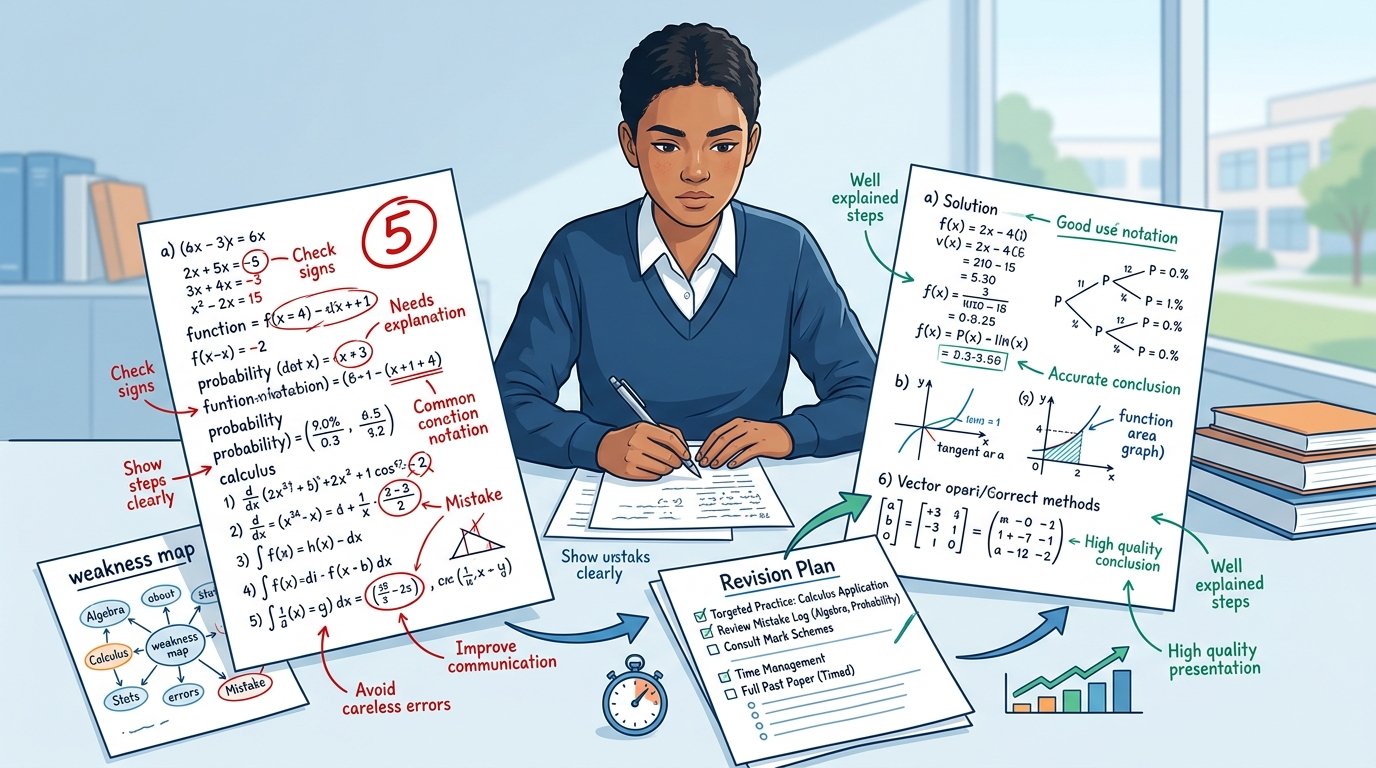
Your past papers contain more information than your final percentage.
If you scored 58%, don’t just write “58%” at the top of the paper and move on.
Go through the questions you lost marks on and examine your working.
Look for the first meaningful point where your solution went wrong.
Perhaps you selected the wrong formula.
Perhaps you understood the method but made an algebraic error.
Perhaps you used a calculator incorrectly.
Perhaps you rounded too early.
Perhaps your answer was mathematically correct but lacked an explanation or interpretation.
Perhaps you couldn’t identify how to begin the question at all.
These are different problems, and each one requires a different response.
Build a Mistake Pattern, Not Just a Mistake List
Writing down every question you got wrong can quickly become overwhelming.
Instead, look for patterns.
If you made four different algebra mistakes across a paper, the individual questions are less important than the common issue.
If you repeatedly struggle with interpreting probability questions, that’s a pattern.
If you repeatedly find the correct stationary points but fail to determine whether they’re maxima or minima, that’s another pattern.
If you lose marks because you don’t show enough working, that’s an exam communication problem rather than a topic knowledge problem.
Your goal is to move from:
“I got Question 12 wrong.”
to:
“I repeatedly lose marks when I need to choose a method in unfamiliar calculus questions.”
The second statement tells you what to do next.
The Difference Between an IB Math Grade 5 Problem and a Grade 7 Problem
There isn’t one single mistake that separates an IB Math Grade 5 student from a Grade 7 student.
However, as students move toward higher performance, they generally need to become more consistent across different types of mathematical tasks.
A student may be able to solve straightforward questions correctly but struggle when several ideas need to be connected.
They may know a formula but not recognise when to use it.
They may understand a procedure but struggle to explain or interpret the result.
They may perform well when the question looks familiar but become stuck when the same mathematics appears in a different context.
This is why simply memorising procedures isn’t enough.
You need to practise recognising what a question is asking you to do.
Secure the Mathematics You Already Know
One of the biggest mistakes students make when aiming for a higher grade is immediately focusing on the hardest questions.
If your performance on basic and standard questions isn’t reliable, harder questions shouldn’t be your first priority.
A IB Math Grade 5 student may already know enough mathematics to earn substantially more marks but lose easy marks through avoidable mistakes.
For example, you might understand quadratic functions but make repeated algebra errors.
You might know differentiation rules but make mistakes when simplifying the derivative.
You might understand probability but misread words such as “at least” or “given that.”
Those marks matter.
Before chasing difficult questions, make the mathematics you already know more reliable.
Move From Familiar to Unfamiliar Questions
Once your core skills are reasonably secure, you need to increase the variety of problems you practise.
A familiar question often gives you clues about the method.
You see “differentiate” and immediately differentiate.
You see “binomial distribution” and immediately reach for the relevant calculator function.
Exam questions don’t always make the method so obvious.
You may need to identify the topic yourself, connect multiple concepts, or decide which mathematical tool is appropriate.
This is why unfamiliar questions matter.
They test whether you understand the mathematics well enough to recognise when and how it should be used.
Don’t Ignore the Questions You Find Difficult
Students sometimes avoid difficult questions because they don’t want to feel stuck.
That can create a revision bubble.
You become very good at solving the questions you already know how to solve.
But your exam performance doesn’t improve as much as expected.
Instead of immediately looking at the solution when you get stuck, give yourself time to analyse the problem.
Ask what information is given.
Ask what the question wants.
Identify the mathematical objects involved.
Think about which topics might connect to the situation.
Try writing one useful mathematical statement.
Even if you don’t finish the question, the attempt itself gives you information about your problem solving ability.
The previous Mathzem article on how to start an unfamiliar IB Math question explores this process in more detail.
Improve Your First Step
Being unable to start a question is often more important than making a calculation error later.
If you can’t identify the first useful mathematical step, you may lose access to several marks.
This is why you should practise the beginning of unfamiliar questions deliberately.
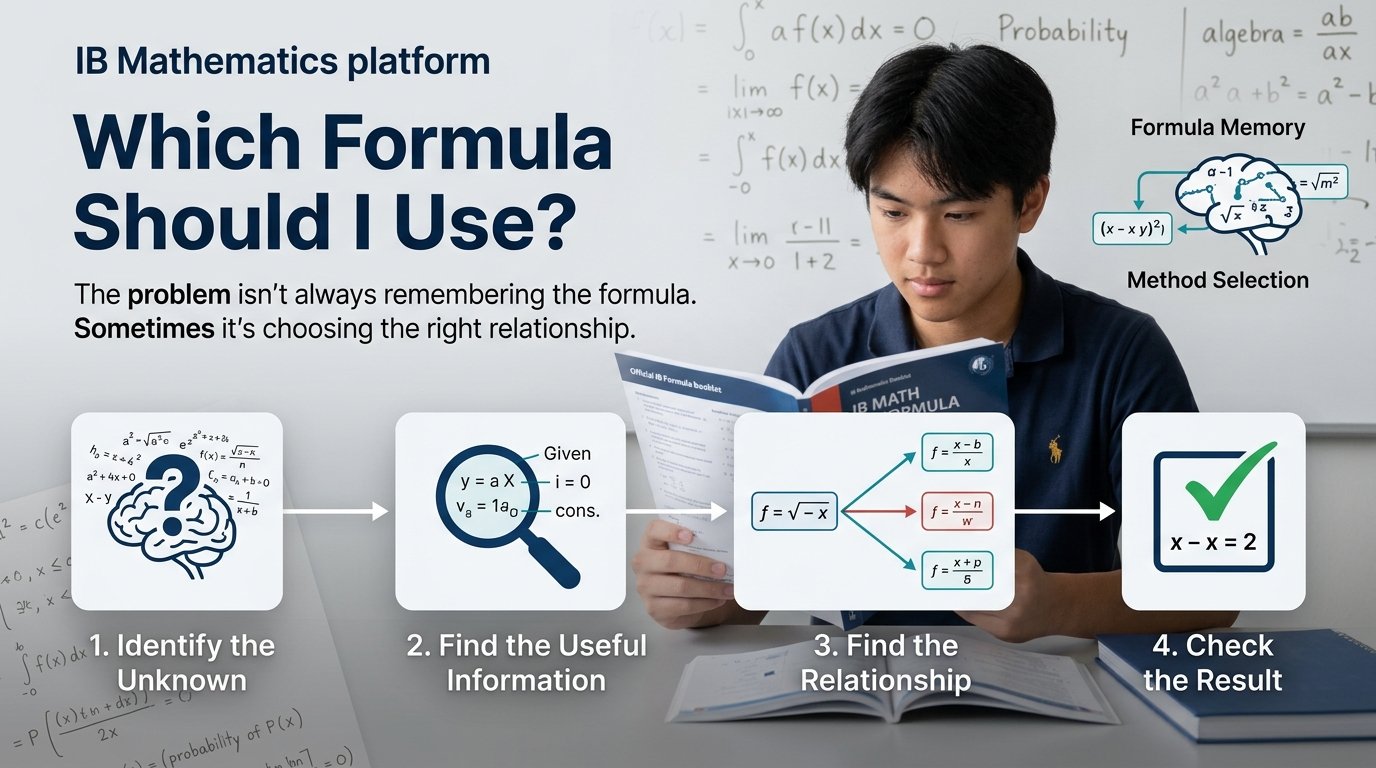
Read the problem and ask:
What information has been given?
What is being asked?
Which mathematical topic could be involved?
What relationship connects the known information to the unknown?
What could I calculate first?
You don’t always need to solve the whole problem immediately.
Learning how to start is a skill in itself.
Review Your Working, Not Just Your Answers
One of the biggest changes you can make to your revision is to stop treating the final answer as the only evidence of performance.
Suppose your final answer is incorrect.
That doesn’t tell you enough.
Your working might show that your method was correct but your algebra failed.
Or your working might show that the very first method was inappropriate.
Those situations require completely different revision.
This is why feedback on your working is so important.
A mark scheme can show you the expected mathematical process, but you need to compare it with your own solution to understand what happened.
The Mathzem approach focuses on this process through IB Math Practice, where students can practise questions, upload their working, receive examiner style feedback, identify mistakes and weak areas, and use that information to guide further practice.
Turn Every Mistake Into an Action
A mistake should lead to a decision.
If you made an algebra mistake, practise the specific algebra skill.
If you misunderstood the question, practise similar questions with different wording.
If you couldn’t choose a method, practise mixed questions rather than another set containing only one topic.
If you lost marks because your conclusion was incomplete, practise writing complete mathematical conclusions.
This sounds simple, but it’s one of the biggest differences between passive and active revision.
Passive revision says:
“I got this wrong.”
Active revision says:
“I got this wrong because I couldn’t identify the appropriate probability model. My next practice should include mixed probability questions where I have to choose the model myself.”
That second approach gives your revision direction.
Don’t Repeat a Question Until You Memorize It
When you get a question wrong, it’s useful to redo it.
But be careful.
If you repeat the same question immediately, you may remember the solution rather than understand the mathematics.
After correcting the original question, try a different question testing the same concept.
If you can solve the new problem, you have stronger evidence that you’ve learned the skill.
This is especially important when preparing for exams because IB questions can test the same mathematical ideas in unfamiliar ways.
Build a Personal Weakness Map
As you review your practice, start building a picture of your strongest and weakest areas.
You might discover that your algebra is strong but your calculus application is inconsistent.
You might find that statistics questions are generally fine, but probability questions cause repeated problems.
You might discover that your mathematical knowledge is good but your exam communication needs work.
This becomes your personal weakness map.
Instead of spending equal time on every topic, you can allocate more revision time to areas that repeatedly cost you marks.
A tool such as the Math Skill Scanner can support this kind of skill focused review by helping identify areas that need attention.
Use a Three Stage Practice Progression
A useful way to structure your practice is to move through three stages.
Start with questions that test the basic skill. The goal here is accuracy and understanding.
Then move to questions that require you to apply the same skill in a less obvious situation.
Finally, practise unfamiliar questions where you have to decide what mathematics is relevant and how to begin.
This progression prevents two common problems.
If you only practise easy questions, you may never develop enough application skill.
If you only practise extremely difficult questions, you may spend too much time struggling with mathematics that depends on weaker foundational skills.
The progression gives you a bridge between the two.
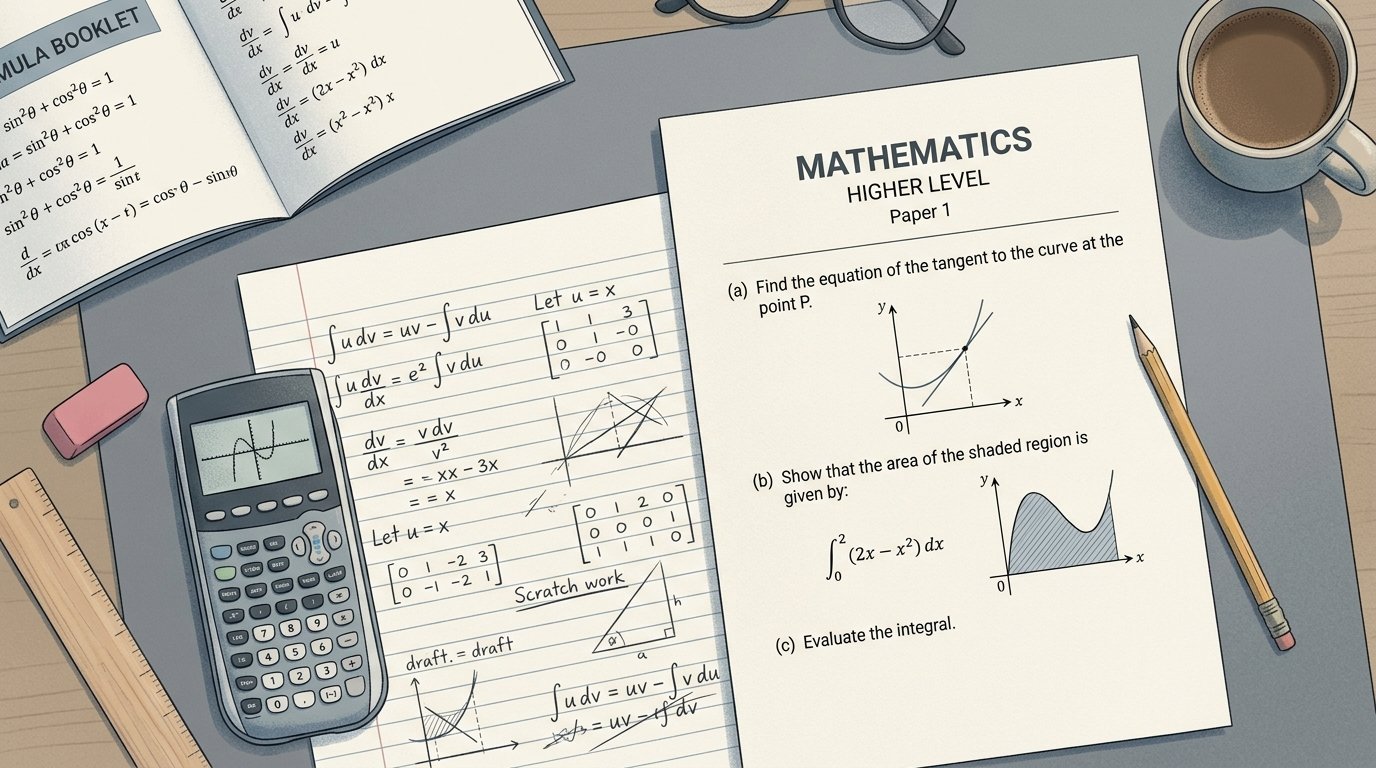
Use Past Papers as Diagnostic Tests
Past papers are extremely useful, but they shouldn’t always be treated as ordinary practice exercises.
Sometimes, sit one under realistic conditions.
Put away your notes.
Follow the time limit.
Use the appropriate calculator.
Then mark it carefully.
The result gives you a snapshot of your current exam performance.
But the real value comes from the analysis afterward.
Look at where your marks disappeared.
Were you too slow?
Did you leave questions unfinished?
Did you make careless errors toward the end?
Did unfamiliar questions cause you to freeze?
Did you know the mathematics but fail to communicate your reasoning?
A past paper can reveal weaknesses that topic practice doesn’t show.
Improve Your Time Management Gradually
A student aiming for a higher grade needs to become comfortable working under time pressure.
But timing every question from the beginning isn’t necessarily the best approach.
First become accurate.
Then begin adding time limits to groups of questions.
Eventually, complete full papers under realistic exam conditions.
During review, look for questions that consumed too much time.
Sometimes the problem isn’t mathematical difficulty.
You may be spending too long trying to force a method that isn’t working.
Recognising when to pause, rethink, and move to another question is part of exam technique.
Learn When to Move On
Getting stuck on one question for too long can cost marks elsewhere.
If you’ve tried a reasonable approach and aren’t making progress, it can be better to move on and return later.
This doesn’t mean giving up.
It means managing your available exam time.
A good revision strategy should therefore include timed practice where you deliberately practise making decisions about when to continue and when to move forward.
Don’t Underestimate Easy Marks
Students aiming for a 7 sometimes focus too heavily on the hardest questions.
But losing marks on straightforward questions can be just as damaging to the overall result.
If you know how to solve a standard question, your goal should be to solve it accurately and efficiently.
Check the wording.
Check your substitution.
Check the arithmetic.
Check the final answer.
Protecting these marks creates a stronger foundation for tackling harder problems.
Improve Your Exam Communication
Your mathematics needs to be understandable to the examiner.
This doesn’t mean writing long explanations for every calculation.
It means making the important reasoning visible.
If you use a formula, show it.
If you substitute values, make the substitution clear.
If you’re solving an equation, show the relevant transformations.
If the question asks you to interpret a result, write the interpretation.
If units are required, include them.
Clear working can also help you when you review your own mistakes.
If your solution is only a collection of calculator answers, it’s much harder to determine what went wrong.
Use Feedback Instead of Guessing
One of the most inefficient revision habits is guessing what you need to improve.
You might decide:
“I need to revise calculus.”
So you spend three hours watching calculus videos.
But perhaps your actual problem is not calculus knowledge.
Perhaps you understand differentiation but repeatedly fail to interpret optimisation questions.
Feedback would reveal that difference.
The same applies to probability, statistics, functions, geometry, and other areas.
Before spending hours revising a topic, ask what your recent working actually shows.
Create a Weekly Improvement Cycle
Your revision doesn’t need to become complicated.
At the beginning of the week, identify two or three weaknesses from recent practice.
Spend part of your study time reviewing the relevant concepts.
Then complete targeted questions.
Review your working carefully.
Correct your mistakes.
Later in the week, complete mixed or unfamiliar questions to see whether the skill transfers.
At the end of the week, review the same weaknesses again.
If a weakness is improving, reduce its priority.
If it continues to appear, keep working on it.
This creates a feedback loop rather than a checklist.
What Changes When You Move From IB Math Grade 5 Toward Grade 6 or 7?
The biggest change isn’t necessarily that you suddenly learn much more mathematics.
You become more consistent.
You make fewer avoidable mistakes.
You recognise methods more quickly.
You become more comfortable with unfamiliar questions.
You communicate your reasoning more clearly.
You review mistakes rather than ignoring them.
You manage time more effectively.
And, perhaps most importantly, you understand your own weaknesses.
That awareness allows you to make better decisions about where to spend your limited revision time.
Don’t Expect an Overnight Jump
Moving from a IB math grade 5 to a 6 or 7 can take time.
If your current performance is around a Grade 5, the aim shouldn’t be to transform every weakness at once.
Start with the mistakes that cost you the most marks.
Fix one recurring issue.
Then another.
Build stronger performance on familiar questions.
Gradually increase exposure to unfamiliar problems.
Use timed practice.
Review your working.
Repeat.
Small improvements across several areas can eventually produce a significant change in your overall performance.
A Grade Is the Outcome, Not the Revision Strategy
It is tempting to make your entire revision goal:
“I need a 7.”
But a grade is the result of many smaller behaviours.
A more useful set of goals might be:
“I want to reduce repeated algebra errors.”
“I want to solve standard calculus questions accurately.”
“I want to improve my first step on unfamiliar questions.”
“I want to finish every practice paper within the time limit.”
“I want to understand why I lose every mark.”
Those goals are actionable.
And when those behaviours improve, your grade has a better chance of improving with them.
How Mathzem Can Support the Process
Mathzem is designed around the idea that students need more than another collection of questions.
Through Mathzem IB Practice, students can practise an IB Math question, submit their working, receive examiner style feedback, identify mistakes and weak areas, and use that information to decide what to practise next.
The student dashboard can then help connect practice results with broader revision decisions. The Mathzem Student Dashboard focuses on areas such as weaknesses, practice progress, and targeted revision.
This approach is particularly useful for a student who has reached the point where simply doing more questions isn’t producing the improvement they want.
The important idea is simple: practice should generate information about what you need to improve.
FAQs About IB Math Grade 5
Can I move from a IB Math Grade 5 to a Grade 7 in IB Math?
It is possible for students to improve significantly, but there is no guaranteed timeline or specific number of questions that will produce a particular grade. Improvement depends on your current knowledge, course level, exam performance, available time, and how effectively you respond to weaknesses.
Should I do more past papers if I’m stuck at Grade 5?
Past papers can be valuable, but doing more without analysing your mistakes may not solve the problem. Review your working first and identify the specific reasons you’re losing marks.
How can I find out why my IB Math grade isn’t improving?
Analyse several recent practice papers rather than one isolated test. Look for repeated patterns involving knowledge, method selection, accuracy, communication, interpretation, unfamiliar questions, and time management.
Should I focus on my weakest IB Math topics?
Yes, but don’t completely ignore your strengths. Secure your weaker areas while maintaining the skills you already perform well in. Protecting easy and familiar marks is important when trying to improve your overall grade.
How often should I do a full IB Math past paper?
There isn’t one ideal frequency for everyone. Full papers are most useful when you can analyse them afterward and act on what they reveal. Doing a paper without reviewing the mistakes wastes much of its potential value.
Is getting a IB Math Grade 7 mostly about doing difficult questions?
No. Higher performance also depends on being accurate and consistent with standard questions, selecting appropriate methods, communicating reasoning, interpreting results, and managing unfamiliar problems effectively.
Conclusion
Moving from an IB Math Grade 5 toward a Grade 6 or 7 isn’t simply about studying for longer.
It’s about making your study more precise.
Find out where your marks are disappearing.
Look at your actual working.
Identify recurring mistakes.
Strengthen the underlying mathematics.
Practise applying it in different situations.
Then move into unfamiliar questions and timed exam conditions.
Most importantly, don’t let an incorrect answer be the end of the learning process.
A wrong answer should tell you something.
Maybe you need to revise a concept.
Maybe you need to practise method selection.
Maybe you need to slow down your calculations.
Maybe you need to improve your working.
Maybe you need to become more comfortable with unfamiliar questions.
Once you know which problem you’re dealing with, you can choose a much better solution.
The path from IB Math Grade 5 to Grade 6 or 7 isn’t about doing everything. It’s about finding the mistakes that matter most and systematically fixing them.
Quick Takeaway
If you’re stuck at Grade 5, don’t respond by blindly doing more questions.
Analyse → identify the weakness → practise the specific skill → review your working → test yourself again.
The more accurately you understand why you’re losing marks, the more targeted your revision becomes.




One Response