You have studied the topics.
You understand most of what your teacher explains.
You have completed practice questions.
You may even understand the mark scheme when you look at the solution.
But your IB Math grade 5 still seems to stay around.
This can be frustrating because it is difficult to know what else you are supposed to do.
The obvious answer is usually to study more.
More questions.
More past papers.
More revision videos.
More hours at your desk.
But if you have already been practising regularly and your grade is not changing much, doing more of exactly the same thing may not solve the problem.
You may need to change how you practise, not simply how much you practise.
Moving from a Grade 5 toward a Grade 6 or 7 is often about making your existing mathematics more reliable, understanding why you lose marks, improving your response to unfamiliar questions, and becoming more deliberate about what you practise next.
Table of Contents
An IB Math Grade 5 Does Not Tell You Exactly What Is Wrong
Two students can both receive a Grade 5 while having very different weaknesses.
One student may understand most of the mathematics but lose marks through algebra mistakes, incomplete working and poor time management.
Another may be accurate with familiar questions but struggle whenever the question requires several concepts to be connected.
A third student may have genuine gaps in important topics.
These students should not revise in exactly the same way.
This is why your grade should be treated as a starting point for diagnosis rather than a complete explanation of your performance.
Your real question should be:
Where are my marks going?
Start With the Marks You Are Losing
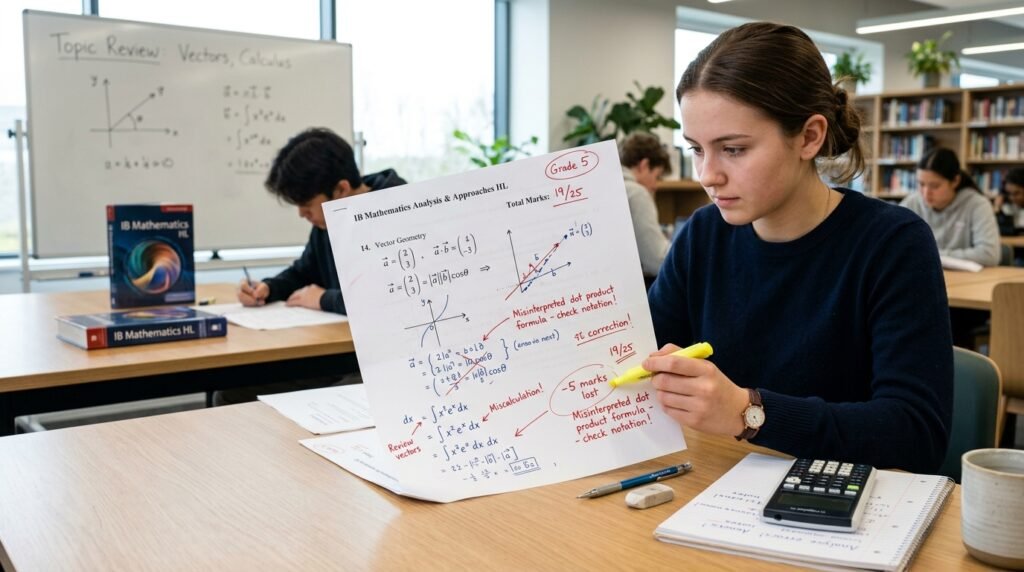
Take one recent test or past paper.
Do not just look at the percentage.
Go through the questions you lost marks on.
For each one, look at your actual working.
Ask:
Did I understand what the question was asking?
Did I choose the appropriate method?
Did I know the relevant formula or concept?
Was my calculation accurate?
Did I show enough working?
Did I interpret the answer correctly?
Did I run out of time?
Did I become stuck because the question looked unfamiliar?
These questions help turn a grade into useful information.
For example, imagine you scored 58 percent.
That number alone does not tell you what to revise.
But suppose your review shows that several lost marks came from algebra errors and another group came from difficulty starting unfamiliar questions.
Now you have two specific areas to work on.
That is much more useful than simply writing “revise Maths” on your study plan.
Do Not Assume Your Weakest Topic Is Your Biggest Problem
This is an important distinction.
You might think:
“I am bad at calculus.”
But your working may tell a different story.
Perhaps you understand differentiation and integration.
The real problem is that you struggle to decide which method to use when a calculus question does not look familiar.
That is not the same weakness.
Similarly, you might think:
“I am bad at probability.”
But perhaps your probability calculations are accurate once you have identified the correct model.
Your main difficulty may be interpreting the wording.
If you revise the entire probability topic without addressing that issue, you may spend hours working without fixing the thing that is costing you marks.
Look for the skill underneath the topic.
The Difference Between Knowing and Applying
This is one of the biggest challenges in IB Mathematics.
You can understand a mathematical idea when someone explains it to you.
You can follow a worked example.
You can even solve a question when the method is obvious.
Then an exam gives you a question where the same mathematics appears in an unfamiliar form.
Suddenly, you do not know where to start.
That does not necessarily mean you have forgotten the topic.
It may mean you need more practice recognising when and how to apply it.
For example, you might know how to differentiate a function.
But an unfamiliar optimisation question may not tell you directly that differentiation is required.
The mathematical skill is there.
The application skill needs more development.
Practise the First Step.
If unfamiliar questions are a problem, deliberately practise starting them.
You do not always need to solve the entire question immediately.
Read the question and identify:
What information has been given?
What is the question asking for?
What mathematical topic could be relevant?
What relationship connects the information you have to the quantity you need?
What could you calculate first?
This is useful because getting the first step right can unlock the rest of the problem.
It also gives you a way to diagnose your difficulty.
If you regularly cannot identify how to begin, your problem may be method selection rather than calculation.
Stop Treating Every Mistake as Careless
“Careless mistake” is sometimes a useful description.
But it can also hide the real problem.
Suppose you repeatedly lose a negative sign.
That could be a one off slip.
But if it happens frequently, you need to investigate why.
Perhaps you rush algebraic manipulation.
Perhaps your working is too compressed.
Perhaps you do too much calculation mentally.
Perhaps you do not check intermediate results.
Perhaps you are making the same algebraic transformation incorrectly.
The solution is not simply to tell yourself:
“Be more careful.”
You need a behaviour that reduces the chance of the mistake happening again.
For example, if you repeatedly lose signs during algebra, write each transformation on a separate line for a period of time.
Then check whether the error becomes less frequent.
That is a measurable change.
Review Your Working, Not Just the Final Answer
A correct answer can sometimes hide weak reasoning.
An incorrect answer can sometimes hide a mostly correct method.
This is why reviewing only the final number is not enough.
Imagine you solve a calculus question and reach the wrong answer.
There are several possible explanations.
You might have chosen the wrong method.
You might have chosen the correct method but differentiated incorrectly.
You might have differentiated correctly but made an algebra mistake.
You might have completed the calculation correctly but failed to interpret the result.
These require different responses.
Mathzem’s practice workflow is built around reviewing the student’s actual working rather than treating the final answer as the only evidence of performance. Students can upload their working and receive examiner style feedback about marks, mistakes and weak areas.
The broader principle is important even if you are reviewing your work yourself.
Find the first meaningful problem.
That is usually more useful than simply looking at the final answer.
Build a Mistake Pattern
Do not create a huge list of every question you have ever got wrong.
Look for repeated patterns.
For example:
You repeatedly make algebra errors.
You repeatedly struggle to interpret probability questions.
You repeatedly forget to justify conclusions.
You repeatedly choose the wrong method in unfamiliar calculus questions.
You repeatedly lose marks because your working is incomplete.
These patterns tell you much more than a list of question numbers.
Instead of saying:
“I got Questions 4, 9 and 17 wrong.”
Try:
“I lose marks when I have to choose the method in unfamiliar questions.”
The second statement gives you a revision strategy.
Change What You Practise
Once you identify a weakness, your next questions should reflect it.
If you have a knowledge gap, review the concept and practise straightforward applications.
If you struggle with method selection, use mixed questions where the method is not obvious.
If you make algebra errors, practise the specific algebraic skill.
If you struggle with interpretation, practise questions that require mathematical conclusions.
If your working is incomplete, practise writing complete solutions.
This sounds obvious, but it is easy to fall back into random practice.
Random practice feels productive because you are doing something.
Targeted practice is more useful because you know why you are doing it.
Do Not Jump Straight to the Hardest Questions
Aiming for Grade 6 or 7 does not mean every question you practise should be extremely difficult.
In fact, that can be counterproductive.
Suppose you are losing easy marks because of algebra errors.
If you immediately start working on the hardest calculus problems in your course, you introduce several additional sources of difficulty.
You may struggle with calculus.
You may struggle with algebra.
You may struggle with the unfamiliar structure of the question.
You may not know which mistake caused the failure.
Instead, strengthen the underlying skill first.
Then increase the difficulty.
A useful progression is:
Understand → Apply → Mix → Challenge
First make the basic mathematics reliable.
Then apply it.
Then practise mixed questions where the method is less obvious.
Then move towards more demanding unfamiliar problems.
Protect the Marks You Already Know How to Get
Students aiming for higher grades sometimes focus too much on difficult questions.
But standard questions still matter.
If you know how to solve a familiar type of question, your goal should be to become highly reliable at it.
That means:
Read the question carefully.
Use the correct method.
Show the important working.
Avoid unnecessary calculator errors.
Check your answer where appropriate.
Interpret the result when required.
Do not throw away marks that you already have the mathematical ability to earn.
Improvement is not only about learning harder mathematics.
It is also about losing fewer marks through avoidable problems.
Use Unfamiliar Questions to Test Transfer
Once a skill becomes reliable, change the context.
Suppose you have practised a particular calculus technique several times.
You can now solve the standard version comfortably.
That is useful.
But can you recognise the same mathematics when the question is worded differently?
That is the next test.
This is where unfamiliar IB style questions become valuable.
They help you move from:
“I know how to solve this type of exercise.”
to:
“I can recognise and apply this mathematics when the problem looks different.”
That second ability is much more useful in an examination.
Use Past Papers as Diagnostic Tools
Past papers should not only be used to calculate a score.
Use them to understand your performance.
Complete a paper under realistic conditions.
Then analyse it carefully.
Look for:
Questions where you knew the mathematics but made an error.
Questions where you did not know how to start.
Questions where you chose the wrong method.
Questions that took too long.
Questions where your working was incomplete.
Questions where you understood the mathematics but struggled with the wording.
Your score tells you where you are.
Your review tells you what to do next.
Improve Your Time Management After You Improve Your Accuracy
If you are still making many avoidable mathematical errors, simply practising faster is unlikely to solve the problem.
First become reliable.
Then work on speed.
Start by timing small groups of questions.
Then practise sections.
Eventually, complete full papers under realistic conditions.
During review, identify where your time went.
Did one unfamiliar question consume too much time?
Did you spend too long checking simple calculations?
Did you become stuck because you did not recognise the method?
Time management is partly a mathematics problem and partly a decision making problem.
Use Feedback to Decide What Comes Next
One of the most valuable outcomes of a practice question is not the mark.
It is the information about what you should do afterwards.
Suppose you receive feedback showing that your method was appropriate but you made an algebra error.
Your next step should probably not be another completely unrelated topic.
Suppose you receive feedback showing that you misunderstood the question.
Your next step might involve practising interpretation.
Suppose several attempts show the same weakness.
That weakness should move higher on your revision priority list.
This creates a learning loop:
Attempt → Feedback → Diagnose → Correct → Practise → Retest
The Mathzem product is designed around this broader loop, with AI Examiner feedback, weak area tracking and information intended to help guide subsequent practice.
What to Do If You Keep Getting the Same Grade
If you have been around Grade 5 for several assessments, resist the temptation to completely change your revision strategy every week.
Instead, look for consistency in your mistakes.
Take several recent pieces of work.
Find the repeated problems.
Choose the two or three that appear most often.
Work on those first.
Then test yourself again.
If the same errors disappear, move to the next priority.
If they remain, investigate further.
Perhaps the issue is not enough practice.
Perhaps you misunderstood the underlying concept.
Perhaps the questions you are using are too similar.
Perhaps you are checking solutions without testing yourself afterwards.
The goal is to turn your revision into a process of continuous diagnosis.
A Practical Weekly Plan for a IB Math Grade 5 Student
You do not need to completely rebuild your study routine.
Try this structure.
Session 1: Diagnose
Complete several IB style questions.
Review the working carefully.
Identify two or three recurring weaknesses.
Session 2: Repair
Review the mathematics behind the first weakness.
Complete focused questions.
Check your working.
Session 3: Apply
Complete questions where the same skill appears in a different context.
Focus on recognising when the skill is needed.
Session 4: Mixed practice
Complete a mixture of topics.
Do not rely on the question telling you which method to use.
Session 5: Retest
Return to the weaknesses you identified earlier in the week.
Complete new questions.
Check whether the same errors appear.
This gives every practice session a purpose.
What Grade 6 or 7 Students Need to Become Better At
There is no single mathematical trick that guarantees a higher grade.
But stronger performance generally requires greater consistency.
You need to become more reliable with mathematics you already know.
You need to recognise methods in unfamiliar situations.
You need to communicate your reasoning clearly.
You need to identify and correct repeated mistakes.
You need to manage your time.
You need to become comfortable with questions that do not immediately look familiar.
And you need to know where your weaknesses actually are.
The exact combination will differ between students.
That is why a personalised diagnosis is more useful than copying someone else’s revision timetable.
Do Not Measure Improvement Only by Your Grade
Your grade may take time to change.
That does not mean your revision is failing.
Look for smaller improvements first.
Are you making fewer algebra errors?
Are you starting unfamiliar questions more confidently?
Are you losing fewer method marks?
Are you finishing more questions within the time available?
Are you recognising repeated mistakes earlier?
Are you able to solve a new question using a method you recently practised?
These changes are useful evidence.
The grade is an outcome.
Your behaviours are what you can actually change.
How Mathzem Fits Into This Process
Mathzem is built for students who understand that simply collecting more questions is not necessarily enough.
With Mathzem IB Practice, you can choose an IB Mathematics course, topic or subtopic, solve an exam style question, upload your handwritten working and receive AI Examiner feedback.
The current workflow can identify marks by question part, explain where marks were lost, identify weak areas and provide recommended next step guidance. The Student Dashboard also tracks information such as weak topics and repeated mistakes.
This can make the review stage more structured.
Instead of finishing a question and moving immediately to another one, you can use the attempt to ask:
What does this tell me about my mathematics?
That question is at the centre of effective revision.
FAQs About IB Math Grade 5
Is a Grade 5 a bad IB math grade?
A Grade 5 does not tell you everything about your mathematical ability. It is a measure of performance, and two students with the same grade can have very different strengths and weaknesses.
How can I move from IB Math Grade 5 to Grade 6?
Start by identifying where you are losing marks. Then target recurring weaknesses, improve your accuracy on familiar questions, practise application, and gradually increase the number of unfamiliar questions you attempt.
How can I move from Grade 5 to Grade 7?
There is no guaranteed formula. A higher grade generally requires stronger consistency across knowledge, application, reasoning, communication, accuracy and exam technique. The first step is understanding which of these areas is currently limiting your performance.
Should I do more past papers?
Past papers are useful, but doing more papers without reviewing your mistakes may have limited value. Use them as diagnostic tools and turn the results into specific revision actions.
Why do I understand IB Math but still get Grade 5?
You may understand the underlying mathematics but struggle with application, method selection, unfamiliar wording, accuracy, communication or time management. Reviewing your actual working can help distinguish between these problems.
Can Mathzem help me improve my IB Math grade?
Mathzem can support the practice and feedback process by letting you solve IB style questions, upload your working, receive AI Examiner feedback, identify weak areas and use the resulting information to guide further practice. It does not guarantee a particular exam grade.
Conclusion
If you are stuck around IB math Grade 5, the answer may not be to study for more hours.
First find out what is actually holding you back.
Look at your lost marks.
Review your working.
Find repeated patterns.
Separate knowledge problems from method problems.
Separate method problems from accuracy problems.
Practise unfamiliar questions once your core skills are secure.
Protect the marks you already know how to earn.
Use past papers to diagnose rather than simply score yourself.
And most importantly, let your mistakes influence what you practise next.
The move from Grade 5 toward Grade 6 or 7 is not one giant leap.
It is a series of smaller improvements.
Better method selection.
Fewer repeated mistakes.
More reliable calculations.
Clearer working.
Stronger application.
Better decisions under time pressure.
If you can identify those improvements, you have something much more useful than a revision timetable.
You have a reason for every question you practise.
Quick Takeaway
If your IB Math grade has been stuck around 5, do not immediately assume you need more content.
Ask:
Where am I losing marks?
Why am I losing them?
Does the same problem keep appearing?
What should I practise because of it?
Then test yourself again.
That is how revision becomes targeted instead of repetitive.