When students start preparing for an IB Math exam, one of the most common questions is surprisingly difficult to answer.
How many questions should IB math questions to practise?
Some students believe they need to solve dozens of questions for every topic. Others complete five or ten questions and assume they’ve done enough.
Neither approach is necessarily right.
The number of questions you should practise depends on how well you understand the topic, how consistently you can solve questions without help, how difficult the questions are, and whether you can apply the mathematics to unfamiliar situations.
A student who understands differentiation and can solve a wide range of calculus questions accurately may not need to spend hours completing basic differentiation exercises.
A student who repeatedly makes the same mistake after ten questions may need more targeted practice, but doing another fifty nearly identical questions might not solve the underlying problem.
The better question isn’t simply “How many IB Math questions should I practice?”
It’s:
“How many questions do I need to practice before I can demonstrate that I actually understand and can apply this skill?”
Table of Contents
Why Counting Questions Can Be Misleading
It is easy to measure revision by quantity.
You can say that you completed 20 questions today.
You can say you finished 100 questions this week.
But those numbers don’t tell you whether the practice was useful.
Imagine completing 30 questions on a topic where every question uses exactly the same method. You become very comfortable recognising that pattern, but you may still struggle when an exam question presents the same mathematics differently.
Now imagine completing 12 carefully selected questions. The first few test the basic concept. The next few require application. The final questions are unfamiliar and require you to decide which mathematical method is appropriate.
The second set may provide considerably more useful practice.
This is particularly important in IB Mathematics because students are expected to apply mathematical knowledge and skills to problems rather than simply recall procedures.
Practice therefore needs to develop more than speed.
It needs to develop recognition, application, reasoning, accuracy, and confidence with unfamiliar problems.
Start With the Question You Can Already Solve
Before deciding how many questions you need, establish your starting point.
Suppose you’re revising quadratic functions.
If you already understand the basic concepts and can solve standard questions confidently, you shouldn’t spend most of your revision time repeatedly answering the easiest questions.
Instead, use a small number of straightforward questions to confirm that your foundation is secure.
Once you can solve those accurately without relying heavily on notes or worked examples, increase the difficulty.
On the other hand, if you cannot confidently solve basic questions, moving immediately to difficult exam questions is unlikely to be efficient.
You need to strengthen the underlying skill first.
This is why the ideal number of questions is different for different students.
A Better Progression Than “Do 50 Questions”
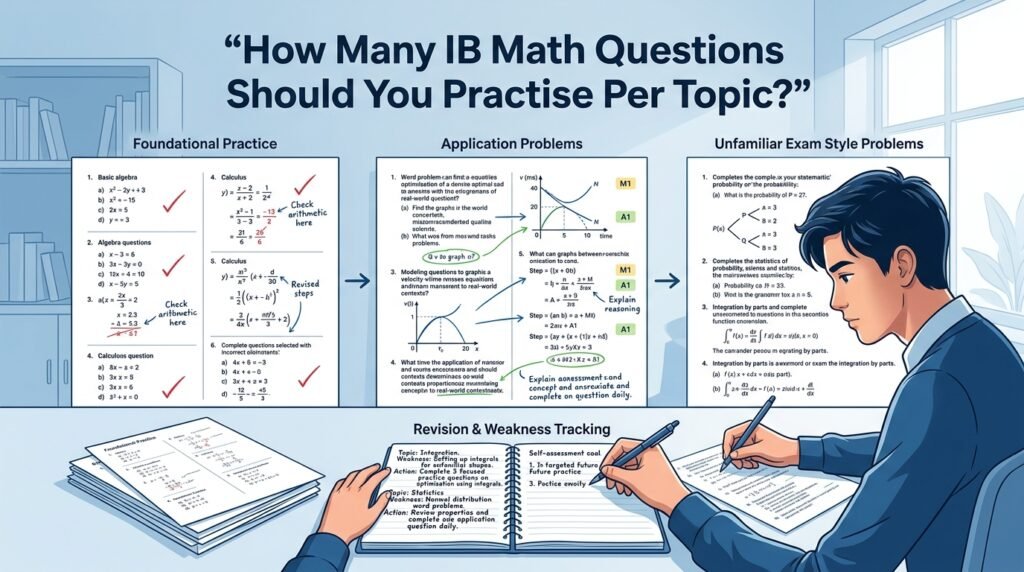
A useful way to structure topic practice is to move through three levels.
First, practise questions that check whether you understand the core skill.
Next, practise questions that require you to apply the skill in a less obvious way.
Finally, practise unfamiliar questions where you have to decide how to approach the problem.
The purpose of the first stage is to establish accuracy.
The purpose of the second stage is to develop application.
The purpose of the third stage is to develop problem solving.
You don’t need to spend an equal amount of time at every stage.
The amount you need depends on your performance.
If you’re making basic errors, stay at the first stage longer.
If basic questions are easy but application questions are difficult, spend more time at the second stage.
If both are comfortable, move toward mixed and unfamiliar questions.
How Many Basic Questions Should You Do?
There is no universal number, but basic practice should normally continue until the underlying skill becomes reliable rather than until you’ve reached an arbitrary question count.
For a topic you’re learning for the first time, several carefully chosen basic questions can be more useful than completing a large repetitive set.
For example, if you’re learning differentiation, you might first practise finding derivatives of standard functions.
Once you can do these reliably, continuing to solve dozens of nearly identical examples may provide diminishing returns.
At that point, your practice should become more varied.
You might need to differentiate functions involving products, quotients, composites, or parameters, depending on your course and the specific skill being tested.
The point isn’t to stop at a fixed number.
The point is to stop repeating a skill mechanically once the practice is no longer teaching you anything new.
How Many Application Questions Should You Do?
Application questions deserve more attention because they test whether you can use mathematics rather than simply reproduce a procedure.
Suppose you’ve learned how to calculate a derivative.
A basic question might explicitly ask you to differentiate a function.
An application question might instead describe a situation involving a rate of change and require you to recognise that differentiation is relevant.
You need to make the connection yourself.
This is where many students discover that understanding a topic in class doesn’t automatically mean they can apply it in an exam.
If you can solve basic questions but struggle with application questions, increase the proportion of your practice devoted to this type of problem.
The exact number isn’t important.
What matters is whether your performance improves.
Unfamiliar Questions Matter Even More
The hardest part of IB Math practice is often not the calculation.
It’s deciding what to do.
An unfamiliar question may combine concepts you’ve studied separately or present familiar mathematics in a context you haven’t seen before.
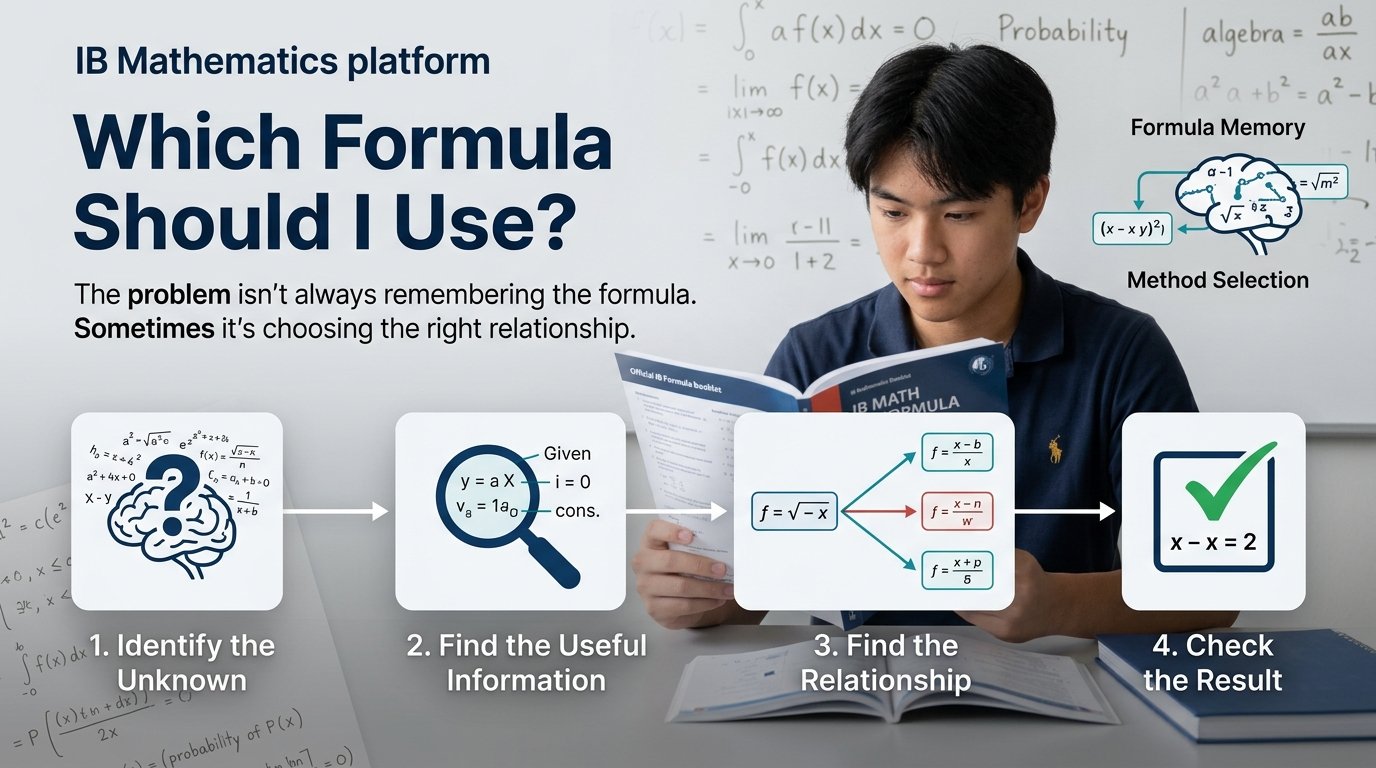
You might recognise the topic but not know which method to use.
You might know several formulas but not know which one is relevant.
You might understand the mathematics but struggle to identify the first useful step.
This is why unfamiliar questions should become part of your revision as you get closer to an exam.
If you only practise questions that look like examples you’ve already seen, you may develop recognition without developing enough problem solving ability.
Don’t Practice Until You Get the Answer Right
Getting the correct final answer is important, but it isn’t the only measure of successful practice.
Consider a student who guesses a method, enters several expressions into a calculator, and eventually gets the correct answer.
They may feel confident.
But if they cannot explain the method, they haven’t necessarily mastered the skill.
The same applies when a student looks at a solution after becoming stuck and then immediately completes the question correctly.
They’ve demonstrated that they can follow the solution.
They haven’t necessarily demonstrated that they can produce the solution independently.
Good practice requires you to distinguish between recognising a solution and producing one yourself.
The Importance of Feedback
This is where feedback changes the answer to the question of how many problems you need.
Suppose you complete ten questions and receive no meaningful feedback.
You might not know whether your errors are random or part of a pattern.
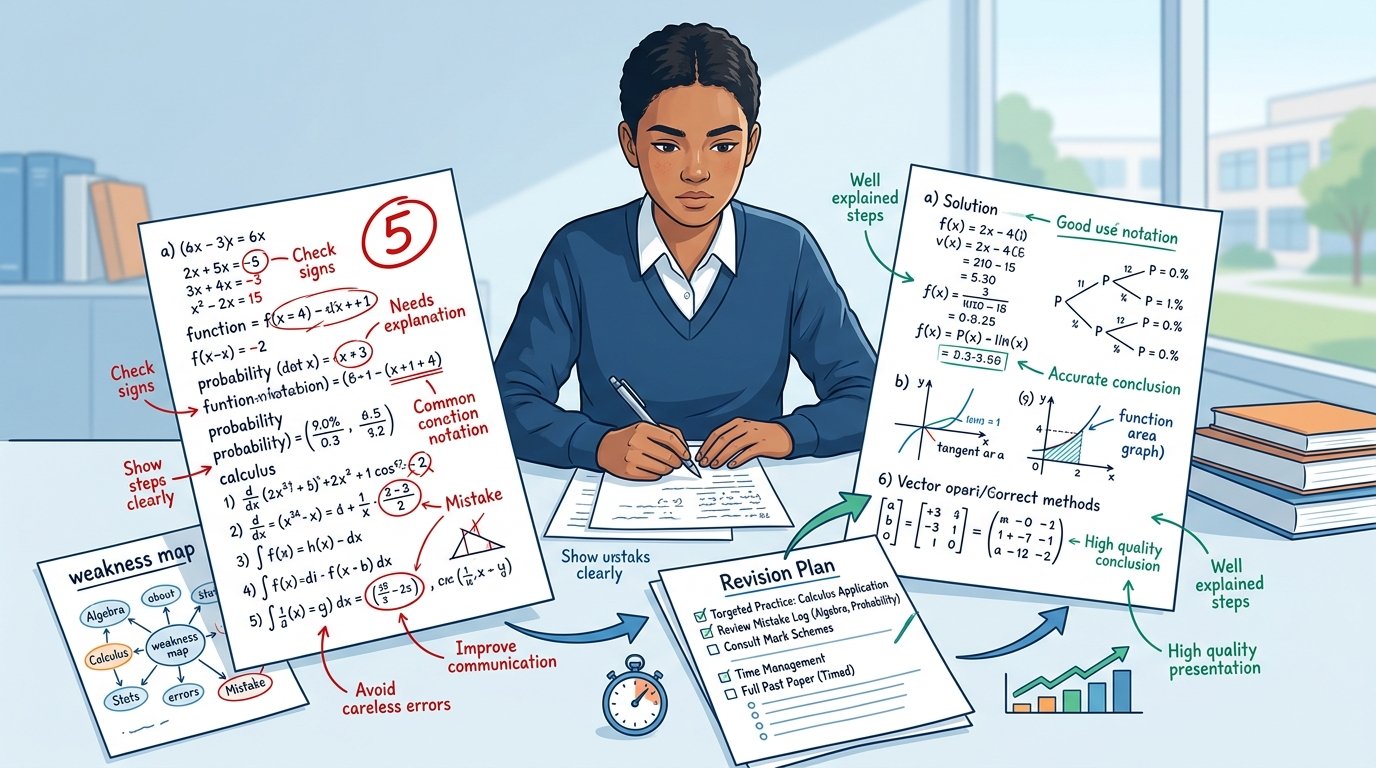
Now imagine completing ten questions and carefully analysing every incorrect solution.
You discover that six of your mistakes involve the same algebraic issue.
Your next ten questions can target that specific weakness.
That’s much more useful than simply completing another ten random questions.
Feedback makes practice more efficient because it tells you what should happen next.
This is why Mathzem’s IB Math Practice workflow focuses not only on answering questions but also on reviewing the student’s submitted working, identifying mistakes and weaknesses, and using that information to guide further practice.
What If You Keep Getting the Same Question Wrong?
If you repeatedly make the same mistake, don’t respond by blindly increasing the number of questions.
Stop and diagnose the problem.
Suppose you’re practising probability and repeatedly use the wrong model.
The problem may not be that you haven’t completed enough probability questions.
You may not yet understand how to identify which probability model fits the situation.
Doing another 30 questions without addressing that weakness could reinforce the same mistake.
Instead, review the concept, examine worked examples, identify the clue that distinguishes different models, and then practise a smaller number of targeted questions.
Once your accuracy improves, return to mixed questions.
The Correction Cycle Is More Important Than the Question Count
A useful practice cycle looks like this:
You attempt a question.
You review the result.
You identify the exact point where your reasoning went wrong.
You correct the solution.
You explain the mistake to yourself.
You attempt a similar question.
Later, you return to the same skill in a different context.
This cycle can turn one incorrect question into several learning opportunities.
Without the correction stage, an incorrect answer can simply become another item in a long list of completed questions.
How Long Should You Spend on One Question?
Students sometimes worry that spending too long on one question means they’re being inefficient.
It depends on what you’re trying to learn.
During ordinary practice, it can be useful to spend time understanding why you’re stuck.
If you’re preparing for an exam, however, you also need timed practice.
The two situations are different.
During learning, your priority is understanding.
During exam simulation, your priority includes making good decisions under time pressure.
You therefore shouldn’t use strict exam timing for every question you practise.
Some questions deserve time for exploration and reflection.
Others should be completed under realistic time conditions.
Don’t Make Every Practice Session a Timed Test
Doing every question under exam conditions can create unnecessary pressure and reduce the quality of learning.
If you are learning a new topic, you need enough time to think.
You may need to consult notes, check a formula, or analyse why a method works.
That’s part of learning.
As your exam approaches, gradually increase timed practice.
Start with short groups of questions.
Then practise larger sections.
Eventually, complete full papers under realistic conditions.
This gives you both learning practice and exam practice.
What About Easy Topics?
You don’t need to spend equal time on every topic.
If a topic is already one of your strongest areas, a smaller amount of maintenance practice may be enough.
For example, if you consistently solve standard questions on functions accurately, you may benefit more from practising unfamiliar function problems than from completing another large set of basic exercises.
This doesn’t mean abandoning the topic.
It means allocating revision time according to need.
Your revision time is limited.
Use it where it can make the biggest difference.
What About Weak Topics?
Weak topics usually need more deliberate practice, but that doesn’t mean endlessly solving questions.
Start by determining what makes the topic weak.
Perhaps you never fully understood the concept.
Perhaps you understand the concept but can’t recall the method.
Perhaps you can perform the method but make algebra errors.
Perhaps you struggle when the question is worded differently.
Each weakness needs a different response.
A student who doesn’t understand conditional probability needs explanation and foundational practice.
A student who understands conditional probability but misreads exam questions needs application practice.
A student who understands both but repeatedly makes calculation errors needs accuracy practice.
The number of questions follows the diagnosis.
It shouldn’t replace it.
How Many Questions Should You Practise Before Moving On?
A better stopping rule is based on performance.
You can consider moving on when you can solve several questions independently, including at least some variation in wording or difficulty, without repeatedly making the same error.
If you can solve basic questions but fail application questions, you’re not finished.
If you can solve application questions but struggle with unfamiliar problems, keep developing problem solving.
If you can solve all three types accurately, move to mixed practice and revisit the topic later.
This is more meaningful than saying, “I’ve done 20 questions, so I’m finished.”
Use Mixed Practice to Test Real Understanding
Topic based practice is useful when you’re building a skill.
But exams don’t normally tell you exactly which method to use.
A paper may move from functions to statistics, then calculus, then probability, without warning you what topic comes next.
Mixed practice recreates some of that decision making.
When you don’t know the topic in advance, you have to recognise the mathematical structure of the problem.
This is an important transition from learning a technique to being able to use mathematics independently.
How Past Papers Change the Question Count
Past papers shouldn’t necessarily be counted as individual topic questions.
They serve a different purpose.
A full paper tests your ability to combine knowledge, manage time, interpret wording, and make decisions across different topics.
After completing a paper, you can identify which questions exposed weaknesses.
Those questions should then influence your next practice session.
For example, if a paper reveals that you struggle with optimisation, don’t simply start another full paper.
Spend some targeted time on optimisation, then return to mixed practice.
The paper becomes a diagnostic tool.
Build a Personal Question Target
Instead of adopting a fixed target such as 50 questions per topic, create a flexible target based on your performance.
For a strong topic, you might need a small set of questions followed by a few challenging or unfamiliar problems.
For a developing topic, you may need several rounds of basic and application practice.
For a major weakness, you may need explanation, targeted practice, feedback, correction, and then another assessment.
This makes your revision more personal.
It also prevents you from wasting time on questions you’ve already mastered.
A Simple Example
Imagine you’re revising integration.
You begin with several basic questions involving standard integration techniques.
Your first few attempts are accurate, so you move to application questions.
You then encounter a problem where you need to use integration in a context rather than simply calculate an integral.
You get stuck.
Instead of immediately completing another ten basic integration questions, you investigate why you couldn’t start.
You realise that your weakness is not integration itself. It’s recognising when integration is required in a word problem.
Your next practice therefore focuses on application and unfamiliar integration questions.
After that, you complete a mixed set and find that you’re beginning to recognise the required approach.
You might have solved fewer total questions than another student.
But your practice was more targeted.
The Goal Is Mastery, Not a Question Count
Question counts can be useful for planning.
They can help you make sure you’re practising consistently.
But they shouldn’t become the goal.
The goal is to become capable of solving mathematical problems independently and accurately.
If you’ve solved 100 questions but still make the same mistake, the number isn’t impressive.
If you’ve solved 15 carefully chosen questions, analysed your errors, corrected your approach, and can now solve unfamiliar variations independently, that practice may have been far more valuable.
Quality doesn’t mean doing fewer questions simply because fewer is better.
It means making sure each question has a purpose.
How Mathzem Can Help You Decide What to Practice Next
One of the challenges with independent revision is deciding what comes next.
You may finish a question and know whether the final answer was right or wrong but still be unsure what the result tells you about your wider mathematical skills.
Mathzem is designed around this feedback gap.
Through Mathzem IB Practice, you can practice a question, upload your working, receive examiner style feedback, identify mistakes and weak areas, and use that information to guide your next practice.
The aim is not to tell every student to complete the same number of questions.
It’s to make practice more targeted.
If your working shows a weakness, that weakness can become the reason for your next practice decision.
The Mathzem Student Dashboard also connects practice with areas such as weaknesses and revision planning, helping students move away from random question selection toward more focused practice.
What Should Your Practice Session Look Like?
A useful revision session doesn’t need to contain dozens of questions.
Start by selecting one skill or topic you want to improve.
Complete a small number of questions independently.
Review your working carefully.
Identify mistakes rather than simply recording whether the final answer was correct.
Then choose your next question based on what you discovered.
If you performed well, increase the difficulty.
If you struggled with a specific concept, return to that skill.
If you made a recurring error, practise that error directly.
If the topic is secure, move to mixed or unfamiliar questions.
This makes the session responsive to your performance.
How Many Questions Are Enough?
There isn’t a magic number.
For one student, ten questions may be enough to establish that a skill is secure.
For another student, ten questions may reveal that the underlying concept still needs work.
The better measure is whether you can demonstrate the skill consistently, independently, and in different forms.
When you can solve standard questions accurately, apply the skill in unfamiliar contexts, explain your reasoning, and avoid repeating the same mistakes, you’ve reached a much more meaningful stopping point.
Don’t practise until you’ve reached a number. Practise until the evidence shows that you can use the mathematics.
FAQs About IB Math Questions to Practice
How many IB Math questions should I practise every day?
There is no universal daily target. Your needs depend on your course level, current ability, available study time, and the topics you’re working on. A smaller number of carefully reviewed questions can be more useful than a large number completed without feedback.
How many questions should I do for each IB Math topic?
Use performance rather than a fixed number to decide. Start with basic questions, move to application questions, and then practice unfamiliar problems. Spend more time on topics where your working reveals repeated weaknesses.
Is doing 50 IB Math questions per topic enough?
Not necessarily. Fifty repetitive questions may provide less useful practice than a smaller set containing different levels of difficulty and unfamiliar applications. The quality and purpose of the questions matter more than the total count.
Should I practice easy IB Math questions?
Yes, especially when learning or rebuilding a weak skill. However, once basic questions become consistently accurate, you should move toward application, mixed, and unfamiliar problems.
How do I know when I’ve mastered an IB Math topic?
A useful sign is that you can solve questions independently and accurately across different levels of difficulty and wording. You should also be able to recognise which mathematical method is appropriate rather than relying only on familiar question patterns.
Should I do questions every day for IB Math?
Consistent practice is generally more useful than occasional large revision sessions. However, the exact schedule should fit your other subjects, course workload, and exam timeline.
Conclusion
There is no magic number of IB Math questions that guarantees improvement.
The right amount depends on what you’re trying to learn and what your working tells you.
When learning a new skill, start with enough basic practice to become accurate.
Then move into application questions.
After that, challenge yourself with unfamiliar problems where you need to decide how to approach the mathematics.
Review your mistakes throughout the process.
If you keep making the same error, stop increasing the question count and investigate the weakness.
If a topic is already strong, don’t spend most of your revision time repeating questions you can solve easily.
And as exams approach, use mixed practice and past papers to test whether your skills transfer when the topic and method aren’t given to you.
The best IB Math practice isn’t measured by how many questions you can say you completed.
It’s measured by what changed because you completed them.
Practise with a purpose, review your working, respond to your mistakes, and let your performance determine what you practise next.
Quick Takeaway
Don’t aim for 20, 50, or 100 questions simply because you’ve heard that’s what you should do.
Start with basic questions, progress to application, challenge yourself with unfamiliar problems, and use feedback to decide when to continue, change direction, or move on.