IB Math Exam Preparation: Where Should You Start?
Preparing for an IB Math exam isn’t simply a matter of completing as many questions as possible.
You need to know the mathematics, recognise what a question is asking, choose an appropriate method, communicate your working clearly, use technology appropriately, and check whether your answer makes sense.
That distinction matters because the IB Diploma Programme assesses more than the ability to recall formulas and carry out standard procedures. The IB describes DP assessment as measuring skills such as analysing information, solving problems creatively, applying standard methods, and demonstrating understanding of key concepts.
For mathematics specifically, the current IB framework includes knowledge and understanding, problem solving, communication and interpretation, technology, reasoning, and inquiry. Students are expected to use mathematical knowledge in familiar and unfamiliar contexts.
That means effective IB Math exam preparation needs to train more than memory.
You need a system that helps you move from:
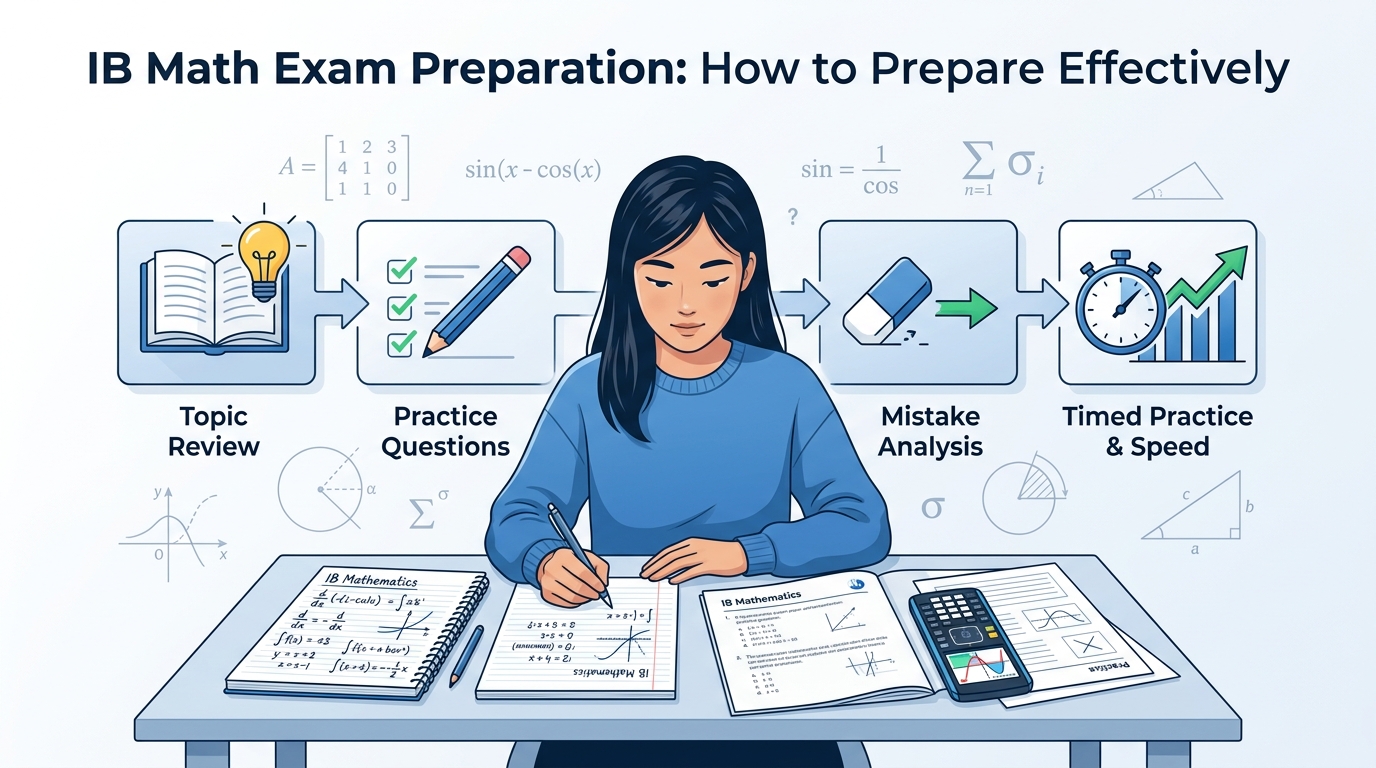
Learn → Practice → Review → Correct → Retest → Improve
This guide explains how to build that system for IB Mathematics AA and AI, at both SL and HL.
Important: IB has announced updated AA and AI courses that will be first taught from August 2027, with first assessment in May 2029. The strategy below is designed around the current courses, so students should always check the syllabus and assessment materials that apply to their examination session.
Table of Contents
What Does Good IB Math Exam Preparation Actually Involve?
A strong preparation plan has several parts.
You should work on:
- Understanding the mathematics
- Recalling important methods and concepts
- Applying mathematics to exam style questions
- Solving unfamiliar problems
- Communicating your working
- Using your calculator or technology correctly
- Reviewing mistakes
- Managing time
- Practising under realistic exam conditions
- Tracking progress
The mistake many students make is spending almost all their revision time on the first two.
They review notes.
They memorise formulas.
They watch explanations.
Then they assume they’re ready.
But knowing how to differentiate a function is different from recognising that differentiation is needed in an unfamiliar problem.
Knowing the normal distribution formula is different from deciding which probability the question is asking you to calculate.
Knowing integration techniques is different from interpreting what an integral represents in a real context.
Exam preparation has to bridge that gap.

Step 1: Know Which IB Math Course You Are Taking
Before building your study plan, make sure you’re working from the correct course.
The IB currently offers four DP mathematics courses:
- Mathematics: Analysis and Approaches SL
- Mathematics: Analysis and Approaches HL
- Mathematics: Applications and Interpretation SL
- Mathematics: Applications and Interpretation HL
The IB states that students take one DP mathematics course, and all four courses require students to develop mathematical knowledge and use technology in mathematics.
Your preparation should therefore be based on your specific course.
Don’t assume that an AA HL revision resource is automatically suitable for AI SL.
Even when topics overlap, the emphasis and level of mathematical thinking can differ.
Create a simple course checklist
Start by listing the topics you need to know.
Then classify each topic as:
Green: I can solve exam style questions confidently.
Yellow: I understand the topic but make mistakes or struggle with harder applications.
Red: I don’t understand the concept or cannot start questions independently.
This gives you your first revision map.
Don’t spend equal time on every topic.
Your weakest high priority areas should receive more attention.
Step 2: Diagnose Your Weak Topics Before Revising
One of the least effective ways to prepare for an exam is to revise the entire syllabus from the beginning without checking what you actually need.
If you already understand functions well, spending three hours rereading your functions notes may produce very little improvement.
Instead, begin with evidence.
Use a practice test, topic questions, or a past paper to identify where marks are being lost.
For each incorrect question, record:
| Question | Topic | What went wrong? | Next action |
|---|---|---|---|
| 1 | Calculus | Chose wrong method | Practise method selection |
| 2 | Probability | Misread wording | Practise interpretation |
| 3 | Algebra | Sign error | Improve checking |
| 4 | Statistics | Weak conclusion | Practise interpretation |
This changes your revision from:
“I need to revise calculus.”
to:
“I understand differentiation, but I struggle to recognise which derivative information the question requires.”
The second statement gives you something specific to practise.
Mathzem’s Math Skill Scanner can also be used as part of a weakness focused revision process.
Step 3: Review the Mathematics You Actually Need
Once you’ve identified your weak areas, return to the underlying mathematics.
But avoid passive revision.
Reading a page of notes can make a topic feel familiar without proving that you can use it.
Instead, use a short cycle:
Concept → Example → Attempt → Check → Explain
For example, if you’re revising integration:
Concept
Review what an integral represents and the relevant techniques.
Example
Study one worked example carefully.
Attempt
Close the notes and solve a similar question yourself.
Check
Compare your method and result with the expected solution.
Explain
Explain why your method worked.
That final step is important.
If you can solve a question mechanically but cannot explain why you selected the method, your understanding may not yet be secure.
Step 4: Move From Familiar Questions to Unfamiliar Questions
This is one of the most important parts of IB Math exam preparation.
Start with familiar questions.
Then gradually remove the clues.
Level 1: Direct practice
The topic and method are obvious.
Example:
Differentiate (f(x)=3x^4-2x^2+5).
The purpose here is accuracy and fluency.
Level 2: Similar exam style questions
The method isn’t stated, but the question resembles examples you’ve studied.
Now you have to recognise the technique.
Level 3: Unfamiliar application
The question gives you a context and requires you to determine what mathematics is relevant.
Now you’re practising problem solving.
The IB explicitly identifies problem solving as central to mathematics and expects students to use mathematical skills and concepts in a wide range of situations, including non routine, open ended, and real world problems.
If you only practise Level 1 questions, the first unfamiliar question in an exam can feel much harder than it actually is.
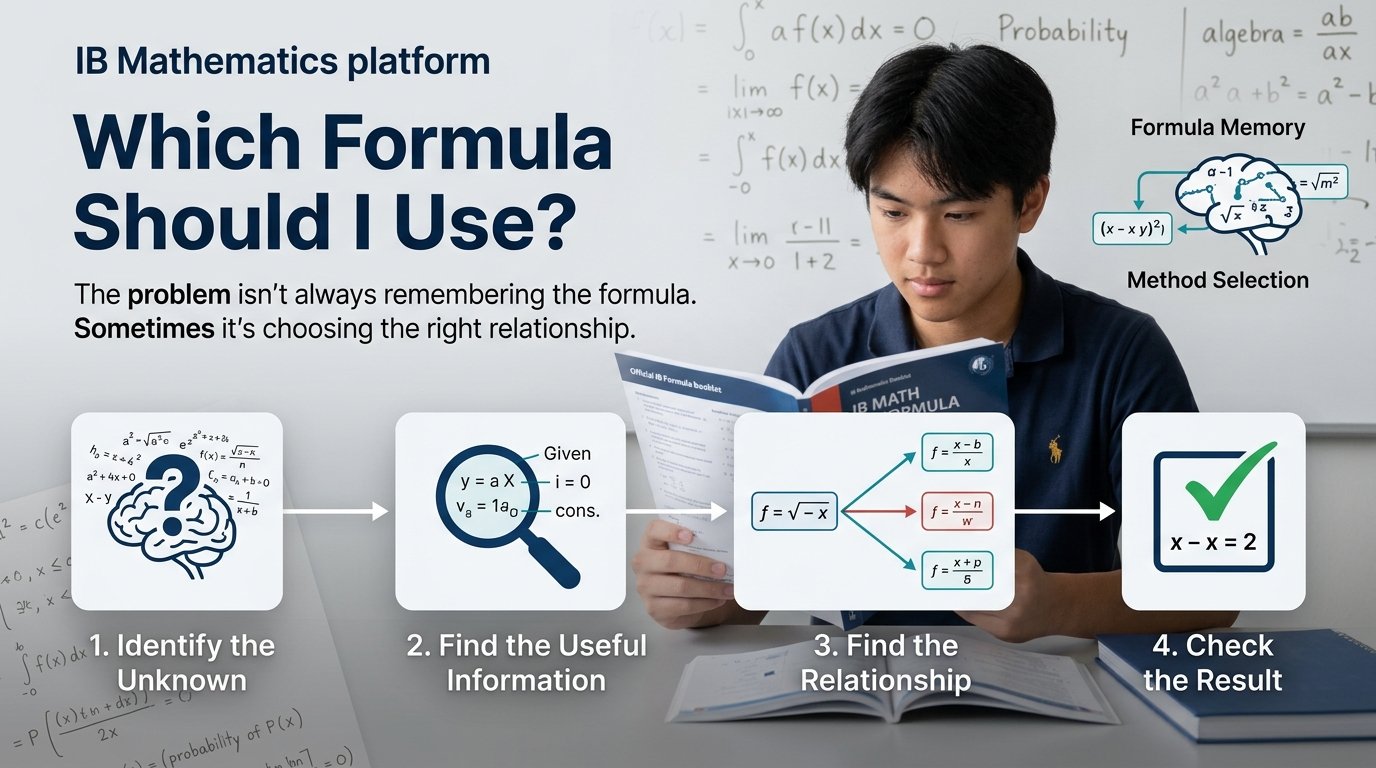
Step 5: Practise Reading the Question Before Calculating
A common exam habit is:
Read → grab calculator → calculate
Try:
Read → identify → plan → calculate
Before writing anything, ask:
- What information has been given?
- What am I being asked to find?
- What topic or mathematical idea might be involved?
- Are there important conditions?
- Does the wording suggest a particular relationship?
- What information do I need before I can answer?
This is particularly useful when a question combines several topics.
For example, a calculus problem might involve:
- a function
- a derivative
- a geometric interpretation
- a maximum or minimum
- an equation
- a contextual conclusion
The challenge isn’t necessarily knowing each individual topic.
It’s recognising how they connect.
Step 6: Practise Writing Complete Solutions
Your working is part of the evidence of your mathematical thinking.
The IB mathematics assessment framework includes communication and interpretation, including recording methods, solutions, and conclusions using appropriate notation and terminology.
So don’t build a habit of writing only the final calculator result.
A good solution should make the important reasoning visible.
For example, instead of writing:
(x=4.73)
show the relevant equation or relationship that leads to that value.
Instead of writing:
Answer: 12.4
when a question asks you to interpret the result, include the interpretation.
Common working problems
Watch for:
- unexplained calculator results
- skipped mathematical steps
- incorrect notation
- unclear equations
- early rounding
- missing units
- unsupported conclusions
- failure to answer the exact question
Not every question requires a long solution.
The goal is not to fill the page.
The goal is to make your mathematical method clear.
For a deeper look at this issue, see Mathzem’s guide to IB Math method marks.
Step 7: Stop Checking Only the Final Answer
This is one of the biggest changes you can make to your revision.
Suppose you complete 20 questions and get 16 correct.
You might think:
“I’m 80% accurate.”
But that number doesn’t tell you why you got four wrong.
Were they:
- knowledge mistakes?
- algebra mistakes?
- calculator mistakes?
- interpretation mistakes?
- method selection mistakes?
- communication mistakes?
Your errors contain more useful information than your final percentage.
For every incorrect question, ask:
What was my first incorrect step?
Don’t just find the correct answer.
Find where your solution first stopped being correct.
Why did I make that mistake?
Was the concept unclear?
Did you misread the question?
Did you choose the wrong method?
Did you rush?
What should I do differently next time?
Write one specific rule.
For example:
“Before using a probability formula, identify whether the events are independent or conditional.”
That rule is more valuable than simply copying the correct solution.
Step 8: Build a Mistake Journal
A mistake journal gives your revision history.
For each significant error, record:
Topic
Calculus
Question type
Optimisation
Mistake
Found a stationary point but didn’t determine whether it was a maximum.
Why it happened
I remembered the derivative step but forgot the interpretation step.
Correction
Use the second derivative or another valid method to classify the stationary point when required.
Next practice
Complete three optimisation questions involving classification.
This turns mistakes into future practice tasks.
You can also group mistakes by category.
Knowledge mistakes
“I don’t know this concept.”
Method mistakes
“I know the mathematics but chose the wrong method.”
Accuracy mistakes
“My method was correct but my algebra or arithmetic failed.”
Interpretation mistakes
“I calculated the value but didn’t explain what it means.”
Communication mistakes
“My reasoning wasn’t clearly shown.”
Exam technique mistakes
“I knew what to do but ran out of time or rushed.”
This classification makes your revision much more targeted.
Step 9: Use Practice Questions Strategically
There is no magic number of questions you must complete before an IB Math exam.
Doing 100 questions isn’t automatically better than doing 30.
The quality of the practice matters.
A useful progression is:
Phase 1: Build confidence
Complete straightforward questions to establish the method.
Phase 2: Build fluency
Complete similar questions with less support.
Phase 3: Build flexibility
Mix question types so you have to identify the method.
Phase 4: Build exam skill
Complete unfamiliar exam style questions.
Phase 5: Test independently
Complete timed questions without notes.
The goal is to make the transition from:
“I know how to do this when I see the example.”
to:
“I can recognise and solve this when the exam doesn’t tell me what method to use.”
You can use Mathzem IB Math Practice to build practice into this cycle.
Step 10: Use Feedback on Your Working
A mark tells you where you finished.
Feedback can help you understand how you got there.
Imagine two students both receive 6 out of 10.
Student A loses marks because of algebra errors.
Student B loses marks because they don’t recognise which method to use.
They should not follow the same revision plan.
This is why feedback on the actual working can be useful.
Mathzem’s practice workflow is designed around:
Choose a question → solve it → upload your working → receive examiner style feedback → identify mistakes → decide what to practise next
The purpose isn’t to replace your own thinking.
It is to make practice more informative.
When reviewing feedback, focus on three questions:
- Where did I lose marks?
- Why did I lose them?
- What should I practise next?
That third question is often the most important.
Step 11: Start Using Past Papers at the Right Time
Past papers are valuable, but using them too early or incorrectly can reduce their usefulness.
If you’ve just started a topic, a full past paper may not tell you much.
You haven’t learned enough of the syllabus yet.
Instead, use past papers in stages.
Early preparation
Use individual past paper questions by topic.
Middle preparation
Use mixed sections or selected papers.
Later preparation
Complete full papers under timed conditions.
Final preparation
Simulate the exam as closely as possible.
Remove notes.
Use the permitted calculator and equipment.
Follow the time limit.
Don’t pause after every difficult question.
Then mark the paper and, most importantly, analyse your mistakes.
A past paper isn’t finished when you know your score.
It’s finished when you understand what caused the lost marks.
Step 12: Practise Time Management
Time management isn’t simply about working quickly.
It’s about allocating your attention intelligently.
During practice, notice:
- which question types take you too long
- where you lose time through repeated calculations
- whether you spend too long on one difficult problem
- whether you leave enough time to check
- whether your working becomes less clear when you’re under pressure
A useful approach is to practise in stages.
Stage 1
Untimed questions.
Focus on understanding.
Stage 2
Lightly timed sets.
Focus on pace.
Stage 3
Full timed papers.
Focus on exam execution.
Stage 4
Timed papers plus review.
Focus on reducing repeated mistakes.
If you regularly run out of time, don’t simply tell yourself to “work faster.”
Find out where the time is going.
Step 13: Learn When to Move On From a Difficult Question
Getting stuck is normal.
The problem is spending too much of the exam stuck in one place.
During practice, develop a routine.
If you can’t make progress:
- Reread the question.
- Identify the information given.
- Write down a relevant equation, definition, diagram, or relationship.
- Try a different representation.
- If you’re still stuck, move on and return later.
The important point is that “I don’t know how to solve this” doesn’t always mean “I know nothing.”
Sometimes you simply haven’t found the first useful step.
Practising this skill can make unfamiliar questions less intimidating.
Step 14: Build a Weekly IB Math Study Plan
Your revision should change as the exam approaches.
Here’s a simple 8 week structure.
| Week | Main goal | Practice |
|---|---|---|
| 1 | Diagnose weaknesses | Topic questions |
| 2 | Repair weak concepts | Targeted practice |
| 3 | Build fluency | Mixed questions |
| 4 | Apply methods | Exam style questions |
| 5 | Unfamiliar problems | Mixed application |
| 6 | Timed practice | Past paper sections |
| 7 | Exam simulation | Full papers |
| 8 | Final correction | Weak topics + timed work |
You can adapt this depending on whether you’re preparing for AA HL, AA SL, AI HL, or AI SL.
The principle stays the same:
Your revision should become more exam focused as the exam gets closer.
A Better Daily IB Math Revision Session
You don’t need every revision session to last three hours.
A focused 60 minute session could look like this:
10 minutes: Recall
Without notes, write down key concepts, formulas, relationships, or methods.
20 minutes: Targeted practice
Complete questions on one weakness.
15 minutes: Unfamiliar application
Attempt one or two questions where the method isn’t obvious.
10 minutes: Review
Analyse mistakes.
5 minutes: Plan the next session
Write down what needs further practice.
This is more useful than spending the entire hour rereading notes.
What Should You Do If You’re Stuck on a Question?
When you see an unfamiliar question and your mind goes blank, don’t immediately reach for the solution.
Use a starting routine.
1. Identify the information
Write down the important values, variables, equations, or relationships.
2. Identify the goal
What exactly does the question want?
3. Identify the mathematical context
Does it involve functions, calculus, statistics, probability, vectors, sequences, geometry, or another area?
4. Look for relationships
Ask what connects the information given to what you need to find.
5. Write one useful mathematical statement
Even if you’re not certain of the complete solution, write the first relationship that you know is relevant.
That first line can help you see the structure of the problem.
The Difference Between Revision and Exam Preparation
These terms are often treated as if they mean the same thing.
They don’t.
Revision
Revision focuses on learning and strengthening the mathematics.
Examples:
- reviewing concepts
- memorising important relationships
- practising techniques
- correcting misunderstandings
Exam preparation
Exam preparation includes all of the above, but also focuses on:
- question interpretation
- method selection
- unfamiliar problems
- written communication
- timing
- calculator use
- past papers
- mark scheme analysis
- mistake patterns
You can understand the entire syllabus and still be poorly prepared for the exam.
That’s why the final weeks should gradually shift from learning content toward applying it under exam conditions.
Common IB Math Exam Preparation Mistakes
Mistake 1: Doing only easy questions
Easy questions build confidence, but they don’t prepare you for unfamiliar problems.
Better: Progress from familiar to unfamiliar.
Mistake 2: Checking only the answer
A correct answer doesn’t prove that your process is reliable.
Better: Review the working.
Mistake 3: Repeating the same topic without diagnosis
Doing 30 more questions won’t necessarily fix a method selection problem.
Better: Identify the exact skill behind the error.
Mistake 4: Starting full past papers too early
If you haven’t covered the syllabus, your score may mainly reflect missing content.
Better: Use topic practice first, then mixed practice, then full papers.
Mistake 5: Ignoring written communication
A calculator result isn’t always a complete mathematical response.
Better: Show important reasoning and answer the question in context.
Mistake 6: Revising everything equally
Not every topic deserves the same amount of time.
Better: Prioritise weaknesses based on evidence.
Mistake 7: Studying without retesting
You can understand a correction while looking at the solution and still make the same mistake later.
Better: Redo the question without help, then solve a similar question later.
How to Know If Your IB Math Preparation Is Working
Don’t rely only on how confident you feel.
Track measurable indicators.
For example:
| Measure | Week 1 | Week 4 | Week 8 |
|---|---|---|---|
| Topic accuracy | 62% | 75% | 84% |
| Unfamiliar questions | 40% | 58% | 72% |
| Method marks | 65% | 78% | 88% |
| Timed paper score | 60% | 68% | 78% |
| Repeated mistakes | 12 | 7 | 3 |
The exact numbers aren’t important.
The trend is.
If your scores aren’t improving, look at the process.
Are you practising the right weaknesses?
Are you reviewing your working?
Are you repeating mistakes?
Are your practice questions too easy?
Are you practising under time pressure?
This turns exam preparation into a feedback loop rather than a guessing game.
A 7 Day IB Math Exam Preparation Checklist
If your exam is approaching, use this as a short review cycle.
Day 1: Diagnose
Complete a mixed set and identify your biggest weaknesses.
Day 2: Repair
Review the concepts behind your weakest areas.
Day 3: Practise
Complete targeted questions.
Day 4: Apply
Complete unfamiliar exam style questions.
Day 5: Timed practice
Complete a timed paper or substantial section.
Day 6: Correct
Analyse every lost mark and redo important questions.
Day 7: Consolidate
Review formulas, recurring mistakes, weak topics, and exam technique.
Don’t try to learn the entire course from scratch in the final few days.
Focus on high value corrections.
How Mathzem Can Fit Into Your IB Math Exam Preparation
Effective exam preparation isn’t just about collecting more questions.
It’s about creating a useful feedback loop.
Mathzem’s approach is built around that idea.
A student can:
1. Choose an IB Math question
Select a question relevant to the topic or skill they want to practise.
2. Solve it independently.
Work through the problem rather than looking for the answer immediately.
3. Upload the working
Submit the solution, including the mathematical steps.
4. Review examiner style feedback
Use the feedback to understand marks, mistakes, and areas that need attention.
5. Identify the weakness
Look for patterns across questions.
6. Practise the next relevant skill
Use the feedback to decide what should come next.
That makes the process:
Practice → Upload → Review → Correct → Retest
rather than:
Practice → Check answer → Move on
Students who want to start practising can use Mathzem IB Practice.
For students who aren’t sure where their weaknesses are, the Math Skill Scanner can help make revision more targeted.
Final IB Math Exam Preparation Checklist
Before the exam, you should be able to say:
Content
□ I know which topics are in my course.
□ I have identified my weakest areas.
□ I understand the key concepts rather than only memorising formulas.
Practice
□ I have completed topic based questions.
□ I have practised mixed questions.
□ I have attempted unfamiliar problems.
□ I have used past papers.
Working
□ I show important mathematical steps.
□ I use appropriate notation.
□ I avoid unnecessary early rounding.
□ I include units where appropriate.
□ I give conclusions or interpretations when required.
Technology
□ I know how to use my calculator effectively.
□ I check calculator inputs.
□ I don’t rely on technology without understanding the mathematics.
Exam technique
□ I have practised under timed conditions.
□ I know how to move on when stuck.
□ I leave time to check my work.
□ I know which mistakes I repeatedly make.
Feedback
□ I review incorrect questions.
□ I identify why I lost each important mark.
□ I redo questions after correction.
□ I use my mistakes to decide what to practise next.
FAQs About IB Math Exam Preparation
How long should I study for an IB Math exam?
There is no single number of hours that works for every student. Your preparation time should depend on your current understanding, target grade, course level, remaining syllabus content, and exam date.
A student who already understands most topics may benefit more from targeted exam practice than from spending hours rereading notes.
How many IB Math questions should I practise?
Quality matters more than a fixed number.
Start with enough straightforward questions to establish the method, then move toward mixed and unfamiliar problems. Review your mistakes rather than simply counting questions completed.
Should I do past papers every day?
Not necessarily.
Past papers are most useful when you have enough syllabus knowledge to interpret your performance. Mix them with targeted topic practice and focused correction.
How can I improve my IB Math grade?
Start by identifying where your current marks are being lost. Then target those weaknesses with focused practice, review your working, correct recurring mistakes, and gradually increase the amount of timed and unfamiliar practice.
Why do I understand IB Math but still lose marks?
The gap is often between understanding a topic and applying it in an exam. You may struggle with question wording, method selection, unfamiliar contexts, communication, accuracy, timing, or interpretation.
Is AI feedback the same as official IB marking?
No. AI feedback should be treated as a learning and practice tool, not as official IB assessment. Official IB examinations are marked according to IB assessment procedures by trained examiners.
Conclusion: Prepare for the Exam You Will Actually Take
Good IB Math exam preparation isn’t about completing the largest number of questions.
It’s about preparing for the decisions you will have to make during the exam.
You need to recognise what a question is asking.
You need to choose an appropriate method.
You need to carry out the mathematics accurately.
You need to communicate your reasoning.
You need to interpret your results.
And when something goes wrong, you need to understand why.
The IB’s mathematics framework reflects this broader view of mathematical performance. Students are expected to demonstrate knowledge and understanding, problem solving, communication and interpretation, technology skills, reasoning, and inquiry.
So build your preparation around a simple cycle:
Learn → Practise → Review → Correct → Retest → Improve
Don’t measure your preparation only by how many hours you’ve studied.
Measure it by how many weaknesses you’ve identified, how many recurring mistakes you’ve eliminated, and how confidently you can solve unfamiliar questions without help.
That is what turns revision into exam preparation.
Your next step
If you already know your weak topics, start with targeted IB Math practice.
If you don’t know where you’re losing marks, start by identifying your weaknesses with the Math Skill Scanner.
Then use your practice results to decide what you should study next.