Introduction
You study the topic.
You understand the examples your teacher explains.
You can follow the worked solution.
You might even get straightforward practice questions right.
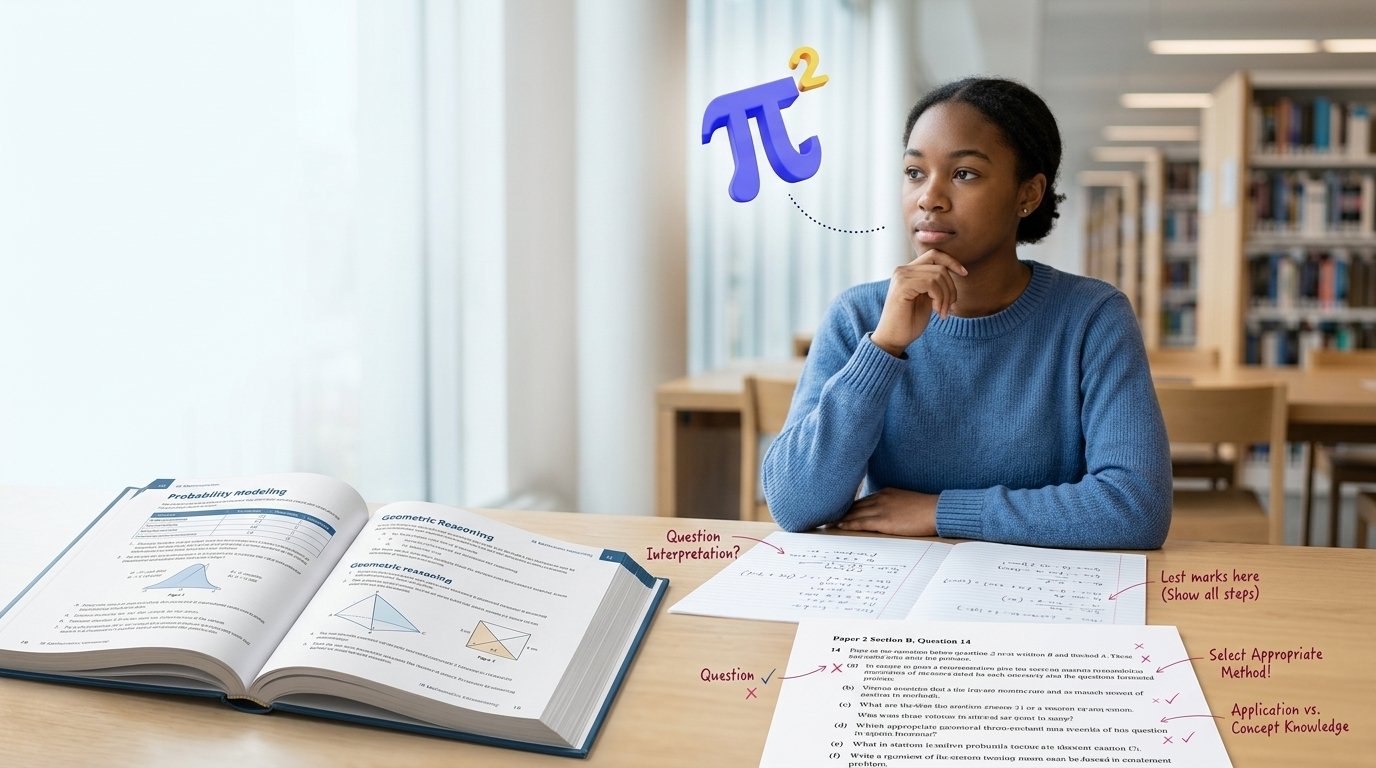
Then you sit an IB Mathematics exam and lose marks on questions you thought you knew how to do.
That can be extremely frustrating.
You may come out of the exam thinking:
“I knew this topic. Why did I lose so many marks?”
The answer is often that understanding a mathematical topic and using that understanding in an unfamiliar exam question are two different skills.
You need the mathematical knowledge.
But you also need to recognise what the question is asking, choose an appropriate method, communicate your reasoning, manage your working and interpret your answer.
That is where many students lose marks.
Table of Contents
The gap between knowing and performing
Imagine you have studied differentiation.
You know the standard rules.
You can differentiate a function correctly.
You can find a stationary point when the question tells you exactly what to do.
You might reasonably conclude that differentiation is one of your stronger topics.
Then you see an unfamiliar exam question.
It does not simply say:
“Differentiate the function.”
Instead, you have to work out what information matters, decide which relationship to use and determine what the question is actually asking you to find.
Suddenly, the problem feels much harder.
Your knowledge has not disappeared.
The difficulty is using that knowledge in the right situation.
This distinction matters across IB Mathematics.
A student can know the formula but choose the wrong method.
They can know the method but make an algebra error.
They can reach the correct numerical value but fail to explain or interpret the result.
They can understand the mathematics but struggle with the wording of an unfamiliar problem.
These are different weaknesses, and they require different types of practice.
1. You may understand the topic but misunderstand the question.
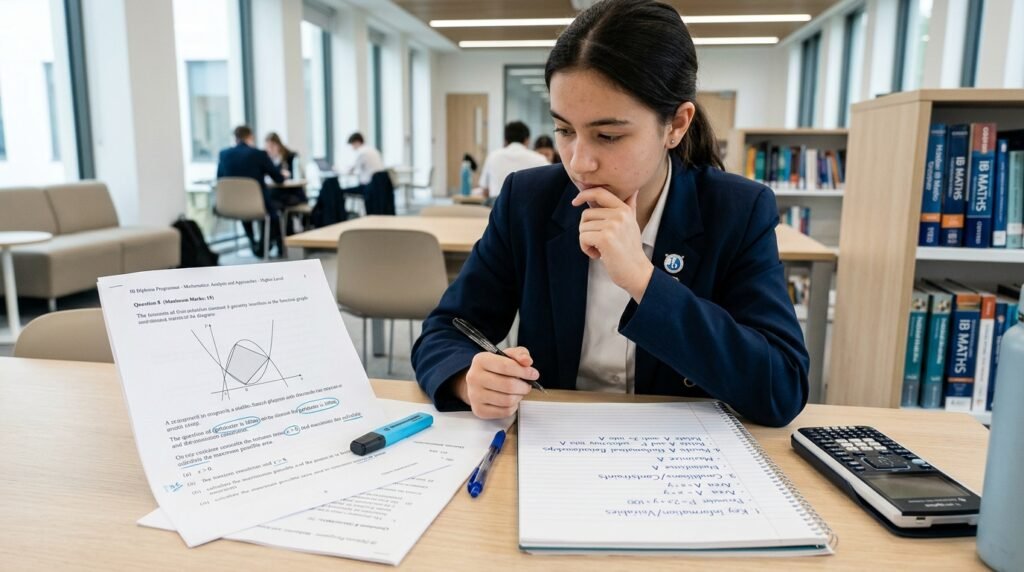
One of the biggest differences between classroom examples and IB exam questions is the amount of interpretation required.
In a classroom example, the mathematical method is often obvious.
The teacher might say:
“Use differentiation to find the maximum.”
An exam question may give you a longer situation and expect you to recognise that differentiation is useful.
That means you have to make the first decision yourself.
Before calculating, ask:
What information have I been given?
What am I actually being asked to find?
What conditions or restrictions matter?
What mathematical relationship connects the information to the required answer?
Only then should you decide what method to use.
This is especially important when a familiar topic appears in an unfamiliar context.
The mathematics may be familiar even though the question does not look familiar.
2. Knowing a formula does not mean knowing when to use it.
Formula memorisation is useful.
But formulas do not tell you automatically when they should be applied.
For example, you might remember a probability formula perfectly but still struggle to identify which quantities belong in the formula.
You might know a differentiation rule but apply it before recognising what the question actually requires.
You might remember a statistical procedure but miss an important condition in the question.
This is why revision should not only ask:
“Do I know this formula?”
It should also ask:
“Can I recognise when this formula is appropriate?”
That is a much more useful test of exam readiness.
3. Your method can be right, while your working still costs you marks
IB Mathematics is not simply about producing a final number.
Your working provides evidence of the mathematical process you used.
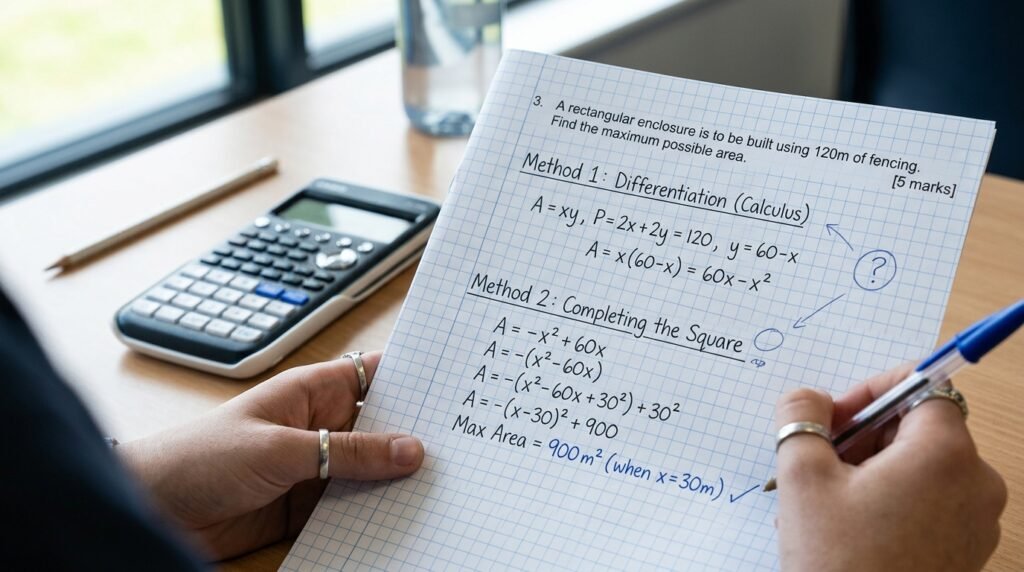
That matters because a solution can contain useful mathematical progress even when the final answer is incorrect. Conversely, a correct final answer does not necessarily tell you whether your reasoning was sound.
Recent Mathzem guidance on method marks highlights several ways students can lose marks even when they understand the mathematics, including skipped steps, unclear notation, early rounding, unexplained calculator results and weak interpretation.
This is why you should not treat working as something you write only because an examiner expects it.
Your working should make your mathematical thinking clear.
For example, instead of jumping from a calculator result to a final statement, show the important mathematical relationship that produced the result.
Instead of writing several unexplained lines of algebra, make the method clear enough that someone reading the solution can follow it.
4. A wrong answer does not always mean you do not understand the topic.
This is one of the most important things to recognise when reviewing your practice.
Suppose you lose four marks on a calculus question.
It is tempting to write:
“Calculus is weak.”
But that conclusion may be completely wrong.
Perhaps you chose the correct method and made one algebra error.
Perhaps your calculation was correct, but you did not interpret the answer.
Perhaps you understood the mathematical process but misread one part of the question.
Perhaps you rounded too early, and that affected later working.
These problems have different solutions.
If the issue is method selection, you need more practice recognising which method fits a question.
If the issue is algebra accuracy, repeating the same conceptual explanation may not help.
If the issue is interpretation, you need to practise explaining mathematical results in context.
The useful question is therefore not simply:
“Which topic did I get wrong?”
Ask:
“What happened in my work?”
5. This is why checking only the final answer is not enough.
A final answer tells you whether you reached the expected result.
It does not always tell you why.
Imagine this:
You answer a question incorrectly.
You look at the mark scheme.
You read the correct solution.
Everything suddenly makes sense.
You think:
“Right, I understand it now.”
Then you move on.
A week later, a similar question appears, and you make almost the same mistake.
This happens because seeing the correct solution is not necessarily the same as understanding the mistake in your own solution.
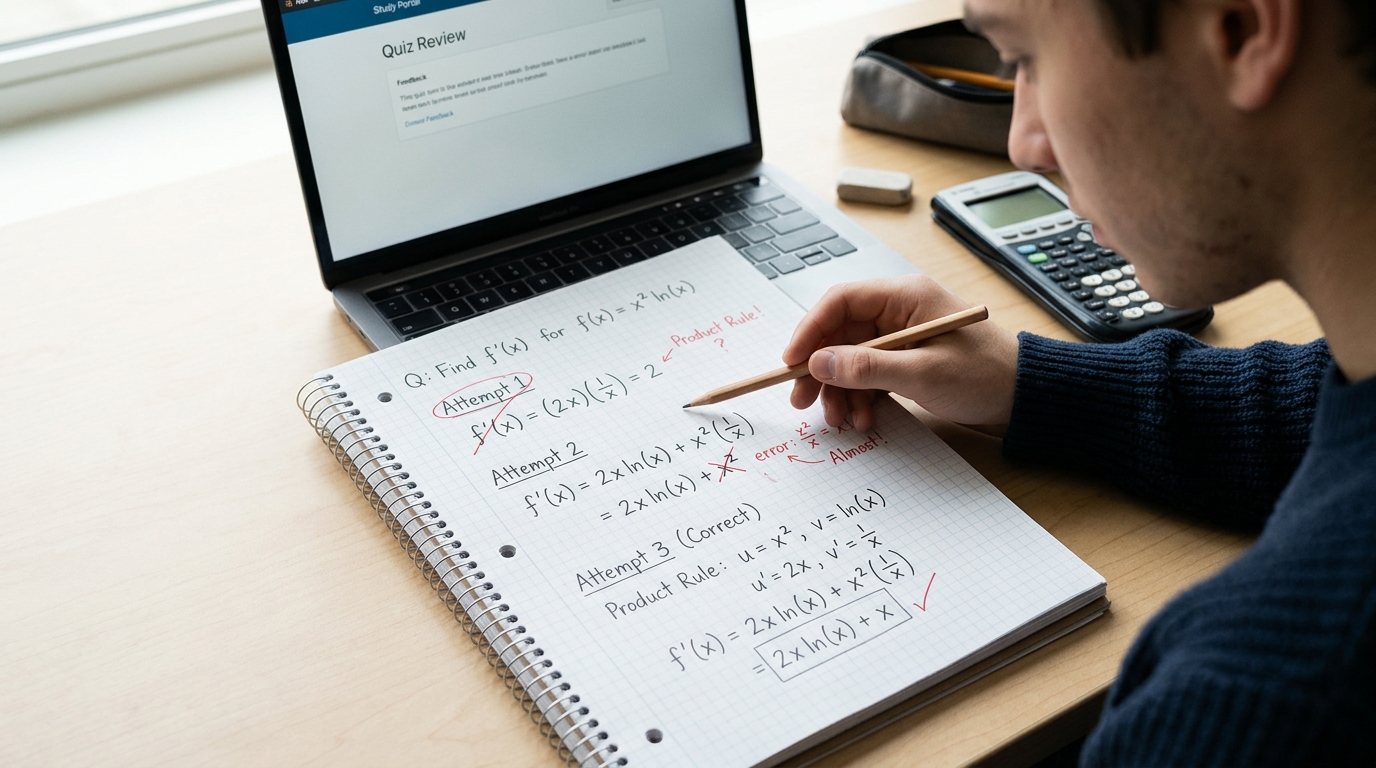
Good practice should create a feedback loop:
Attempt the question.
Review your actual working.
Identify where the method broke down.
Understand why it happened.
Practise the specific weakness.
Try a similar problem again.
The goal is not simply to collect correct answers.
The goal is to reduce repeated mistakes.
A simple example
Suppose a student is working on a functions question.
They understand composite functions.
They know how to substitute values.
But when faced with an unfamiliar question, they choose the wrong expression for the second step.
The final answer is wrong.
If they only check the mark scheme, they may conclude:
“I need to revise functions.”
But that is too broad.
Their actual problem may be:
“I can perform the algebra, but I am not identifying which function should be applied first.”
That gives them a much better revision target.
Instead of spending another hour reviewing every function rule, they can practise questions that require them to identify the correct structure before calculating.
That is targeted practice.
What should you look for when reviewing a lost mark?
After completing an IB Mathematics question, classify the problem.
Question interpretation
Did I understand what the question was asking?
Method selection
Did I choose an appropriate mathematical method?
Mathematical execution
Did I carry out the method correctly?
Accuracy
Did I make an algebra, arithmetic, notation or calculator error?
Communication
Did I show enough working and reasoning?
Interpretation
Did I explain what my mathematical result means?
Timing
Did I spend too much time on this question or rush the final steps?
This gives you more information than a simple percentage score.
A student who scores 60 percent because of repeated algebra errors needs a different plan from a student who scores 60 percent because they struggle to identify methods in unfamiliar questions.
How to practise the gap between understanding and exam performance
If you understand your course content but your exam marks are not reflecting that, try changing the way you practise.
Step 1: Stop judging yourself only by correct answers.
A correct answer is useful.
But ask what happened during the solution.
Could you explain why the method worked?
Could you recognise the same type of problem in a different context?
Could you reproduce the reasoning without looking at the solution?
Step 2: Record the actual reason for each lost mark.
Do not write:
“Bad at calculus.”
Write something more specific:
“Chose the wrong method.”
“Lost accuracy after the first line.”
“Did not justify the result.”
“Rounded too early.”
“Could not identify what the question was asking.”
Specific mistakes lead to specific practice.
Step 3: Practise unfamiliar questions.
If every practice question looks like the example you just studied, it is easy to confuse recognition with understanding.
Include questions where the topic is not immediately obvious.
Give yourself time to decide:
What is happening here?
What do I know?
What do I need?
What method might connect the two?
Step 4: Review the working, not only the answer.
When you finish, go back through the solution.
Find the first point where your approach stopped being valid.
That is often more useful than simply comparing the final answer.
Step 5: Repeat the skill.
Once you identify a weakness, practise it again.
If you repeatedly choose the wrong method, do questions where method selection is the main challenge.
If you repeatedly lose accuracy marks, focus on careful execution.
If you struggle with interpretation, practise writing clear conclusions.
Your next question should respond to what you learned from the previous one.
How Mathzem approaches this problem
This is the thinking behind Mathzem’s IB practice workflow.
Instead of treating practice as:
Question → answer → next question
The aim is to make the attempt itself useful.
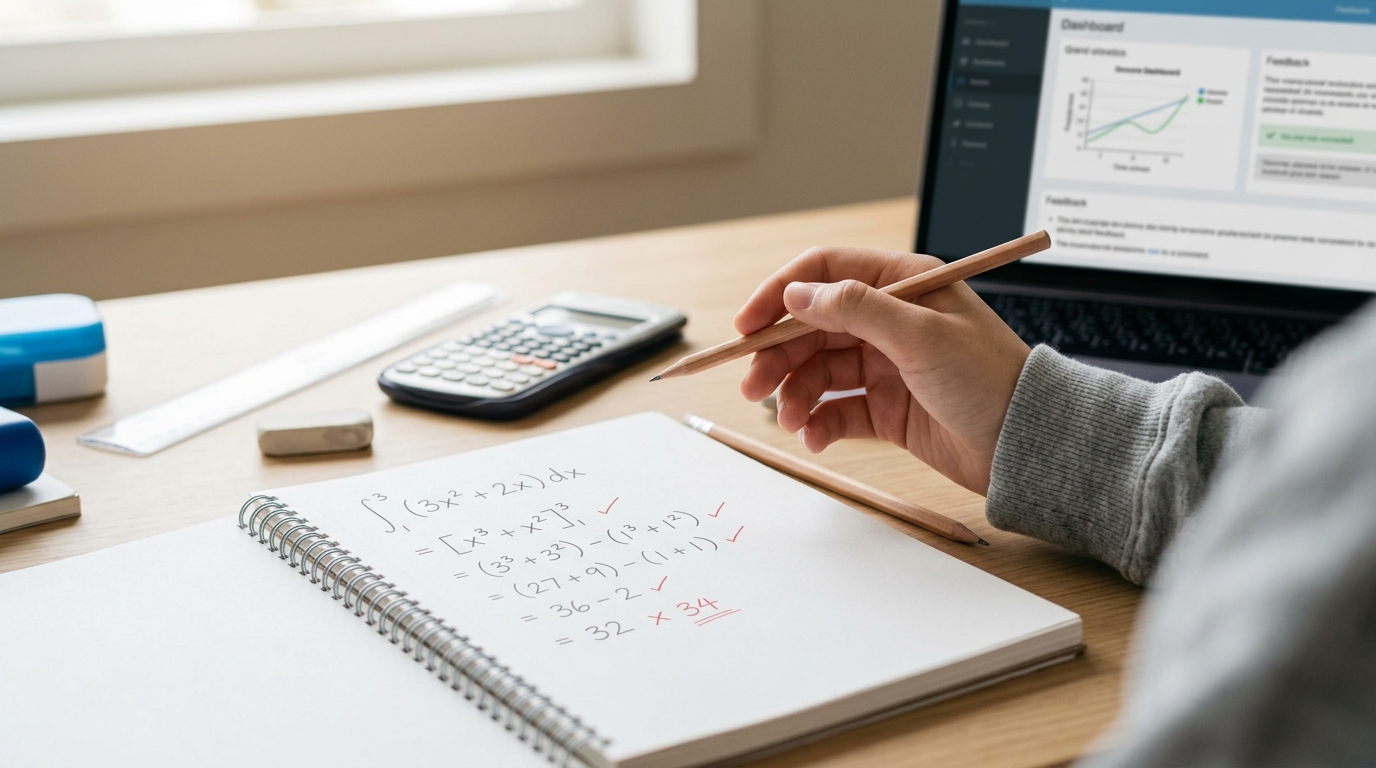
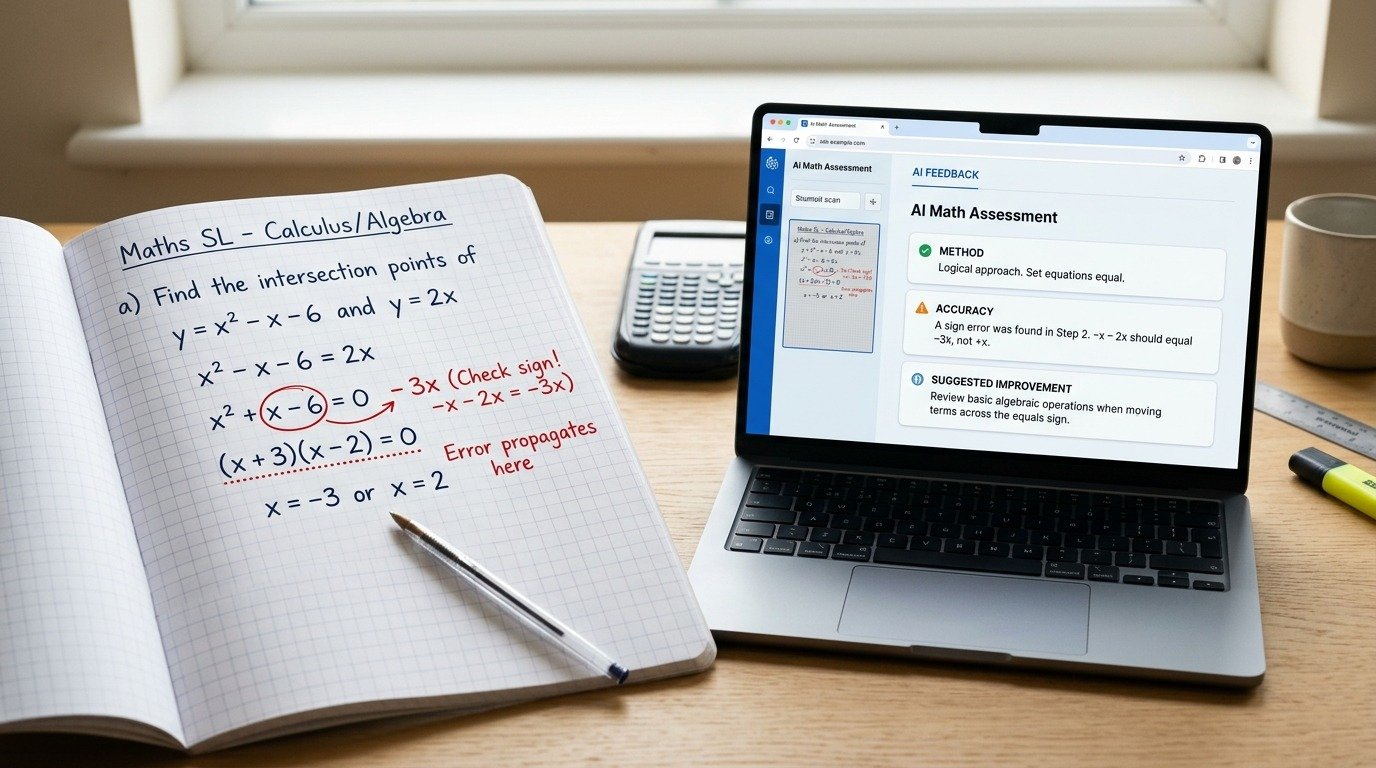
You choose an IB-style question, solve it on paper and upload your working.
Mathemaz’s current IB Practice page allows students to upload handwritten solutions and receive AI Examiner feedback on their working, including marks, mistakes and a suggested next step. It also provides topic- and focus-based practice and saves progress through the Student Dashboard.
That changes the question after an attempt.
Instead of only asking:
“Did I get it right?”
You can ask:
“Where did my method go wrong?”
“Which part of my working caused the problem?”
“What should I practise next?”
That distinction matters because the purpose of practice is not to prove that you already know something.
It is to discover what you need to improve.
The goal is not to reduce mistakes immediately.
Mistakes are part of learning mathematics.
The more important question is whether the same mistake keeps appearing.
If you repeatedly make the same algebra error, that is useful information.
If you repeatedly struggle to start unfamiliar questions, that is useful information.
If you consistently reach the right method but lose marks through incomplete working, that is useful information.
Your mistakes can show you where your revision time should go.
That is much more useful than simply doing another twenty questions without reviewing what happened.
A practical weekly routine
You do not need to completely change your study routine.
Try adding one feedback step.
During each practice session
Solve several IB-style questions without immediately looking at the solution.
For each question, record:
What I thought the question was asking.
The method I chose.
Where I became uncertain.
Any marks I lost.
The reason I lost them.
Then identify the pattern.
If most of your problems come from one specific skill, make that skill the focus of your next practice session.
Over time, you should be able to move from:
“I am bad at functions.”
to:
“I understand functions, but I struggle to identify the correct relationship when the question is unfamiliar.”
That is a much more useful problem to have.
You now know what to practise.
Final takeaway
Understanding IB Mathematics is essential.
But understanding the topic is not the same as being able to apply it under exam conditions.
You need to be able to read unfamiliar questions, choose an appropriate method, show your reasoning, maintain accuracy and interpret your result.
That is why your revision should go beyond:
“Did I get the answer?”
Ask:
Where did my method work?
Where did it break down?
Why did it break down?
What should I practise next?
That is how practice becomes a learning process rather than simply a collection of questions.
And if you are repeatedly losing marks despite understanding the underlying mathematics, the answer may not be more content revision.
You may need better feedback on the way you are solving the problem.
FAQs About Knowing IB Math Is Not Enough for Exam Marks
Why do I understand IB Math but still get low marks?
Understanding the mathematical content is only one part of exam performance. You may still lose marks through question interpretation, method selection, accuracy, incomplete working, reasoning, interpretation or timing.
Should I practise more questions if I keep losing marks?
More questions can help, but only if you learn from them. If you keep making the same mistake without analysing it, additional practice may simply repeat the same pattern.
Should I look at the mark scheme after every IB Math question?
The mark scheme is useful, but do not stop at checking the final answer. Review your own working first and identify where your approach differed from the expected method.
How can I identify my real weakness in IB Math?
Track the specific reason you lose marks. Over several practice sessions, look for repeated patterns in question interpretation, method selection, accuracy, communication, reasoning or interpretation.
Is getting a question wrong always a sign that I do not understand the topic?
No. A wrong answer can come from several different causes. You may understand the concept but make an execution error, choose the wrong method, misunderstand the wording or fail to communicate the solution clearly.
What should I do after finding a repeated mistake?
Turn the mistake into a specific practice target. Then complete similar questions and check whether the same problem appears again. The goal is to reduce repeated errors rather than simply increase the number of questions completed.
Try the process yourself.
If you want to practise IB-style questions and get feedback on your actual working, you can start with Mathzem’s IB Practice. You can choose your IB course and topic, solve the question on paper, upload your working and receive AI Examiner feedback.