You finish an IB Math question.
Maybe you got it wrong.
Maybe you got it right but needed a lot of help.
Or maybe you got the answer correct, but you are still not sure whether you could solve a similar question in an exam.
So what should you practise next?
This is where many students get stuck.
They open another question and start again.
The problem is that the next question is often chosen randomly. It might be too easy, completely unrelated to the previous mistake, or testing a skill the student already understands.
Good practice should have a reason behind it.
Your last question should give you information about what to do next.
Table of Contents
The best next question depends on what happened in the last one
There is no single rule that says every wrong answer means you should practise the same topic again.
You first need to understand what went wrong.
Imagine you are working on a calculus question.
You make a differentiation error.
There are several possibilities.
You may not understand the differentiation rule.
You may know the rule but apply it incorrectly.
You may differentiate correctly but make an algebra mistake afterwards.
You may understand the mathematics but misunderstand what the question is asking.
Those problems require different types of practice.
Simply doing another calculus question does not necessarily address the real weakness.
That is why the useful question is not:
“What topic did I get wrong?”
It is:
“What did this question tell me that I need to improve?”
Step 1: Identify the first meaningful problem
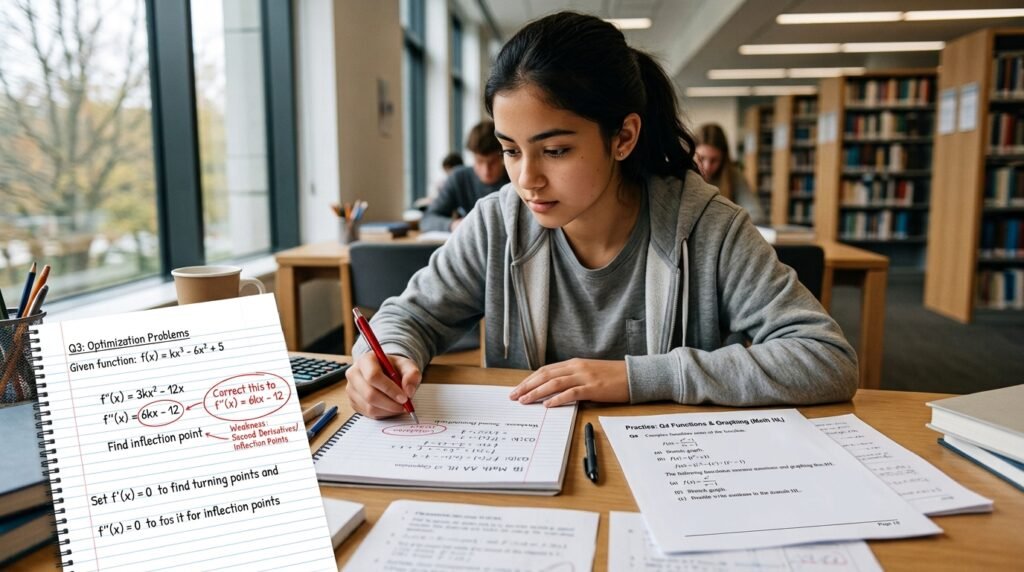
When reviewing an incorrect IB Math question, do not focus only on the final answer.
Look at your working.
Where did the solution first stop making sense?
For example:
You correctly identify that a stationary point requires the derivative to equal zero.
You differentiate the function correctly.
You set the derivative equal to zero.
Then you make an algebra error while solving the resulting equation.
The final answer is wrong.
But your main weakness may not be calculus.
It may be algebraic manipulation.
If you respond by doing ten more differentiation questions, you might be practising the wrong thing.
The better next step could be a small set of algebra questions involving equations of the same type.
Your mistake has given you useful information.
Use it.
Step 2: Decide what type of problem you have
Before choosing another question, classify the problem.
Knowledge problem
You do not know the mathematical idea or rule needed.
For example, you cannot remember how a particular derivative works.
Your next step should involve revisiting the concept and then practising straightforward examples.
Method problem
You know the mathematics but do not know which method to use.
This is common with unfamiliar IB questions.
You might recognise the topic but fail to see whether the question requires differentiation, integration, a graph, an equation, a probability model, or another approach.
Your next practice should include questions where method selection matters.
Accuracy problem
You understand the method but make calculation errors.
These could include algebra mistakes, calculator input errors, incorrect signs, premature rounding, or copying a value incorrectly.
More difficult questions may not solve this problem.
You may first need focused practice where accuracy is the main target.
Interpretation problem
You can perform the mathematics but struggle to explain what the result means.
This can happen in statistics, probability, modelling, calculus applications, and questions involving context.
Your next questions should give you opportunities to interpret results rather than simply calculate them.
Communication problem
Your mathematical thinking may be correct, but your working does not clearly show enough reasoning.
This matters because IB Mathematics assessment considers the quality of the mathematical work, not simply whether you eventually arrive at the expected number.
Your next step should include practising complete solutions with clear working.
Step 3: Look for repeated patterns
One mistake is information.
A repeated mistake is stronger evidence.
Suppose you complete several questions and notice:
You choose the wrong method in functions.
You choose the wrong method in calculus.
You choose the wrong method in probability.
At first, these look like three separate topic weaknesses.
But there may be a common skill underneath them.
You may be struggling to recognise the mathematical structure of unfamiliar questions.
That means revising three entire topics may not be the most efficient response.
You may need more mixed practice where the main challenge is deciding how to begin.
Mathzem’s current practice workflow is designed to identify mistakes, weak areas and a recommended next step from your uploaded working.
The broader idea is simple:
Your mistakes should influence your next practice session.
Step 4: Match the difficulty to the problem
Your next question should not automatically be harder.
Sometimes students make a mistake and immediately search for a much harder question because they think difficult practice will force improvement.
Not necessarily.
Imagine you keep making mistakes when applying the product rule.
A very difficult calculus problem containing several other concepts may make the situation worse.
You may not know whether you failed because of the product rule, algebra, integration, interpretation, or the overall complexity of the question.
A better sequence could be:
- Review the product rule
- Solve a straightforward example
- Solve a moderate application
- Solve a mixed question
- Try an unfamiliar exam style problem
The goal is not to make every question difficult.
The goal is to make each question useful.
Step 5: Use unfamiliar questions at the right time
Familiar questions are useful.
They help you build fluency.
But if you only practise questions that look like examples you have already seen, you may not develop the ability to recognise what to do when the wording changes.
IB Mathematics exams can require you to apply familiar mathematics in unfamiliar situations.
That means your practice should eventually include questions where you have to make the mathematical decision yourself.
For example, instead of practising ten questions that all clearly say you need to differentiate, practise a mixed set where you have to decide whether differentiation is actually relevant.
This tests a different skill.
It asks:
“Can I recognise what mathematics this situation requires?”
That is much closer to what happens when you face an unfamiliar exam question.
What if you get the question right?
A correct answer does not always mean you should immediately move on.
Ask yourself:
Did I understand why my method worked?
Could I solve a similar question without help?
Did I make any small errors along the way?
Was my working clear?
Could I solve the same type of problem if the wording changed?
If the answer is yes, you may be ready to move on.
If not, another question may still be useful.
For example, perhaps you solved a standard integration question correctly but relied heavily on recognising the exact pattern from a previous exercise.
Your next question should change the context.
That helps test whether you actually understand the method or simply recognised the question type.
What if you get the question wrong?
Do not automatically abandon the topic.
First diagnose the mistake.
Consider this example.
You are solving a probability question.
Your final answer is incorrect.
Your working shows that you understood the probability model, but you treated two events as independent when the question provided information showing that they were not.
Your next step should not necessarily be general probability revision.
You need practice recognising when independence can and cannot be assumed.
That is much more specific.
A useful correction cycle is:
Attempt → Review → Identify the problem → Correct it → Practise the same skill → Retest
This is more useful than:
Attempt → Check answer → Start another random question
Mathzem’s own practice guidance follows this broader cycle of choosing a question, solving it, uploading the working, receiving feedback, identifying mistakes and deciding what to practise next.
How Mathzem can help with the next step
Mathzem is built around the idea that your working contains more information than your final answer.
You choose an IB Mathematics question, solve it yourself and upload your working.
The current AI Examiner workflow can then provide marks by question part, identify where and why marks were lost, detect a weak area and recommend a next step.
This changes the role of a practice question.
Instead of treating the question as something to complete and forget, you can use it as a diagnostic.
For example:
You attempt a calculus question.
Your method is mostly correct, but you make an algebra error.
The feedback identifies the problem.
You now know that repeating the entire calculus topic may not be necessary.
You choose a targeted next step.
You practise the algebra skill that caused the error.
You return to a similar calculus question.
Now you can see whether the correction actually helped.
This is the part of practice that often gets missed.
The important question is not simply:
“What question should I do next?”
It is:
“What should I learn from the question I just completed?”
A simple rule for choosing your next IB Math practice
You can use this framework after almost any question.
If you did not know the concept
Review the concept and practise basic applications.
If you knew the concept but chose the wrong method
Practise recognising which method fits different question types.
If your method was correct but your calculation failed
Practise the specific accuracy issue.
If your calculation was correct but your interpretation failed
Practise explaining what mathematical results mean in context.
If your working was incomplete
Practise writing complete solutions and showing the reasoning needed.
If you solved the question confidently
Try a similar problem with different wording.
If the same mistake keeps appearing
Stop treating it as an isolated error and make it a revision priority.
This gives your practice direction.
Do not confuse activity with progress
It is easy to feel productive because you completed a large number of questions.
But question count is not the same as learning.
Suppose Student A completes 40 questions and checks only the final answers.
Student B completes 15 questions, reviews the working, identifies repeated mistakes, corrects them and deliberately practises those skills again.
We cannot say that Student B will always improve more.
But Student B is collecting much more useful information about what needs to change.
That information is what makes the next practice decision better.
As Mathzem’s current practice guidance puts it, the goal is not simply to complete more questions. Effective practice should help you understand what happened during the attempt and what to work on next.
A 15 minute routine for your next practice session
You do not need to spend hours deciding what to practise.
Try this.
First 5 minutes
Complete one focused IB Math question without looking at the solution.
Next 3 minutes
Review your working.
If you made a mistake, find the first meaningful error.
Next 2 minutes
Write down the reason.
Was it knowledge, method selection, accuracy, interpretation, communication, or something else?
Next 5 minutes
Choose another question that directly tests the same skill.
The second question is important.
It tells you whether the correction actually changed your performance.
If you get it right, try a slightly different version later.
If you make the same mistake, you have stronger evidence that the skill needs more attention.
The goal is not to predict the perfect question
You do not need a system that magically knows the one perfect question for you.
You need a practice process that responds to evidence.
Your previous attempt gives you evidence.
Your working gives you evidence.
Your mistakes give you evidence.
Your repeated patterns give you evidence.
Your performance on the next question gives you more evidence.
That is how revision becomes more targeted over time.
The current Mathzem product supports this process through IB topic and subtopic practice, AI Examiner feedback, weak area detection and next step guidance.
The important part is what you do with that information.
FAQs
What should I practise after getting an IB Math question wrong?
First identify why you got it wrong. You may need concept review, method practice, accuracy practice, interpretation practice or a similar question. Do not assume that every wrong answer means you need to revise the entire topic.
Should my next question be harder?
Not always. If you are still struggling with a basic skill, a harder question may add unnecessary difficulty. Build from straightforward practice to moderate, mixed and unfamiliar questions as your understanding improves.
How do I know what my biggest IB Math weakness is?
Look for patterns across several questions. Repeated errors in method selection, algebra, interpretation, calculator use or reasoning are stronger evidence of a weakness than one isolated mistake.
Should I practise the same question again?
Yes, sometimes. Redoing the original question helps you check whether you understand the correction. After that, solve a similar question with different numbers or wording to test whether the skill transfers.
Can Mathzem tell me what to practise next?
Mathzem’s current AI Examiner workflow provides feedback on marks, mistakes, weak areas and a recommended next step. You can also practise by course, topic and subtopic and track your progress through the Student Dashboard.
Is doing more IB Math questions always better?
No. Practice quality matters. A smaller number of carefully reviewed questions can reveal weaknesses that would remain hidden if you only checked final answers and moved on.
Final takeaway
The next IB Math question should not always be random.
It should often be connected to what the previous question taught you.
If you did not understand the concept, learn it.
If you chose the wrong method, practise method selection.
If your method was correct but your algebra failed, target the algebra.
If you misunderstood the question, practise reading and interpretation.
If the same mistake keeps appearing, make it a priority.
And when you think you have fixed the problem, test yourself again.
The most useful practice cycle is simple:
Attempt → Review → Diagnose → Correct → Practise → Retest
That is how one question can tell you what to do with the next one.
And that is much more useful than simply asking how many questions you completed today.