You finish an IB Mathematics question.
You look at your final answer.
It is wrong.
So you check the mark scheme and find the correct answer.
But there is still a problem.
You know what the answer should have been, but you do not necessarily know where your own solution went wrong.
Maybe your first equation was wrong.
Maybe you chose the wrong method.
Maybe your method was correct, but you made an algebra mistake halfway through.
Maybe you had the right answer but did not show enough reasoning.
Simply knowing the correct answer does not always tell you which of these happened.
That is why Mathzem is built around checking the student’s actual mathematical working, rather than only checking the final answer.
Table of Contents
Why the final answer does not tell the whole story
Consider a simple example.
A question is worth eight marks.
You write several lines of working and reach an incorrect answer.
If a system only checks the final answer, the result might be
Incorrect.
That tells you very little.
You could have made the first decision incorrectly.
Or you could have used the correct method and made one calculation error near the end.
Those are very different problems.
In the first case, you need to improve your method selection.
In the second, you may need to improve accuracy.
Your final answer is the same in both situations.
Your learning need is not.
This is why looking at the working matters.
What happens when you use Mathzem?

The process starts with an IB style question.
You choose your IB Mathematics course and a topic or subtopic.
You then solve the question yourself, just as you would in an exam.
The important part is that you show your working.
You can then upload a photo of your handwritten solution, upload an image from your computer, paste a screenshot, or use the phone upload option.
Mathzem’s current IB Practice workflow is specifically designed around this process. You choose a question, solve it, upload your working and receive AI Examiner feedback on marks, mistakes, weak areas and the next step.
The purpose is not to replace the attempt.
The attempt comes first.
Step 1: You solve the question yourself
This part is important.
Mathzem is not asking you to enter a question and immediately request a solution.
You first attempt the problem.
That means your working contains useful information about how you actually think through an IB Mathematics problem.
You might start with the correct method.
You might choose the wrong method.
You might make a small algebra error.
You might get stuck halfway through.
All of those outcomes provide information.
If you never attempt the question yourself, that information does not exist.
Step 2: You upload your handwritten working
You do not need to type your entire solution into a special format.
You can solve the question on paper and upload a clear photo of your working.
Mathzem also currently supports image uploads, screenshots and phone based uploads. The practice page specifically asks students to show their full working so the system can assess the method rather than only the final answer.
This matters because real IB Mathematics practice often happens with pen and paper.
You write equations.
You cross things out.
You rearrange expressions.
You draw diagrams.
You change your approach.
Your written solution shows the path you took.
That path is what needs to be understood.
Step 3: Mathzem reviews the solution
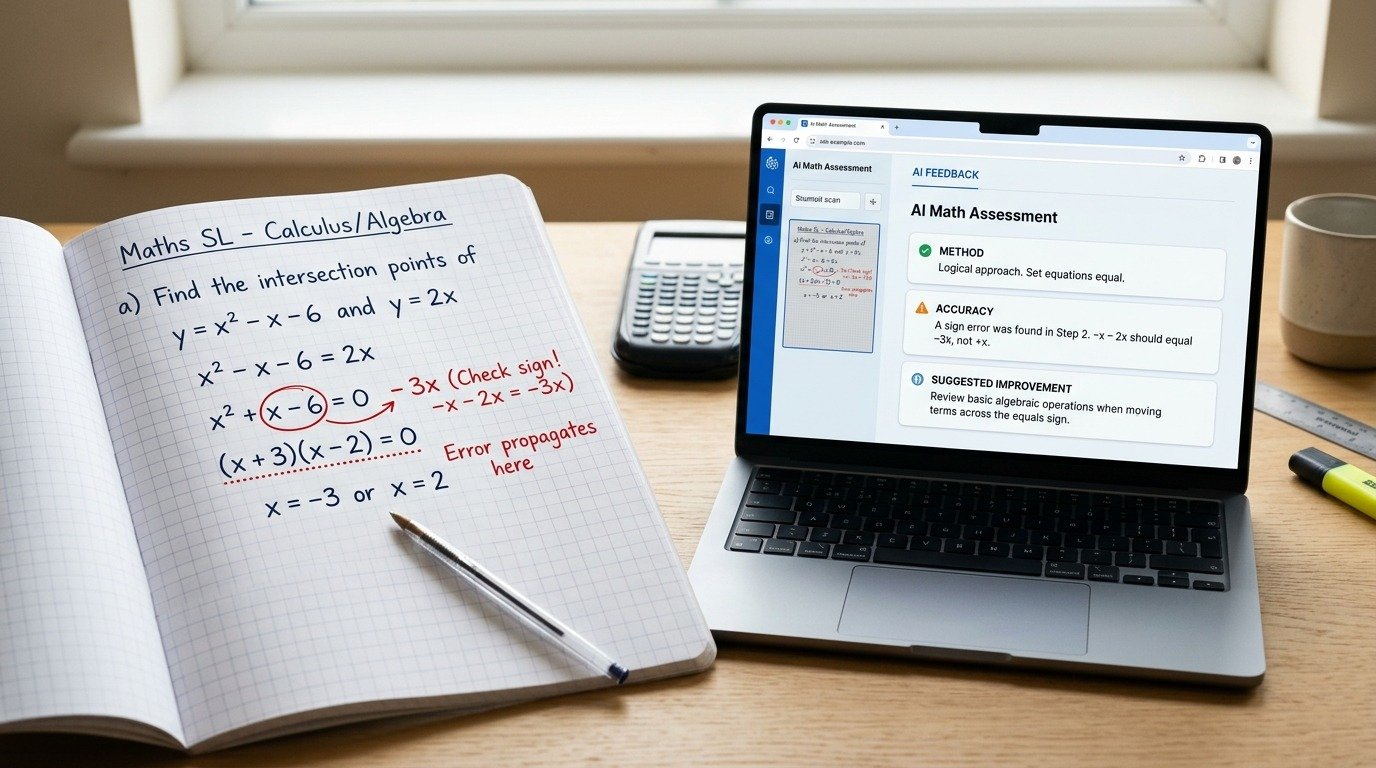
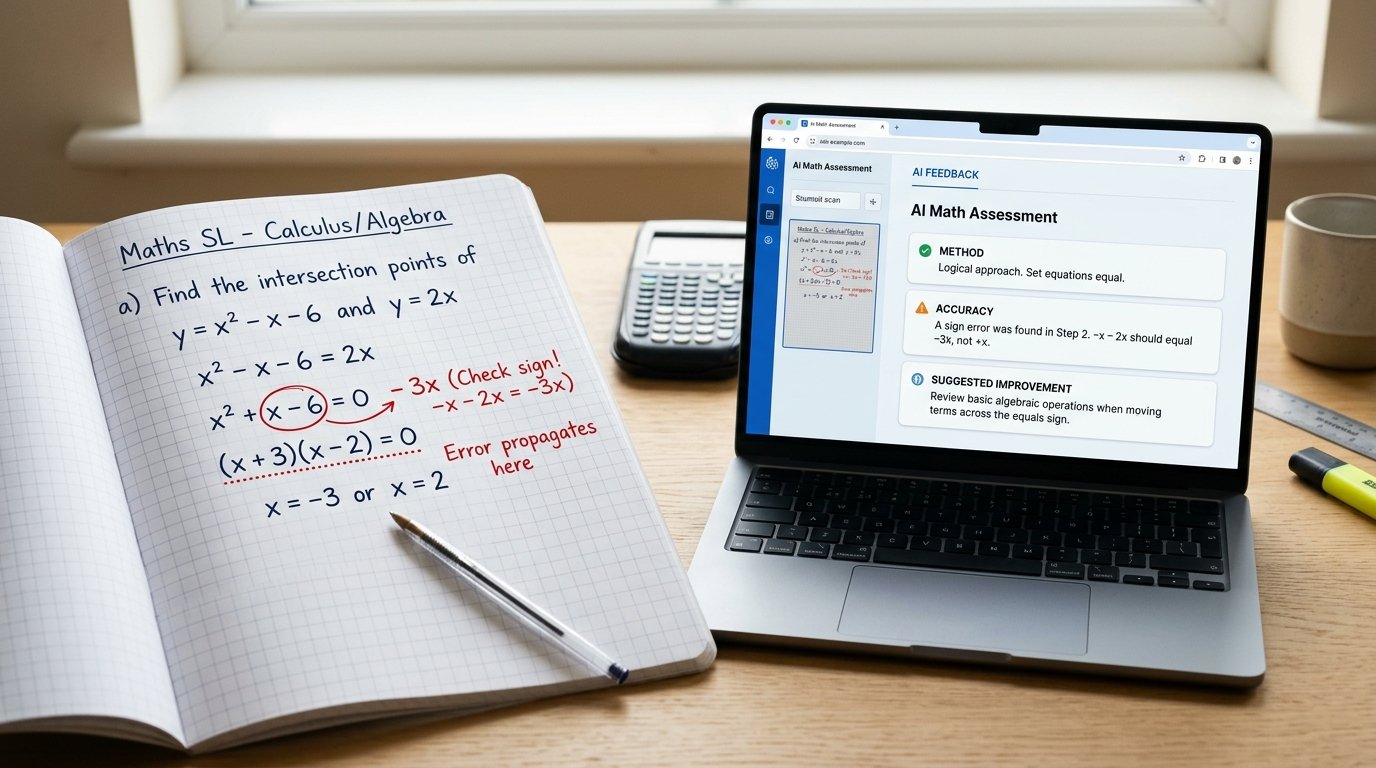
Once your working is uploaded, Mathzem’s AI Examiner reviews the solution.
The current practice workflow is designed to provide marks by question part, identify where and why marks were lost, detect weak areas and suggest a next step.
This is different from simply asking:
“Is my final answer correct?”
The more useful questions are:
Did I choose an appropriate method?
Where did the mistake first appear?
Which part of my working was correct?
Where did I lose marks?
What mathematical skill needs more attention?
What should I practise next?
That creates a much more useful feedback loop.
Step 4: You can see where the method broke
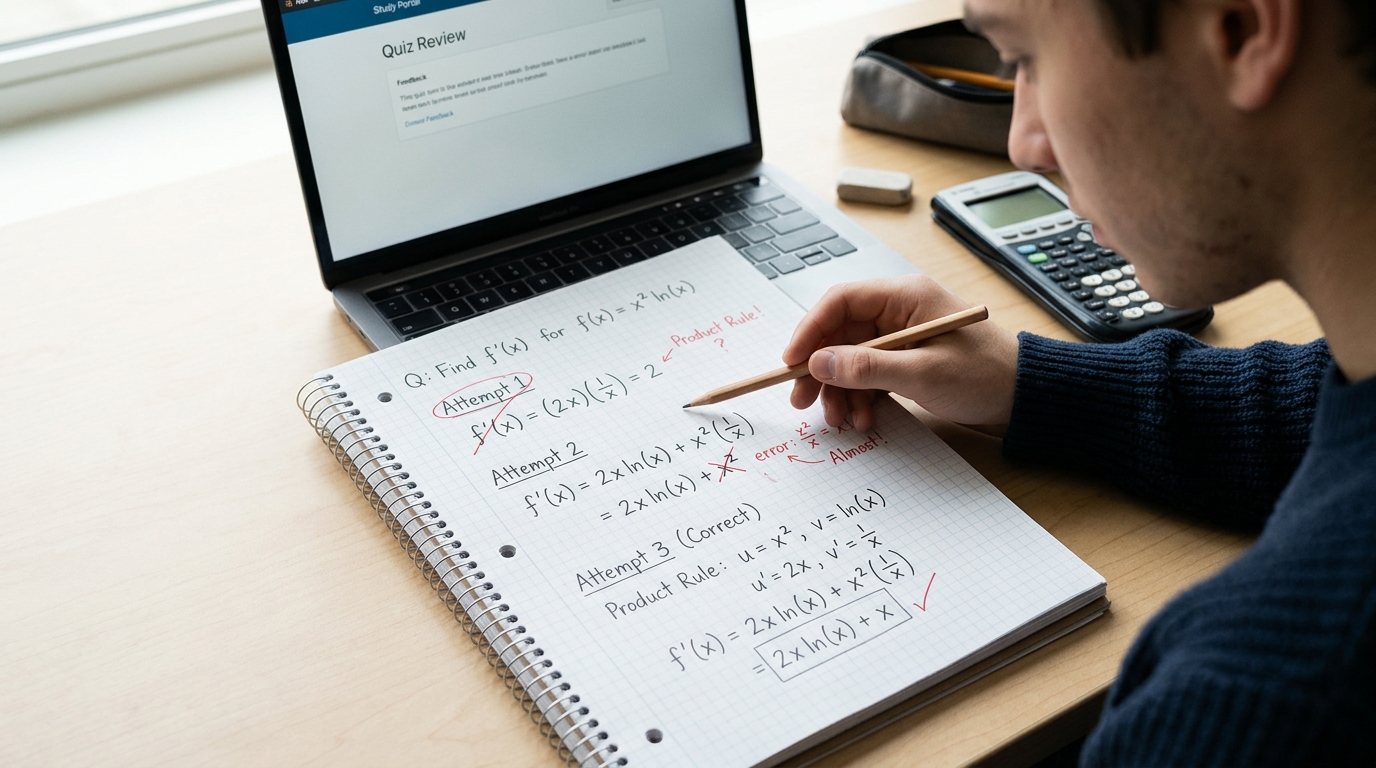
Suppose you are solving a calculus question.
Your differentiation is correct.
Your next step is also correct.
Then you make an algebra mistake.
That mistake changes the rest of the solution.
If you only look at the final answer, the whole solution may appear to be wrong.
But that is not what actually happened.
Most of your method may have been sound.
The problem was a specific execution error.
This distinction matters.
If your revision response is simply
“I need to revise calculus again,”
You may spend hours revisiting material you already understand.
A more useful conclusion might be:
“I understand the calculus method, but I need to improve my algebra accuracy when simplifying the resulting expression.”
Now you have a specific target.
Step 5: You can identify the type of mistake
Not every lost mark has the same cause.
For example, you might have:
A method selection problem
You know several methods but choose the wrong one for the question.
A question interpretation problem
You misunderstand what the question is asking.
An accuracy problem
Your approach is correct but an algebraic or numerical error changes the result.
A reasoning problem
You reach an important result but do not show the reasoning needed to support it.
An interpretation problem
You calculate a value correctly but do not explain what it means in the context of the question.
These require different practice.
Mathzem’s current feedback workflow is designed to surface method related issues, mistakes, weak areas and suggested next actions rather than stopping at a correct or incorrect result.
A realistic example
Imagine this question:
A function is given and you are asked to find the coordinates of a stationary point and determine its nature.
You differentiate correctly.
You set the derivative equal to zero.
You solve the resulting equation.
But when substituting your value back into the original function, you make an arithmetic error.
Your final coordinates are wrong.
You might initially think:
“I do not understand stationary points.”
But that is not necessarily true.
You understood the main mathematical process.
Your problem was accuracy during substitution.
That should change what you practise next.
Instead of going back to the beginning of the calculus topic, you could focus on carefully checking substitution and algebraic execution.
The difference may seem small.
For revision, it is important.
Why handwritten working is useful for feedback
Your handwritten solution can reveal things that a final answer cannot.
It can show:
The method you chose.
The order in which you approached the problem.
The mathematical relationships you recognised.
Where you changed direction.
Where an algebra error appeared.
Whether an important step was missing.
Whether your conclusion followed from your calculation.
This is why Mathzem’s workflow asks students to upload the working itself.
The current IB Practice page describes the system as checking reasoning, awarding marks, identifying exact mistakes, and suggesting the next step.
Your working becomes part of the learning process.
This is not the same as getting a solution.
There is an important difference between getting a solution and getting feedback on your solution.
Imagine you ask an AI tool:
“Solve this IB Mathematics question.”
You may receive a correct explanation.
That can be useful when you genuinely do not understand the mathematics.
But it does not automatically explain what happened in your attempt.
Suppose your own solution had six lines.
Which of those six lines was correct?
Where did the method stop working?
Did you lose a mark because of the method?
Did you lose it because of accuracy?
Was the question misunderstood?
Those are feedback questions.
Mathzem is designed around that second type of interaction.
What happens after the feedback?
The useful part of feedback is not reading it and moving on.
It is deciding what to do with it.
Suppose your feedback shows that you repeatedly struggle with method selection in functions.
Your next practice should reflect that.
If you repeatedly make algebra errors in otherwise correct solutions, your practice should reflect that instead.
The current Mathzem dashboard tracks examiner scores, weak topics, repeated mistakes, and what to practice next.
This creates a simple cycle:
Attempt
Upload
Review
Identify the weakness
Practise the weakness
Then repeat.
The aim is to make each practice attempt more informative than the previous one.
What Mathzem does not claim
AI feedback should still be treated as learning support rather than official IB marking.
Mathzem’s terms state that AI feedback may not always be perfect and should not be treated as official exam marking or a guaranteed final answer.
For important exam preparation, you should still use your teacher’s feedback and official IB resources where appropriate.
The value of the system is in helping you inspect your own practice more closely and identify patterns that might otherwise be easy to miss.
How to get better feedback from your working
The quality of the feedback depends partly on the quality of the attempt.
When practising, try to:
Show your full working
Do not write only the final calculation.
Show the important mathematical steps.
Write clearly
Make sure equations, fractions, diagrams and annotations can be read from the uploaded image.
Attempt the question independently
Do not look at the solution before submitting your work.
Your mistakes are useful information.
Do not erase every mistake
If you change your approach, leave enough of the original work visible to understand what happened.
Review the feedback
Do not simply look at the mark.
Look for the reason behind the lost mark.
Practise the identified weakness
Use the feedback to decide what deserves attention next.
The real purpose of checking your working
The point is not to produce a more detailed mark.
The point is to make your practice more useful.
Suppose you complete ten questions and get six wrong.
That score alone does not tell you much.
But suppose you discover that four of those six mistakes came from the same issue.
Now you have something actionable.
You are not simply “bad at Maths”.
You have identified a specific weakness.
That changes how you revise.
You can target it.
Then you can check whether the same mistake appears again.
That is the difference between doing practice and learning from practice.
Final takeaway
In IB Mathematics, your final answer is only one part of the story.
The working shows how you reached that answer.
It can reveal whether you understood the question, selected the right method, applied the mathematics correctly and communicated your reasoning clearly.
That is why Mathzem is built around uploading your handwritten working.
You solve the question yourself.
You submit the work.
Mathzem reviews the solution and provides examiner style feedback on marks, mistakes, weak areas and the next step.
The goal is not simply to tell you:
“Your answer is wrong.”
The more useful question is:
“Why did your solution go wrong, and what should you do next?”
That is the kind of feedback that can make practice more useful.
FAQs About Handwritten IB Math Working
Does Mathzem check handwritten IB Math solutions?
Yes. Mathzem’s current IB Practice workflow allows students to upload handwritten work as a photo or image and receive AI Examiner feedback on the solution.
Does Mathzem only check the final answer?
No. The current workflow is designed to review the reasoning and working, including marks by question part, mistakes, weak areas, and recommended next steps.
Can I upload a photo of my solution from my phone?
Yes. Mathzem currently provides a phone upload option for handwritten solutions, alongside computer image uploads and screenshot uploads.
Can Mathzem tell me exactly why I lost marks?
It is designed to identify where and why marks were lost and highlight method related issues. Because the feedback is AI generated, it should still be treated as learning support rather than official IB marking.
Should I still use IB mark schemes?
Yes. Mark schemes remain useful for understanding expected answers and marking. Mathzem is designed to add feedback about your own working rather than replace official resources.
What should I do after Mathzem identifies a mistake?
Do not simply move to another random question. Identify the underlying skill, practise that weakness and then check whether the same type of mistake appears again.
Try it with your own working
If you want to see what happens when your actual IB Mathematics working is reviewed, start with Mathzem IB Practice.
Choose your course and topic, solve an exam style question on paper, upload your working and review the AI Examiner feedback. Your first checks can be started without a card.