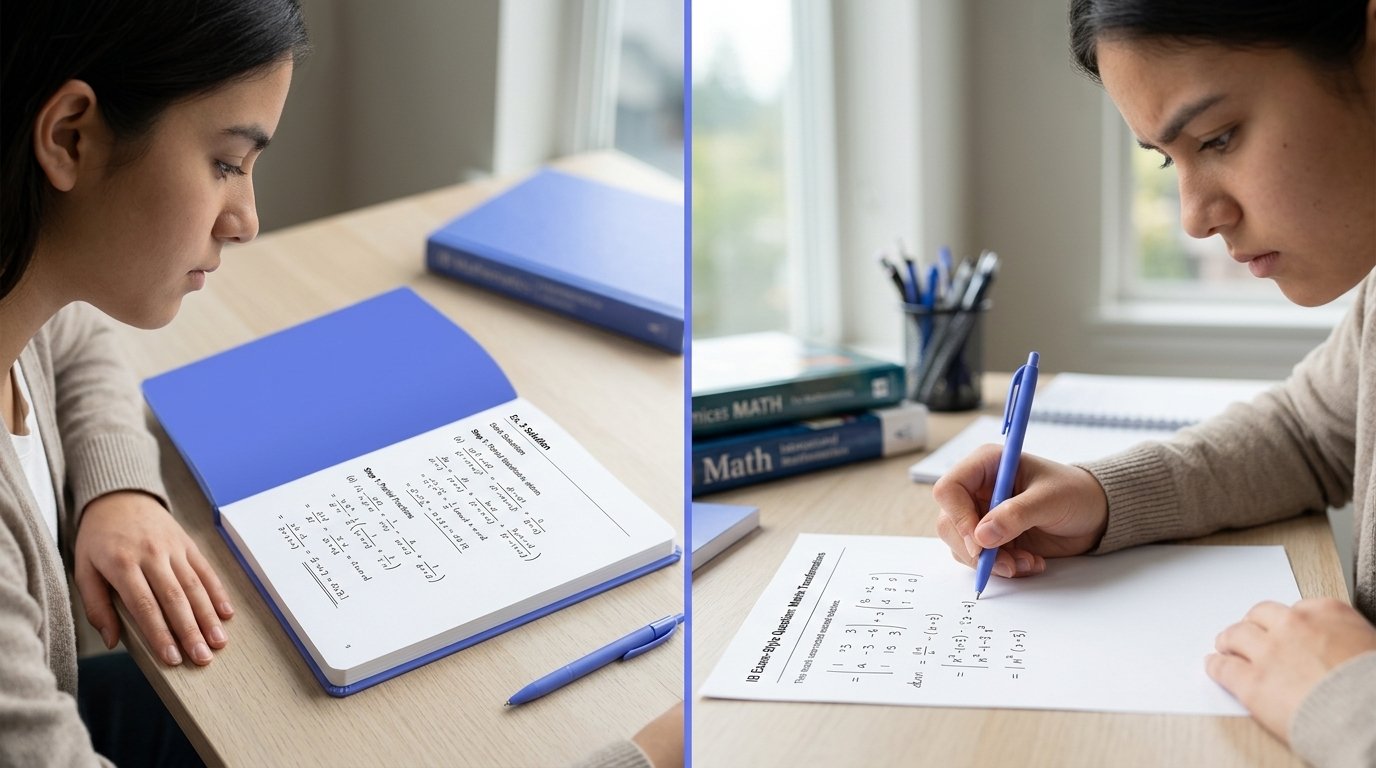
You get an IB Mathematics question wrong.
You look at the solution.
Suddenly, everything makes sense.
You think:
“Of course. I should have done that.”
You read through the working again and it feels obvious.
So you move on to the next question.
A few days later, you see a similar problem.
And you get stuck again.
This is a common problem with mathematics revision.
Table of Contents
Understanding a solution after you have seen it is not the same as being able to produce the solution yourself.
The difference matters enormously in IB Mathematics because exam questions do not always tell you which method to use or present a problem in the same form as the example you studied.
A worked solution can teach you something.
But it cannot replace the attempt.
Why a solution can feel easier than the original question
There is a simple reason.
When you look at a worked solution, the difficult decisions have already been made for you.
You can see:
Which formula was used.
Which mathematical relationship was recognised.
Which method was selected.
What the first step should be.
How the algebra was rearranged.
What the final answer means.
The solution is now a clear path from beginning to end.
But when you face the original question without that information, you have to make those decisions yourself.
That is the real test.
Consider a calculus question.
You look at the worked answer and see:
Differentiate.
Set the derivative equal to zero.
Solve.
Substitute.
Interpret the result.
Everything looks straightforward.
But in the exam, the question may never tell you directly that differentiation is the method you need.
You have to recognise that yourself.
That is a different skill.
Recognition is not the same as recall
One of the biggest traps in revision is confusing recognition with independent problem solving.
You see a solution and recognise it.
You think:
“I understand.”
But try closing the solution and solving the question again.
Can you still remember how to begin?
Can you explain why that method was appropriate?
Can you reproduce the important steps?
Can you solve a different question testing the same mathematical idea?
That is a much stronger test.
For IB Mathematics, you need to move beyond recognising a solution and towards producing a method independently.
The first step is often the hardest part
Students often think the difficult part of an IB Mathematics question is the calculation.
Sometimes it is.
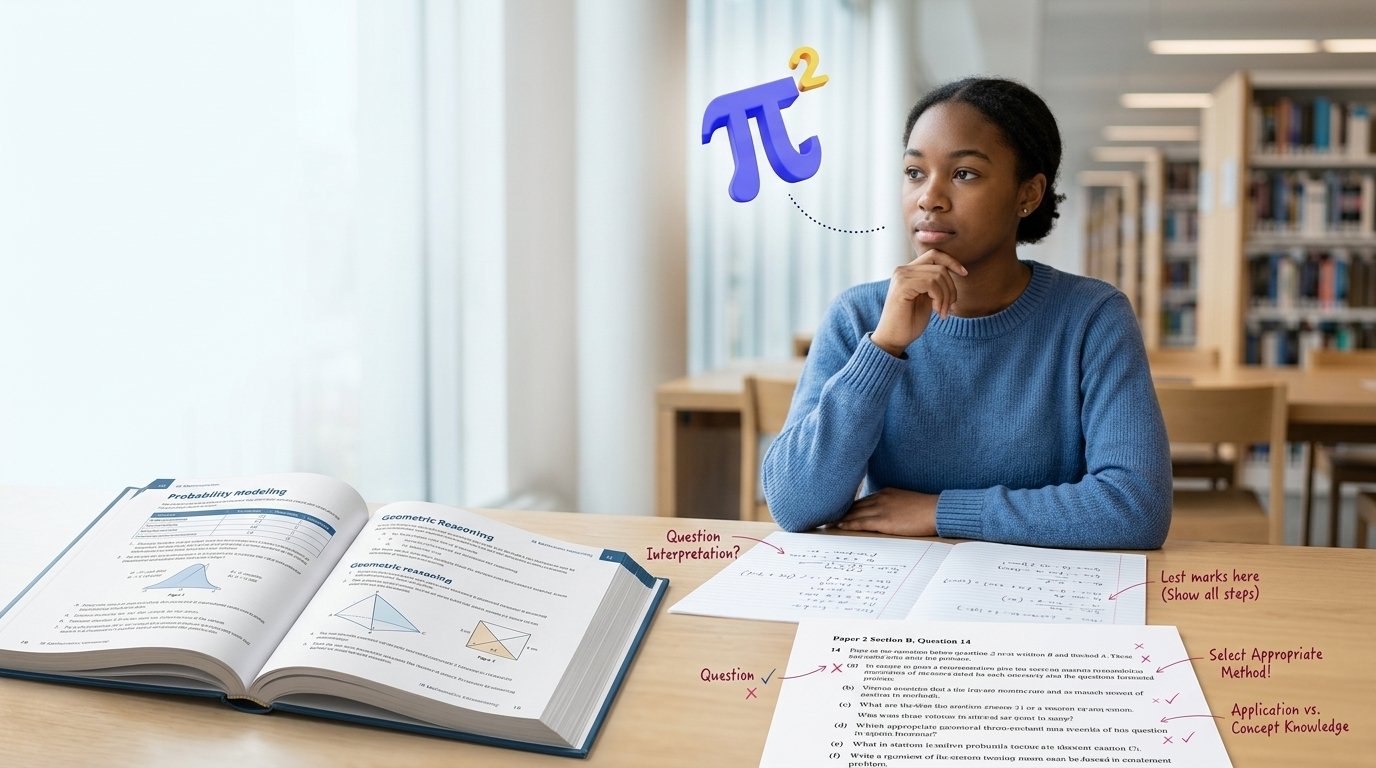
But for unfamiliar questions, the first mathematical decision can be the bigger challenge.
You may know differentiation.
You may know integration.
You may know the binomial theorem.
You may know conditional probability.
You may know how to work with vectors.
But which idea applies to the question in front of you?
That is where understanding needs to become application.
For example, suppose you have revised probability thoroughly.
You know the formulas.
You can follow several worked examples.
Then you see an unfamiliar probability question.
The problem is not necessarily that you have forgotten the formula.
You may simply not recognise which probability model or relationship is appropriate.
Looking at the worked solution afterwards will make the answer seem obvious.
But the important learning question is:
Would I have chosen that method without seeing it first?
Why copying the solution can create false confidence
Imagine you get a question wrong.
You read the solution carefully.
Then you copy the solution into your notebook.
Everything looks correct.
You feel that you have fixed the problem.
But copying the correct working does not necessarily prove that you can solve a new problem.
You may simply have become familiar with the solution.
There is a difference between:
“I understand this solution.”
and:
“I can solve a similar problem independently.”
The second statement requires evidence.
That evidence comes from attempting another question.
What to do instead
When you get a question wrong, do not immediately copy the solution and move on.
Use a simple review process.
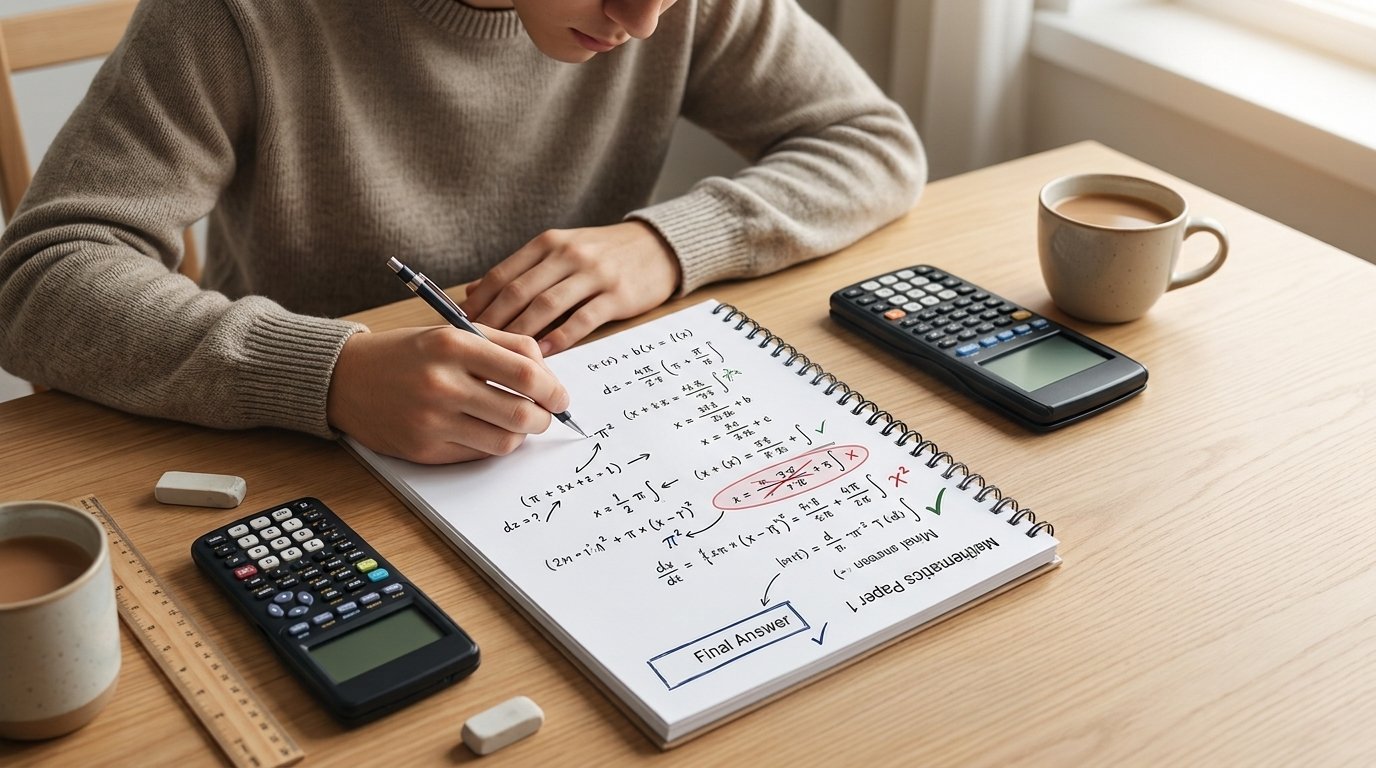
First, return to your own working
Before looking at the solution, identify what you were trying to do.
Ask:
What did I understand?
What was I trying to calculate?
What method did I choose?
Where did I become uncertain?
What was the first step that was no longer correct?
This tells you much more about your thinking.
Then compare your method with the solution
Now look at the worked answer.
Do not just compare the final number.
Compare the decisions.
Ask:
What did the solution recognise that I missed?
Why was this method appropriate?
What information did the solution use?
What was the first important step?
Was my method completely wrong, or did I make an error inside an otherwise sensible approach?
This turns the solution into feedback rather than something to copy.
Then close the solution
This is the step many students skip.
Put the solution away.
Now try the question again.
Can you reproduce the method?
If you can, that is useful evidence that the correction has started to stick.
If you cannot, you have discovered that reading the solution created recognition but not yet independent understanding.
That is also useful information.
Then try a different question
Repeating the exact same question immediately has a limitation.
You may remember what you just saw.
That does not necessarily mean you have learned the underlying skill.
Instead, try a different question testing the same mathematical idea.
For example:
You make a mistake with an optimisation problem.
You review the solution.
You understand why differentiation was used.
You close the solution.
You redo the original question.
Then you try another optimisation question with different wording.
If you can solve the second problem, you have stronger evidence that you understood the method rather than simply remembering the original answer.
This matters because IB Mathematics can test familiar mathematics in unfamiliar contexts.
Use the solution to ask better questions
A worked solution is not the enemy.
It can be extremely useful.
The problem is using it too passively.
Instead of asking:
“What is the answer?”
Ask:
Why did they start here?
What information did they use?
Why was this method appropriate?
What would have happened if I had chosen my method?
Which step was the turning point?
Could I explain this solution without looking at it?
Can I solve a different question using the same idea?
These questions turn a solution into a learning tool.
A worked example
Imagine you are given a functions question.
You attempt it and get stuck.
You look at the solution and see that the key step is to compose two functions in a particular order.
Once you see it, the answer seems obvious.
You think:
“I understand composite functions.”
Maybe you do.
But there are two different possibilities.
You might understand the concept but have difficulty identifying which function should be applied first when the question is presented in an unfamiliar way.
Or you might not fully understand the concept.
Those are different weaknesses.
To find out which one you have, try another question.
Do not look at the solution.
Read the question.
Identify the functions.
Decide which composition is required.
Then solve.
If you can do it independently, the original problem may have been a question interpretation issue.
If you cannot, you may need more teaching or practice on the underlying concept.
The second question gives you information that the first worked solution could not.
Why mark schemes can create the same problem
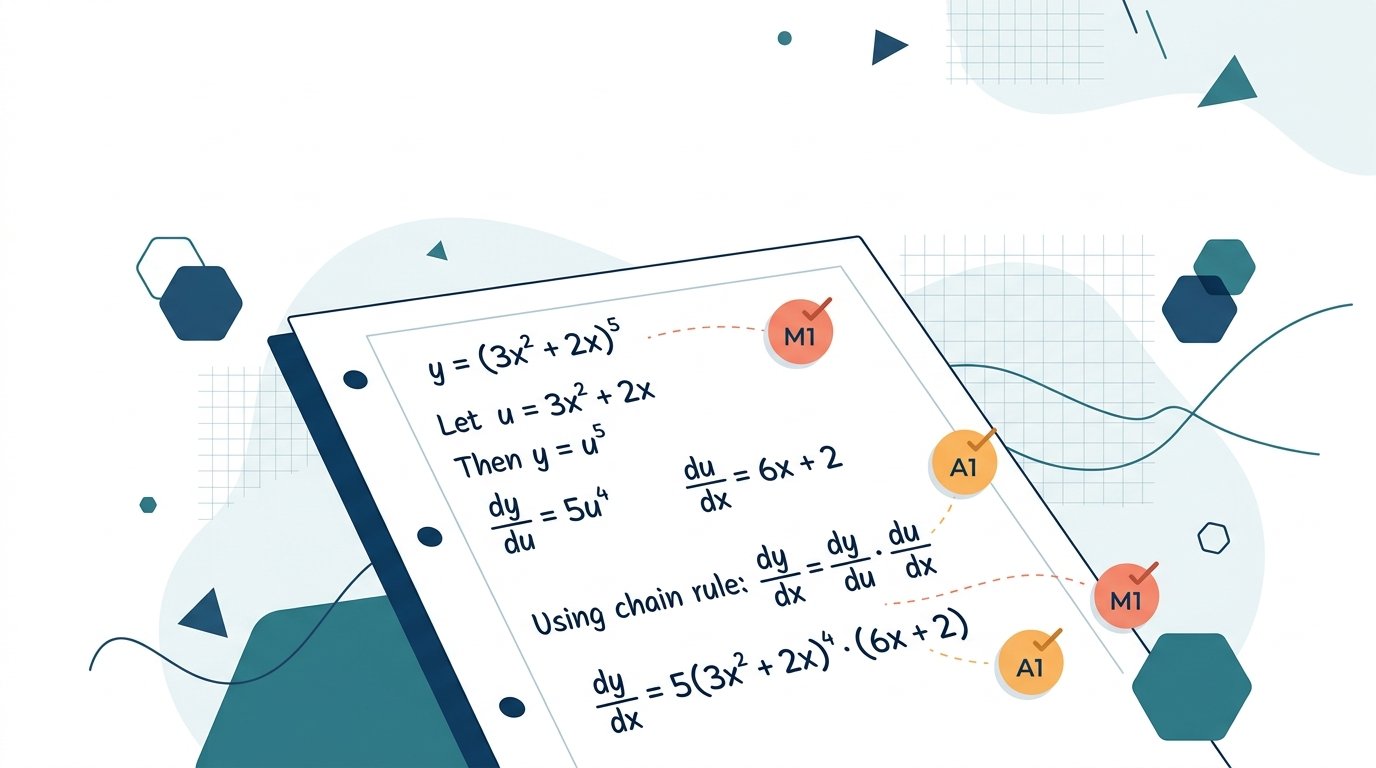
Mark schemes are essential for IB Mathematics practice.
But they are primarily designed to show how marks are awarded.
They are not always written as full teaching explanations.
Mathzem’s recent guidance on mark schemes makes the same distinction: a mark scheme can show the expected mathematical steps, but students still need to understand why those steps are appropriate.
Suppose a mark scheme shows:
Set the derivative equal to zero.
A student may memorise:
“Stationary point means derivative equals zero.”
But the more useful understanding is:
A stationary point occurs where the gradient is zero, so setting the derivative equal to zero allows us to identify candidate stationary points.
That difference matters when the question is presented differently.
The goal is not to memorise the appearance of a solution.
It is to understand the mathematical decision behind it.
The three stage test
After reviewing a solution, use this simple test.
Stage one: Explain
Can you explain why the solution used that method?
Stage two: Reproduce
Can you solve the original question without looking at the solution?
Stage three: Transfer
Can you solve a different question using the same mathematical idea?
If you can only complete stage one, you may understand the explanation but not yet have independent control of the method.
If you can complete stage two, you have stronger evidence that you can reproduce the process.
If you can complete stage three, you are showing that you can transfer the mathematical idea to a new problem.
That third stage is particularly valuable for exam preparation.
What to do when you still cannot solve the new question
Sometimes you review the solution and still cannot solve a similar problem.
That does not mean you should keep staring at the same answer.
Break the problem down.
Ask whether the issue is:
Concept
Do I actually understand the mathematics?
Recognition
Can I identify which topic or idea applies?
Method
Can I choose an appropriate approach?
Execution
Can I carry out the mathematics accurately?
Communication
Can I show enough working and reasoning?
Interpretation
Can I explain what my result means?
This gives you a more precise revision target.
For example, if the concept is understood but method selection is weak, reading another explanation of the same concept may not solve the problem.
You need more questions where you have to choose the method yourself.
This is where feedback becomes important
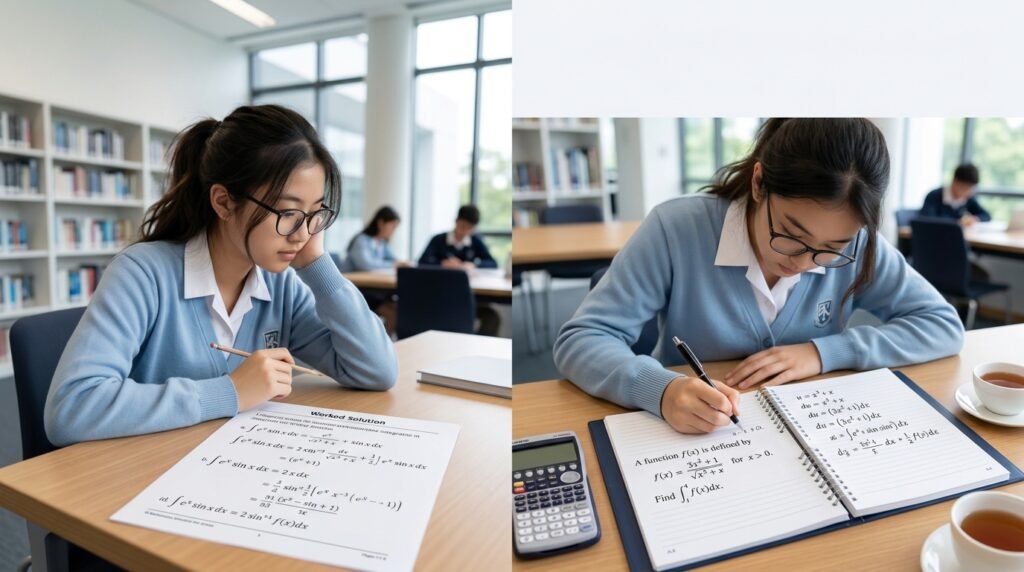
A solution tells you what a successful approach looks like.
Feedback on your own working tells you how your approach differed.
That distinction is important.
Mathzem’s current IB Practice workflow is built around this process.
You choose an IB Mathematics question, solve it on paper, upload your handwritten working and receive AI Examiner feedback focused on your method, mistakes, marks, weak areas and next steps.
The aim is not simply to provide another worked solution.
It is to help you understand your own attempt.
That can change the question from:
“What is the correct answer?”
to:
“Where did my method go wrong?”
and then:
“What should I practise next?”
A better way to use worked solutions
Try this routine during your next revision session.
Before seeing the solution
Give the question a genuine attempt.
Write down your first idea.
If you are stuck, write what you do know.
Do not immediately open the answer.
When reviewing the solution
Identify the first major decision.
Ask why it was made.
Compare it with your own approach.
Identify the first point where your reasoning differed.
After reviewing
Close the solution.
Redo the original question.
Then attempt a different question testing the same skill.
At the end
Write one sentence describing the weakness.
For example:
“I understand integration but struggle to decide which information to use in unfamiliar questions.”
That is much more useful than:
“I got this question wrong.”
What progress should actually look like
Progress is not simply seeing more solutions and feeling that they make sense.
A better sign of progress is that you need the solutions less often.
At first, you may need to study an example carefully.
Then you should be able to reproduce the method.
Then you should be able to recognise when to use it.
Eventually, you should be able to apply it to an unfamiliar question.
That is a much stronger progression.
You are moving from:
Seeing
to
Understanding
to
Reproducing
to
Applying
The final stage is what exam practice needs to develop.
A simple rule for IB Mathematics revision
When you see a solution and think:
“That makes sense.”
do not stop there.
Ask:
“Can I do it without looking?”
Then ask:
“Can I do a different question that tests the same idea?”
If the answer is yes, you have stronger evidence that the learning has transferred.
If the answer is no, you have found something worth practising.
That is not failure.
That is useful information.
Final takeaway
Worked solutions are valuable.
They can explain a method, reveal a useful mathematical idea and help you understand where your approach went wrong.
But seeing the solution is only part of learning.
The real test comes afterwards.
Can you reproduce the method independently?
Can you recognise when the method applies?
Can you use the same mathematical idea in a different question?
Can you explain why the method works?
That is why effective IB Mathematics practice needs more than exposure to correct solutions.
You need to attempt, review, correct and apply again.
Your goal is not to become better at recognising solutions.
Your goal is to become better at producing them yourself.
FAQs About IB Math Solution Is Not Enough
Why do I understand IB Math solutions but still get questions wrong?
Because understanding a worked solution after seeing it is easier than choosing and applying the method independently. You need practice making the mathematical decisions yourself.
Is it bad to look at the solution?
No. Worked solutions are useful. The problem is looking at them passively and moving on without testing whether you can reproduce or transfer the method.
How long should I try a question before looking at the solution?
There is no single correct time for every question. Give yourself enough time to make a genuine attempt, identify useful information and try a reasonable first step before checking the solution.
Should I redo a question after seeing the answer?
Yes. Close the solution and try the question again without looking. Then attempt a different question testing the same mathematical skill.
Why can an easy looking solution be difficult during the exam?
Because the solution has already made the important decisions for you. During the exam, you need to recognise the mathematical structure and choose the method yourself.
How can I tell whether I actually learned from a solution?
Try a different question testing the same idea without looking at the solution. If you can choose the appropriate method and solve it independently, you have stronger evidence of learning.
Turn solutions into better practice
Mathzem is designed around the student’s own attempt.
You solve an IB style question, upload your handwritten working and receive AI Examiner feedback on your method, mistakes, marks, weak areas and next steps.
That means the solution is not the end of the process.
It becomes the starting point for better practice.
You can begin with Mathzem IB Practice and test whether you can move from seeing the mathematics to applying it yourself.