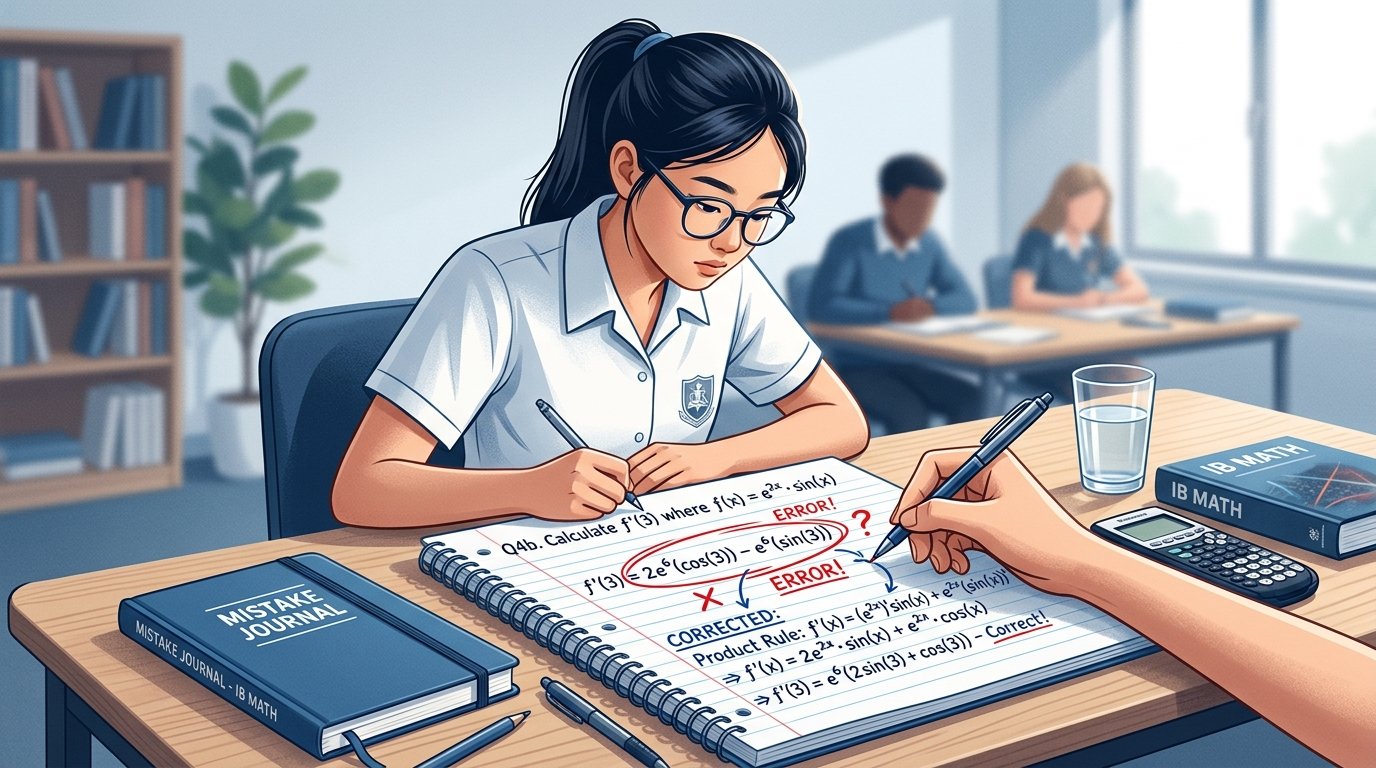
Getting an review incorrect IB Math questions wrong isn’t necessarily a problem.
In fact, an incorrect question can be one of the most useful parts of your revision.
The problem is what happens afterward.
Many students look at the mark scheme, see the correct answer, understand the solution for a few minutes, and then move on to the next question.
It feels productive because you’ve found the answer.
But finding out what the correct answer is isn’t the same as understanding why your own answer was wrong.
If you want your IB Math performance to improve, you need to turn incorrect questions into information about your mathematical weaknesses.
A wrong answer should lead to a better question:
Why did I get this wrong, and what should I do differently next time?
That question changes the way you revise.
Instead of collecting incorrect answers, you start identifying patterns.
Instead of repeating random questions, you practise specific weaknesses.
And instead of hoping that the same mistake doesn’t happen again, you deliberately test whether you’ve fixed it.
Table of Contents
Why Checking the Correct Answer Isn’t Enough
Suppose you calculate an answer and get 12.6, while the mark scheme gives 14.2.
You look at the solution and immediately understand the difference.
You realise that you substituted the wrong value.
Problem solved?
Not necessarily.
You might understand the correction while looking at the answer but still make exactly the same mistake in a different question.
This happens because recognising a correct solution is easier than producing one independently.
The real learning happens when you can explain the error, understand why it happened, correct your reasoning, and then successfully apply the same skill to a new problem.
That is why reviewing an incorrect question should be treated as part of the practice process rather than an optional extra.
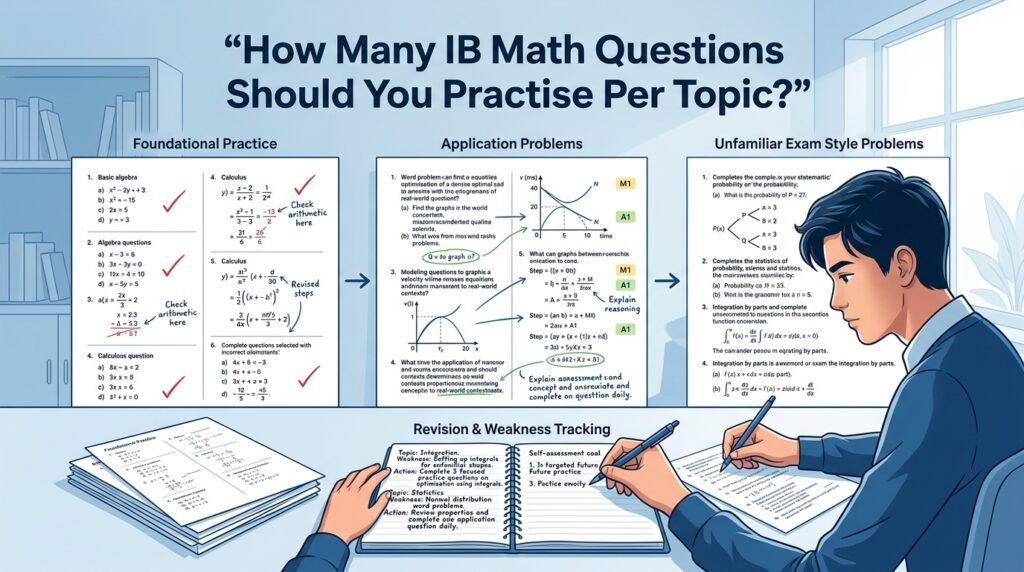
Step One: Don’t Immediately Look at the Solution
When you realise your answer is wrong, your first instinct may be to open the mark scheme.
Try not to do that immediately.
First, look at your own solution.
Read the original question again.
Ask yourself what you were trying to calculate and why you chose that method.
Sometimes you’ll notice the error yourself.
Perhaps you misread the question.
Perhaps you used P(A∩B) when the question required a conditional probability.
Perhaps you differentiated correctly but made an algebra mistake afterward.
Perhaps you rounded too early.
Perhaps you calculated the right quantity but didn’t answer the question being asked.
Finding the error yourself is valuable because it requires you to analyse your own reasoning.
Step Two: Identify the First Point Where Things Went Wrong
When reviewing an incorrect solution, don’t focus only on the final line.
Find the first meaningful error.
Imagine your working looks like this: f(x)=x³−4x²+5x f′(x)=3x²−8x+5 3x²−8x+5=0
So far, your method is correct.
Then you solve the quadratic incorrectly and obtain the wrong values of x.
Your final answer is wrong, but the calculus method wasn’t the problem.
The issue was algebra.
That’s an important distinction.
If you label the whole question as a “calculus mistake,” you may spend time revising differentiation when the actual weakness is solving a quadratic equation.
Finding the first meaningful error gives you a much more accurate diagnosis.
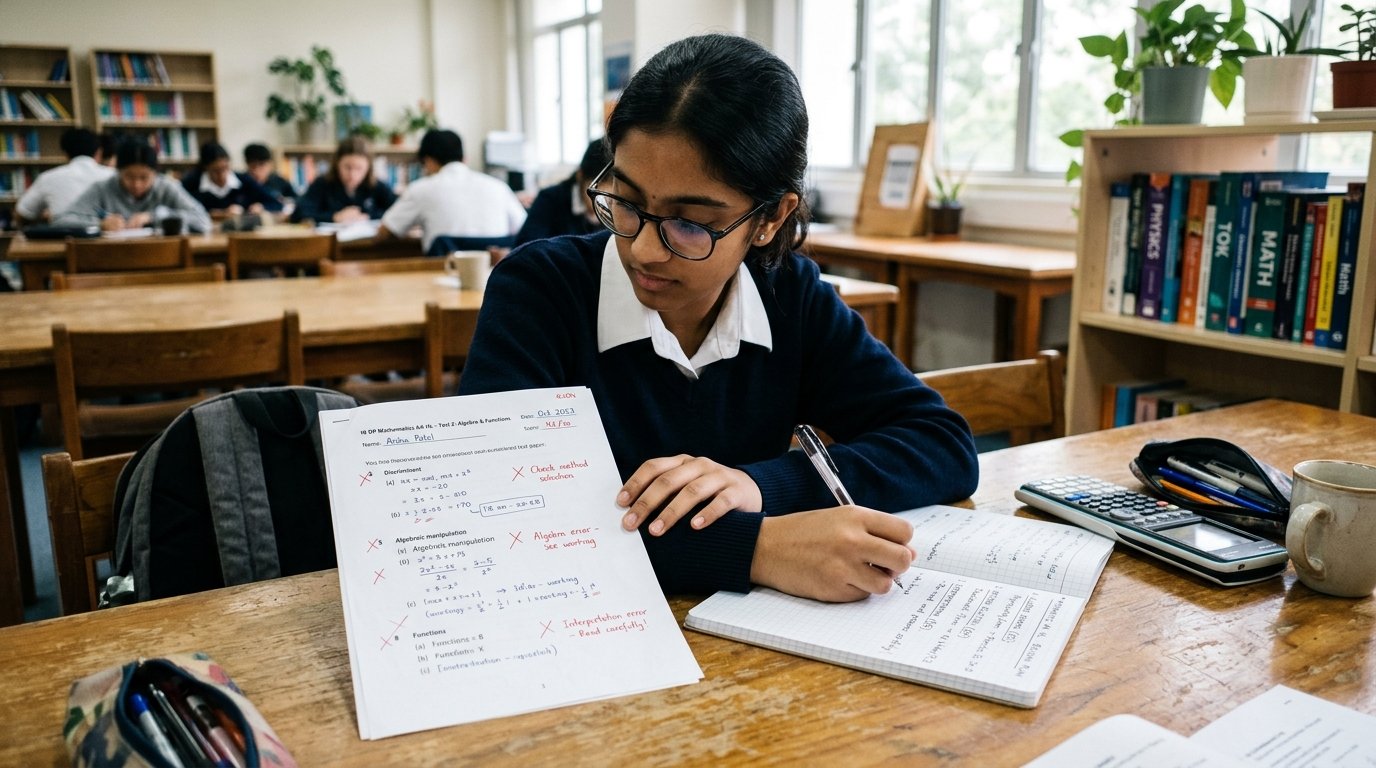
Step Three: Classify the Mistake
Once you’ve identified the error, ask what type of mistake it was.
Was it a knowledge problem?
Did you not understand the mathematical concept?
Was it a method selection problem?
Did you understand the topic but choose the wrong approach?
Was it an algebra or arithmetic error?
Was the mathematics correct until a calculation went wrong?
Was it a reading problem?
Did you misunderstand what the question was asking?
Was it a communication problem?
Did you fail to show sufficient working, justification, units, or interpretation?
Was it a calculator problem?
Did you enter the wrong expression or use the wrong calculator function?
Was it an accuracy problem?
Did early rounding affect your result?
This classification matters because each type of mistake requires a different correction.
Step Four: Explain Why You Made the Mistake
This is the step students most often skip.
They write:
“Wrong formula.”
or:
“Calculation mistake.”
Then they move on.
Those descriptions aren’t specific enough.
Instead, try to explain what caused the error.
For example:
“I used the binomial distribution because I recognised the probability topic, but I didn’t check whether the situation satisfied the conditions required for a binomial model.”
That’s useful.
Or:
“I rounded the intermediate value to two decimal places, and the rounded value caused the final answer to fall outside the expected tolerance.”
That’s useful too.
The explanation should tell you what to watch for next time.
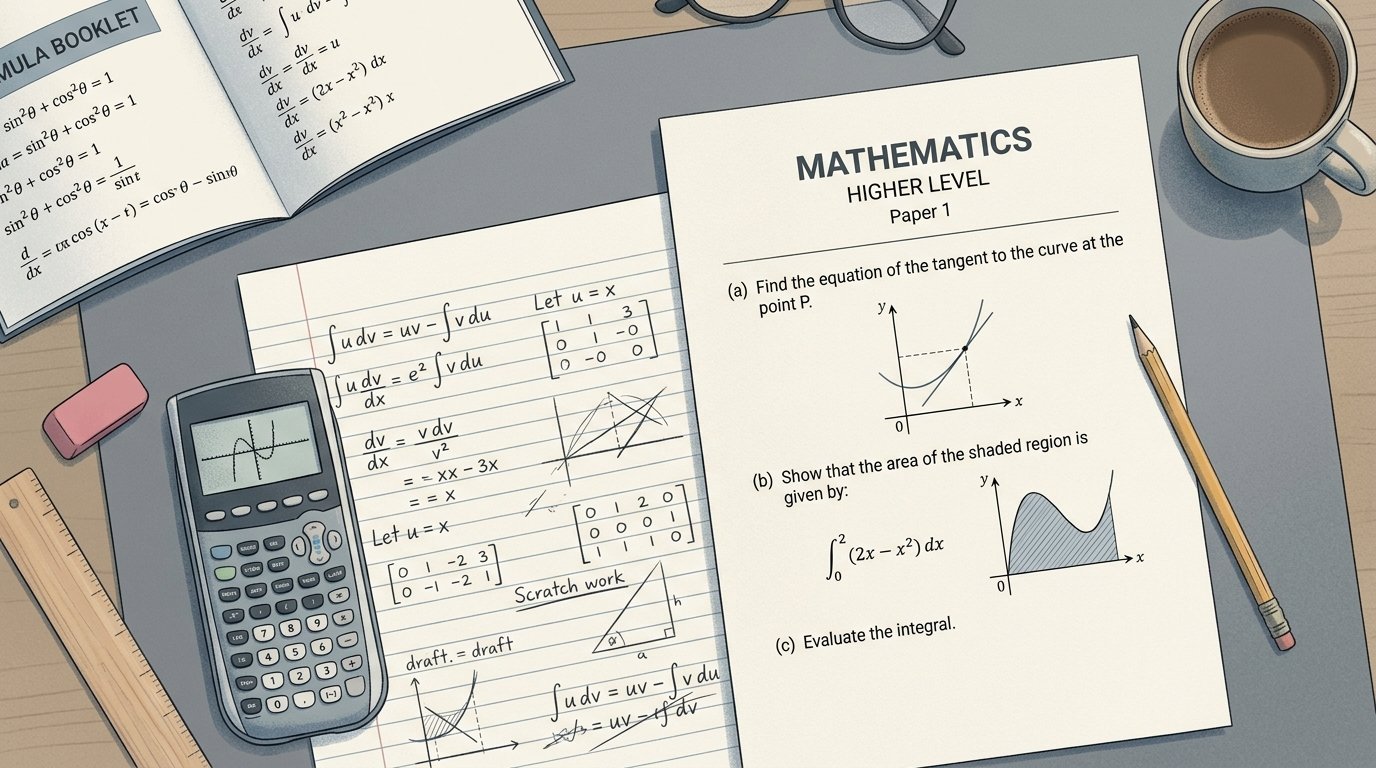
Step Five: Compare Your Working With the Mark Scheme
Now it’s time to use the mark scheme.
Don’t just look at the final answer.
Compare the mathematical structure of your solution with the expected solution.
Look at where your approach agrees.
Then identify where it diverges.
This can reveal something important.
You may discover that your method was actually correct for the first several lines and that the error occurred much later.
You may also discover that you took an entirely different approach.
That isn’t automatically a problem.
Different mathematical methods can sometimes lead to the same answer.
The important question is whether your method is mathematically valid and satisfies what the question requires.
Step Six: Rewrite the Correct Solution Yourself
After identifying the error, close the mark scheme.
Then solve the question again.
Don’t simply copy the official solution.
Try to produce the solution independently using what you’ve learned from the correction.
This is important because copying a solution can create the illusion of understanding.
If you can reproduce the reasoning without looking, you have stronger evidence that you’ve learned something.
If you get stuck again, that’s useful information.
It means the underlying issue hasn’t been completely resolved.
Step Seven: Solve a Similar Question
This is where the correction becomes real practice.
Find another question that tests the same mathematical skill.
Don’t make it identical.
The goal is to test whether you can transfer what you’ve learned.
Suppose you made a mistake finding the inverse of a function.
After correcting the original question, try another inverse function problem.
If you solve it correctly, that’s encouraging.
If you make the same mistake again, your original correction wasn’t enough.
You may need to return to the underlying concept.
Step Eight: Try an Unfamiliar Version
Once you’ve successfully solved a similar question, increase the challenge.
Try a problem where the same mathematics appears in a different context.
This is particularly important for IB Math because exam questions don’t always present mathematical skills in the same form as textbook examples.
You might know how to differentiate a function when explicitly asked to differentiate.
But can you recognise that differentiation is needed when the problem describes a rate of change?
You might know the binomial distribution formula.
But can you recognise when a word problem satisfies the assumptions needed to use it?
You might know how to find a confidence interval.
But can you interpret the result in context?
Transfer is the real test.
Step Nine: Revisit the Mistake Later
One of the most useful things you can do is return to an old mistake after some time has passed.
If you correct a question immediately and solve a similar question five minutes later, your memory is still fresh.
That doesn’t prove you’ve fully fixed the weakness.
Return to the skill after a day or several days.
Try another question without looking at your previous solution.
If you now solve it independently, the correction is more likely to have become part of your actual mathematical understanding.
This also helps reveal recurring weaknesses.
Why a Mistake Journal Can Help
A mistake journal can make this process easier to manage.
The purpose isn’t to create another notebook full of copied solutions.
Instead, it should record useful information about your mistakes.
For example, you might record:
Topic: Conditional probability
Problem: Misread “given that”
Cause: I treated the events as independent.
Correction: Check whether the wording changes the sample space.
Next practice: Complete mixed conditional probability questions.
This gives you something much more useful than a list of wrong answers.
It becomes a record of your learning patterns.
Mathzem’s approach includes a mistake journal for IB Math students because repeated mistakes can reveal weaknesses that aren’t obvious from a single test score.
Look for Repeated Mistakes Across Questions
One incorrect answer doesn’t necessarily indicate a major weakness.
A repeated mistake is much more informative.
Imagine you make the same type of algebra error three times across different topics.
That suggests algebra may be affecting your performance more broadly.
Similarly, if you repeatedly lose marks because you don’t interpret your final answer, the issue may not belong to one specific syllabus topic.
It may be an exam communication habit.
This is why you should periodically review your mistakes as a group.
Don’t only analyse individual questions.
Look for patterns across them.
Don’t Label Everything as a Careless Mistake
“Careless mistake” is one of the least useful explanations students give themselves.
Sometimes the mistake really was a simple slip.
But if the same “careless” mistake happens repeatedly, it isn’t random anymore.
Suppose you repeatedly forget negative signs.
That may indicate an algebra accuracy problem.
Suppose you repeatedly enter expressions incorrectly into your calculator.
That may indicate a calculator checking problem.
Suppose you repeatedly forget units.
That may indicate that you aren’t checking the final response against the question.
Instead of saying:
“I’m just careless.”
Ask:
“What habit is producing this error?”
That gives you something you can actually change.
What If You Couldn’t Start the Question?
Not every incorrect question contains a calculation error.
Sometimes you don’t know how to begin.
That’s also valuable information.
If you stare at a question and don’t know what mathematical idea to use, identify that as a method recognition or problem solving weakness.
Review the question after seeing the solution and ask yourself what clue should have helped you identify the method.
Then practise another question where the same mathematical idea is hidden inside different wording.
This helps you develop recognition rather than memorisation.
What If Your Method Was Right but Your Final Answer Was Wrong?
Don’t automatically mark the entire question as a failure.
Your working may reveal that you understood most of the mathematics.
For example, you might set up the correct equation, manipulate it correctly, and then make one arithmetic mistake.
That’s different from choosing the wrong mathematical model from the beginning.
This distinction matters when planning revision.
You probably don’t need to relearn the entire topic.
You need to improve the specific skill that caused the error.
What If Your Final Answer Was Right but You Still Lost Marks?
This situation is just as important.
You can sometimes arrive at the correct answer while your method is incomplete or your reasoning is unclear.
If you relied entirely on a calculator, skipped important working, failed to justify a result, or didn’t provide a required interpretation, you may have left marks on the table.
Reviewing correct answers is therefore useful too.
Don’t only study your wrong answers.
Ask whether your correct solutions were complete enough to receive all available marks.
Don’t Spend Equal Time on Every Mistake
Not every error deserves the same amount of revision time.
A one off arithmetic slip may require a quick correction.
A repeated conceptual misunderstanding may require much more work.
A useful way to prioritise mistakes is to consider how often they happen and how many marks they tend to cost.
If one weakness appears repeatedly across different papers, move it higher on your revision list.
If another mistake happened once and hasn’t appeared again, it may not deserve the same attention.
This helps keep your revision focused.
Turn Mistakes Into Your Next Practice Plan
The most powerful part of mistake review is deciding what happens next.
Suppose your review shows that you’re repeatedly struggling with unfamiliar calculus questions.
Your next session shouldn’t simply contain another random set of calculus exercises.
Instead, choose questions that specifically require method selection and application.
If you’re losing marks because of weak algebra, target algebra.
If you’re struggling with interpretation, practise applied questions and focus on writing complete conclusions.
If your mistakes are mostly caused by time pressure, introduce timed practice.
The mistake should determine the next question.
A Complete Example of the Correction Cycle
Imagine you’re solving a normal distribution question.
You calculate the probability and get an answer that doesn’t match the expected result.
Instead of immediately checking the mark scheme, you read your working.
You notice that you standardised the value incorrectly.
You then ask why.
You realise you used the standard deviation incorrectly when calculating the z value.
You correct the calculation and solve the original question again.
Then you complete a similar normal distribution question.
You get it right.
A few days later, you attempt a mixed statistics question involving a normal distribution without being told which method to use.
You solve it correctly.
Now you’ve done more than correct an answer.
You’ve tested whether the correction transferred to a different problem.
That’s what effective mistake review looks like.
How Mathzem Can Support This Process
The challenge with independent revision is that students often know when an answer is wrong but don’t know exactly what to do next.
Mathzem is built around connecting practice with feedback.
Through IB Math Practice, students can attempt IB Math questions and submit their work for examiner style feedback.
The feedback can help students identify marks, mistakes, weak areas, and possible next steps rather than treating the final answer as the entire assessment.
This creates a cycle of:
Practice → review → identify the mistake → correct → practice again.
The Mathzem Student Dashboard can then help connect those results with broader revision planning, while the Math Skill Scanner can help identify areas where additional practice may be useful.
The purpose isn’t to eliminate mistakes.
Mistakes are a normal part of learning mathematics.
The goal is to make sure the same mistake doesn’t keep costing you marks.
Build a Habit of Reviewing, Not Just Completing
If you have one hour for IB Math revision, it can be tempting to spend all 60 minutes solving questions.
Instead, reserve part of that time for review.
For example, complete a focused set of questions and then spend time analysing the solutions.
Ask what you did correctly.
Ask what went wrong.
Ask whether the problem was knowledge, method, accuracy, communication, or interpretation.
Then choose the next question based on that information.
You may complete fewer questions.
But you will understand more about your performance.
The Goal Is to Make Mistakes Less Repetitive
You don’t need to reach a point where you never make mistakes.
Even strong students make errors.
The important question is whether your mistakes are changing.
If you repeatedly make the same error for weeks, your revision system isn’t addressing the problem.
If you make a mistake, analyse it, practise the underlying skill, and later demonstrate that you can solve a similar problem independently, your revision is working.
That is real progress.
FAQs About the Review Incorrect IB Math Questions
Should I redo every IB Math questions I get wrong?
You should review every important mistake, but you don’t necessarily need to spend the same amount of time on every error. Repeated conceptual or method errors deserve more attention than isolated minor slips.
Should I look at the mark scheme immediately?
It’s usually more useful to examine your own working first. Try to identify where you went wrong before comparing your solution with the mark scheme.
Why do I keep making the same IB Math mistakes?
Repeated mistakes often indicate an unresolved weakness, such as a conceptual misunderstanding, poor method recognition, weak algebra, inaccurate calculator use, or an exam communication issue.
Is a mistake journal useful for IB Math?
Yes, if you use it to record the cause of mistakes and the action needed to fix them. Simply copying incorrect questions and solutions into a notebook is much less useful.
How many times should I redo an incorrect question?
Redoing it once after analysing the mistake is useful, but the stronger test is to solve a different question that uses the same skill. Later, revisit the skill again to check whether the improvement lasts.
Should I review questions that I got correct?
Yes. A correct final answer doesn’t always mean you earned every available mark. Reviewing some correct solutions can reveal incomplete working, weak justification, or unnecessary reliance on calculator results.
Conclusion
An incorrect IB Math questions isn’t wasted practice.
It becomes wasted practice when you look at the correct answer and move on without understanding what caused the mistake.
The most effective correction process starts with your own working.
Identify the first point where the solution went wrong.
Understand why it happened.
Compare your approach with the mark scheme.
Redo the original question independently.
Then solve a similar question.
Finally, revisit the skill later to see whether the correction has actually lasted.
Over time, this process reveals patterns.
Those patterns become your personal revision priorities.
And that is where mistake review becomes much more powerful than simply doing more questions.
Don’t measure your revision only by how many questions you complete. Measure it by how many recurring mistakes you eliminate.
Quick Takeaway
A wrong answer should start a learning process, not end one.
Analyse the mistake, understand its cause, correct your working, practice the same skill in a new question, and revisit it later.
That’s how one incorrect IB Math questions can become the starting point for better exam performance.


2 Responses