Introduction
Many IB Math students experience the same frustrating situation.
They make a mistake on a practice question, understand the correct solution, and move on.
A few weeks later, the exact same mistake appears again.
This cycle can continue for months.
The problem is not always a lack of understanding. Often, students simply do not have a system for tracking and learning from their mistakes.
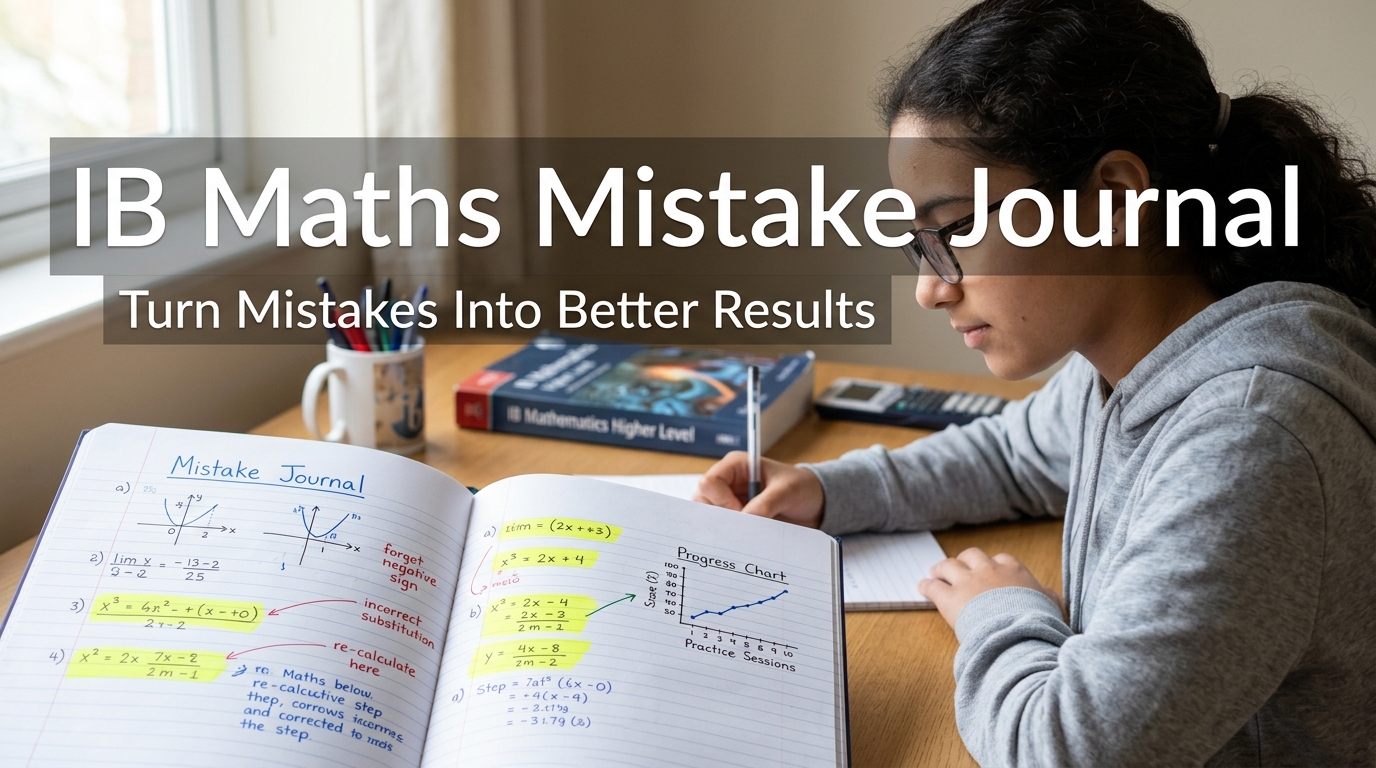
One of the most effective ways to improve performance in mathematics is to keep a mistake journal.
Rather than treating mistakes as isolated events, a mistake journal helps students identify recurring patterns, focus revision more effectively, and reduce repeated errors over time.
For IB Math students, where small mistakes can have a significant impact on final grades, such a journal can be a powerful revision tool.
Table of Contents
Why Students Keep Repeating the Same Mistakes

Most students review corrections once and then move on to the next question.
While this approach feels productive, it often creates a false sense of progress.
The mistake may seem obvious immediately after reviewing the solution, but without reinforcement, it is simple to forget.
Common repeated errors include:
- Algebra mistakes
- Calculator input errors
- Incorrect notation
- Missing working
- Misreading questions
- Probability formula mistakes
- Differentiation and integration errors
Without a system to record these issues, students often encounter them repeatedly throughout the course.
What Is a Mistake Journal?
A mistake journal is a structured record of errors made during practice and revision.
Instead of simply writing the correct answer, students record:
- The question topic
- The mistake made
- Why the mistake occurred
- How it can be avoided in future
The goal is not to collect mistakes.
The goal is to learn from them.
Over time, the journal becomes a personalised guide to the student’s most common weaknesses.
Why Mistake Tracking Improves Learning
Educational research suggests that reflection is an important part of effective learning.
When students actively analyse mistakes, they are more likely to remember and correct them in future situations.
Mistake tracking helps students:
- Develop self-awareness
- Recognise recurring patterns
- Improve problem-solving habits
- Strengthen weak areas
- Build exam confidence
Instead of seeing mistakes as failures, students begin using them as learning opportunities.
Common Types of Mistakes in IB Math
Conceptual Mistakes
These occur when a student misunderstands a topic or applies the wrong method.
Example:
Using a differentiation technique when integration is required.
Procedural Mistakes
These happen when the correct method is known but executed incorrectly.
Example:
Applying the chain rule incorrectly.
Algebra Mistakes
Many students lose marks because of algebra rather than the main topic itself.
Example:
Sign errors during simplification.
Exam Technique Mistakes
These involve issues such as:
- Skipping steps
- Poor notation
- Incomplete reasoning
- Misreading instructions
A good mistake journal helps students categorize errors and identify which type occurs most often.
The Hidden Cost of Repeated Mistakes
Repeated mistakes affect more than individual questions.
They can impact entire topics.
For example, weak algebra skills can cause problems in the following:
- Functions
- Calculus
- Probability
- Statistics
- Sequences and series
Students may believe multiple topics are weak when the real issue is a single underlying skill.
Tracking mistakes helps reveal these connections.
How a Mistake Journal Creates a Better Revision Plan
Many students revise based on what feels difficult.
A mistake journal provides evidence instead.
By reviewing recorded mistakes, students can identify:
- Frequently missed topics
- Common exam technique issues
- Areas where marks are consistently lost
- Skills requiring additional practice
This approach creates a much more effective revision strategy.
Instead of revising everything equally, students can focus on areas that will have the greatest impact on exam performance.
How Mathzem Uses the Mistake Journal Concept
One challenge with traditional mistake journals is maintaining them consistently.
Students often forget to update them or struggle to identify patterns.
Mathzem helps simplify this process.
When students practise IB-style questions and upload their working, the platform analyses performance and records mistakes automatically.
This allows students to see the following:
- Recurring errors
- Topic-specific weaknesses
- Lost method marks
- Areas for improvement
The result is a more organised and actionable approach to revision.
From Mistakes to a Personal Revision Plan
The most valuable part of mistake tracking is what happens next.
A mistake journal should not simply record errors.
It should help guide future study.
Mathzem connects mistake analysis with other tools such as the following:
Weakness Map
Shows where marks are most frequently lost.
Strong and Weak Topic Analysis
Helps students understand overall performance.
Revision Recommendations
Suggests which topics should be prioritised next.
Together, these features help students move from mistake identification to meaningful improvement.
AI Examiner Feedback and Mistake Analysis
Understanding a mistake is often more important than knowing the correct answer.
Mathzem’s AI examiner feedback helps students identify:
- Why marks were lost
- Which steps were correct
- Which methods need improvement
- What should be practised next
This transforms mistakes into learning opportunities.
Instead of asking:
“What was the correct answer?”
Students begin asking the following:
“Why did I lose marks, and how can I improve?”
This mindset is often associated with stronger long-term progress.
The Practice → Upload → Review → Improve Cycle
A simple process can help students obtain more value from every practice session.
Practise
Attempt IB-style questions independently.
Upload
Submit your complete working for review.
Review
Analyze mistakes and examiner feedback.
Improve
Focus revision on identified weaknesses.
The Mistake Journal supports every stage of this cycle.
Conclusion
Mistakes are an unavoidable part of learning mathematics.
The difference between successful students and struggling students often lies in how they use those mistakes.
A mistake journal helps students identify recurring errors, focus revision more effectively, and stop losing marks for the same reasons repeatedly.
By tracking mistakes, analysing patterns, and building targeted revision plans, students can turn weaknesses into strengths over time.
Tools such as Mathzem support this process by helping students record mistakes, identify weak areas, and receive examiner-style feedback that guides future improvement.
Start Improving With Mathzem
Identify your strongest and weakest IB Math topics:
Practise IB-style questions:
Access AI examiner feedback, Weakness Maps, and personalized revision support:
FAQ About Mistake Journal helps IB Math Students
What is a mistake journal in mathematics?
A mistake journal is a record of errors made during practice, helping students identify recurring mistakes and improve future performance.
Why do students repeat the same mistakes?
Students often repeat mistakes because they review corrections briefly but do not track patterns over time.
What should be included in a mistake journal?
Students should record the topic, mistake, cause of the mistake, and strategy for avoiding it in future.
How does a mistake journal help IB Math students?
It helps students identify weaknesses, improve revision efficiency, and avoid losing marks for repeated errors.
How does Mathzem support mistake tracking?
Mathzem analyses uploaded work, identifies recurring mistakes, updates weakness insights, and provides personalised revision recommendations.



One Response