You finish an IB Mathematics question, check your final answer, and discover that it is wrong.
But what actually went wrong?
Did you choose the wrong formula? Did you use the correct method but make an algebraic mistake? Did you misunderstand the question, or did you reach the right idea without explaining it clearly enough?
Your final answer alone cannot tell you the whole story. Your mathematical working provides much more evidence about how you approached the problem.
That is why reviewing your working matters. With Mathzem AI Examiner, you can submit your solution for structured examiner style feedback designed to evaluate your mathematical steps, identify mistakes, and help you decide what to improve next.
Table of Contents
1. Why your working matters in IB Mathematics
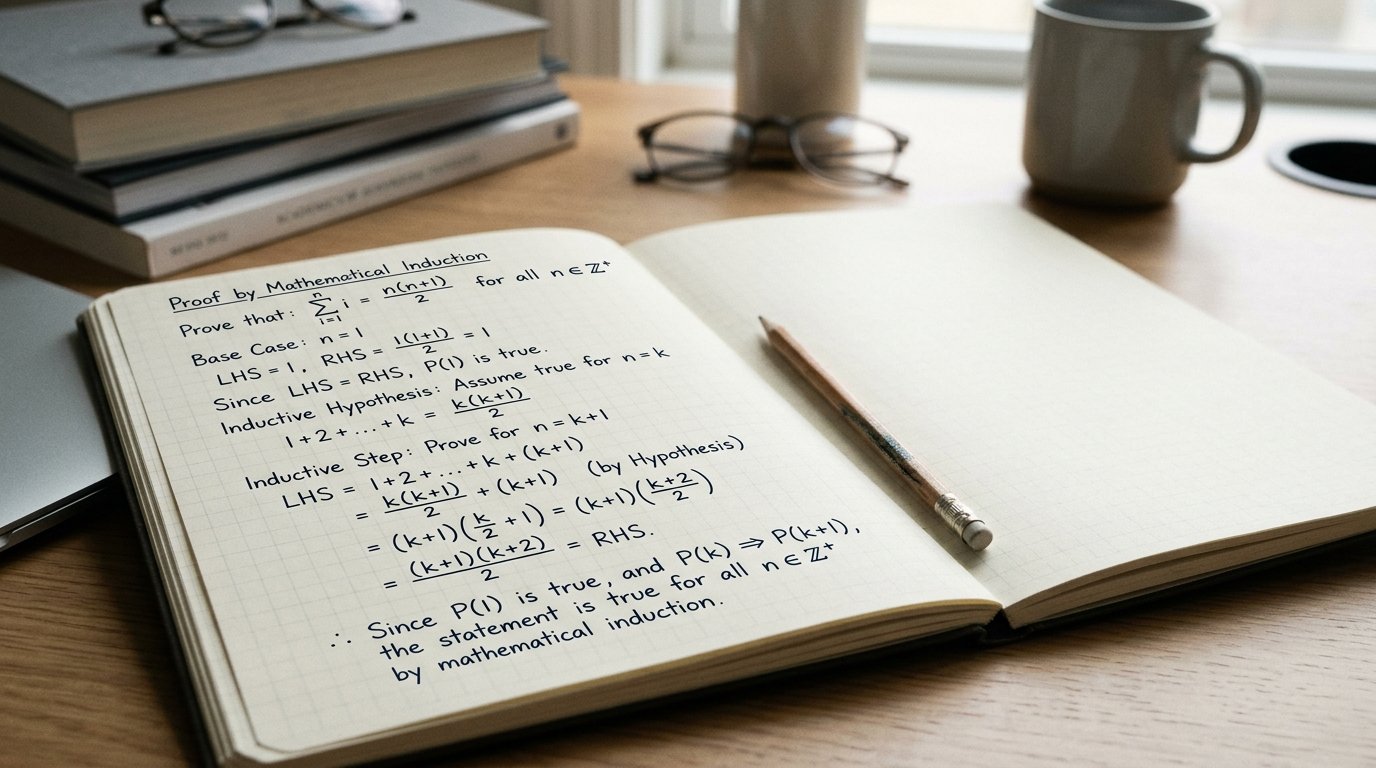
In mathematics, reaching the correct answer is important, but the reasoning used to reach it can also matter.
Consider a question that asks you to solve an equation. You might identify the correct method and carry out most of the calculation correctly, then make a small arithmetic error in the final step.
Your final answer would be incorrect, but the earlier working could still demonstrate relevant mathematical understanding.
Now consider a different situation. You arrive at the correct answer by guessing or using an invalid method. The number might be right, but the working may not demonstrate the reasoning the question requires.
These examples show why checking only the final answer is not enough to understand the quality of a solution.
When you review your working, you can investigate three important questions:
- Method: Did I choose an appropriate mathematical approach?
- Accuracy: Did I carry out the calculations correctly?
- Reasoning and communication: Did I show the necessary steps and explain my conclusions where required?
The exact marks available depend on the question and its marking criteria. However, examining these aspects gives you a more useful picture of your performance than simply labelling a question right or wrong.

2. What are Mathzem AI Examiner Reviews?
Mathzem AI Examiner is the marking and feedback layer within Mathzem’s practice workflow.
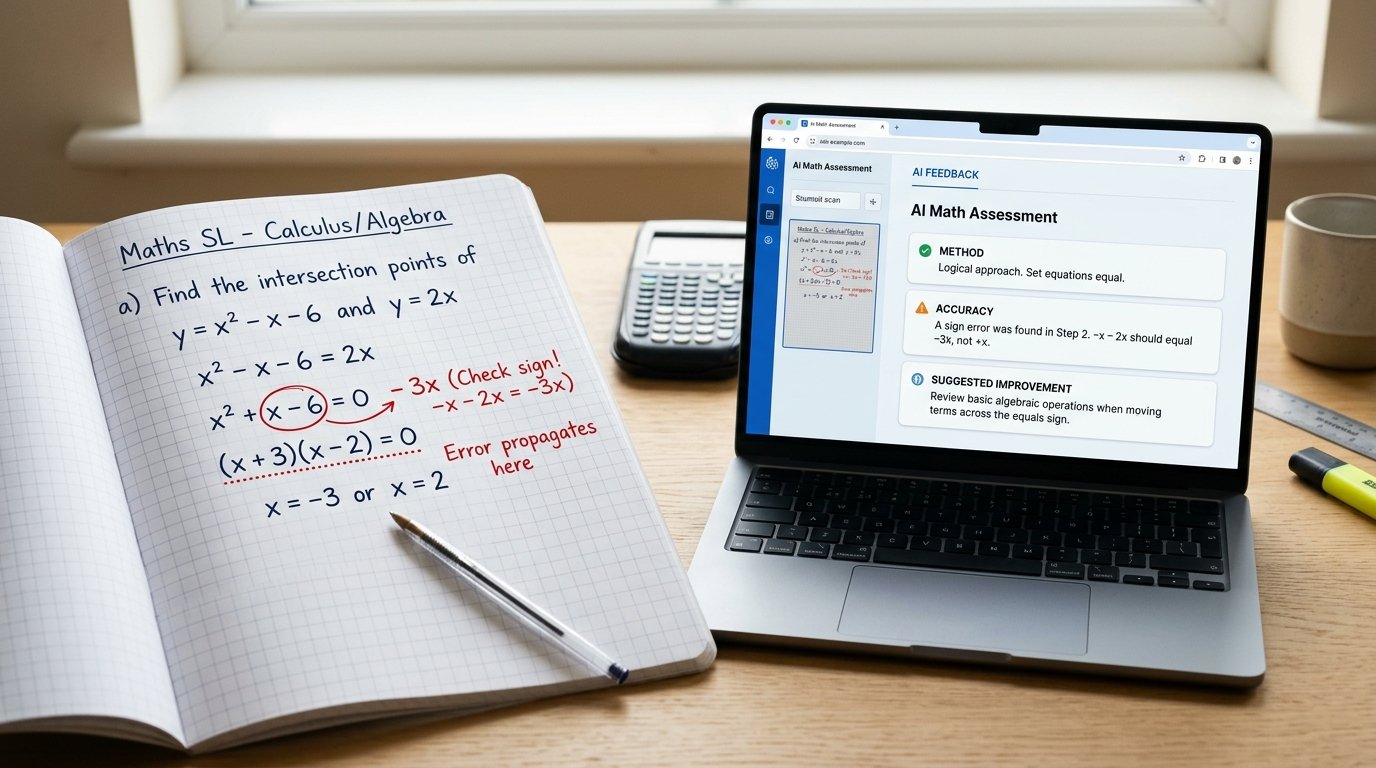
It analyses the working you submit against the question and relevant reference material. It is designed to evaluate the visible mathematics, consider different question parts, identify mistakes or weak areas, and provide feedback on what you can improve.
This makes it different from simply checking whether your final answer matches an expected value.
For example, if your method is appropriate but your calculation goes wrong, the feedback can help you investigate the error in your working. If your approach is not suitable for the question, you can focus on understanding the method you should have used.
The aim is to make your mistakes easier to understand and act on.
Mathzem AI Examiner provides examiner style feedback. It is not official IB marking, and its feedback should not be treated as a guarantee of the marks an IB examiner would award.
3. How to submit your working and learn from the feedback
The most useful way to use AI Examiner is to treat it as part of a learning cycle rather than a final check.
Step 1: Attempt the question yourself
Start with an IB Mathematics practice question and make a genuine attempt before looking at a solution.
Write down your method, calculations, and reasoning. If you get stuck, record what you have tried and where you are uncertain.
Avoid skipping steps simply because you can perform a calculation mentally. Showing your reasoning gives the feedback process more information to assess.
Step 2: Submit your working in Mathzem
Once you have attempted the question, submit your working through the Mathzem practice workflow.
The purpose is to review the mathematics you actually produced, not an ideal solution that you copied from somewhere else.
Make sure your working is legible and includes the important intermediate steps. If a step is missing or difficult to read, the feedback may not fully reflect what you intended to do.
Step 3: Review the examiner feedback
Read the feedback carefully instead of looking only at the result.
Pay attention to the method you selected, the accuracy of your calculations, the reasoning shown, and the specific mistake or weak area identified.
If the question contains several parts, review each part separately. You may have handled one part correctly while struggling with another.
Step 4: Identify the underlying mistake
Do not stop at the first visible error. Ask yourself why it happened.
For example, suppose you are solving a quadratic equation and make a sign error while rearranging the expression.
The immediate mistake is the incorrect sign. The underlying issue might be that you are not checking how each term changes when rearranging an equation.
Correcting the sign fixes that calculation. Understanding the source of the error helps you avoid repeating it.
Step 5: Correct your solution
Return to your original working and write a corrected version.
Do not simply replace the wrong answer with the right one. Show the step where your method changed, explain the correction to yourself, and complete the remaining calculation.
This turns examiner feedback into an active learning exercise.
Step 6: Practise the same skill again.
After correcting the solution, try another question that tests the same concept or method.
If you made an algebraic error, practise a question requiring similar algebra. If you struggled to choose a method, practise identifying which mathematical technique fits different question types.
A correction is more valuable when you can apply it to a new problem.
4. A practical example: When the final answer is wrong
Imagine you are solving a quadratic equation and use the correct formula. You substitute the coefficients correctly, simplify most of the expression, but make an arithmetic error when evaluating the discriminant.
Your final roots are therefore incorrect.
If you check only the final answer, you may conclude that you do not understand quadratic equations.
But that conclusion may be inaccurate.
The real issue is a calculation error, not necessarily a misunderstanding of the quadratic formula.
A useful review would separate the solution into stages:
Stage 1: Choosing the method
Did you recognise that the quadratic formula was appropriate?
Stage 2: Substitution
Did you identify the coefficients correctly and substitute them into the formula?
Stage 3: Calculation
Did you evaluate the discriminant accurately and simplify the expression correctly?
Stage 4: Final result
Did you calculate the roots correctly and present the answer in the requested form?
This breakdown helps you distinguish a conceptual problem from a procedural or arithmetic mistake.
That distinction matters because the two problems require different kinds of practice.
5. Why you should not focus only on the mark
A mark or estimated score can tell you something about your performance, but it does not always tell you what to do next.
Suppose you receive feedback indicating that your method was appropriate but your calculation contained an error.
Your next step should probably involve checking calculations and practising accuracy, rather than abandoning the entire method.
Now suppose the feedback indicates that your approach was unsuitable from the beginning. Repeating the same calculation technique will not solve that problem. You need to revisit the relevant concept and learn how to recognise when the method applies.
In other words, the most useful feedback is feedback you can turn into a specific action.
When reviewing a question, try to leave with one clear lesson:
What did I do incorrectly? Why did it happen? And what will I practice to improve?
6. Mathzem AI Examiner Reviews and AI Tutors serve different purposes
Mathzem separates marking and feedback from teaching assistance.
AI Examiner reviews your submitted working, and provides structured feedback. AI Tutor helps you understand the mathematics and work through the question when you need further explanation.
This distinction creates a useful workflow.
First, attempt the question independently. Then submit your working to AI Examiner and review the feedback. If you do not understand why a particular step was incorrect, use AI Tutor to ask about the relevant method or mathematical concept.
After you understand the correction, return to the question and try again.
The Examiner helps you identify what needs attention. The tutor helps you understand the mathematics behind it.
Together, they support a more deliberate approach to practice than simply checking answers and moving on.
Explore Mathzem to learn more about its IB Mathematics practice and feedback tools.
7. Make every attempt useful
Students often treat a completed question as the end of a task. But the question you get wrong may provide some of the most valuable information about your learning.
A useful review routine is simple:
- Attempt the question independently.
- Submit your working for feedback.
- Identify the specific error or weakness.
- Correct the original solution.
- Practise a related question.
- Check whether you can now solve it with less help.
This process turns mistakes into evidence you can use to guide your revision.
It also helps you recognise patterns. If you repeatedly struggle with the same method, topic, or calculation skill, you can prioritise that area instead of spending all your time practising questions you already understand. Join membership.
Final thoughts
Your final answer tells only part of the story. Your working can reveal how you think mathematically, which methods you understand, and where your reasoning begins to break down.
Mathzem AI Examiner is designed to review that working and provide structured feedback that helps you identify mistakes and choose a useful next step.
Use the feedback to understand the error, correct your solution, and practise the skill again. If you need help understanding the mathematics, use AI Tutor to explore the method further.
The objective is not simply to get a better result on one question. It is to learn from each attempt and become more capable of solving the next question independently.
Do not just ask whether your answer was right. Ask what your working can teach you.