You attempt an IB Mathematics question and get it wrong. You read the explanation, understand the method, and try the question again.
This time, you get the correct answer.
Does that mean you have mastered the concept?
Not necessarily.
You might have remembered the solution rather than learn from first second third attempt at how to solve the problem independently. You might understand the calculation but still struggle to recognise when to use the same method in a different question.
To make real progress, you need to use each attempt for a different purpose.
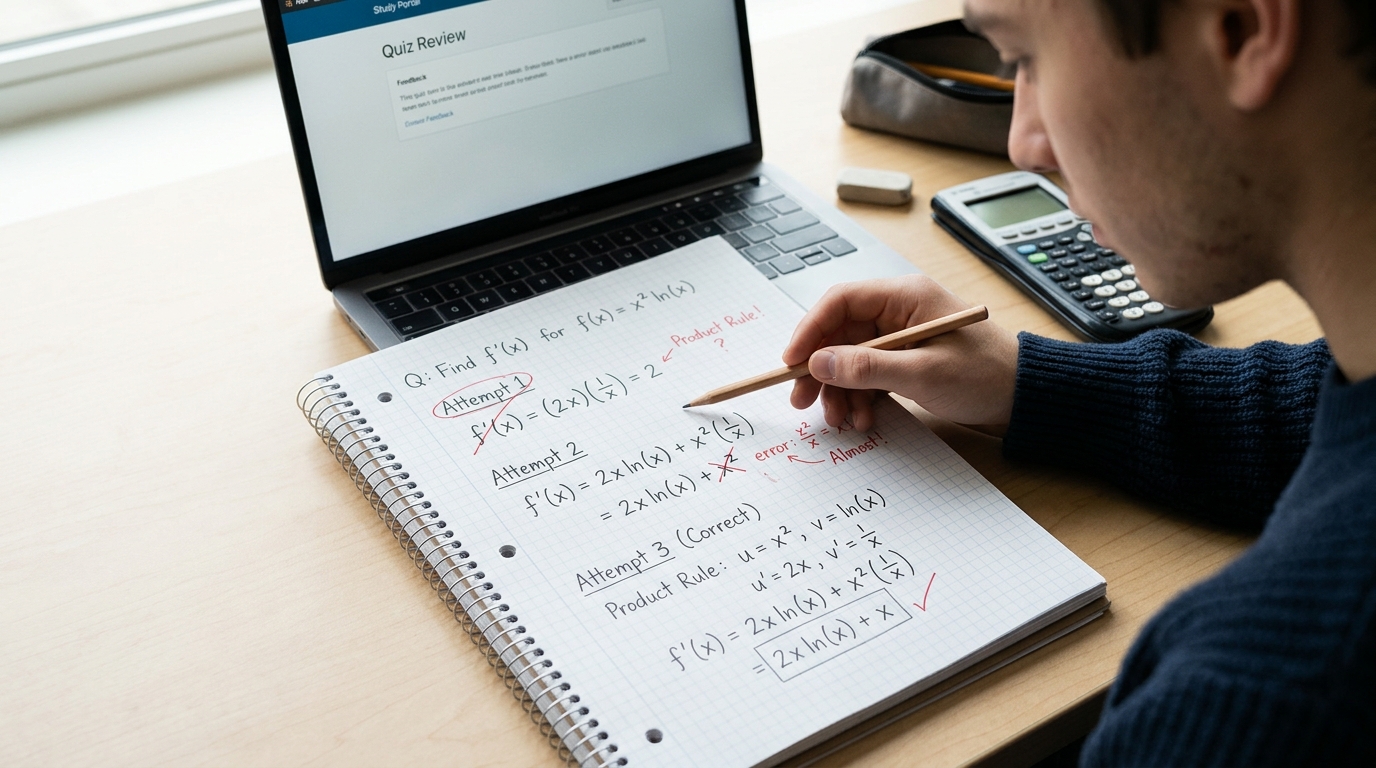
Your first attempt reveals your current understanding. Your second tests whether you can correct your mistakes. Your third helps you check whether you can apply what you have learned more independently.
Here is how to make all three attempts count.
Table of Contents
1. Your first attempt: Discover what you can do independently
The purpose of your first attempt is to understand your starting point.
Before requesting help or reading a worked solution, try to solve the question yourself. Write down the relevant information, choose a method, and show your mathematical working.
You do not need to get everything right. In fact, an unsuccessful attempt can provide useful information about what you need to practice.
During your first attempt, pay attention to where you struggle.
Did you know how to start?
If you could not identify the first step, you might need to improve your ability to recognise the mathematical concept being tested.
For example, a question may involve a function, but you may be unsure whether to use its graph, equation, derivative, or another property.
The problem may be method selection rather than calculation.
Did you choose the right method?
Perhaps you recognised the topic but selected an unsuitable technique.
This suggests that you need more practice connecting the wording of a question to the appropriate mathematical approach.
Did your calculations go wrong?
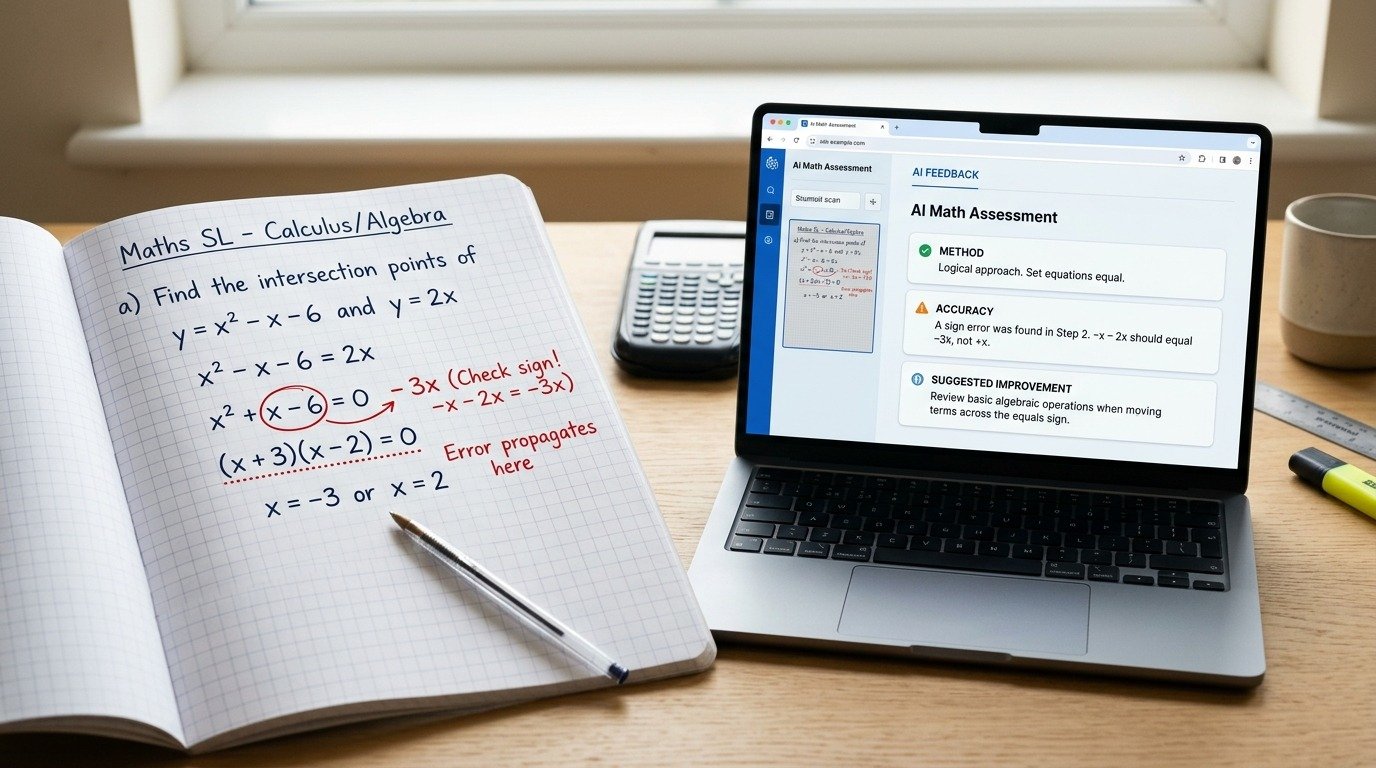
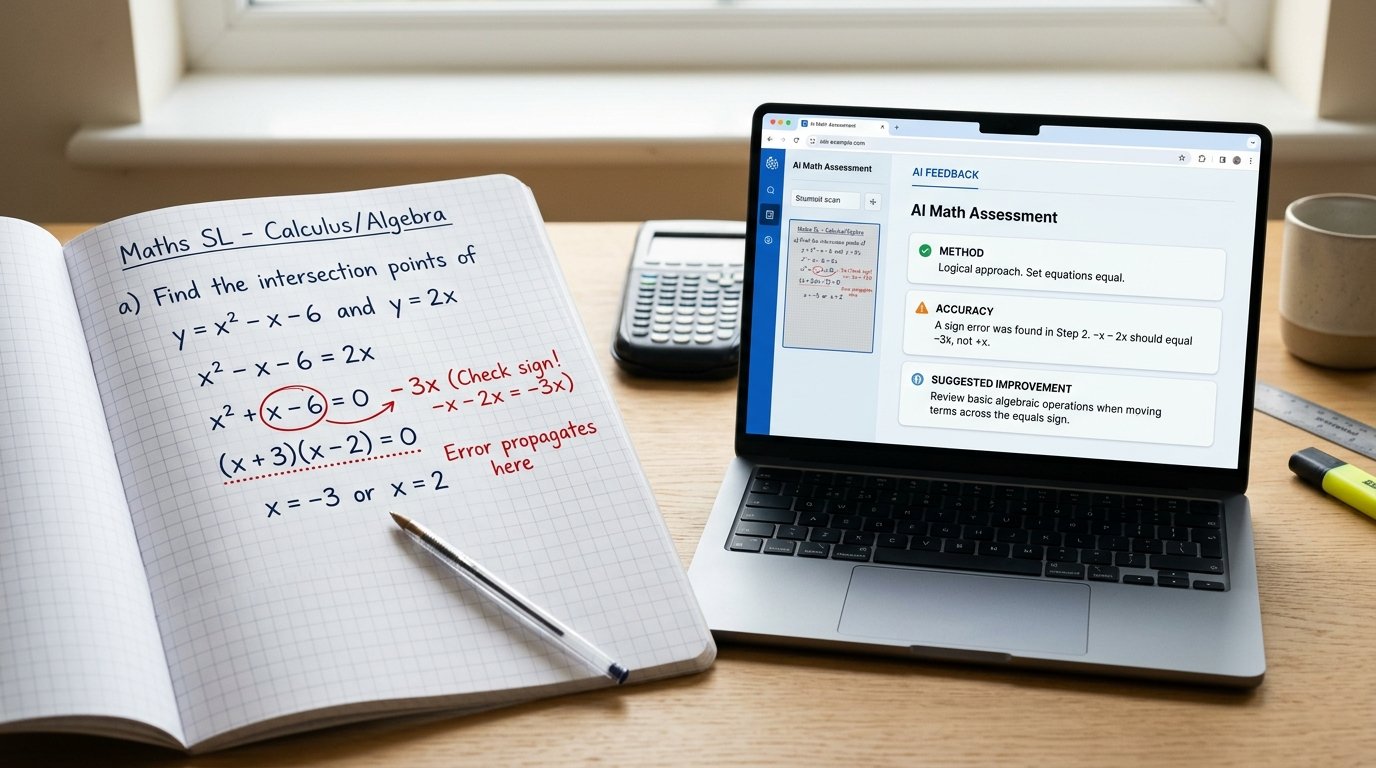
You might have selected the correct method and set up the problem properly but made an algebraic or arithmetic error.
In this case, revising the entire topic may be unnecessary. You may benefit more from targeted practice on the specific skill that caused the mistake.
Did you reach an answer without explaining your reasoning?
Some questions require you to show working, justify a conclusion, or interpret a result.
If your answer lacks the necessary reasoning, practise communicating the mathematics as well as calculating it.
The goal of your first attempt is not perfection. It is to reveal what you already understand and where you need help.
2. Your second attempt: Apply what you learned from the mistake
Once you have completed your first attempt, review the feedback or explanation before trying again.
However, avoid copying the complete solution immediately.
Start by identifying the first step that went wrong. Determine whether the problem involved your method, your calculations, or your understanding of the question.
Then study the relevant correction.
For example, imagine you are solving a quadratic equation. You choose the correct formula and substitute the coefficients correctly, but make a sign error while simplifying.
Your second attempt should focus on correcting that specific weakness.
Before restarting, ask yourself:
- What was the first incorrect step?
- Why was it incorrect?
- What should I do differently?
- Can I explain the corrected method without looking at the solution?
Once you can answer these questions, close the explanation and solve the question again.
Try to reproduce the reasoning rather than memorise the sequence of lines.
What if you still get it wrong?
Do not simply restart and repeat the same process.
Return to the point where your reasoning breaks down. You may need a clearer explanation of the underlying concept or more practice with an intermediate skill.
For example, if you repeatedly make errors when rearranging equations, practise that algebraic skill separately before returning to the full question.
Your second attempt is successful when you understand the correction and can apply it, even if you still need further practice to become consistent.
3. Your third attempt: Check whether you can solve it independently
The third attempt serves a different purpose.
By now, you have seen the question, reviewed the mistake, and attempted a correction. You need to check whether the method is becoming something you can use independently.
Return to the question without looking at your previous working or the explanation.
Start from the beginning.
Identify what the question requires, select your method, complete the calculations, and check your answer.
Then ask yourself whether you could explain why each major step was appropriate.
If you can solve the question independently, that is useful evidence of progress.
However, solving the same question again is not a complete test of mastery. You may remember its structure or specific answer.
For a stronger check, attempt a similar question that tests the same concept in a slightly different context.
If you can recognise the relevant method and complete the new problem, you have stronger evidence that you understand the underlying mathematics.
The real test is not whether you can repeat a solution. It is whether you can use what you learned when the question changes.
4. How Mathzem helps you learn from each attempt
Mathzem brings practice and feedback into a workflow designed to help students understand their mistakes.
You can use the platform to practise IB Mathematics questions, submit your working for AI Examiner feedback, and use AI Tutor when you need help understanding the mathematics.
Each tool serves a different purpose.
First attempt: Use IB Practice
Choose a relevant question and attempt it independently.
Write down your method and calculations so you have a record of your approach. This gives you something meaningful to review when you receive feedback.
Second attempt: Review AI Examiner feedback
Submit your working for review through Mathzem’s AI Examiner.
The Examiner is designed to analyse your submitted mathematical steps, identify mistakes or weak areas, and provide structured feedback.
Use that feedback to locate the part of your solution that needs attention.
If you do not understand why a particular step is incorrect, use Mathzem AI Tutor to ask about the relevant concept or method.
Third attempt: Correct and test your understanding
Return to the original question and solve it again without relying on the explanation.
Then practise a related question to check whether you can apply the same idea independently.
This creates a learning cycle:
Practise → Review → Understand → Correct → Practise again
The purpose is not to complete as many attempts as possible. It is to make each attempt more informative than the last.
Mathzem’s feedback is a learning aid, not a guarantee of official IB marks.
Explore Mathzem to learn more about its IB Mathematics practice and feedback tools.
5. How to compare your attempts properly
Simply recording that you got a question wrong on the first attempt and right on the third does not tell you everything you need to know.
You should compare the actual working.
Use these questions to review your progress.
| What to compare | What to look for |
|---|---|
| Starting method | Did you identify a suitable approach more confidently? |
| Mathematical steps | Did you correct the original error? |
| Accuracy | Did you reduce calculation and algebraic mistakes? |
| Reasoning | Can you explain why the method works? |
| Independence | Could you complete the question without help? |
| Transfer | Can you apply the method to a similar question? |
This comparison can reveal whether your improvement came from a genuine understanding of the mathematics or simply from remembering the solution.
For example, you might get the original question correct on your second attempt but still struggle with a similar question.
That is not wasted effort. It tells you that you have understood part of the process but need more practice applying it in a different context.
Use that information to decide what to practise next.
6. Keep a record of repeated mistakes
Some errors appear across several questions.
You might repeatedly forget a restriction on a logarithm, make sign errors during algebraic manipulation, or struggle to interpret a value in context.
If you treat every incorrect answer as an isolated event, you may miss the underlying pattern.
Instead, record the mistakes that recur.
For each important mistake, write down:
The question: What were you trying to solve?
The error: Which step was incorrect?
The cause: Why did the mistake happen?
The correction: What should you have done instead?
The next practice task: Which skill or question type should you practise?
For example, if you repeatedly make sign errors when rearranging equations, your next practice task should include questions that require similar algebraic manipulation.
You can use Mathzem’s Mistake Journal to track mistake patterns and revisit them during revision.
Over time, these records can help you distinguish between topics that need conceptual review and skills that need more accurate execution.
7. When should you stop repeating the same question?
Repeating a question can be useful, but endless repetition is not necessarily productive.
If you have completed three attempts and still cannot explain the method, return to the underlying concept. You may need a clearer explanation or additional practice with simpler examples.
If you can solve the original question independently but struggle with a similar one, practise transferring the method to different question formats.
If you can solve both confidently, move on to another question and return to the topic later to check that you still remember the method.
Your goal is not to reach a fixed number of attempts. It is to develop enough understanding to solve the relevant type of problem independently.
Some questions may require only one correction. Others may require several attempts and a review of the underlying mathematics.
Let the evidence from your work determine what you do next.
8. A practical three attempt revision routine
Use this routine whenever you encounter a question that challenges you.
Attempt one: Diagnose
Give yourself time to work independently. Record your method, calculations, and final answer. Identify where you became uncertain.
Review: Understand
Study the feedback and locate the first important mistake. Ask for additional explanation if you do not understand the correction.
Attempt two: Correct
Solve the question again without copying the solution. Focus on applying the corrected method.
Attempt three: Verify
Return to the question after putting away the explanation. Reproduce the reasoning independently and check your result.
Transfer practice: Apply
Try a related question. Check whether you can recognise the method and use it in a different context.
This routine turns a wrong answer into a structured learning opportunity.
It also helps you avoid two common revision habits: moving on immediately after getting a question wrong, and spending too much time rereading solutions without testing your understanding.
Final thoughts
Your first, second, and third attempts should not be identical learning experiences.
The first reveals your starting point. The second tests whether you can apply a correction. The third helps you check whether you can solve the question independently.
When you compare your working, review your mistakes, and practise related questions, you gain more useful information about your progress.
Mathzem supports this process through IB Practice, AI Examiner feedback, AI Tutor guidance, and tools such as the Mistake Journal.
Do not judge your progress only by how many questions you get right on the first try.
Judge it by whether you understand your mistakes, correct them, and become more independent on the next question.
Start your next practice session with Mathzem.