You finish an IB Mathematics question, check your final answer, and realise it is wrong.
Your first thought might be, “I got the whole question wrong final answer.”
But is that necessarily true?
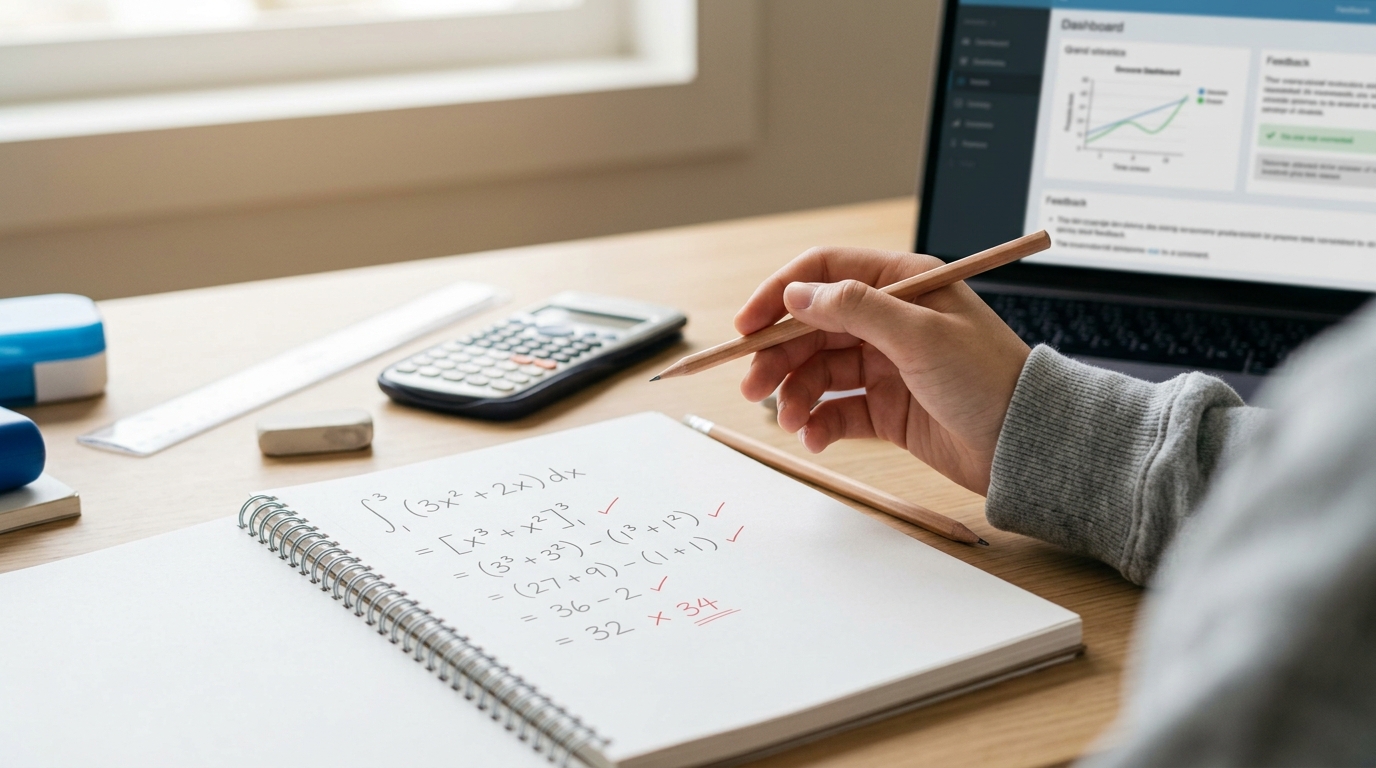
You might have chosen the correct method, substituted the right values, and shown several correct steps before making one calculation error. Your final answer would be incorrect, but your working could still demonstrate mathematical understanding.
This is why your working matters.
In IB Mathematics, marks may be available for relevant methods and intermediate steps, depending on the question and its marking criteria. Focusing only on the final answer can make it harder to understand what you did well and what needs improvement.
The goal is not simply to reach the correct answer. It is to develop a reliable mathematical approach and communicate your reasoning clearly.
Table of Contents
1. Why your wrong final answer does not tell the whole story
Imagine two students attempting the same equation.
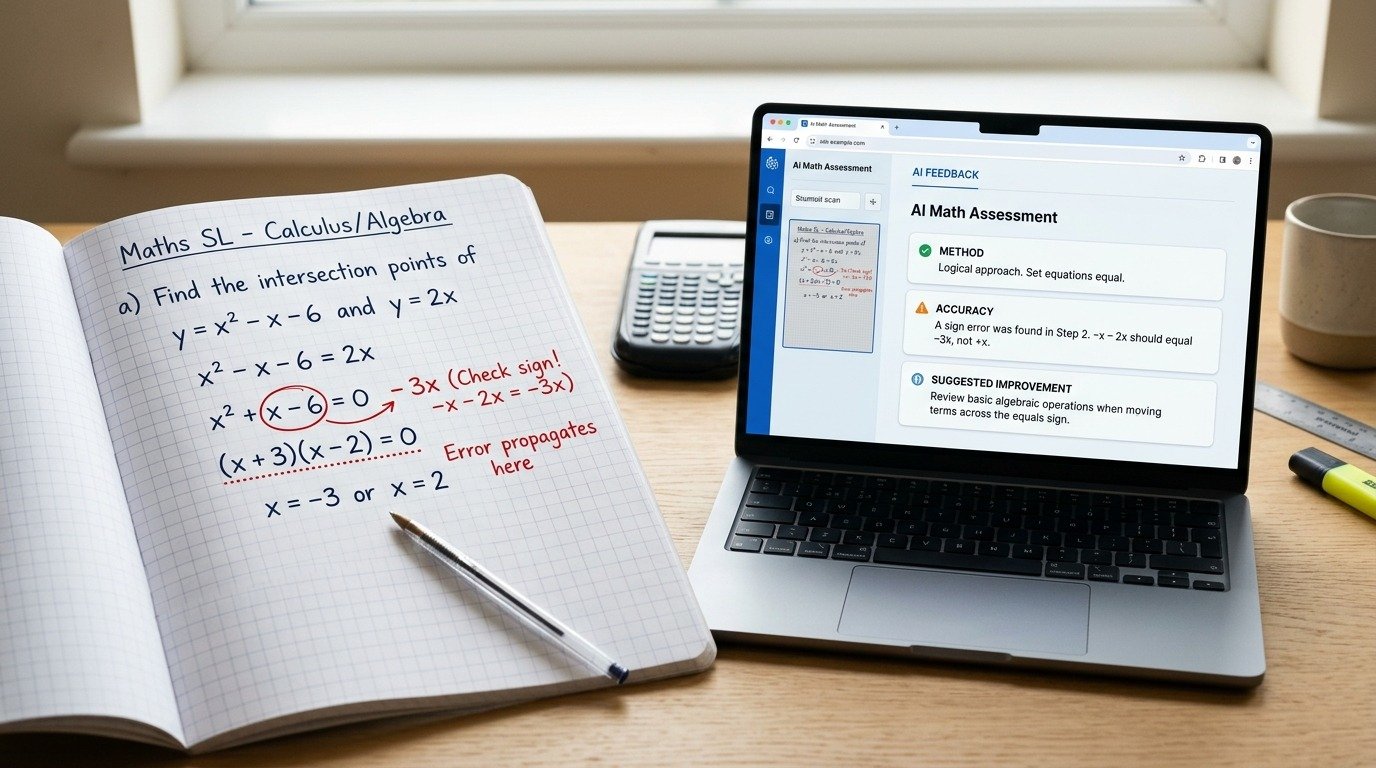
Student A chooses an appropriate method, shows the necessary steps, but makes an arithmetic error near the end.
Student B writes an incorrect answer without showing any working.
Both students have an incorrect final answer, but their written solutions provide different evidence of mathematical understanding.
Student A has demonstrated a relevant method and several intermediate steps. Student B has provided less information about how the answer was obtained.
The marks awarded depend on the actual question and its marking criteria. However, the example illustrates an important principle: an incorrect final answer does not automatically mean every preceding step is incorrect.
When reviewing your work, separate the question into three areas:
- Method: Did you choose a suitable approach?
- Accuracy: Did you calculate and simplify correctly?
- Communication: Did you show enough working to make your reasoning clear?
This gives you a more useful way to understand your performance than treating every incorrect answer as a complete failure.
2. What are method marks?
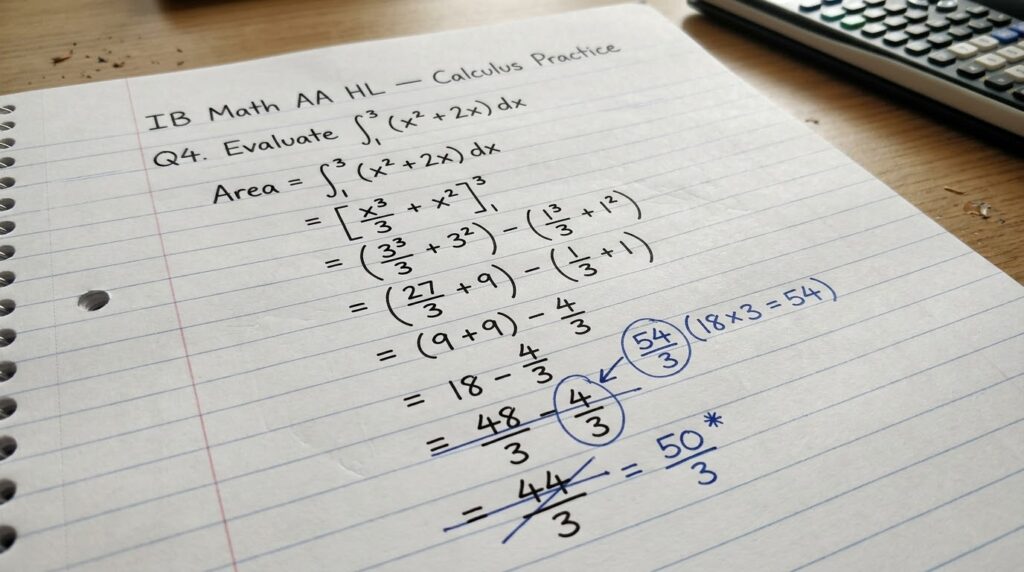
Method marks are marks associated with demonstrating an appropriate mathematical method or process, where the question’s marking criteria award them.
For example, a question may require you to solve an equation using a suitable technique. The marking criteria may award credit for selecting or applying the correct method, even if a later calculation error leads to an incorrect final result.
The exact allocation of marks varies by question. You should not assume that every question awards partial credit in the same way.
Nevertheless, showing your working gives the marker evidence of the process you followed.
Consider a quadratic equation:
[
x^2-5x+6=0
]
You correctly factorise the expression:
[
(x-2)(x-3)=0
]
Then you identify the roots:
[
x=2,\quad x=3
]
This is a correct solution. Now imagine that you factorise correctly but make an error when identifying one of the roots.
The incorrect final result does not change the fact that your factorisation was correct. The relevant marking criteria determine how that correct work is credited.
The lesson is straightforward: write the mathematical steps that demonstrate how you approached the problem.
3. Five common reasons students lose marks despite understanding the topic
Sometimes students know the mathematics but struggle to demonstrate that understanding consistently in an exam.
Here are five common situations to watch for.
Mistake 1: Skipping intermediate steps
You may perform several calculations mentally and write only the final result.
This can make your solution difficult to follow and leave little evidence of how you reached the answer.
What to do instead: Show the important equations, substitutions, and transformations. You do not need to write down every trivial mental calculation, but your solution should make the main reasoning clear.
Mistake 2: Making an arithmetic error
You choose the correct formula and substitute the values correctly, but make an error while calculating.
What to do instead: Check the calculation at the point where it occurs. If possible, substitute your result back into the original equation or use another appropriate method to verify it.
Mistake 3: Using an unsuitable method
You understand the topic but choose a technique that does not correctly address the question.
For example, you might apply a formula without checking whether its conditions are satisfied.
What to do instead: Before calculating, identify what the question asks you to find and why your chosen method is appropriate.
Mistake 4: Giving an incomplete explanation
Some questions require more than a numerical result. You may need to justify a conclusion, interpret a value, or explain a mathematical relationship.
What to do instead: Read the question carefully and check what evidence it requests. Include a clear conclusion when appropriate.
Mistake 5: Not answering the question that was asked
You might calculate a correct intermediate value but fail to provide the requested quantity or interpret it in context.
What to do instead: Return to the wording of the question before finishing. Check that your final statement addresses the actual requirement.
These mistakes are different from one another. That is why reviewing the working is more useful than simply recording whether an answer was correct or incorrect.
4. How to review an incorrect IB Mathematics solution
When you get a question wrong, resist the urge to erase everything and immediately start again.
Instead, work through the following review process.
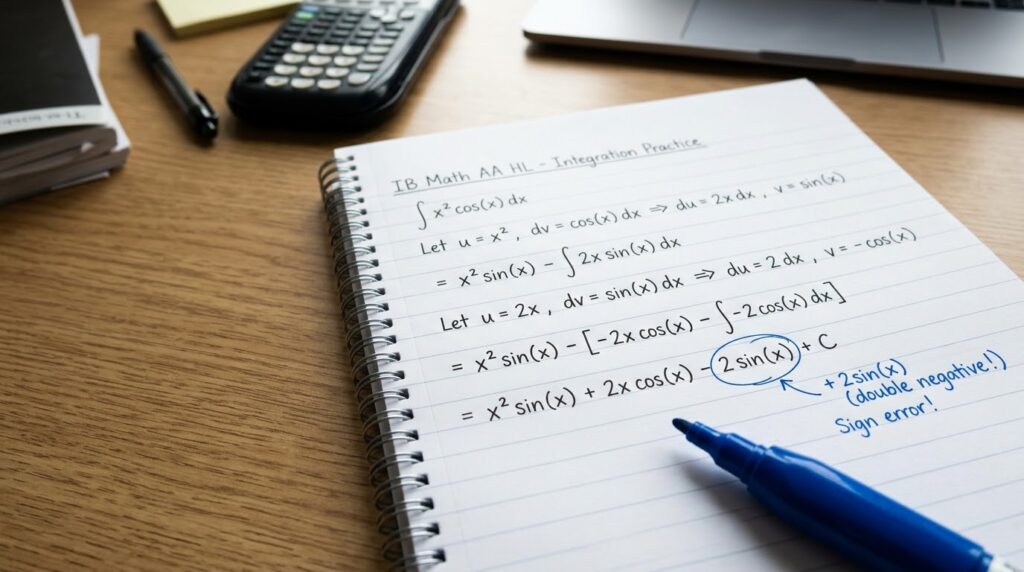
Step 1: Find the first incorrect step
Start at the beginning of your solution and check each line.
Identify the earliest step where your reasoning, method, or calculation became incorrect.
This is important because a mistake early in a solution can affect several later steps. Correcting only the final line may hide the real cause of the problem.
Step 2: Separate correct work from incorrect work
Look at the steps before the error.
Did you identify the right formula? Was your substitution correct? Did you simplify the expression properly?
Recognising the parts you handled correctly helps you avoid revising material you already understand.
Step 3: Identify the type of mistake
Classify the error as accurately as possible.
Was it a conceptual misunderstanding, a method selection problem, an algebraic error, an arithmetic slip, or an incomplete explanation?
If you cannot identify the cause, review the relevant concept before attempting the question again.
Step 4: Correct the solution
Rewrite the incorrect step and continue the calculation from that point.
Make sure you understand why the correction works. Simply copying the correct step does not guarantee that you will recognise the same issue in another question.
Step 5: Try a similar question
Once you have corrected your original solution, attempt another question that tests the same skill.
This is a practical way to check whether you have learned from the mistake rather than merely memorised the answer.
5. How Mathzem AI Examiner can help you review your working
Checking your own solution is useful, but it can be difficult to identify mistakes when you are unsure what went wrong.
Mathzem AI Examiner is designed to review submitted mathematical working and provide structured feedback based on the question and relevant reference material.
Instead of focusing only on your final answer, it is designed to evaluate the visible mathematical steps, consider different question parts, identify mistakes or weak areas, and suggest a useful next step.
Here is how you can use it as part of your revision routine.
First, attempt the question independently. Write down your method, calculations, and reasoning.
Next, submit your working for review. Make sure your writing and mathematical notation are clear enough to interpret.
Then, study the feedback. Look for the specific step or method that needs attention, rather than focusing only on the overall result.
Finally, correct your work and practise again. Use the feedback to identify what to change and attempt a related question to test your understanding.
Mathzem AI Examiner provides examiner style feedback, not official IB marking. Its feedback should be used as a learning aid rather than a guarantee of the marks an IB examiner would award.
You can explore Mathzem at mathzem.com.
6. Why showing your working can improve your revision
Showing working is not only useful for assessment. It also improves the quality of your own revision.
When you write down your method, you create a record that you can review later. You can see whether your mistakes occur during formula selection, algebraic manipulation, calculations, or interpretation.
Over time, this may reveal patterns in your work.
For example, you might discover that you consistently choose the right method but make errors when rearranging equations. In that case, practising more difficult questions from unrelated topics may not be the most effective use of your time.
You may benefit more from targeted algebra practice, followed by questions that require you to apply those skills in different contexts.
Alternatively, you might calculate accurately but struggle to explain your reasoning. You can then practise writing clearer solutions and interpreting what the question requires.
The more information you preserve in your working, the easier it becomes to identify what to practise next.
7. Build a better habit after every wrong answer
A wrong answer should lead to a decision about what to do next.
Use this checklist whenever you complete a difficult IB Mathematics question.
- Have I identified the first incorrect step?
- Can I explain why that step was wrong?
- Do I understand which parts of my original method were correct?
- Have I rewritten the solution with the correction?
- Can I solve a similar question without looking at the explanation?
If you cannot answer one of these questions confidently, you have identified an area that needs more attention.
You do not need to spend the same amount of time reviewing every mistake. A small arithmetic slip may require a quick correction, while a conceptual misunderstanding may need a more thorough review.
The important thing is to make your next action depend on what you learned from the attempt.
Final thoughts
An incorrect final answer can hide useful evidence of mathematical understanding.
Your method, intermediate calculations, and reasoning help show where you made progress and where your solution went wrong. When you review those details carefully, you can distinguish a small calculation error from a deeper gap in understanding.
Mathzem AI Examiner is designed to support this process by reviewing your submitted working and providing structured feedback on your mathematical approach.
Attempt the question, examine the feedback, correct the mistake, and practise the skill again.
Do not let one wrong answer convince you that you understood nothing. Find the first mistake, learn from it, and use your next attempt to improve.
Start your next IB Mathematics practice session with Mathzem.