
IB Math Practice Questions: More Questions Aren’t Always Better
If you’re preparing for an IB Math exam, you’ve probably heard the same advice many times:
Do more practice questions.
The advice isn’t wrong.
Practice is essential for learning mathematics. But there is a problem with treating the number of questions you complete as the main measure of preparation.
A student who completes 100 questions without reviewing their mistakes may learn less than a student who completes 40 carefully selected questions and analyses every important error.
Effective IB Math practice isn’t about racing through the biggest possible question bank.
It’s about using questions to develop several different skills:
- Understanding mathematical concepts
- Choosing the correct method
- Applying mathematics to unfamiliar situations
- Communicating your working
- Checking your answer
- Recognising recurring mistakes
- Working under time pressure
- Identifying what you need to practise next
The IB’s mathematics courses place importance on problem solving, reasoning, communication, and interpretation, as well as mathematical knowledge and the appropriate use of technology. Students therefore need practice that goes beyond repeating identical procedures.
This guide explains how to use IB Math practice questions in a way that makes each practice session more useful.
Table of Contents
Why IB Math Practice Questions Matter
Mathematics is learned partly through doing.
You can read an explanation of differentiation and understand every sentence. But that doesn’t necessarily mean you’ll recognise when differentiation is required in an unfamiliar exam question.
You can watch someone solve a probability problem and follow every step. But that doesn’t prove you can choose the correct approach independently.
Practice exposes that difference.
When you attempt a question without help, you discover whether you can actually:
- Understand the information given
- Identify what the question wants
- Select an appropriate method
- Carry out the mathematics
- Communicate your reasoning
- Interpret the result
That makes practice questions a diagnostic tool, not just a way to keep busy.
What Makes a Good IB Math Practice Question?
Not every question has the same purpose.
A useful practice set should contain questions that challenge different parts of your mathematical ability.
1. Concept questions
These test whether you understand the underlying mathematics.
For example, a question might ask you to identify a property, explain a relationship, or apply a basic definition.
These questions are useful when you’ve recently learned a topic.
2. Skill questions
These give you an opportunity to practise a particular mathematical procedure.
For example:
- Differentiating a function
- Solving an equation
- Finding a probability
- Applying a statistical method
- Working with vectors
These questions help develop accuracy and fluency.
3. Application questions
These place the mathematics into a context.
The mathematical method may not be stated directly.
You have to decide what to do.
4. Unfamiliar questions
These are particularly important for exam preparation.
The question may combine concepts, present information differently, or require you to decide how to approach the problem.
The IB identifies problem solving as an important part of mathematics, including applying mathematical knowledge in different situations.
If all your practice questions look exactly like the examples you’ve already studied, you may become very good at recognising patterns without becoming equally good at solving unfamiliar problems.
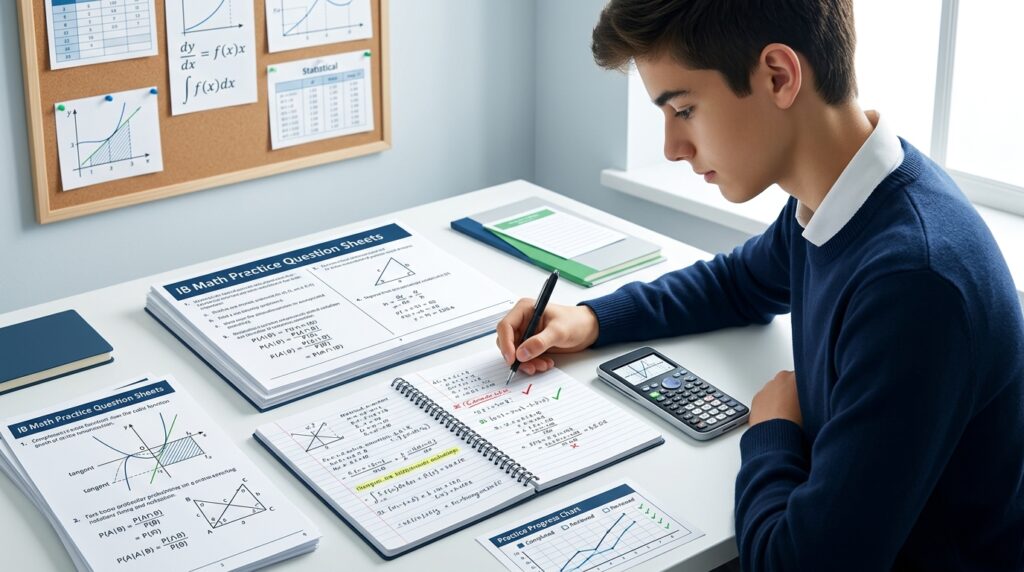
The Best IB Math Practice Progression
A useful practice progression is:
Understand → Practise → Mix → Apply → Challenge → Simulate
Each stage has a different purpose.
Stage 1: Understand
Start with questions where the mathematical method is relatively clear.
Your goal is to understand the process.
Don’t rush through this stage.
If you don’t understand why a method works, move back to the concept before attempting dozens of additional questions.
Stage 2: Practise
Complete several questions using the same underlying skill.
This develops fluency.
For example, after learning a differentiation technique, solve several problems that require that technique.
Focus on:
- Correct notation
- Accurate algebra
- Efficient working
- Correct final answers
Stage 3: Mix
Now combine different question types.
Instead of being told:
“Use integration by parts.”
you might simply receive a collection of calculus questions.
You must decide which technique applies.
This is a major step toward exam readiness.
Stage 4: Apply
Move into contextual and real world problems.
Now ask yourself:
What mathematics describes this situation?
That is different from:
Which formula did my teacher tell me to use?
Stage 5: Challenge
Attempt unfamiliar and more demanding questions.
Expect to struggle.
Getting stuck isn’t automatically a sign that the practice was unsuccessful.
It may mean the question has exposed a skill you haven’t developed yet.
Stage 6: Simulate
Finally, practise under exam conditions.
Use mixed questions or full past papers.
Work within the appropriate time limit.
Don’t use notes.
Use your permitted calculator and equipment.
Then analyse the result.
How Many IB Math Practice Questions Should You Do?
There is no universal number.
Ten carefully reviewed questions can be more useful than fifty questions completed mechanically.
Instead of asking:
“How many questions should I do today?”
Ask:
“What skill am I trying to improve?”
For example, suppose you’re struggling with probability.
A focused session could look like this:
Question 1: Basic conditional probability
Question 2: Similar conditional probability
Question 3: Conditional probability in a different context
Question 4: Mixed probability question
Question 5: Unfamiliar exam style question
Then review all five.
If you made a mistake on Question 3, don’t automatically move on.
Understand the mistake.
Redo the question.
Then try another similar question.
That is productive practice.
Practise by Topic First
Topic based practice is particularly useful when you don’t yet feel confident with the syllabus.
For example, you might choose:
Functions
Then practise:
- Domain and range
- Composite functions
- Inverse functions
- Graph transformations
- Function modelling
You can do the same with calculus, statistics, probability, vectors, sequences, geometry, or other areas relevant to your course.
Topic based practice helps answer:
“Can I do this particular type of mathematics?”
But it has a limitation.
In an exam, nobody usually tells you:
“This is a conditional probability question.”
You have to recognise the mathematics yourself.
That’s why topic practice should eventually become mixed practice.
Then Mix Your IB Math Questions
Once you’ve developed reasonable confidence in individual topics, remove the labels.
Imagine you have ten questions:
• One functions question
• Two calculus questions
• One statistics question
• Two probability questions
• One sequence question
• One geometry question
• Two questions combining concepts
Now you need to decide what mathematics applies.
This is much closer to the decision making required in an exam.
Mixed practice is especially useful for students who say:
“I can do the questions when I know what topic they are.”
That statement usually means the mathematical technique may be understood, but method recognition still needs work.
Practise Unfamiliar IB Math Questions
Unfamiliar questions can feel uncomfortable because they don’t immediately resemble something you’ve already seen.
That’s exactly why they’re valuable.
When you encounter one, don’t immediately look at the answer.
Try this process.
Step 1: Read the question carefully
Don’t calculate yet.
Identify what information has been provided.
Step 2: Identify the goal
What exactly are you being asked to find, prove, estimate, explain, or interpret?
Step 3: Identify relevant mathematics
Think about possible concepts or relationships.
Step 4: Write something useful
This could be:
- An equation
- A definition
- A diagram
- A known relationship
- An relevant formula
- A substitution
You don’t necessarily need to know the complete solution before starting.
Step 5: Review your approach
Ask:
Does this mathematical statement connect the information given to what I need?
If yes, continue.
If not, reconsider your approach.
This process makes unfamiliar questions less intimidating because you aren’t expecting yourself to see the entire solution immediately.
Don’t Check Only the Final Answer
This is one of the most important rules for IB Math practice.
Suppose your answer is:
[
x=3.72
]
and the expected answer is:
[
x=3.72
]
You might mark the question as correct and move on.
But what if you used an unnecessarily complicated method?
What if you made a mistake in an earlier step and happened to correct it later?
What if your calculator entry wasn’t clearly supported by your working?
What if you didn’t answer the interpretation part of the question?
A final answer doesn’t tell you everything about the quality of your solution.
Your working contains much more information.
Review Your Working After Every Important Mistake
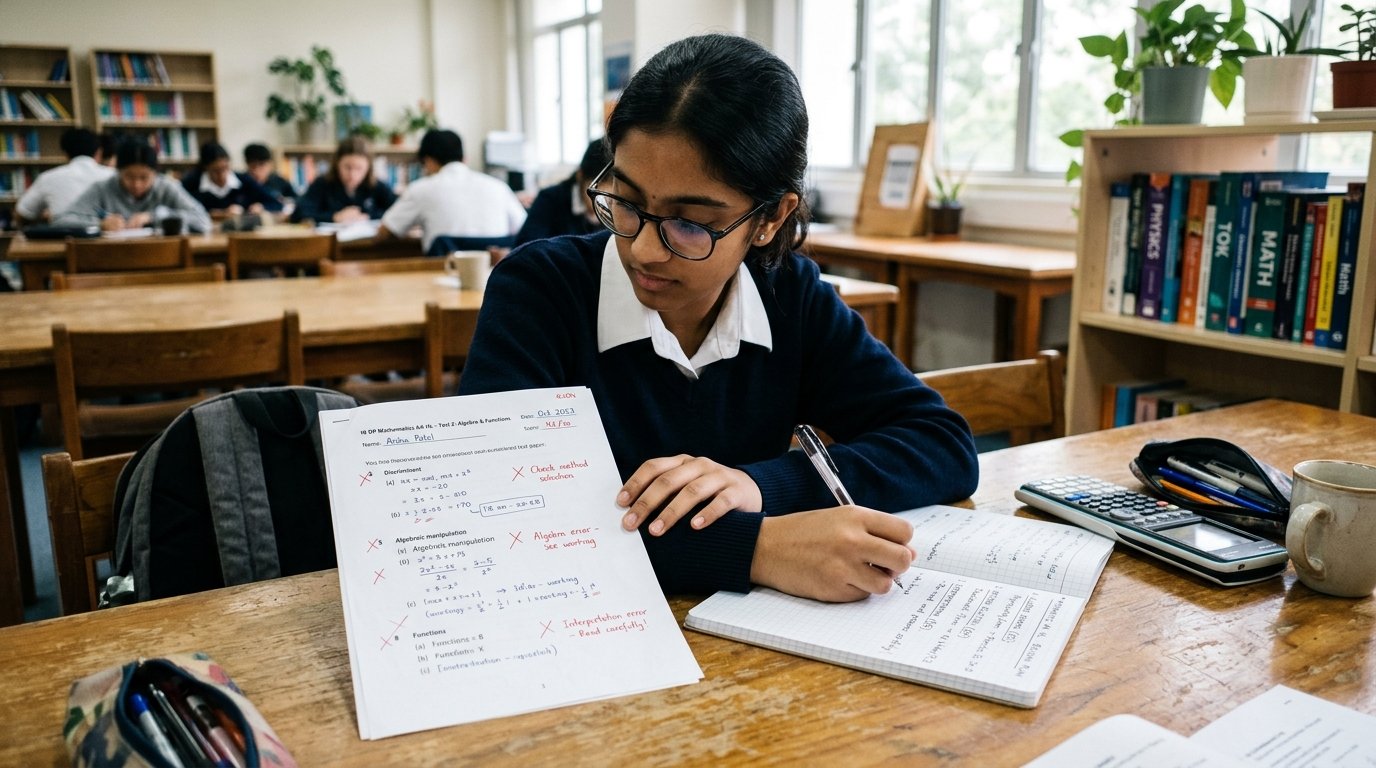
When you get a question wrong, don’t immediately copy the correct solution.
First find the point where your reasoning went wrong.
Ask:
What was my first incorrect step?
This is often more useful than identifying the final incorrect line.
Then ask:
Why did I make that mistake?
Possible reasons include:
- I didn’t understand the concept.
- I selected the wrong method.
- I misunderstood the wording.
- I made an algebra error.
- I entered something incorrectly into my calculator.
- I rounded too early.
- I forgot to interpret the result.
- I rushed.
Finally:
What should I do differently next time?
Write one specific action.
For example:
“Before solving a probability problem, identify the events and check whether the question involves conditional probability.”
That becomes a revision rule.
Turn Wrong Questions Into New Practice
A wrong answer shouldn’t be the end of the learning process.
Use this correction cycle:
Attempt → Identify error → Understand error → Redo → Similar question → Retest later
Suppose you make an error when finding the equation of a tangent.
Don’t simply read the solution.
Instead:
First
Identify the error.
Second
Review the relevant concept.
Third
Redo the original question without looking at the solution.
Fourth
Solve a similar question.
Fifth
Return to the concept later.
If you can solve the original question after seeing the explanation but still fail a similar question, the problem hasn’t been fully fixed.
Keep a Record of Repeated Mistakes
A mistake journal can make practice much more useful.
Record mistakes such as:
| Topic | Mistake | Why it happened | Next practice |
|---|---|---|---|
| Calculus | Wrong derivative | Formula confusion | 5 derivative questions |
| Probability | Misread condition | Rushed wording | 3 conditional probability questions |
| Statistics | Weak conclusion | Focused only on calculation | Practise interpretation |
| Algebra | Sign error | Rushed manipulation | Slow checking practice |
After several practice sessions, look for patterns.
You might discover that your biggest problem isn’t calculus.
It might be:
Rushing algebra inside calculus questions.
That changes your revision plan.
Use Practice Questions to Find Your Weaknesses
Your practice results should influence what you study next.
Imagine you complete 40 questions.
Your results show:
| Area | Questions | Correct | Accuracy |
|---|---|---|---|
| Functions | 8 | 7 | 88% |
| Calculus | 10 | 6 | 60% |
| Probability | 8 | 5 | 63% |
| Statistics | 7 | 6 | 86% |
| Algebra | 7 | 4 | 57% |
Your next revision session shouldn’t necessarily be:
“Study everything.”
You have evidence that calculus, probability, and algebra need more attention.
But even this data isn’t enough by itself.
You should also identify why the questions were wrong.
Two students can both score 60% in calculus for completely different reasons.
Student A doesn’t understand integration.
Student B understands integration but makes algebra errors.
They need different practice.
This is why feedback on the actual working matters.
Familiar Questions vs Unfamiliar Questions
A useful way to think about practice is through three levels.
Familiar
You recognise the question type quickly.
Purpose: Build fluency.
Similar
The question looks different but uses a method you’ve practised.
Purpose: Build recognition.
Unfamiliar
You need to determine what mathematics might apply.
Purpose: Build problem solving.
You need all three.
If you only solve familiar questions, your practice may feel comfortable but provide limited preparation for unfamiliar exam problems.
If you only solve difficult unfamiliar questions, you may spend too much time struggling with techniques you haven’t mastered.
Good practice balances the levels.
How to Use Mark Schemes Properly
Mark schemes can be useful after you’ve attempted a question.
But don’t use them as your first source of learning.
A mark scheme is designed primarily to show how marks are awarded. It isn’t necessarily written as a complete teaching explanation.
When reviewing a mark scheme, ask:
- What mathematical step earned this mark?
- What information did I fail to include?
- Did I use an acceptable alternative method?
- Was my notation clear?
- Did I reach the correct conclusion?
- Did I lose marks because of an earlier mistake?
Then rewrite the important reasoning in your own words.
The goal isn’t to memorise the mark scheme.
The goal is to understand what a successful solution demonstrates.
For more on this, Mathzem can build a dedicated resource around IB Math exam preparation.
How to Use a Calculator During Practice
Your calculator is an important tool, but calculator practice should not become calculator dependence.
Before entering a calculation, understand what you are trying to calculate.
Then check:
- Did you enter the correct expression?
- Is your calculator in the correct mode?
- Did you use brackets correctly?
- Is your answer reasonable?
- Should you give an exact answer or a decimal?
- Does the question require a particular level of accuracy?
A calculator can produce a precise answer to the wrong calculation.
Your mathematical reasoning still matters.
Practice Writing Complete Answers
IB Math practice shouldn’t train you to produce numbers only.
Depending on the question, your solution may need:
- Equations
- Mathematical notation
- Working
- Diagrams
- Units
- Justification
- Interpretation
- A conclusion
For example, if a question asks for the maximum height of an object in a real world context, writing only:
[
14.83
]
may not communicate the complete answer.
You may need to state what the value represents and include the appropriate unit.
Practice answering the question that was actually asked.
How to Build a 60 Minute IB Math Practice Session
You can structure a focused practice session like this.
5 minutes: Choose the target
Pick one skill or weakness.
Don’t start with:
“I’m going to practise Math.”
Start with:
“I’m going to improve my ability to solve conditional probability questions.”
20 minutes: Targeted questions
Complete several questions related to the skill.
15 minutes: Unfamiliar application
Attempt one or two questions where the method isn’t obvious.
10 minutes: Review
Analyse mistakes and compare your working with the expected solution.
5 minutes: Redo
Redo an important incorrect question without looking at the solution.
5 minutes: Plan
Write down what you need to practise next.
That final step turns one practice session into the starting point for the next.
A Weekly IB Math Practice Structure
If you’re preparing for an exam, you could use a structure like this:
| Day | Practice focus |
|---|---|
| Monday | Weak topic |
| Tuesday | Second weak topic |
| Wednesday | Mixed questions |
| Thursday | Unfamiliar applications |
| Friday | Weakness correction |
| Saturday | Timed practice |
| Sunday | Mistake review and light revision |
You can adapt the schedule around school, tutoring, coursework, and other subjects.
The key is not the exact day.
The key is variety.
Your week should contain both targeted practice and exam style application.
When Should You Use IB Math Past Papers?
Past papers are particularly valuable once you have enough knowledge to make the results meaningful.
A useful progression is:
Topic questions → Mixed questions → Past paper sections → Full past papers
Early in your preparation, topic questions help you repair specific weaknesses.
Later, past papers test whether those skills work together under exam conditions.
After completing a past paper, don’t stop at your score.
Create a post paper analysis.
Record:
Lost marks
Which questions?
Cause
Why?
Category
Knowledge, method, accuracy, interpretation, communication, or timing?
Correction
What should change?
Next practice
Which question or topic should you do next?
This makes each past paper more valuable.
What Mathzem Adds to IB Math Practice
A traditional practice cycle often looks like this:
Question → Answer → Correct or incorrect → Next question
The problem is that “incorrect” doesn’t tell you enough.
Why was it incorrect?
What part of the working failed?
Was the method wrong?
Was the question misunderstood?
Was the final answer wrong because of an earlier algebra error?
What should you practise next?
Mathzem is built around a more detailed practice cycle:
Choose → Solve → Upload → Receive feedback → Identify mistakes → Practise again
Students can use their working as part of the feedback process rather than relying only on whether the final answer matches.
This can help turn practice into a more structured learning process.
You can start with Mathzem IB Practice.
If you’re unsure which skills need attention, the Math Skill Scanner can help you identify areas to focus on.
Common IB Math Practice Mistakes
Doing questions without a purpose
If you don’t know what you’re trying to improve, practice can become random.
Better: Give each session a specific target.
Choosing only easy questions
Easy questions can build confidence but won’t fully prepare you for unfamiliar problems.
Better: Gradually increase difficulty.
Looking at the solution too quickly
If you look at the solution after thirty seconds, you haven’t really tested your ability.
Better: Give yourself time to think and attempt a useful first step.
Checking only the final answer
A correct answer doesn’t tell you whether your method is reliable.
Better: Review important working.
Repeating the same mistake
Reading a correction isn’t the same as learning from it.
Better: Redo the question and then solve a similar problem.
Counting questions instead of learning from them
Completing 50 questions isn’t automatically better than completing 20 carefully.
Better: Measure progress through accuracy, understanding, repeated mistakes, and performance on unfamiliar questions.
Avoiding difficult questions
Struggling can feel uncomfortable.
But difficult questions often reveal exactly what you need to improve.
Better: Use difficult questions diagnostically.
A Simple IB Math Practice Checklist
Before finishing a practice session, ask:
- Did I practise a specific skill?
- Did I attempt questions without looking at the solution?
- Did I include some questions where the method wasn’t obvious?
- Did I check my working, not just my final answers?
- Did I identify why I made mistakes?
- Did I redo important incorrect questions?
- Did I record any recurring errors?
- Do I know what I should practise next?
If you can answer yes to most of these, your practice is doing more than simply increasing your question count.
FAQs About IB Math Practice Questions
How many IB Math practice questions should I do each day?
There is no fixed number. Focus on completing enough questions to practise the target skill properly and review your mistakes. Five carefully analysed questions can be more useful than twenty rushed questions.
Should I practise IB Math questions by topic?
Yes, especially when you’re learning or repairing a weak topic. Once your understanding improves, move toward mixed questions so you have to identify the appropriate method yourself.
Are difficult IB Math questions better?
Not always. Easy and moderate questions help build accuracy and fluency. Difficult and unfamiliar questions help develop problem solving. Effective preparation needs both.
Should I use mark schemes after every question?
Use them after attempting the question. Don’t simply check whether your final answer matches. Analyse the working, marks awarded, and reasoning expected.
Why do I get IB Math practice questions right but struggle in exams?
You may be practising questions that are too familiar, solving them without time pressure, or receiving too much guidance about which method to use. Add mixed, unfamiliar, and timed practice to your preparation.
How can I turn wrong answers into useful revision?
Identify the first incorrect step, understand why it happened, redo the original question, solve a similar question, and revisit the skill later. This creates a correction cycle instead of simply moving on.
Conclusion: Practise With a Purpose
The best IB Math practice isn’t about completing the largest number of questions.
It’s about making each question teach you something.
Use straightforward questions to build understanding.
Use similar questions to develop fluency.
Use mixed questions to practise method selection.
Use unfamiliar questions to develop problem solving.
Use timed questions to develop exam technique.
And use your mistakes to decide what you should practise next.
The most useful practice cycle is:
Attempt → Review → Correct → Retest → Improve
That is much more powerful than:
Attempt → Check answer → Move on
If you’re ready to start practising, use Mathzem IB Practice and make your next practice session specific.
Don’t just ask:
“How many questions did I complete?”
Ask:
“What can I solve now that I couldn’t solve before?”


One Response