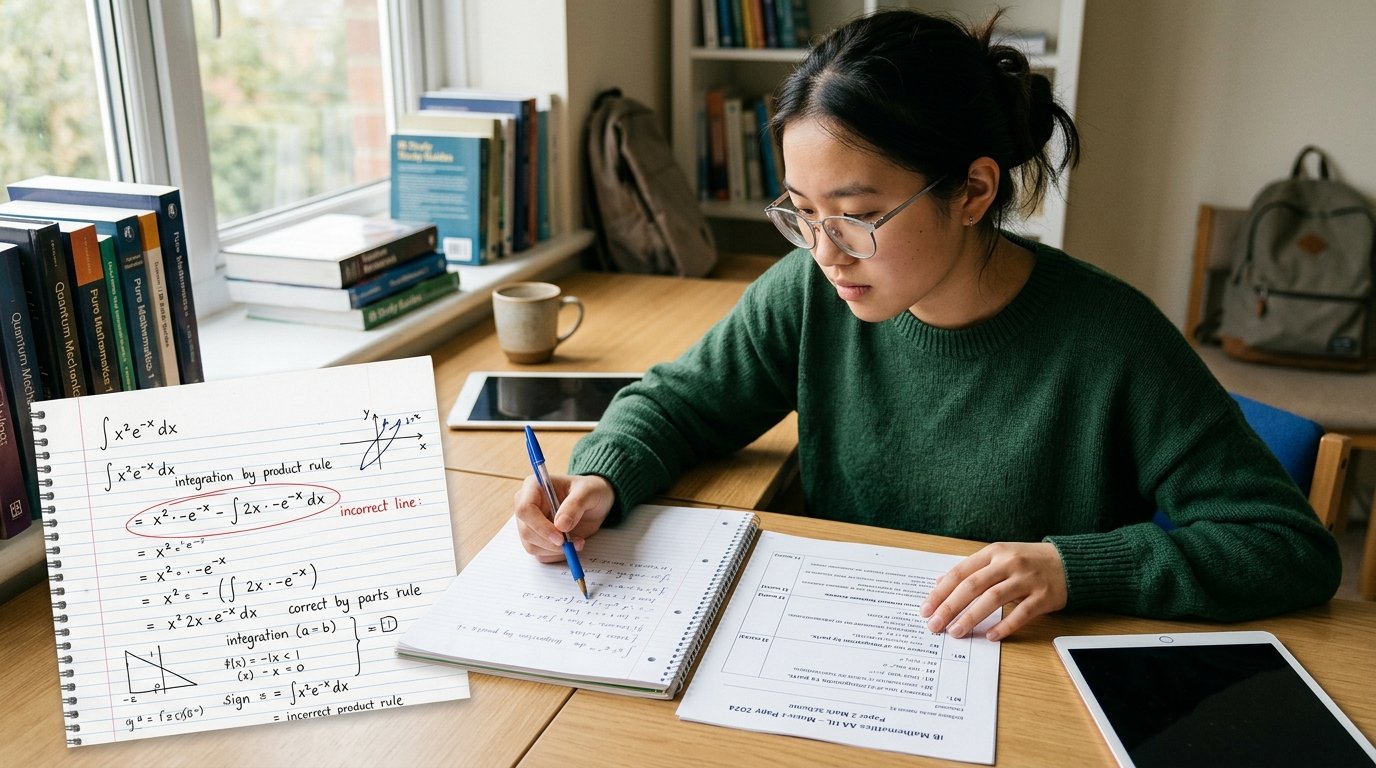
You open an IB Math practice question bank and choose a question.
You solve it.
Then you choose another.
Then another.
After an hour, you have completed twenty questions.
It feels productive.
But there is an important question to ask:
Why did you choose those twenty questions?
If the answer is simply “because they were next”, your practice may be missing something important.
Random IB Math questions can be useful. They expose you to different problems and prevent your revision from becoming too predictable.
But random practice does not necessarily respond to your weaknesses.
If you repeatedly make algebra errors, for example, doing another random calculus question may not help.
If you understand a topic but cannot recognise which method to use, completing another question that tells you the method may not develop that skill.
This is where personalised practice becomes useful.
The goal is not to eliminate random practice.
It is to know when random practice is useful and when your next question should be chosen because of what you have already learned about yourself.
Table of Contents
What is random IB Math practice?
Random practice means selecting questions without deliberately connecting each new question to the previous one.
You might choose:
A random topic.
A random subtopic.
A random question from a question bank.
Or simply the next question in a collection.
There is nothing inherently wrong with this.
Random questions can give you variety.
They can expose you to topics you have not practised recently.
They can also prevent you from becoming too comfortable with one particular question type.
The problem comes when random practice becomes your entire revision strategy.
The problem with doing questions at random
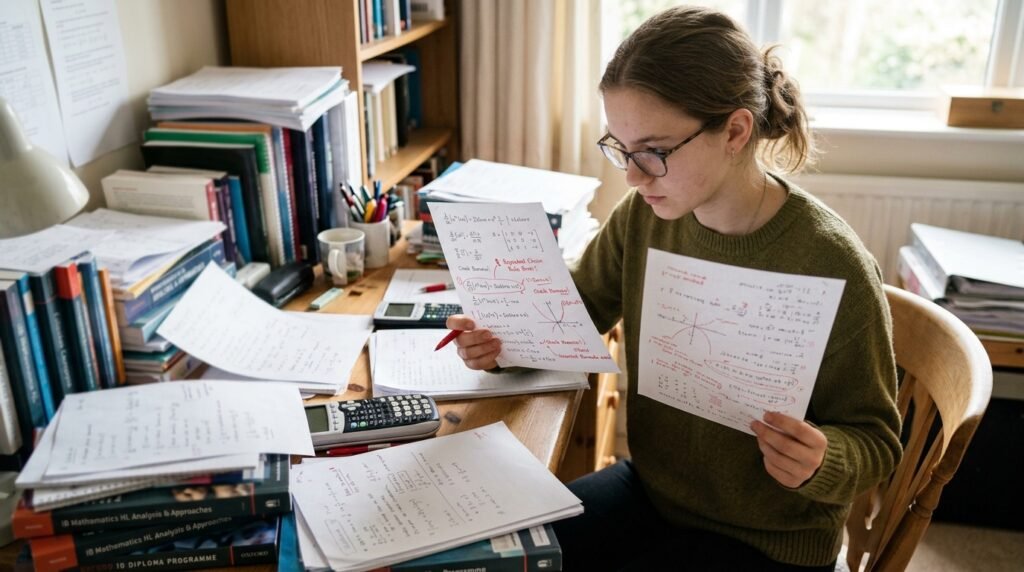
Imagine you have just made three algebra mistakes.
You finish reviewing them and immediately start another random question.
The new question happens to be about statistics.
You solve it correctly.
Then you get a probability question.
You solve that correctly too.
Then you get a straightforward calculus question.
Again, correct.
At the end of the session, you feel like you have had a good practice session.
But the algebra weakness is still there.
You have completed more questions without addressing the problem that caused the original mistakes.
This is the central weakness of completely random practice.
The next question does not know what happened in the previous one.
More questions do not automatically mean better practice
Question volume is easy to measure.
Learning is harder to measure.
You can say:
“I completed 30 questions today.”
But that does not tell you:
Whether you understood the questions.
Whether you made repeated mistakes.
Whether you chose the right methods.
Whether you can solve unfamiliar versions.
Whether your working is complete.
Whether you fixed an earlier weakness.
Mathzem’s existing guidance makes this distinction clearly: effective IB Math practice is not simply about completing the largest number of questions. The purpose of practice is to understand mistakes, correct them and use that information to guide further practice.
The question count is activity.
The change in your performance is what matters.
What is personalised IB Math practice?
Personalised practice starts with information about the student.
That information might include:
Recent mistakes.
Weak topics.
Skills that have not been practised recently.
Questions you struggled with.
Types of questions you can already solve reliably.
The difficulty of recent questions.
Your ability to apply a method in an unfamiliar context.
The next question is then chosen with some reason behind it.
For example:
You make repeated algebra errors.
Your next practice focuses on the relevant algebra skill.
You improve.
The next questions become more varied.
You then test whether the same skill works inside more complicated IB Math questions.
That is personalised practice.
Personalised does not mean every question must be different
There is another misconception here.
Some students think personalised practice means the system should produce a completely different question every time.
Not necessarily.
Sometimes the best next question is deliberately similar to the previous one.
Suppose you made an error while solving a particular type of equation.
The next question might test the same skill with different numbers.
That gives you an opportunity to correct the mistake.
After that, the next question can change the context.
Then you might try an unfamiliar exam style version.
The sequence becomes:
Similar skill → Different context → Mixed application → Unfamiliar question
Each step has a purpose.
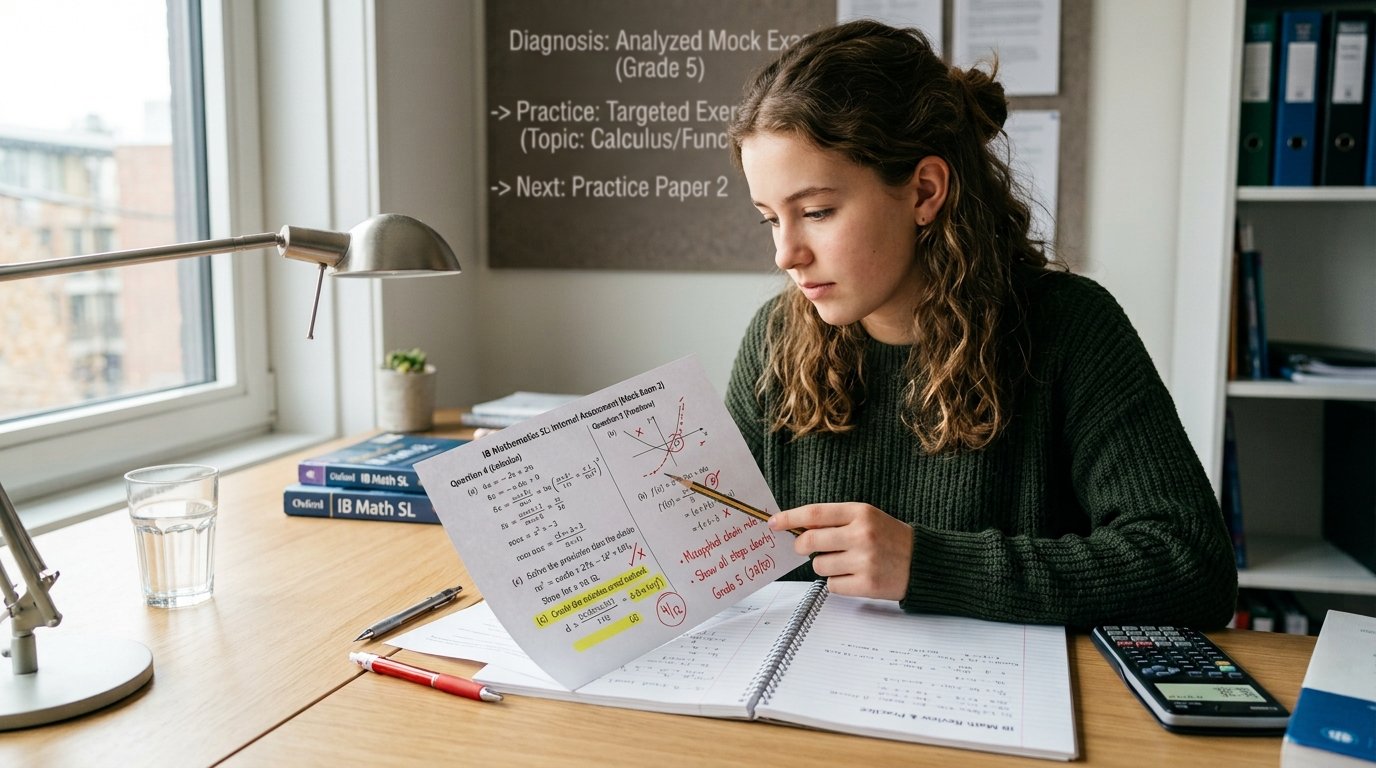
Personalised practice starts with diagnosis
You cannot personalise practice properly if you do not know what needs attention.
This is why reviewing your working matters.
Suppose you get a calculus question wrong.
There are several possibilities.
You may not understand differentiation.
You may understand differentiation but choose the wrong method.
You may choose the correct method but make an algebra mistake.
You may calculate correctly but fail to interpret the result.
These are four different problems.
If you simply record:
Calculus wrong
you have not learned enough to choose the best next question.
If you record:
Correct calculus method, but repeated algebra error during rearrangement
you have a much better starting point.
Topic based practice is not the same as personalised practice
This distinction matters.
Choosing “Calculus” from a question bank is more focused than choosing a completely random question.
But it is still not necessarily personalised.
You might already be strong at differentiation.
Your real weakness might be optimisation.
Or perhaps you understand optimisation but struggle to translate the wording into the correct mathematical model.
A topic gives you a category.
A personalised practice decision uses evidence about your performance inside that category.
Example: Two students, same topic
Imagine two students are practising probability.
Student A understands the concepts but makes frequent arithmetic mistakes.
Student B calculates accurately but struggles to recognise conditional probability questions.
They are studying the same topic.
But they need different practice.
Student A needs more attention to accuracy.
Student B needs more attention to recognising the structure of the question.
Giving both students the same random set of probability questions ignores that difference.
Personalised practice starts from the student’s actual difficulty.
Personalised practice should change as you improve
A good practice process should not permanently label you as weak in one topic.
Suppose you repeatedly make algebra mistakes.
You complete focused practice.
Your accuracy improves.
You then need a new challenge.
Perhaps the next step is applying the same algebra inside functions or calculus.
Eventually, the weakness may no longer need special attention.
Your practice should change with your performance.
This is important because personalisation is not simply about identifying weaknesses.
It is about responding when those weaknesses change.
What random practice is actually good for
Random practice still has an important role.
It tests recall
You cannot predict exactly which topic will appear in an examination.
Random questions can force you to retrieve mathematics without being told what chapter to think about.
It tests method selection
When the topic is not provided, you have to decide what mathematics might be useful.
This can be valuable exam preparation.
It exposes forgotten topics
You may discover that a topic you have not practised recently has become less reliable.
It prevents overfitting
If you practise ten almost identical questions, you can become very good at that particular pattern without being able to transfer the mathematics elsewhere.
Random and mixed questions help test transfer.
So the answer is not:
Random practice is bad.
The better conclusion is:
Random practice is useful at the right stage.
Use targeted practice when you have a known weakness
If your practice has revealed a specific problem, use that information.
For example:
You repeatedly lose signs during algebra.
Practise the relevant algebra skill.
You repeatedly choose the wrong method in unfamiliar calculus questions.
Practise mixed calculus problems where the method is not obvious.
You understand probability calculations but misread conditional information.
Practise questions that require you to identify the condition.
You lose marks because you do not explain your reasoning.
Practise complete written solutions.
The more specific the diagnosis, the more specific the next practice can be.
Then return to mixed practice
Targeted practice should not continue forever.
Once you have worked on a weakness, test whether the improvement transfers.
This is where mixed practice becomes important.
Suppose you have spent several sessions improving algebra accuracy.
Do not only solve isolated algebra questions.
Return to mixed IB Math questions.
Now algebra appears inside other topics.
Can you maintain the improvement when you are thinking about calculus?
What about functions?
What about probability?
This is a much stronger test.
You are no longer asking:
“Can I do this algebra exercise?”
You are asking:
“Can I use this skill reliably when the exam does not tell me to use it?”
The most useful practice cycle combines both approaches
A strong revision routine can combine targeted and random practice.
Stage 1: Diagnose
Complete a question.
Review your working.
Identify the first meaningful problem.
Stage 2: Target
Practise the specific skill that caused the problem.
Stage 3: Apply
Use the skill in a different context.
Stage 4: Mix
Return to questions where the method is not obvious.
Stage 5: Retest
Check whether the original weakness has actually improved.
This gives you both depth and breadth.
You are not trapped in one topic.
You are also not moving randomly from question to question without learning from the previous attempt.
How Mathzem supports this approach
Mathzem’s current IB Practice workflow lets students choose their course, topic and subtopic before attempting an exam style question.
After solving, students can upload their handwritten working for AI Examiner feedback.
The current feedback can show marks by question part, where and why marks were lost, weak areas and a recommended next step. The Student Dashboard also tracks weak topics, repeated mistakes and what to practise next.
That creates a useful distinction between choosing a question and choosing what to practise because of your previous performance.
For example:
You select a calculus question.
You solve it.
You upload your working.
The feedback identifies an algebra issue.
Instead of immediately pressing random question again, you can use that information to decide what needs attention.
That is the important part.
The technology is useful when it helps turn feedback into a better practice decision.
What personalised practice should not mean
Personalised practice should not mean making every question easy.
If a system only gives you questions that you can already solve, you may feel successful without developing further.
It should also not mean jumping to the hardest possible question after every mistake.
Difficulty should have a purpose.
If your basic algebra is unreliable, an extremely difficult calculus problem may not help.
If your algebra is strong, staying with simple algebra questions forever will not challenge your application.
Personalisation means choosing a useful level of challenge for the skill you are trying to develop.
How to know when you need targeted practice
Ask yourself these questions after a session:
Did I make the same type of mistake more than once?
Did I struggle with the same skill across different topics?
Did I understand the solution but fail to reproduce it independently?
Did I know the mathematics but struggle to start?
Did I lose marks for the same reason in several questions?
If the answer is yes, your next practice should probably be more targeted.
How to know when you need random or mixed practice
Ask:
Can I solve the individual skills reliably?
Can I recognise which method to use without being told?
Can I transfer the skill to a different context?
Have I been practising only one topic recently?
Am I becoming too comfortable with predictable question types?
If the answer is yes, mixed or unfamiliar practice can provide a useful test.
A practical 30 minute IB Math session
You can combine both approaches in one short session.
First 10 minutes: Target a weakness
Choose a skill that recent practice shows needs attention.
Complete one or two focused questions.
Next 10 minutes: Change the context
Complete a question where the same skill appears in a less obvious way.
Do not rely on the question telling you what method to use.
Final 10 minutes: Go mixed
Complete a question from a different topic.
Now test whether you can select the mathematics independently.
At the end, review your working.
You may discover that the weakness has improved.
Or you may discover that it appears again.
Either result is useful.
Do not confuse personalisation with prediction
A practice system does not need to predict exactly which question will make you improve.
That is not how learning works.
Instead, it should use evidence.
Your attempts provide evidence.
Your mistakes provide evidence.
Your repeated patterns provide evidence.
Your performance on follow up questions provides evidence.
The more useful question is:
“What does my recent work suggest I should practise?”
That is more grounded than trying to find a magical perfect question.
A simple decision tree for your next question
After completing an IB Math question:
If you did not understand the concept:
Review the concept, then practise a straightforward example.
If you knew the concept but chose the wrong method:
Practise method selection and mixed questions.
If your method was correct but your calculation failed:
Target the specific accuracy issue.
If you understood the mathematics but misunderstood the wording:
Practise interpreting unfamiliar questions.
If you got everything correct comfortably:
Try a less familiar version or move to mixed practice.
If the same mistake keeps appearing:
Make that skill a revision priority.
This is a simple way to make your practice more responsive.
The best approach is not random versus personalised
It is tempting to treat these as competing methods.
They are not.
They solve different problems.
Random and mixed practice help you test whether you can retrieve and apply mathematics without being told what to expect.
Targeted practice helps you repair a specific weakness.
You need both.
The important thing is knowing when to switch between them.
A useful pattern is:
Diagnose → Target → Apply → Mix → Retest
That gives your revision a reason at every stage.
FAQs About IB Math Practice
Is random IB Math practice useful?
Yes. Random and mixed questions can help with recall, method selection and applying mathematics when the topic is not given. They are particularly useful after you have worked on specific weaknesses.
Is personalised IB Math practice better than random practice?
They serve different purposes. Personalised practice is useful when you have identified a specific weakness. Random or mixed practice is useful for testing whether you can choose and apply mathematics independently.
How do I personalise my IB Math revision?
Start with your recent practice. Identify repeated mistakes, weak skills and areas where you struggle with unfamiliar questions. Then choose practice that directly addresses those problems.
Should I only practise my weak IB Math topics?
No. Target weak areas, but continue maintaining topics where you are already strong. Mixed practice is also important because exams do not tell you exactly which method to use.
How does Mathzem personalise IB Math practice?
Mathzem currently lets students choose their IB course, topic and subtopic, then provides AI Examiner feedback after students upload their working. The feedback includes marks, mistakes, weak area information and next step guidance, while the Student Dashboard tracks weak topics, repeated mistakes and what to practise next.
How many IB Math questions should I practise each day?
There is no useful universal number. The quality and purpose of the questions matter. A session should give you enough practice to identify and work on a skill rather than simply maximise the number completed.
Conclusion
Random questions have a place in IB Mathematics revision.
They can test recall.
They can expose forgotten topics.
They can make you choose methods independently.
They can show whether you can transfer mathematics to unfamiliar problems.
But random practice has a limitation.
It does not automatically respond to what you did wrong.
That is why personalised practice matters.
When your working reveals a specific weakness, use that information.
Target the skill.
Practise it.
Change the context.
Return to mixed questions.
Then retest yourself.
The most useful revision strategy is not:
Random or personalised?
It is:
Target when you need to improve. Mix when you need to test.
Your practice should respond to your performance.
And every question should give you information about what to do next.