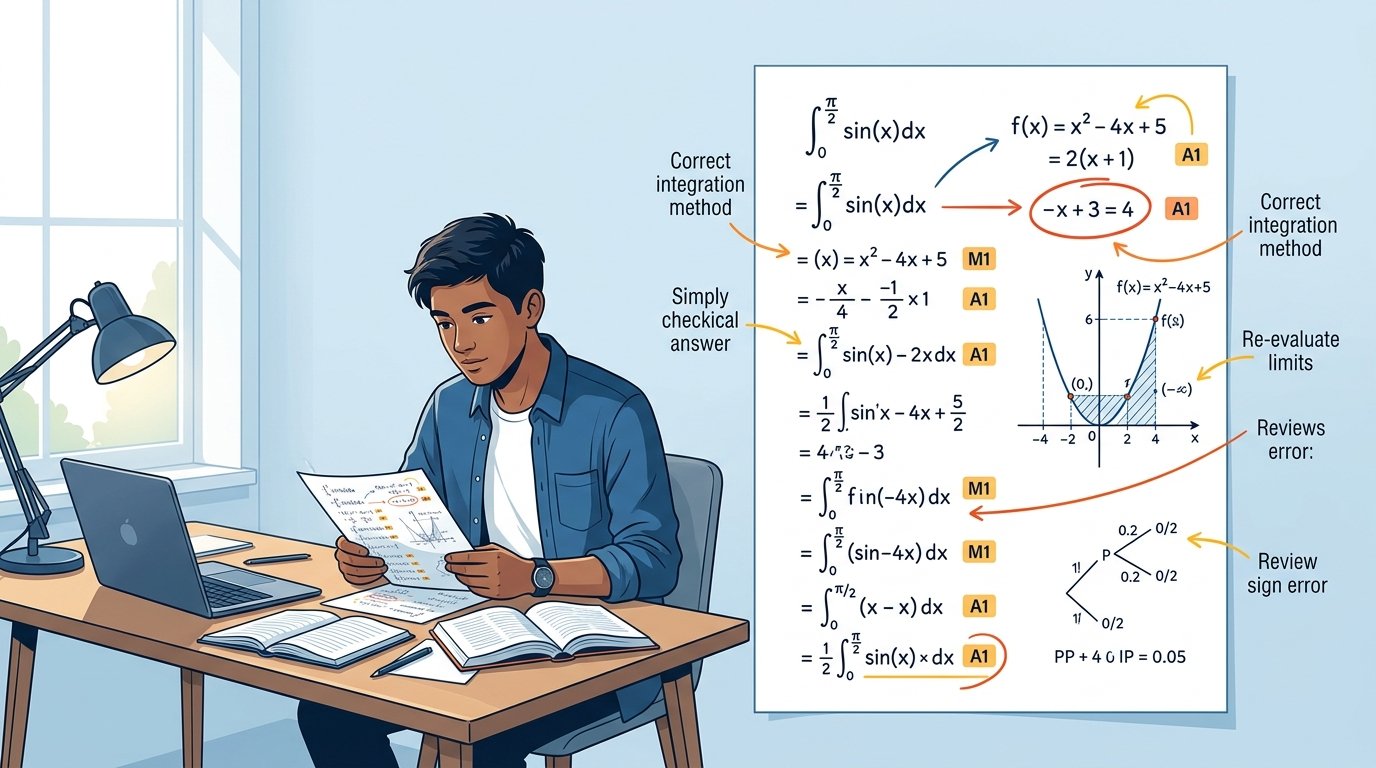
You finish an IB Math practice feedback question.
You get an answer.
You check the mark scheme.
It’s wrong.
So you look at the correct answer, understand it for a few seconds, and move on.
Then you do another question.
And another.
Eventually, you’ve completed dozens of questions, but you’re still making the same mistakes.
This is one of the biggest problems with traditional IB Math practice.
Doing more questions doesn’t automatically mean you’re improving.
Practice only becomes powerful when you understand what happened during the attempt.
Did you misunderstand the question?
Did you choose the wrong method?
Did you know the method but make an algebra mistake?
Did you lose a method mark because you skipped an important step?
Did you use your calculator correctly but fail to interpret the result?
Did you actually understand the topic, or did the question simply look familiar?
These questions can’t always be answered by looking at the final answer.
They require feedback on your work.
For IB Math students preparing for exams, this distinction can make a major difference.
Table of Contents
Why Getting the Final Answer Right Isn’t Enough
Imagine two students solve the same question.
Student A reaches the correct answer but doesn’t show much working.
Student B makes a small arithmetic mistake but shows a clear, appropriate method.
If you only compare final answers, Student A appears stronger.
But that conclusion may be completely wrong.
Mathematics assessment doesn’t always depend on the final numerical result. IB Mathematics assessments can award marks for mathematical methods, reasoning, communication, interpretation, and appropriate use of technology. The exact allocation depends on the question and mark scheme.
This means the working tells you something that the final answer cannot.
It shows how you think.
That’s why your practice review should examine the complete solution, not just the number at the bottom.
What Your Working Reveals
Your handwritten working contains information about your mathematical thinking.
Suppose you are solving a calculus question.
You might correctly identify the function but differentiate it incorrectly.
That suggests a calculus procedure problem.
Another student might differentiate perfectly but fail to recognise that the question requires optimisation.
That’s a problem with method selection.
A third student might set up the correct optimisation method, calculate the stationary points, and then fail to determine which point represents the required maximum.
That’s a reasoning or interpretation problem.
All three students may receive an incorrect final answer.
But they need completely different revisions.
This is why feedback matters.
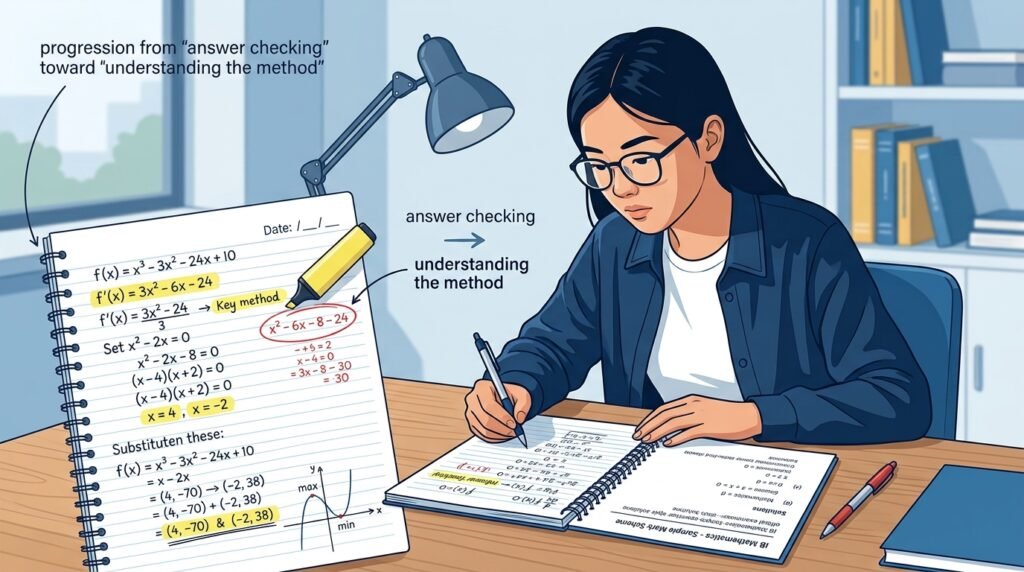
The Difference Between an Answer and an Explanation
Consider this example.
A question asks you to find the maximum value of a function.
A student writes: x=4, f(4)=27.
The final answer may be correct.
But what happened before this?
Did the student differentiate?
Did they solve f′(x)=0?
Did they check whether x=4 is actually a maximum?
Did they consider the domain?
Did they use a graphing calculator?
Did they simply guess the value from a graph?
The final answer doesn’t tell you.
The working does.
This is why good IB Math practice isn’t simply:
Question → Answer → Correct/Wrong
It should be:
Question → Working → Feedback → Correction → New practice
Why Students Often Practise Without Getting Better
There is a natural assumption that more practice automatically produces better results.
If you solve 100 questions, surely you’ll be better than someone who solved 20.
Not necessarily.
Imagine you repeatedly make the same mistake.
You complete 100 questions but never identify the underlying problem.
You’ve now practised the wrong behaviour 100 times.
The problem isn’t necessarily a lack of effort.
It’s a lack of information.
You don’t know what to change.
That’s why effective practice needs a feedback loop.
What Good IB Math Feedback Should Tell You
Useful feedback should answer more than:
“Correct.”
or:
“Wrong.”
It should help answer four questions.
What did I do correctly?
This reinforces the mathematical skills you already have.
Where did I make a mistake?
This identifies the exact point where your solution stopped working.
Why did I make that mistake?
This is where genuine learning happens.
What should I practise next?
This turns feedback into an action plan.
Without that final step, feedback can become interesting information rather than useful revision.
Feedback Should Focus on the First Meaningful Error
Suppose your solution contains eight lines.
The first five are correct.
The sixth contains an algebra error.
Everything after that becomes incorrect.
If someone simply tells you:
“Your final answer is wrong.”
You haven’t learned much.
If they tell you:
“Your method was correct until this algebraic step. This transformation changes the equation incorrectly.”
That’s much more useful.
You now know exactly what to fix.
This is called error localisation.
Instead of treating an entire solution as wrong, you identify the point where the reasoning first diverged from the correct mathematics.
That’s a much better basis for revision.
Not All IB Math Mistakes Are the Same
One of the biggest benefits of reviewing working is that it helps you classify mistakes.
A student may have a knowledge gap because they don’t remember a mathematical concept.
They may have a method selection problem because they know several techniques but don’t recognise which one applies.
They may have an accuracy problem because their mathematical approach is correct but they make algebraic or numerical errors.
They may have a communication problem because the correct reasoning isn’t clearly shown.
They may have an interpretation problem because they calculate a result correctly but don’t explain what it means in the context of the question.
They may have a calculator problem because they enter an expression incorrectly, use the wrong mode, or rely on technology without checking whether the output makes sense.
These problems look similar when you only look at the final answer.
They look very different when you examine the working.
Method Marks Make Working Especially Important
IB Math students often hear the phrase “show your working,” but it’s easy to treat it as a formality.
It isn’t.
Your working can provide evidence of the mathematical method you’re using.
Suppose a question requires you to solve a mathematical model.
You might write: model equation
Then manipulate it: rearranged equation
Then solve: x=…
That sequence tells the examiner how you reached the result.
If you only enter the original equation into a calculator and write the final number, you may not demonstrate the same mathematical reasoning.
The precise marks available depend on the question, but the general principle is important: your working communicates your method.
A Calculator Answer Is Not Always a Mathematical Explanation
IB Mathematics students have access to technology, and calculators can be extremely useful.
But a calculator output isn’t automatically a complete solution.
Imagine you enter a complicated expression and your calculator produces 3.728491.
What does that number represent?
Why did you calculate it?
How does it answer the question?
Should it be rounded?
Does it satisfy the conditions?
Does it have the correct units?
A calculator can perform a calculation.
It can’t replace the explanation of why the calculation is appropriate.
This is especially important for questions involving modelling, statistics, probability, and real world interpretation.
Handwritten Working Contains Valuable Information
There is a big difference between seeing:
Final answer: x=3.42
and seeing the student’s complete working.
The complete solution might reveal that the student correctly identified the formula, substituted the wrong value, rounded too early, and then carried that error through the rest of the calculation.
That is valuable information.
The student doesn’t need to revise the entire topic.
They need to fix a specific behaviour.
This is one reason reviewing actual working can make revision more efficient.
The Feedback Loop You Should Use
A strong practice cycle looks like this:
Practise → Upload or review working → Identify the mistake → Understand the reason → Correct the question → Practise a similar question → Revisit later
The important part is that you don’t stop after seeing the correct solution.
You need to test whether you can now perform the skill independently.
Suppose you repeatedly forget to justify an answer.
Reading the correct solution once doesn’t necessarily fix the problem.
You need another question that requires the same behaviour.
Then you can check whether the feedback changed your performance.
Example: A Student Who Keeps Losing Marks in Probability
Imagine a student repeatedly gets probability questions wrong.
They complete question after question.
Their final answers are often incorrect.
They conclude:
“I’m bad at probability.”
But feedback on their working reveals something more specific.
They understand probability formulas.
They can calculate conditional probability.
They can use a calculator.
Their repeated mistake is that they don’t identify the condition given in the question.
The problem isn’t “probability.”
It’s interpreting conditional information.
Now their revision can become much more targeted.
Instead of doing 50 random probability questions, they can practise questions specifically involving conditional probability and focus on identifying the given condition.
That’s a much better use of study time.
Example: A Student Who Understands Calculus but Loses Marks
Another student understands differentiation extremely well.
They can differentiate complicated functions accurately.
But in exam questions, their scores remain disappointing.
Feedback on their working reveals that they often stop after finding stationary points.
They don’t check whether the point is a maximum or minimum.
They know the mathematics.
Their problem is completing the reasoning.
That student doesn’t necessarily need another hour of basic differentiation exercises.
They need practice with complete optimisation problems, including interpretation and justification.
Again, feedback changes the revision strategy.
Why Repeating the Same Question Isn’t Enough
If you get a question wrong and immediately read the solution, you may feel that you’ve learned something.
But there is a difference between:
“I understand the solution when I see it.”
and:
“I can produce the solution independently.”
The second is what matters in an exam.
After reviewing a mistake, close the solution and redo the question.
Then try another question that tests the same idea.
If you can solve the new question independently, you’ve gained evidence that the correction worked.
Create a Mistake Journal
One of the simplest ways to make feedback useful is to keep a mistake journal.
Don’t record every single incorrect answer.
Record patterns.
For example:
“I often choose the correct formula but substitute the wrong variable.”
Or:
“I need to justify why the stationary point is a maximum.”
Or:
“I lose marks when interpreting regression results.”
Or:
“I round intermediate values too early.”
Over time, these notes become a map of your weaknesses.
Your revision can then focus on the areas that repeatedly cause problems.
Your Weaknesses Are More Useful Than Your Total Score
Suppose you score 65% on a practice paper.
That number tells you something.
But it doesn’t tell you what to do next.
Imagine your review shows that most lost marks came from calculus interpretation and probability application.
Now you have a direction.
Your next revision session can target those areas.
This is why a detailed feedback report can be more useful than a single percentage.
The score measures performance.
The mistake pattern explains it.
How to Turn Feedback Into a Revision Plan
After each practice session, identify the mistakes that occurred most often.
Then group them.
For example, perhaps several mistakes involve algebra.
Another group involves interpreting questions.
Another involves calculator use.
Another involves incomplete explanations.
Now decide what needs attention first.
If one weakness appears repeatedly, prioritise it.
If a mistake happens once and never returns, it may not deserve the same amount of revision time.
This creates a more personalised study plan.
Instead of:
“I need to practise IB Math.”
You have:
“I need to improve my method selection in calculus and my interpretation of probability questions.”
That’s much more actionable.
How Mathzem Uses Working to Provide Examiner Style Feedback
This is where Mathzem’s approach is different from simply checking an answer.
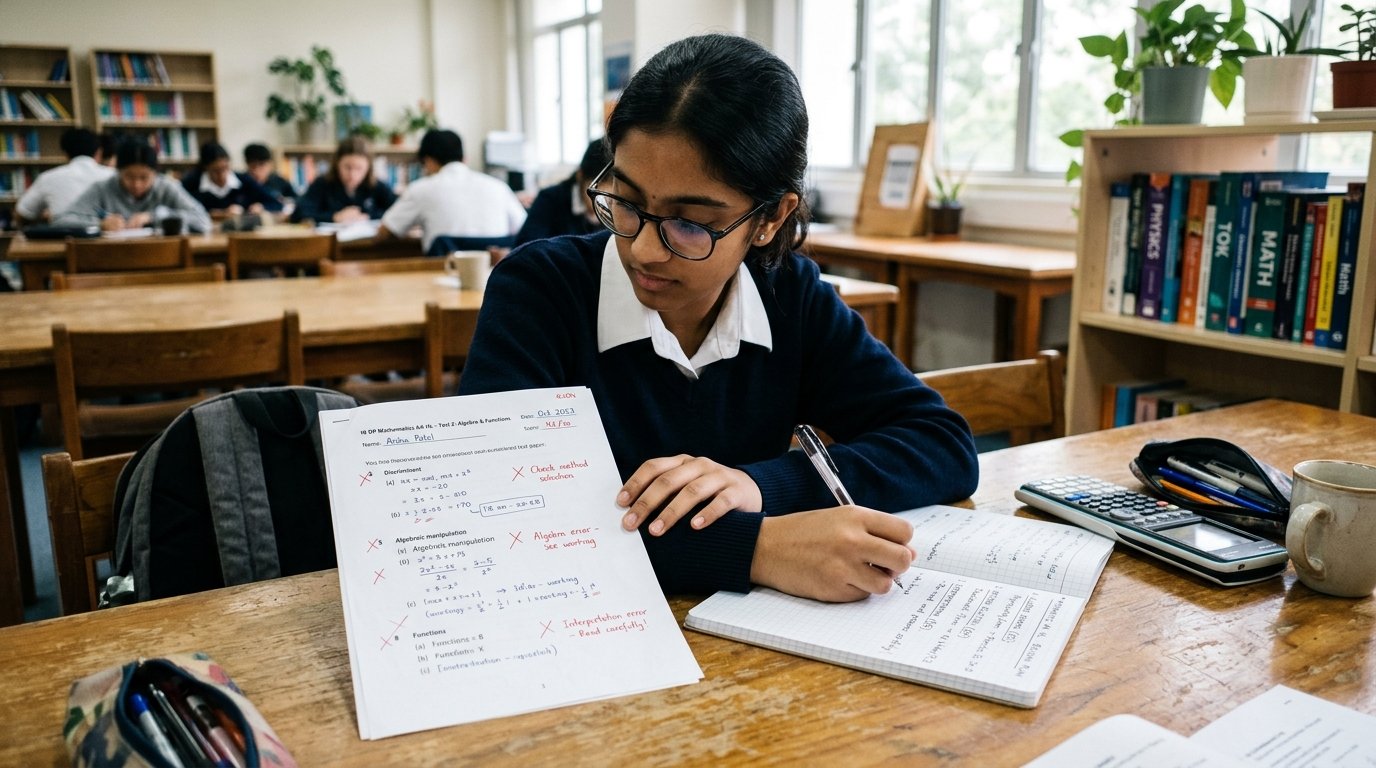
With Mathzem IB Practice, a student can choose an IB Math question, solve it, upload their working, and receive examiner-style feedback focused on the solution.
The aim is to make the practice cycle more informative.
Instead of stopping at:
“Correct answer: 7.2”
The student can review their marks, mistakes, weak areas, and suggested next steps.
The student’s working becomes part of the learning process.
That makes it easier to move from practice to diagnosis and from diagnosis to targeted revision.
Students can also use the Math Skill Scanner to identify areas that need more attention.
Feedback Is Especially Important for Unfamiliar Questions
A familiar practice question can sometimes hide weaknesses.
You see the topic.
You recognise the method.
You apply it.
An unfamiliar question removes those clues.
That’s why feedback is particularly valuable for exam style and unfamiliar questions.
It can reveal whether you actually understand the mathematics or whether you’re relying on recognition.
This connects directly with the previous article in this content series about how to start an unfamiliar IB Math question.
When reviewing an unfamiliar question, don’t just ask whether you got it right.
Ask:
Did I identify the right topic?
Did I extract the relevant information?
Did I choose a reasonable method?
Did I explain my reasoning?
Did I interpret the result correctly?
Those are much deeper questions.
Feedback Should Change What You Practice Next
This is perhaps the biggest difference between passive and active revision.
Passive revision says:
“I finished the questions.”
Active revision says:
“I know what these questions taught me about my weaknesses.”
Imagine you’ve completed ten questions.
Seven were easy.
Two were moderate.
One was difficult.
You got nine correct.
It might seem like a successful session.
But what if the one difficult question exposed a major weakness that appears frequently in exams?
That question may be more valuable than the seven easy questions.
Difficulty and feedback matter.
Don’t Chase the Highest Number of Questions
There is a temptation to measure revision by quantity.
“Today I solved 40 questions.”
That sounds productive.
But consider another student who solved 15 questions, carefully reviewed every mistake, corrected each one, and completed follow-up questions.
Which student learned more?
There isn’t always a simple answer, but quantity alone is a poor measure of learning.
A better question is
“What changed because I practised?”
If your understanding, accuracy, method selection, or exam technique improved, the practice was useful.
How to Review Every Practice Question More Effectively
After completing a question, take a moment before moving on.
If you’re correct, ask whether the method was efficient and clearly communicated.
If you’re incorrect, identify the first meaningful error.
Then ask why it happened.
Was it a knowledge problem?
A method problem?
An accuracy problem?
A reading problem?
A communication problem?
A calculator problem?
Then correct the solution.
Finally, decide what question you should attempt next.
This last step is important.
Your next question shouldn’t always be random.
It should sometimes be chosen specifically because of what the previous question taught you.
What Students Should Expect From Good Feedback
Good feedback shouldn’t simply tell you what you did wrong.
It should help you understand the reason.
For example, compare these two comments.
Weak feedback:
“Wrong answer.”
Useful feedback:
“Your method is appropriate, but the substitution into the formula uses the value of x from the wrong part of the question. Recheck which variable the given value represents, then repeat the calculation.”
The second comment tells you what happened and gives you a direction for improvement.
That’s what effective feedback should do.
What Tutors Can Learn From Student Working
IB Math Practice Feedback on working is also valuable for tutors.
A student’s final score may show that they are struggling.
Their working can show why.
A tutor might discover that the student understands the concepts but makes frequent algebra errors.
Another student may have excellent calculations but struggle to interpret word problems.
Another may know the mathematics but fail to communicate enough working.
These students need different interventions.
Looking at working makes that distinction possible.
From Mistake to Improvement
A mistake becomes useful when it changes what you do next.
The process can be simple.
You attempt a question.
You receive feedback.
You identify the exact problem.
You understand why it happened.
You correct the original question.
You solve a similar question.
You revisit the skill later.
That is how a wrong answer becomes a learning opportunity.
Without the correction cycle, mistakes can simply become repeated mistakes.
FAQs About IB Math Practice Feedback
Is checking the final answer enough for IB Math practice?
No. The final answer tells you whether your result matches the expected result, but it doesn’t always reveal whether your method, reasoning, notation, or interpretation was correct.
Why should I show all my working?
Your working communicates your mathematical method and reasoning. It also makes it possible to identify where an error occurred and whether you understand the underlying process.
What should I do when I get an IB Math question wrong?
Find the first meaningful error, understand why it happened, redo the question correctly, and then solve another question that tests the same skill.
How many IB Math questions should I practice?
There isn’t one ideal number for every student. The quality of review matters more than simply counting questions. A smaller number of carefully reviewed questions can be more useful than a large number of questions completed without feedback.
What is examiner style feedback?
Examiner style feedback focuses on the mathematical work shown in a student’s solution, including method, accuracy, reasoning, communication, and possible lost marks. It aims to resemble the kind of evaluation students need for exam preparation.
Can feedback help me move from a Grade 5 to a Grade 6 or 7?
Yes, feedback can make revision more targeted by showing which mistakes are holding back your performance. However, improvement also depends on understanding the mathematics, practicing consistently, and applying the feedback to new questions.
Conclusion: Don’t Practice Blind
IB Math practice feedback shouldn’t be about collecting completed questions.
It should be about improving the quality of your mathematical thinking.
When you get a question wrong, don’t immediately move on.
Find the first meaningful error.
Understand why it happened.
Correct it.
Practise the same skill again.
Then check whether the mistake returns.
Your working contains information that your final answer doesn’t.
It can show whether you understand the method, whether you can select an appropriate approach, whether your calculations are reliable, and whether you can communicate and interpret your mathematics clearly.
That’s why feedback matters.
Practice gives you an attempt. Feedback tells you what to change.
And when feedback changes what you practise next, every question becomes more valuable.
Quick Takeaway
The goal isn’t to solve the largest possible number of IB Math questions.
The goal is to make each practice session teach you something specific.
Practise → Review your working → Find the mistake → Understand why → Correct it → Practise again.
That’s how practice turns into progress.


One Response