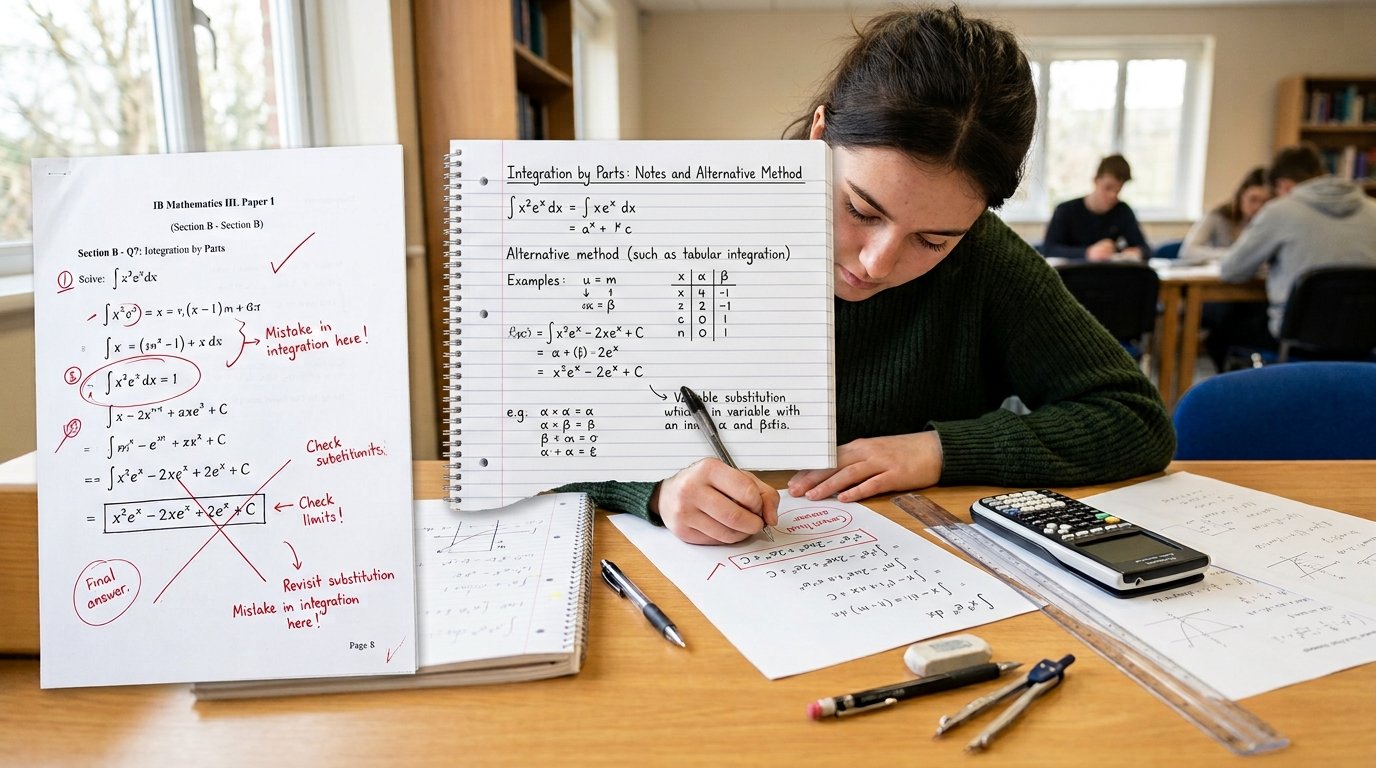
You sit at your desk.
You open your IB math practice vs exam performance notes.
You choose a practice question.
You recognise the topic.
You remember the method.
You work through it and get the correct answer.
Good.
Then the exam arrives.
The question looks different.
You know the topic, but you are not sure how to begin.
You spend several minutes trying one approach.
It does not work.
You move to another question.
Later, you look at the solution and realise that you actually knew the mathematics.
So what happened?
For many IB Mathematics students, the problem is not simply knowledge.
It is the difference between solving a familiar practice question and using mathematics independently in an exam.
That difference is a skill in itself.
Table of Contents
Getting questions right is not the whole picture
Suppose you practice differentiation.
Your question says:
Find the stationary points of the following function.
You know immediately what to do.
Differentiate.
Set the derivative equal to zero.
Solve.
Check.
You get the answer.
Now imagine an exam question describing the height of an object, the revenue of a business or the area of a shape.
The question does not say:
Find the stationary point.
Instead, you have to recognise that the situation can be modelled using a function and that differentiation may be relevant.
The mathematics has not necessarily become harder.
The decision making has changed.
This is one reason students can perform well during topic practice but struggle with unfamiliar exam questions.
Current Mathzem guidance makes the same distinction between topic practice, mixed questions and unfamiliar application.
IB math practice often tells you what method to use
There is an important difference between these two questions.
Question A
Solve the following quadratic equation.
Question B
A mathematical model produces the following relationship. Determine the possible values of the variable and explain which values are valid in the context.
Question A tells you much more about what mathematics to use.
Question B requires you to interpret the situation first.
When students practise by topic, they often receive hidden assistance from the organisation of the questions.
If the next ten questions are all about differentiation, the student already knows that differentiation is probably relevant.
An exam does not organise every question that way.
The student has to make that decision independently.
The first challenge is often recognising the problem
When students say:
“I knew how to do this at home, but I could not do it in the exam.”
the missing skill may be method recognition.
You may know how to differentiate.
You may know how to integrate.
You may know how to use probability distributions.
You may know how to work with functions.
But can you recognise when each method is appropriate?
That is a different ability.
Consider probability.
A student might be excellent at solving conditional probability exercises when every question is clearly labelled.
But in an examination, the wording may require the student to recognise that conditional information is present.
The calculation is not necessarily the difficult part.
Identifying the structure is.
Familiar practice can create false confidence
Familiar practice is useful.
You need it to learn procedures and build accuracy.
The problem comes when all your practice remains familiar.
Imagine you practise ten questions using exactly the same method.
By Question 10, you are very fast.
You may conclude:
“I know this topic.”
But what have you actually demonstrated?
You have demonstrated that you can perform the method when the question tells you what type of mathematics to use.
You have not necessarily demonstrated that you can recognise the method independently.
This is why practice should gradually become less predictable.
A useful progression is:
Understand → Practise → Mix → Apply → Challenge → Simulate
Mathzem’s current practice guidance uses a similar progression from topic based practice towards mixed and unfamiliar application.
The exam removes some of the support
Think about everything that can quietly help you during revision.
You may know the topic.
You may have your notes open.
You may have a worked example nearby.
You may be practising questions from one chapter.
You may know that every question in the current exercise uses the same technique.
You may have no time pressure.
You may be able to check the answer immediately.
An exam removes much of that support.
You need to decide what matters.
You need to choose a method.
You need to manage your time.
You need to communicate your reasoning.
You need to interpret your answer.
You need to decide when to continue and when to move on.
That is why exam preparation cannot consist only of repeating comfortable questions.
Why mixed practice matters
Mixed practice changes one important thing.
You do not always know what method is coming.
Imagine you have a set containing:
A functions question.
A probability question.
A calculus question.
A statistics question.
A vectors question.
Now the question itself has to tell you what mathematics might be relevant.
You need to read carefully.
You need to identify the mathematical objects involved.
You need to connect the information given to what the question asks.
This is much closer to what happens in an examination.
Mixed practice therefore trains a different skill from topic practice.
Topic practice asks:
Can I perform this mathematical skill?
Mixed practice asks:
Can I recognise which mathematical skill I need?
Both matter.
Unfamiliar questions add another layer
Mixed questions are useful, but you can still become comfortable with predictable question structures.
Unfamiliar questions introduce another challenge.
The mathematics may be familiar.
The presentation is not.
You may need to:
Interpret a new context.
Combine two mathematical ideas.
Decide which information matters.
Ignore information that is not immediately useful.
Work out the first useful step.
Build the solution progressively.
This is why getting stuck on an unfamiliar question does not automatically mean you do not understand the mathematics.
Sometimes you simply have not practised the process of starting.
Mathzem’s guide to unfamiliar IB Math questions recommends breaking the problem into smaller decisions rather than expecting the complete solution immediately.
Your first step matters more than you think
Suppose you are stuck.
Instead of asking:
How do I solve this entire question?
ask:
What do I know?
Then:
What is the question asking me to find?
Then:
What mathematical relationship might connect those two things?
Then:
What is one useful line I can write?
This makes the problem smaller.
For example, you may not know how to complete a modelling question.
But you may know:
The variables involved.
The function being described.
The quantity that needs to be maximised.
The relevant constraint.
Writing one of these down can give you a starting point.
You do not need to see the entire solution before making progress.
Being correct at home does not always mean you are exam ready
There are several different levels of performance.
Level 1: Recognition
You recognise the question type.
Level 2: Procedure
You can perform the mathematical method.
Level 3: Application
You can use the method when the context changes.
Level 4: Method selection
You can decide which method is appropriate.
Level 5: Unfamiliar problem solving
You can begin and develop a solution when the route is not obvious.
Level 6: Exam performance
You can do all of this accurately while managing time and communicating your reasoning.
A student can be strong at Level 2 and still struggle at Level 4 or Level 5.
That does not mean the earlier practice was useless.
It means the next stage of practice needs to target a different skill.
Timing can change what you know into what you score
There is another reason practice performance can look better than exam performance.
Time pressure.
At home, you may spend ten minutes thinking about one difficult question.
You can take a break.
You can search your notes.
You can return to it later.
During an examination, the same ten minutes has a cost.
You may have other questions waiting.
Exam technique, therefore, involves knowing when to persist and when to move on.
This does not mean rushing every question.
It means becoming aware of where your time is going.
Mathzem’s current exam technique guidance highlights issues such as misreading questions, inefficient method selection, rushing, early rounding and spending too much time on difficult problems.
A wrong answer can reveal a different problem than you think
Suppose you receive a question wrong in an exam.
You might write:
“I need to revise calculus.”
But perhaps calculus was not the problem.
Maybe you:
Understood the calculus.
Chose the correct derivative.
Made an algebra mistake.
Lost the final answer.
That requires different practice.
Or perhaps your algebra was completely correct, but you chose the wrong model.
Again, different problem.
This is why reviewing your working matters.
The final answer tells you what happened at the end.
The working can help show how you got there.
Use your practice to separate these problems
After a question, ask which category best describes your difficulty.
Knowledge
Did I know the required mathematical idea?
Method selection
Did I know which mathematical approach to use?
Execution
Could I carry out the mathematics accurately?
Interpretation
Did I understand what the result meant?
Communication
Did I show enough working and reasoning?
Timing
Did I spend an appropriate amount of time on the question?
This classification makes your revision more precise.
If your problem is method selection, another explanation of differentiation may not solve it.
You may need mixed questions.
If your problem is algebraic accuracy, increasingly difficult questions may not solve it.
You may need focused accuracy practice.
Build practice that removes support gradually
A useful way to prepare is to reduce the amount of information you receive as your skill improves.
Stage 1: Clear topic practice
You know what mathematical skill you are practising.
Stage 2: Similar applications
The context changes, but the underlying method is familiar.
Stage 3: Mixed practice
You need to decide which method applies.
Stage 4: Unfamiliar questions
The structure and context are less predictable.
Stage 5: Timed practice
You must make decisions while managing limited time.
Stage 6: Full exam simulation
You combine all of these skills.
This progression helps prevent a common mistake:
Going directly from comfortable topic exercises to a full paper and then assuming a poor score means you do not know the mathematics.
Sometimes there is an intermediate skill that needs practice.
How to review an exam question properly
After completing an important question, do not simply write:
Wrong.
Instead, ask:
Where did my solution first go wrong?
Then:
Why did that happen?
Then:
What would I do differently next time?
Then:
What question should I practise to test that correction?
For example:
Problem: I could not start.
Cause: I did not recognise the mathematical relationship.
Correction: Identify known information and the required quantity before choosing a method.
Next practice: Mixed application questions.
Or:
Problem: Correct method, incorrect answer.
Cause: Algebra sign error.
Correction: Check each rearrangement before continuing.
Next practice: Short algebra accuracy set.
This turns a mistake into a practice decision.
How Mathzem fits into this process
Mathzem’s current IB Practice workflow is designed around students attempting IB style questions, uploading their handwritten working and receiving AI Examiner feedback. The current feedback can include marks, mistakes, weak areas and next step guidance.
That matters because exam performance is not only about whether the final answer matches.
The student’s working can reveal where the problem occurred.
For example, a student may solve a calculus question correctly but lose marks because their reasoning is incomplete.
Another student may show a sensible method but make an algebra error.
Another may understand the mathematics but choose an inappropriate method for an unfamiliar question.
Those students should not necessarily follow the same revision path.
The current Mathzem Student Dashboard also tracks topic performance, repeated mistakes and areas for further practice.
The useful principle is simple:
Your practice results should influence your next practice decision.
A practical weekly structure
If you are getting good results in ordinary practice but struggling in exams, try changing the balance of your revision.
Session 1: Repair
Choose a known weakness.
Practise the underlying skill.
Session 2: Apply
Use that skill in different contexts.
Session 3: Mix
Complete questions from several topics without being told the method.
Session 4: Unfamiliar
Attempt questions where the starting point is not obvious.
Session 5: Timed
Complete a set under realistic time pressure.
Session 6: Review
Analyse the mistakes and identify patterns.
Session 7: Retest
Return to the skills that caused problems.
This creates a cycle rather than a collection of disconnected practice sessions.
How to know if your IB math practice is becoming more exam relevant
Ask yourself:
Can I solve the question when the topic is obvious?
Can I solve it when the topic is not given?
Can I identify the relevant mathematics from the wording?
Can I start an unfamiliar question without seeing a worked example?
Can I explain why I chose a particular method?
Can I maintain accuracy when working faster?
Can I decide when to move on from a difficult question?
Can I review my working and identify why marks were lost?
Can I reproduce the skill in a different context?
These questions tell you much more about exam readiness than the number of questions completed.
The goal is not to make every practice question difficult
There is a temptation to respond to poor exam performance by choosing the hardest questions available.
That is not always useful.
If your basic algebra is unreliable, very difficult calculus questions may simply create more opportunities for several weaknesses to interact.
Likewise, if you can already solve straightforward questions reliably, spending all your time on basic exercises may not prepare you for unfamiliar application.
The right question is:
What skill am I trying to develop?
Then choose the difficulty accordingly.
FAQs About IB Math Practice vs Exam Performace
Why can I solve IB Math questions at home but not in exams?
Your home practice may be more familiar or structured than the examination. You may already know the topic, method or question type. Exams require additional skills such as method selection, unfamiliar problem solving, communication and time management.
Should I stop doing topic based IB Math practice?
No. Topic practice is useful for learning and repairing specific skills. The important step is to progress from topic practice towards mixed, unfamiliar and timed questions.
Why do unfamiliar IB Math questions feel so much harder?
They often require you to decide what mathematics is relevant instead of being told the topic or method. The underlying mathematics may still be familiar.
How can I practise method selection?
Use mixed questions where the topic and method are not provided. Before calculating, identify what the question is asking and think about which mathematical relationships could connect the information.
Should I do full past papers if I am struggling in exams?
Past papers can be useful diagnostic tools. But review the paper carefully afterward. Identify whether the main problem was knowledge, method selection, execution, interpretation, communication or timing before deciding what to practise next.
Can Mathzem help with exam preparation?
Mathzem currently supports IB course, topic and subtopic practice, handwritten working uploads, AI Examiner feedback, weak area information and next step guidance. These features are designed to help students use their practice attempts as evidence for future revision.
Final takeaway
Getting an IB Math question right at home is useful.
But it is only one part of exam preparation.
You also need to recognise the mathematics when the topic is not obvious.
You need to choose a method independently.
You need to handle unfamiliar wording.
You need to communicate your reasoning.
You need to maintain accuracy under time pressure.
And you need to understand what your mistakes are actually telling you.
A useful progression is:
Understand → Practise → Mix → Apply → Challenge → Simulate
Then review what happens.
If you are losing marks because of knowledge, repair the knowledge.
If you are losing marks because of method selection, practise choosing methods.
If you are losing marks because of execution, target accuracy.
If you are losing marks because of interpretation, practise explaining results.
If you are losing marks because of timing, analyse where your time is going.
The goal is not simply to become better at answering practice questions.
It is to become better at using mathematics when the question does not tell you exactly what to do.
That is the skill your IB Mathematics exam is actually asking you to demonstrate.