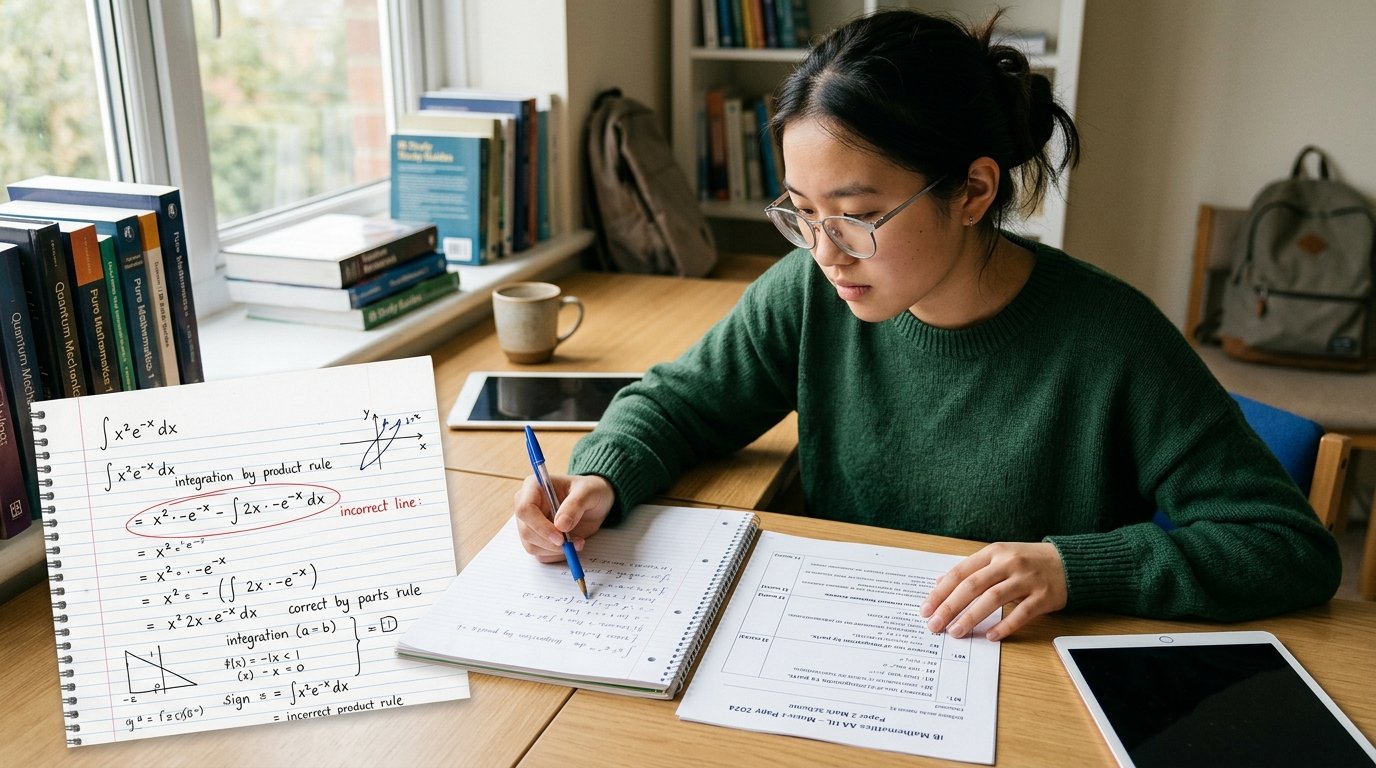
You finish another repeated IB Math mistakes question.
Wrong again.
You look at the solution and immediately see what you should have done.
You tell yourself:
“I understand it now.”
Then a few days later, you see a similar question.
You make almost the same mistake.
This is one of the most frustrating parts of IB Mathematics.
The problem is not always that you do not understand the topic.
Sometimes you understand the explanation perfectly well.
The problem is that the mistake has not actually been repaired.
You have recognised the correct solution.
You have not yet proved that you can produce it independently.
That distinction matters.
Table of Contents
The first mistake is not always the real problem
Suppose you get a calculus question wrong.
Your first reaction might be:
“I need to revise calculus.”
But look at the actual working.
Perhaps your differentiation was correct.
Your method was appropriate.
The mistake happened when you rearranged an equation.
In that case, the real problem may be algebraic accuracy rather than calculus.
Or perhaps the calculation was correct, but you gave an answer that did not match the question’s context.
That points towards interpretation.
Or perhaps you knew all the mathematics but could not decide which method to use.
That is a method selection problem.
The final answer tells you that something went wrong.
Your working can help explain what went wrong.
That is why reviewing the solution matters.

Stop treating every wrong answer as the same type of mistake
A useful first step is to classify the problem.
Knowledge mistake
You did not know the required mathematical idea.
Example:
You could not recall the relationship needed for the question.
Method mistake
You knew the mathematics but selected an inappropriate method.
Example:
You used a method that worked for a similar question but did not apply to this one.
Execution mistake
You chose the correct method but made an error while carrying it out.
Example:
A sign error appeared during algebraic manipulation.
Interpretation mistake
Your mathematics was reasonable but you misunderstood what the result meant.
Example:
You calculated a value but did not explain what it represented in the given context.
Communication mistake
Your approach was reasonable but the working did not clearly communicate enough of the reasoning.
Accuracy mistake
You made an avoidable calculation or transcription error.
These categories matter because they require different responses.
Do not immediately do ten more questions
This is one of the most common reactions to a bad practice session.
You get a question wrong.
You decide to practise more.
So you complete ten similar questions.
Sometimes that helps.
But sometimes you are simply repeating the same misunderstanding ten times.
More practice is not automatically corrective practice.
Before starting another question, ask:
What exactly went wrong?
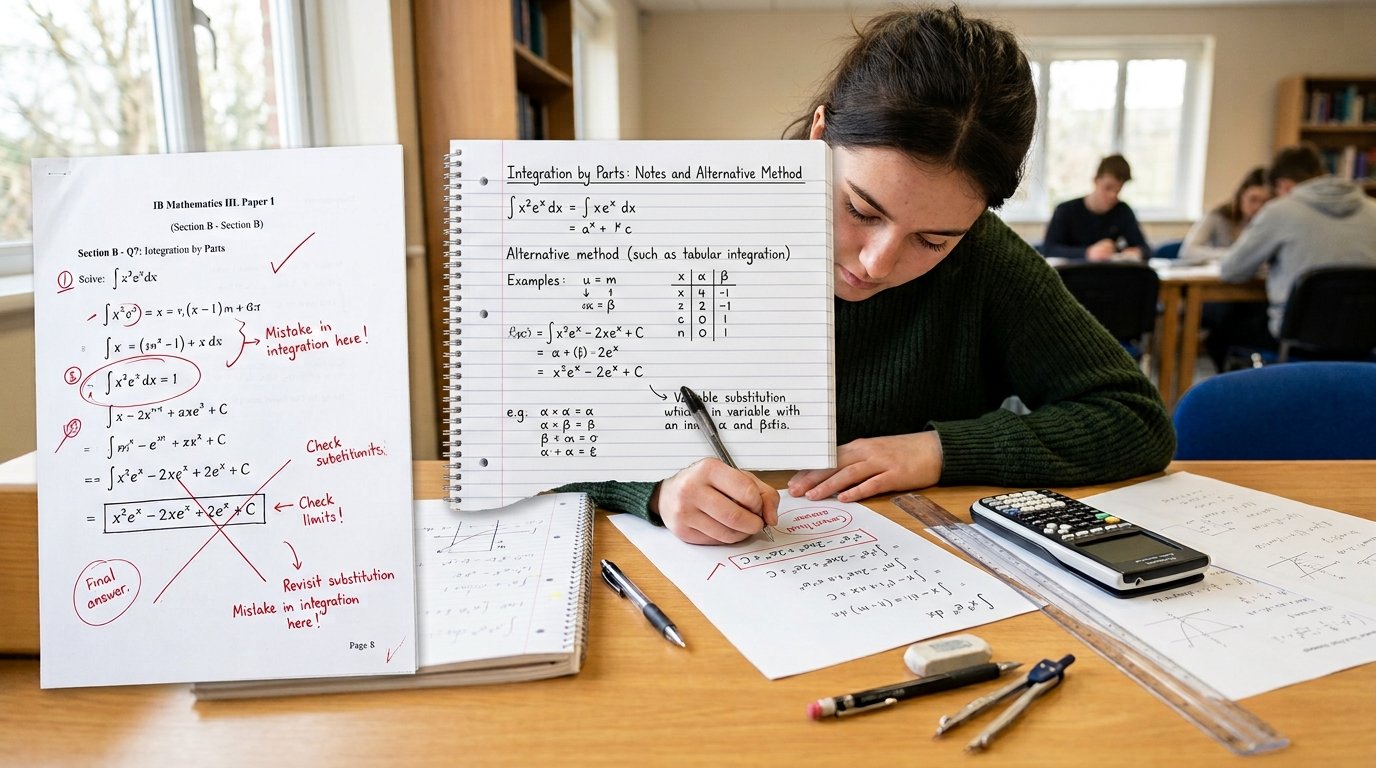
Find the first point in your working where the solution stopped being valid.
That is often more useful than staring at the final answer.
Find the first wrong step
Imagine a student solves:
They write:
Then:
The final answer is wrong.
But the first line is correct.
The problem appears in the final division.
Now imagine a much longer IB Mathematics question.
The final answer may be several lines away from the first mistake.
If you only look at the final result, the entire solution can appear wrong.
Instead, work backwards.
Find the first line where your reasoning or calculation stops being valid.
That is the point that deserves attention.
Ask why the mistake happened
Finding the wrong line is useful.
Finding the cause is better.
Suppose you made a sign error.
Why?
There are several possibilities.
You were rushing.
You regularly lose negative signs.
You are uncomfortable rearranging expressions.
You copied something incorrectly.
You did not check the previous line.
The same visible mistake can have different causes.
This is why simply writing “careless mistake” is often not enough.
“Careless” describes what happened.
It does not tell you what to practise.
Turn “careless mistake” into something actionable
Instead of writing:
Careless algebra error
try:
I changed the sign when moving the term and did not check the rearrangement.
That tells you something useful.
You can now practise:
Algebraic rearrangement.
Sign accuracy.
Line by line checking.
You can also watch for the same pattern in future questions.
A good mistake record should help you make a different decision next time.
The next question should test the correction
This is where many students stop too early.
They find the mistake.
They read the solution.
They understand the explanation.
Then they move on.
But understanding a correction is not the same as being able to reproduce it.
Suppose you repeatedly forget to consider the domain of a function.
You review the solution.
You understand why the domain matters.
Now you need another question where domain restrictions actually matter.
If you get it right, that is useful evidence.
If you make the same mistake again, you have discovered that the issue needs more work.
The second question therefore has a purpose.
It is not just another question.
It is a test of the correction.
Use a simple repair cycle
When you make a repeated mistake, try this sequence:
Find → Explain → Repair → Practise → Retest
Find
Locate the first incorrect step.
Explain
Write down why it was wrong.
Repair
Write what you should have done instead.
Practise
Complete a question that requires the same skill.
Retest
Return to a different question later and see whether the correction holds.
This is much more useful than simply reading the answer.
The second question should not always be identical
Suppose your original question involved a quadratic function.
You make an algebra mistake.
Your next question is another quadratic with almost identical wording.
You get it right.
That is encouraging.
But it may not prove that the underlying weakness is fixed.
You may simply have memorised the structure.
A stronger retest changes something.
The context changes.
The numbers change.
The wording changes.
Another mathematical idea appears alongside the original skill.
The student has to recognise and apply the corrected method again.
This is where practice becomes more meaningful.
Use different levels of difficulty
Not every mistake needs the hardest question available.
If the underlying skill is weak, start with a manageable example.
For example:
Stage 1
Practise the specific skill directly.
Stage 2
Use the skill in a slightly different context.
Stage 3
Combine it with another mathematical idea.
Stage 4
Use it in an unfamiliar exam style question.
Stage 5
Retest it under realistic time pressure.
This gives the student somewhere to go after identifying the problem.
Current Mathzem guidance also recommends progressing from understanding and application towards mixed and more challenging questions rather than immediately jumping to the hardest problems. (mathzem.com)
Repeated IB math mistakes are more useful than isolated mistakes
One mistake can happen for many reasons.
You might misread one question.
You might make one unusual calculation error.
You might be tired.
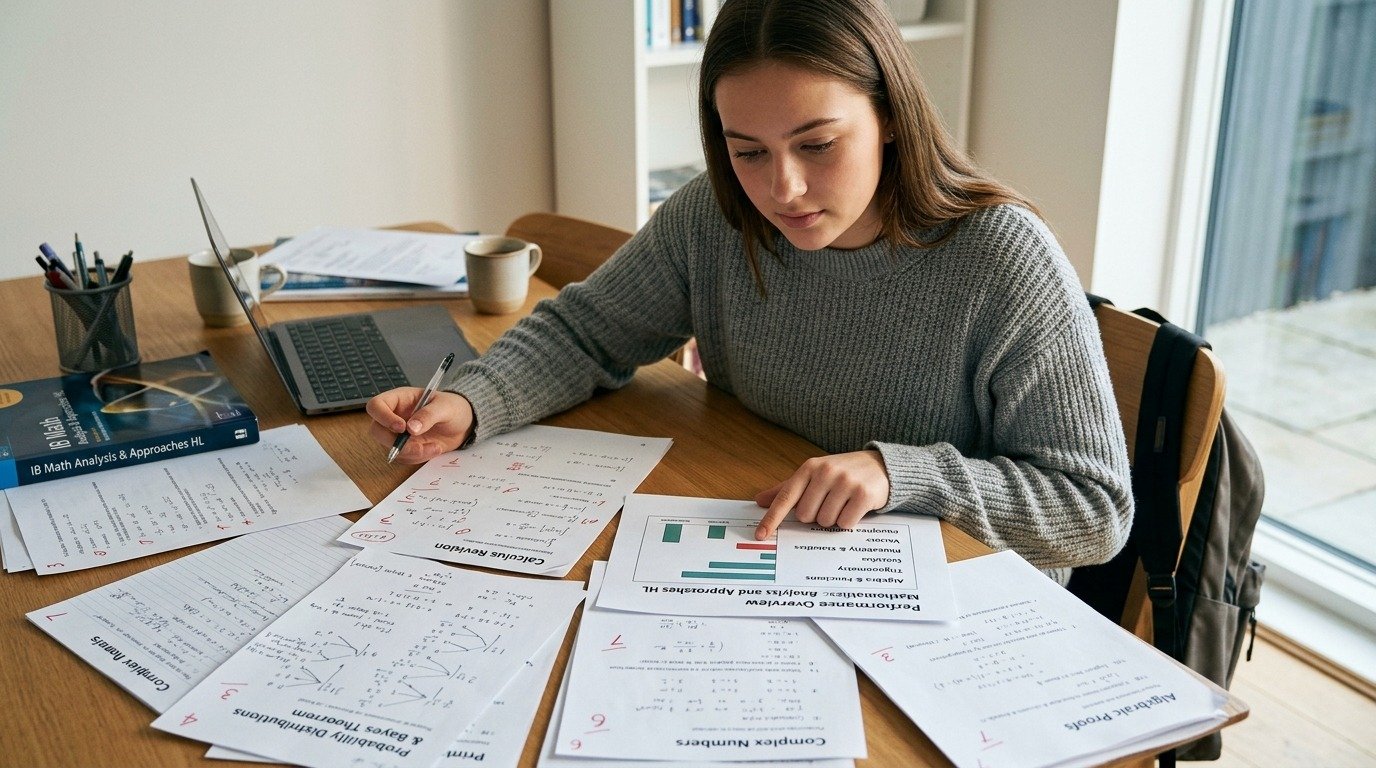
Patterns are more informative.
Imagine your practice history shows:
Question 1: lost marks through incomplete reasoning.
Question 2: incomplete reasoning again.
Question 3: correct answer but insufficient explanation.
Question 4: incomplete reasoning.
That tells you something different from four unrelated mistakes.
The pattern suggests that communication and justification may need attention.
The same applies to:
Repeated sign errors.
Repeated method selection problems.
Repeated domain errors.
Repeated interpretation mistakes.
Repeated calculator input mistakes.
Repeated early rounding.
Patterns tell you where your practice may need to change.
This is where a mistake journal becomes useful
A mistake journal should not become a collection of embarrassing wrong answers.
Its purpose is to identify patterns.
A useful entry can contain five things:
Question: What did I attempt?
Mistake: What went wrong?
Cause: Why did it happen?
Correction: What should I do differently?
Retest: How will I check whether I fixed it?
For example:
Question: Optimisation problem.
Mistake: Differentiated correctly but selected the wrong critical point.
Cause: Did not consider the domain.
Correction: Check critical values against the valid interval.
Retest: Complete another optimisation question with domain restrictions.
That is actionable information.
Your revision should respond to the mistake
Imagine you have identified three repeated problems.
Algebra accuracy.
Method selection.
Interpreting answers.
Your revision should reflect those findings.
You might spend one session on algebra accuracy.
Another on mixed method selection.
Another on interpretation and written conclusions.
This is more targeted than spending equal time on every topic simply because the syllabus contains them.
Mathzem’s Student Dashboard is designed to connect practice results with weak areas and repeated mistakes so students can see patterns in their work. (mathzem.com)
The important idea is not the dashboard itself.
It is the feedback loop behind it.
Attempt → Review → Identify pattern → Target weakness → Practise → Retest
What if you keep making the mistake anyway?
Sometimes the first repair attempt does not work.
That is useful information.
Suppose you repeatedly choose the wrong method.
You complete one correction question.
You still choose the wrong method on the next unfamiliar question.
Do not simply conclude:
“I am bad at this topic.”
Instead, ask whether the practice was too narrow.
Perhaps you need mixed questions.
If you repeatedly make algebra errors, perhaps the questions are too complicated and several skills are interacting.
You may need simpler questions first.
If you understand the method but cannot explain the result, perhaps you need more practice interpreting mathematical answers in context.
The response should depend on the evidence.
Be careful with the phrase “I understand now”
There is a big difference between:
I understand the solution when I see it.
and:
I can produce the solution independently.
The first is recognition.
The second is performance.
This is why reading worked solutions can be useful but incomplete.
A solution can explain what should have happened.
Only another independent attempt can give you evidence about whether you can reproduce it.
Try explaining the correction without looking
After reviewing a mistake, close the solution.
Then explain:
What was wrong?
Why was it wrong?
What should happen instead?
What would I look for in the next question?
If you cannot explain the correction without looking, you may not understand it as well as you thought.
If you can explain it but cannot apply it, you need more practice.
If you can apply it correctly several times in different contexts, you have stronger evidence that the weakness is improving.
Use mistakes to choose your next question
This is one of the most important changes you can make.
Do not always ask:
What question do I feel like doing?
Ask:
What question would give me useful evidence right now?
If you need algebra accuracy, choose a question that tests algebra.
If you need method selection, choose a mixed question.
If you need interpretation, choose a question where the conclusion matters.
If you need unfamiliar problem solving, choose a question where the first method is not obvious.
Your next question should have a reason.
How Mathzem fits into this process
Mathzem is built around the idea that a practice question should produce useful feedback.
Students can choose an IB Math course and topic, solve an exam style question, upload their handwritten working and receive AI Examiner feedback. The current workflow can provide marks, identify mistakes, show weak areas and give next-step guidance. (mathzem.com)
This makes the working important.
A final answer can tell you that the question went wrong.
The working can provide more information about where the problem occurred.
The resulting feedback can then help the student decide what to practise next.
That is particularly useful when the same type of mistake keeps appearing.
The aim is not to tell a student simply:
Wrong.
It is to help them understand:
Where did I go wrong?
Why did I go wrong?
What should I practise?
Can I do it correctly next time?
A practical 20 minute mistake repair session
You do not need an entire afternoon to work on one mistake.
Try this.
Minutes 1 to 5: Diagnose
Look at your original working.
Find the first incorrect step.
Write down the cause.
Minutes 5 to 8: Correct
Write the correct reasoning yourself.
Do not simply copy the solution.
Minutes 8 to 14: Practise
Complete a similar question without looking at the correction.
Minutes 14 to 18: Change the context
Try another question where the same skill appears differently.
Minutes 18 to 20: Record
Write one sentence describing what you need to remember next time.
For example:
Before choosing a method, identify what the question is actually asking me to find.
That sentence becomes a useful reminder for future practice.
A simple checklist for your next mistake
When you get an IB Mathematics question wrong, ask:
- Where did my solution first go wrong?
- Was the problem knowledge, method, execution, interpretation or communication?
- Why did the mistake happen?
- What should I do differently?
- What question can test that correction?
- Can I solve it without looking at the solution?
- Can I apply the same correction in a different context?
- Does this mistake appear elsewhere in my practice?
- Do I need targeted practice or mixed practice?
- Should I retest the skill later?
If you can answer these questions, a wrong answer becomes much more useful.
FAQs About Repeated IB Math Mistakes
Why do I keep making the same IB Math mistakes?
Usually because identifying a mistake is not the same as repairing it. You may understand the correct solution when you see it but have not practised producing that solution independently.
Should I redo the exact same question?
It can help, especially immediately after correcting the mistake. But a later retest should usually use a different question so that you can check whether you can transfer the correction.
How do I know what my actual weakness is?
Look for patterns across several attempts. One error may be accidental, while repeated errors can reveal a weakness in knowledge, method selection, execution, interpretation or communication.
Is a careless mistake still worth reviewing?
Yes. Instead of recording only “careless mistake”, identify what actually happened. For example, “I lost the negative sign while rearranging” gives you something specific to monitor and practise.
Should I practise more questions after making a mistake?
Not automatically. First diagnose the mistake. Then choose practice that directly tests the skill that caused the problem.
Can Mathzem help identify repeated IB Math mistakes?
Mathzem’s current practice workflow provides AI Examiner feedback on submitted working, including mistakes, weak areas and next step guidance. Its Student Dashboard also tracks repeated mistakes and areas that need attention. (mathzem.com)
Final takeaway
Getting a question wrong is not the main problem.
Making the same mistake repeated IB math mistakes without understanding why is the bigger problem.
The solution is not always more questions.
It is better diagnosis.
Find the first wrong step.
Understand why it happened.
Repair the specific skill.
Practise it again.
Change the context.
Retest it later.
Then look for patterns across your work.
The goal of revision is not to create a perfect record where every question is correct.
It is to make each mistake less likely to happen again.
That is how a wrong answer becomes useful.
And that is how practice gradually turns into improvement.