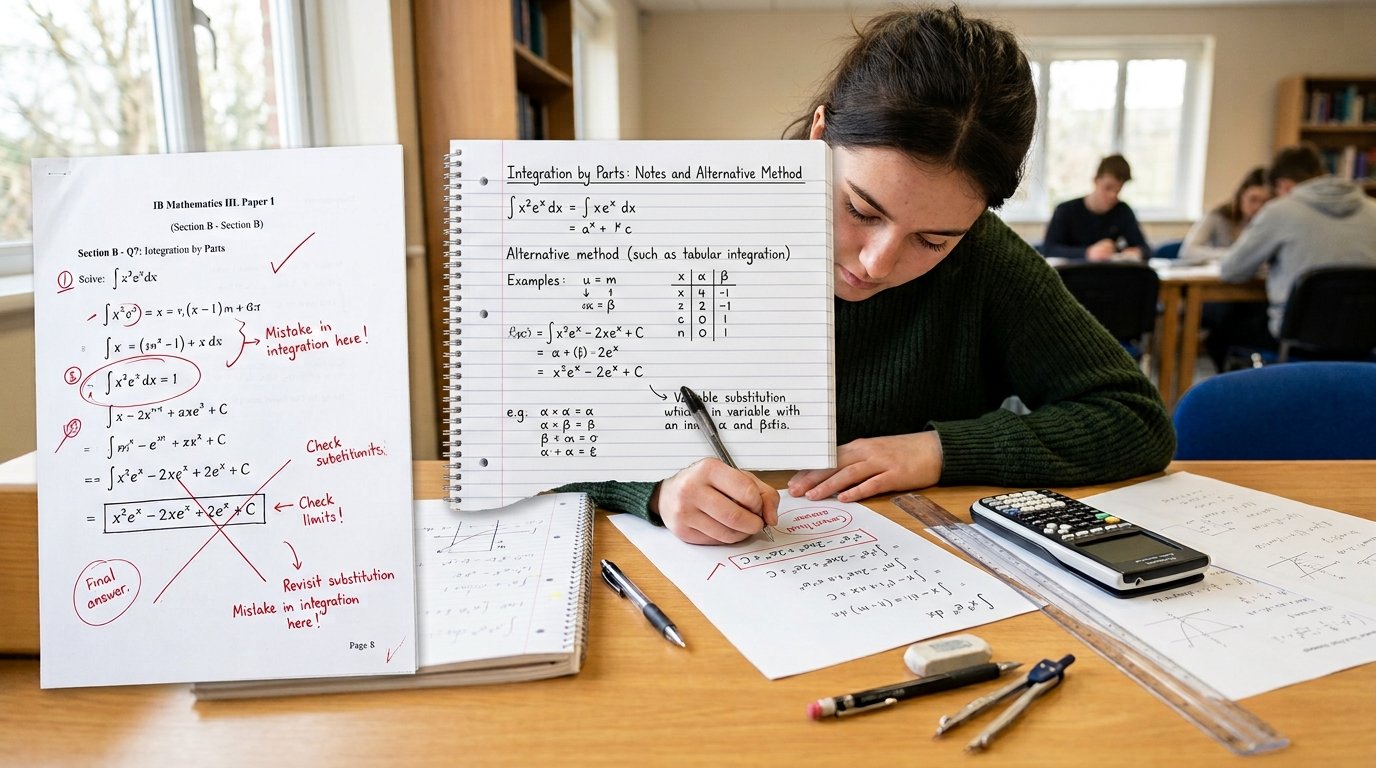
You have spent two hours revising IB Mathematics.
You completed questions.
You watched a few explanations.
You checked your answers.
You filled several pages of working.
So you close your notebook feeling that the session was productive.
But there is a problem.
You still do not know whether you actually improved.
This is surprisingly common.
Students often measure revision by time spent, pages completed, or questions answered.
Those numbers can be useful, but they do not tell the whole story.
You can complete thirty questions and repeat the same algebra mistake throughout all thirty.
You can spend an hour on one difficult problem and learn more than you did from ten easy questions.
You can even feel less confident after a good revision session because you have started attempting more unfamiliar problems.
So how should you tell whether your IB Math revision is working?
The answer is to look for evidence of change.
Table of Contents
Completing questions is not the same as improving
Imagine two students.
Student A completes forty questions.
Most are familiar.
The topic is clearly stated.
The method is similar to the examples they have already studied.
Student B completes fifteen questions.
Some are familiar.
Some are mixed.
Several require method selection.
After each difficult question, Student B reviews the working and records what caused the problem.
Who improved more?
You cannot answer that from the number of questions alone.
The number of questions tells you how much work was completed.
It does not tell you what changed.
Mathzem’s current practice guidance makes a similar distinction between simply completing questions and using practice to identify weaknesses, review working and decide what to practise next.
A better question after revision is:
What can I do now that I could not do before?
That is much closer to measuring learning.
Your score is useful, but it is only one signal
A practice score gives you information.
Suppose you score 62 percent on one paper and 68 percent on another.
That might indicate improvement.
But you need more context.
Perhaps the second paper was easier.
Perhaps you had already seen several of the question types.
Perhaps the first paper exposed a weakness that you specifically revised before taking the second.
Or perhaps your score stayed similar while the type of mistakes changed significantly.
The percentage alone cannot explain all of this.
A useful review therefore looks at several indicators.
For example:
Accuracy
Are you making fewer mathematical errors?
Method selection
Are you choosing appropriate methods more consistently?
Application
Can you use familiar mathematics in less familiar situations?
Communication
Is your working clearer and more complete?
Interpretation
Are you answering what the question actually asks?
Independence
Can you solve questions without relying on worked solutions?
Consistency
Are the same mistakes appearing less often?
These indicators give you a much better picture of progress.
Indicator 1: You are making fewer repeated mistakes
One of the clearest signs of improvement is not simply getting more answers correct.
It is seeing an old mistake disappear.
Suppose you regularly lose marks because of negative signs.
You identify the problem.
You practise carefully.
You review your working.
You then complete several later questions without making the same error.
That is evidence of progress.
The same applies to:
- Incorrect calculator input.
- Early rounding.
- Incorrect substitution.
- Choosing the wrong probability model.
- Incomplete reasoning.
- Poor interpretation.
- Unclear notation.
The important point is that improvement should eventually appear in your actual work.
A revision note saying “remember signs” is not evidence that the problem has been fixed.
A new question where you handle the signs correctly is stronger evidence.
Indicator 2: You can explain why your method works
Getting the correct answer is useful.
Understanding why the method works is stronger.
Imagine you solve a stationary point question.
You differentiate.
Set the derivative equal to zero.
Find the solutions.
You obtain the expected answer.
Now ask:
Why did I set the derivative equal to zero?
What do those solutions represent?
How do I know whether they correspond to a maximum or minimum?
What conditions apply?
If you can answer these questions without looking at the solution, your understanding is more robust.
This matters because IB Mathematics questions do not always present mathematics in exactly the same form.
The student needs to recognise relationships and apply methods rather than simply reproduce a memorised sequence.
Indicator 3: You need less help to get started
Starting a question independently is an important skill.
Early in revision, you may need to look at an example before knowing what to do.
That is normal.
But over time, you should need less support.
For example, you might move from:
“I need to see an example first.”
to:
“I recognise the mathematical area.”
Then:
“I know what information matters.”
Then:
“I can identify a reasonable first step.”
Then:
“I can work through the problem independently.”
That progression is valuable even if your final answer is not yet perfect.
Mathzem’s current guidance on unfamiliar questions emphasises reading the problem, extracting information, identifying the mathematical context, connecting the information to a method and building the solution one step at a time.
Indicator 4: You are improving on unfamiliar questions
This is one of the most important tests.
A student can become very good at familiar questions without becoming much better at independent problem solving.
Suppose you practise ten questions about integration.
If every question clearly signals that integration is required, you are mainly testing your ability to perform the procedure.
Now try a mixed set.
You do not know whether the next question involves integration, differentiation, functions, probability or another area.
The mathematical decision becomes part of the task.
Later, try unfamiliar questions where the route is less obvious.
If you gradually become better at identifying what to do, that is meaningful progress.
This is one reason Mathzem’s current practice approach includes course, topic, and subtopic practice alongside feedback, weak area information, and next-step guidance.
Indicator 5: Your working is becoming clearer
Your working can improve even before your final scores change dramatically.
Consider a student who previously wrote:
x = 4.72
after entering a complicated expression into a calculator.
Later, the same student writes the relevant equation, shows the important substitution, gives the numerical result, and explains the conclusion.
That is progress.
The final number might even be the same.
But the mathematical communication is stronger.
This matters because the IB Mathematics assessment can involve methods, reasoning, communication, and interpretation, not simply the final numerical result. The precise requirements depend on the individual question and its mark scheme.
Your goal is not to write more for the sake of writing more.
It is to make the important mathematics visible.
Indicator 6: You are making better decisions about difficulty
Another sign of good revision is knowing what kind of question you need.
If you are struggling with basic algebra, jumping immediately into the hardest AA HL question available may not be useful.
If you can already solve straightforward questions reliably, spending every session on basic exercises may also be inefficient.
Your practice should respond to your current ability.
A useful progression is:
Understand
Make sure the mathematical idea is clear.
Practise
Build reliable execution.
Apply
Use the skill in different contexts.
Mix
Choose methods without being told which topic applies.
Challenge
Attempt less predictable problems.
Simulate
Practise under realistic exam conditions.
Mathzem’s current practice guidance uses a similar progression from topic understanding towards application, challenge and simulation.
The exact balance should change as your weaknesses change.
Indicator 7: You can identify why you lost a mark
This is a powerful test of revision quality.
Suppose you lose three marks.
Can you explain why?
Compare these two reviews.
Review A
“I got Question 5 wrong.”
Review B
“I chose the correct mathematical method but made an algebra error while rearranging the equation.”
Review B is much more useful.
It tells you what to practise.
It also tells you what you probably do not need to relearn.
Mathzem’s current review guidance recommends identifying the first meaningful error, classifying the problem and explaining why the mistake happened before deciding on the next practice step.
That turns a lost mark into information.
Indicator 8: Your mistakes are changing
Do not expect your mistakes to disappear immediately.
A more realistic sign of improvement is that the pattern changes.
Perhaps at the beginning you make:
Many knowledge mistakes.
Several algebra mistakes.
Frequent interpretation mistakes.
After targeted revision, the knowledge mistakes become less common.
Your algebra becomes more reliable.
Now you notice that unfamiliar application questions are the main problem.
That is not necessarily bad news.
Your revision has uncovered a more specific next challenge.
Improvement can therefore look like moving from broad problems towards narrower ones.
The question changes from:
“Why am I bad at this topic?”
to:
“I understand the topic, but I need to improve method selection in unfamiliar questions.”
That is a much more useful position.
Do not confuse difficulty with lack of progress
This is an important point.
Your revision may feel harder as it improves.
At first, you might complete easy questions and feel confident.
Later, you begin attempting unfamiliar problems.
You get more questions wrong.
It is tempting to conclude:
“I am getting worse.”
But the comparison may be misleading.
You have changed the difficulty.
You are now testing a deeper skill.
A student who gets eight out of ten easy questions correct is not necessarily progressing faster than a student who gets six out of ten difficult questions correct after moving into an unfamiliar application.
The important question is:
What did the attempt reveal?
If the harder questions show you exactly where your current limits are, they can be extremely valuable.
A simple weekly progress check
At the end of each week, review your practice.
You do not need a complicated spreadsheet.
Write down five things.
1. What became easier?
For example:
Solving quadratic equations.
Using the calculator correctly.
Recognising standard differentiation problems.
2. What mistake appeared less often?
For example:
Negative signs.
Early rounding.
Incorrect substitution.
3. What still causes problems?
For example:
Choosing a method.
Interpreting probability questions.
Starting unfamiliar problems.
4. What can you now do independently?
For example:
Solve a mixed calculus question without looking at an example.
5. What should you practise next?
Make this specific.
Not:
“Revise calculus.”
Instead:
“Practise mixed optimisation questions where the method is not stated.”
This gives your next revision session a purpose.
How Mathzem can support this process
Mathzem’s current IB Practice workflow is built around giving students more information from their attempts.
Students can choose their IB course and topic, solve an exam style question, upload their working and receive feedback that can include marks, mistakes, weak areas, and next step guidance. The current Student Dashboard also brings practice information together, including topic performance and repeated mistakes.
This is useful because a score by itself does not tell you what to do next.
The more useful sequence is:
Attempt
What did I actually do?
Feedback
What happened in the solution?
Diagnosis
Why did it happen?
Practice
What skill needs attention?
Retest
Can I now do it independently?
That creates evidence of progress rather than simply a record of activity.
A twenty minute progress test
If you want a quick way to test whether your revision is working, try this.
Choose one skill you have been practising.
Do not look at your notes.
Attempt one question that is slightly different from the examples you studied.
Work independently.
Then review the solution.
Ask:
Did I know what the question was asking?
Did I choose a sensible method?
Could I explain why I chose it?
Did I carry out the mathematics accurately?
Did I communicate the important steps?
Did I interpret the result correctly?
Did I need help?
Compare your answers with an earlier attempt.
You are looking for change.
Perhaps you now start more confidently.
Perhaps your algebra is more accurate.
Perhaps your working is clearer.
Perhaps you still struggle with the same skill.
All of these outcomes are useful.
The point is to measure what changed.
What not to use as your main progress measure
Some revision measures are easy to track but can be misleading.
Hours studied
More hours do not automatically mean more learning.
Questions completed
A large number of questions can still contain repeated mistakes.
Pages of notes
Writing notes can help understanding, but notes alone do not demonstrate independent problem solving.
Number of solutions watched
Recognising a solution is different from producing one.
One practice paper score
One paper gives limited evidence about long term progress.
These measures can still have a place.
They simply should not be your only evidence.
The best question to ask after revision
Instead of asking:
“Did I study enough today?”
ask:
“What can I do better now?”
Maybe you can start unfamiliar questions more confidently.
Maybe you can identify the correct method faster.
Maybe you make fewer algebra errors.
Maybe you explain your answers more clearly.
Maybe you can solve questions without checking a worked example.
Maybe you have discovered a weakness that you did not know existed.
That last one is progress too.
Finding a weakness gives you something specific to improve.
FAQs About IB Math Revision Is Working
How do I know if my IB Math revision is working?
Look beyond the number of questions completed. Check whether repeated mistakes are becoming less common, whether you can solve more questions independently, whether method selection is improving and whether you perform better on unfamiliar questions.
Is getting more questions correct enough to show improvement?
It is useful evidence, but not complete evidence. Also consider the difficulty of the questions, the type of mistakes you make and how independently you solved them.
Should I track my IB Math score every week?
You can, but treat the score as one indicator. Reviewing mistake patterns and performance on different question types can give you more useful information about what is improving.
Why can revision feel harder even when I am improving?
Your practice may have become more challenging. Moving from familiar topic questions to mixed or unfamiliar problems can temporarily reduce your percentage while developing more advanced problem solving skills.
What should I do if my score is not improving?
Review the reasons behind your lost marks. Separate knowledge, method selection, execution, interpretation, communication and timing problems. Then change your practice according to the most important weakness rather than simply doing more questions.
Can Mathzem show whether my IB Math revision is improving?
Mathzem currently provides practice feedback including marks, mistakes, weak area information and next step guidance. Its Student Dashboard also brings together practice information and repeated mistakes, helping students see patterns across their attempts.
Final takeaway
Good IB Math revision is not simply revision that feels productive.
It is revision that changes what you can do.
You should gradually become more accurate.
You should make fewer repeated mistakes.
You should need less help.
You should become better at selecting methods.
You should handle more unfamiliar questions.
Your working should become clearer.
And your mistakes should become more specific and easier to act on.
Do not ask only:
“How many questions did I complete?”
Ask:
“What did those questions teach me?”
Then ask:
“Can I now do something that I could not do before?”
That is a much better way to judge whether your IB Mathematics revision is working.