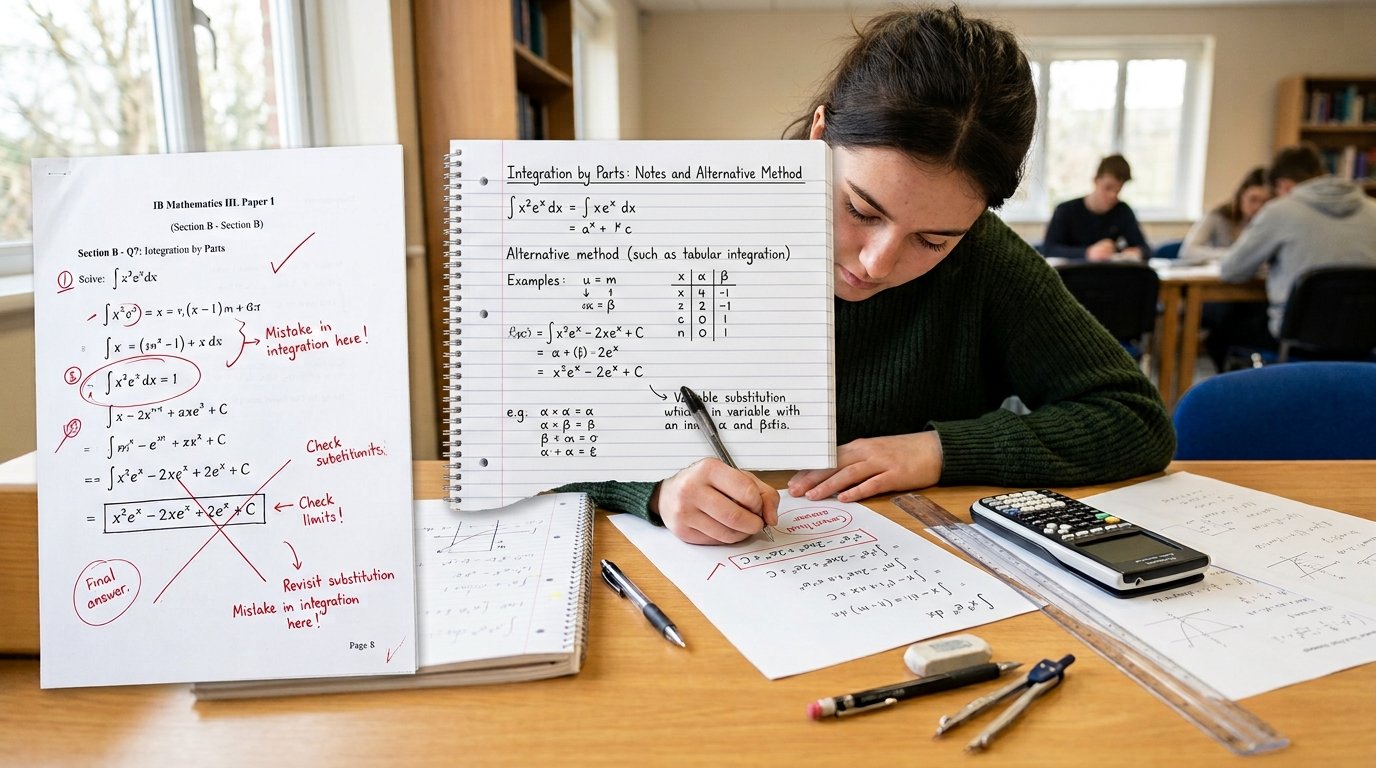
Most students practice IB Mathematics, which follows a simple pattern.
Find a question.
Solve it.
Check the answer.
Move on.
It works.
Students need questions. They need repetition. They need to practise applying mathematics rather than only reading about it.
But there is a gap in that process.
What happens after the question?
If the answer is wrong, why?
If the method is partly correct, where did it break?
If you lost marks, what should you practise next?
And if you got the question right, does that mean you have actually mastered the skill?
These are the problems Mathzem is being built around.
Not simply giving students more IB Mathematics questions.
Making each attempt more useful.
Table of Contents
The problem with treating practice as a question bank
A question bank is useful.
You can find questions by topic.
You can practise calculus.
You can practise probability.
You can practise functions.
You can work through past paper questions.
But there is a difference between having questions and having a learning loop.
Imagine two students both get an IB Mathematics question wrong.
Student A misunderstood the mathematical concept.
Student B understood the concept but made an algebra error halfway through the solution.
Both have an incorrect final answer.
But they should not necessarily do the same revision.
Student A may need to revisit the concept.
Student B may need targeted algebra practice.
The final answer does not tell you that difference.
The working can.
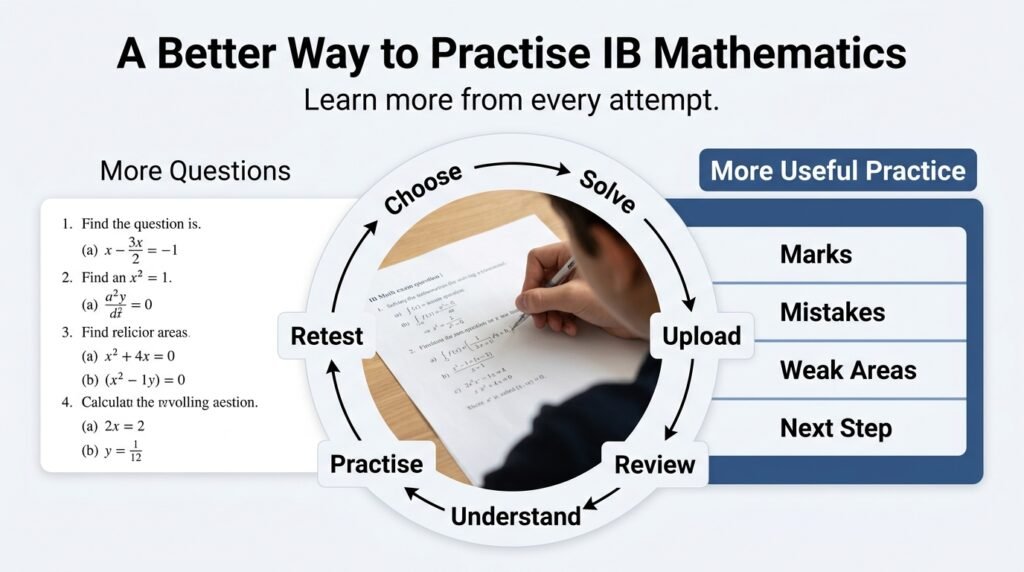
That is why Mathzem starts with the student’s attempt
Mathzem’s current IB Practice workflow follows a simple sequence.
You choose your IB Mathematics course and topic.
You receive an exam style question.
You solve it yourself.
You show your working.
You upload the working.
Then Mathzem’s AI Examiner reviews the attempt.
The current workflow can provide marks, identify mistakes, highlight weak areas and suggest a next step.
The important part is that the student attempts the question before seeing the feedback.
That creates something valuable.
Evidence.
Your working shows how you approached the problem.
Your handwritten working contains information
Consider a calculus question.
You might:
Choose the correct method.
Differentiate correctly.
Set up the equation correctly.
Make one algebra error.
Then carry that error through the rest of the solution.
If you only look at the final answer, it can appear that the whole solution was wrong.
But that is not what happened.
Most of your approach may have been sound.
The problem was one specific step.
Your handwritten working makes that visible.
That is why Mathzem’s current practice page specifically asks students to upload their full working so the system can assess the method, not only the final answer.
A mark is useful. Knowing why is more useful.
Suppose you receive:
5 / 8
That tells you something.
But it does not automatically tell you what to do tomorrow.
You need more information.
Maybe you lost marks because:
You chose the wrong method.
You skipped an important step.
You made an algebra error.
You used an incorrect value.
You did not justify your answer.
You failed to interpret the result.
You ran out of time.
These are different problems.
A useful practice system should help you distinguish them.
Mathzem’s AI Examiner workflow is designed to provide this additional layer of feedback, including where marks may have been lost, mistakes, weak areas and suggested next steps.
The next question should depend on what happened in the last one
This is one of the ideas behind Mathzem.
Imagine you get three questions wrong.
Question 1
You did not understand the mathematical concept.
Question 2
You understood the concept but chose the wrong method.
Question 3
You used the correct method but made an algebra error.
A traditional practice session might simply give you three more random questions.
Mathzem is being built around a different question:
What does this attempt tell us about what you need next?
That is a much more useful question.
Practice should create information
A practice question should not only produce an answer.
It should produce information about the student.
For example:
Question attempted
The student solves an optimisation problem.
Working reviewed
The model shows that the student understands differentiation but struggles to construct the function.
Weak area
Modelling and method selection.
Next step
Practise another application where the student has to construct the model before differentiating.
Now the next question has a reason.
It is not simply question number 14 in a sequence.
It responds to evidence from question number 13.
This is why Mathzem focuses on the working
There are many ways to check an answer.
A calculator can check a calculation.
A mark scheme can show an expected solution.
A teacher can review the working.
An AI system can also analyse the attempt.
The important thing is not replacing one with another.
It is making the student’s own attempt more useful.
Mathzem’s current workflow is designed around the student’s actual working, with handwritten uploads, examiner style feedback, marks, mistakes, weak area information and next step guidance.
The aim is to make feedback part of practice rather than something that happens separately.
The Weakness Map adds another layer
One question tells you about one attempt.
Several attempts can reveal a pattern.
Suppose you repeatedly lose marks in calculus.
That does not necessarily mean you do not understand calculus.
The pattern might show that:
Your differentiation is usually correct.
Your algebra is inconsistent.
Your interpretation of stationary points is weak.
Your method selection is fine on familiar questions but weaker in applications.
That is much more useful than simply seeing:
Calculus: 62%
Mathzem’s current Student Dashboard includes topic progress, weak area information and repeated mistake tracking.
The purpose is not to label a student permanently.
The purpose is to help answer:
Where should I focus now?
Personalised practice should not mean simply making questions harder
Personalisation is sometimes reduced to difficulty.
If you get a question right, the next one becomes harder.
If you get it wrong, the next one becomes easier.
That can be useful.
But it is not the whole problem.
Suppose you get a difficult question wrong because of a small algebra mistake.
The answer is not necessarily another easier question about the same topic.
You may need to repair the algebra issue.
Or suppose you get a medium difficulty question correct because the method was obvious.
That does not necessarily prove that you can solve an unfamiliar version.
The more useful form of personalisation considers what happened in the working, not simply whether the final answer was correct.
The product is being built around a learning loop
The current Mathzem product direction can be described as a loop:
Choose → Solve → Upload → Review → Understand → Practise → Retest
The student chooses an appropriate question.
They solve it independently.
They upload their actual working.
The system provides feedback.
The student understands what happened.
They practise the relevant weakness.
Then they attempt another question.
The next attempt provides new evidence.
That loop can continue.
The aim is to make every attempt contribute to the next decision.
What Mathzem is not trying to do
Mathzem is not being built to give students an answer before they think.
That would solve the wrong problem.
If a student is stuck, immediately showing the complete solution may feel helpful.
But it can also remove the opportunity to diagnose the student’s thinking.
The more useful sequence is often:
Try first.
Understand where you got stuck.
Get enough guidance to move forward.
Correct the problem.
Try again.
That keeps the student doing the mathematics.
The current Mathzem practice workflow therefore begins with the student’s own attempt rather than an instant generated solution.
AI should help students inspect their thinking
This is an important distinction in AI based education.
There is a big difference between:
“Solve this question for me.”
and:
“Here is my solution. Help me understand where my method went wrong.”
The second interaction contains more information about the learner.
It also keeps the student involved in the mathematical process.
For IB Mathematics, that matters because knowing a formula is not enough.
Students need to select methods.
They need to construct solutions.
They need to show working.
They need to interpret results.
They need to respond to unfamiliar problems.
A useful AI tool should support those behaviours rather than replace them.
The Student Dashboard makes practice cumulative
A single practice session can be forgotten.
Mathzem’s current Student Dashboard connects practice history with information such as course, exam date, target grade, current level, topic progress and feedback history. It also supports a 7 day improvement plan based on the student’s stored practice information.
A record of many attempts can become useful.
That creates a longer view.
Instead of asking only:
What did I get wrong today?
you can eventually ask:
What keeps going wrong?
And then:
Has that weakness improved?
And:
What should I focus on next?
That is where practice becomes more organised.
There is still a lot to build
Building a better practice system does not mean pretending every problem has already been solved.
Some parts of the broader vision are still being developed.
The current product roadmap distinguishes between live features and future ideas, including more adaptive question selection, deeper context aware tutoring and stronger mastery verification. Those future capabilities should not be treated as current product features.
That distinction matters.
A product should be judged by what it actually does, not by what it might eventually do.
Today, the useful core is already clear:
Practice.
Show your working.
Get feedback.
See weaknesses.
Decide what to practise next.
The real challenge is changing what students do next
This is probably the most important product question.
Not:
Does the dashboard look impressive?
Not:
Can the AI generate an explanation?
Not:
How many questions can the system produce?
The better question is:
Does the feedback change the student’s next attempt?
Mathzem’s internal product roadmap puts this principle at the centre of the product: feedback only has real value when it changes what the student does next and the next attempt improves.
That is a useful standard for any learning technology.
If a student makes the same mistake after receiving feedback, something needs to change.
If the student understands the mistake and fixes it on a fresh question, the feedback has done something useful.
What better IB Math practice could look like
Imagine a student preparing for an exam.
Monday:
They practise functions.
They make repeated errors when interpreting domain restrictions.
Tuesday:
Their next practice targets that weakness.
They make fewer errors.
Wednesday:
They encounter the same idea in a less familiar question.
They solve it independently.
Thursday:
A different weakness appears.
They shift their attention.
Friday:
They complete a mixed practice session.
The system now has more evidence about what they can and cannot do.
The practice changes again.
That is different from following the same revision timetable every week.
It is a process that responds to the student.
The goal is not more practice
More practice can help.
But more questions do not automatically produce better learning.
The goal is more useful practice.
A question should challenge something.
The working should reveal something.
The feedback should explain something.
The next question should respond to something.
And the student should gradually become more capable of solving the mathematics independently.
That is the standard Mathzem is trying to build towards.
FAQs About Practice IB Mathematics
What is Mathzem trying to change about IB Math practice?
Mathzem is building around the idea that practice should not stop at checking the final answer. Its current workflow connects exam style questions with handwritten working, AI Examiner feedback, weak area information and next step guidance.
Does Mathzem replace a teacher?
No. Mathzem is a practice and feedback tool. Teacher feedback remains valuable, particularly for complex mathematical reasoning, individual learning needs and exam preparation.
Does Mathzem give official IB marks?
No. The platform provides AI Examiner style feedback and estimated marks. It should not be treated as an official IB marking service.
Why does Mathzem ask students to upload handwritten working?
Because the working contains information that the final answer does not. It can show the method selected, intermediate steps, calculation errors, missing reasoning and how the student approached the problem.
Can Mathzem identify weak areas?
The current Student Dashboard includes topic progress, weak area tracking and repeated mistake information based on practice activity.
What should I do after receiving feedback?
Use the feedback to decide what to practise next. Correct the specific issue, attempt another question and check whether the same mistake appears again.
Start with one real attempt
You do not need to change your entire revision system today.
Start with one question.
Choose your IB Mathematics course and topic in Mathzem.
Solve the question yourself.
Show your working.
Upload it.
Review the AI Examiner feedback.
Then ask one question:
What should I practise next?
That is the idea behind the learning loop Mathzem is building.
Not more questions for the sake of more questions.
More useful information from every attempt.
And a clearer path from:
“I got this wrong.”
to:
“I know why I got it wrong, I know what to practise, and I can test whether I fixed it.”
That is what a better approach to IB Mathematics practice should aim to do.