Introduction to Should I Revise Next for IB Math
When you sit down to revise IB Mathematics, it is tempting to start with the topic you enjoy most or the one that feels hardest. Neither is always the best choice.
A useful revision plan balances three things: what you need to know, what your recent work shows, and how much time you have before your next assessment.
The aim is not to spend every study session on your weakest topic. It is to make a clear decision about what deserves your attention next.
Table of Contents
1. Start with your course and your time
Before choosing a topic, check the material that is relevant to your course and the assessment you are preparing for. Your priorities may differ depending on whether you study Analysis and Approaches or Applications and Interpretation and whether you take Higher Level or Standard Level.
Then consider how much time you have. If a test is approaching, focus on the topics and skills that are included in it. For longer term revision, you can also work on gaps that need more time to improve.
Avoid making a plan based only on what you remember from class. Use your course materials and assessment guidance to confirm what you need to revise.
2. Look at evidence from your recent work
Your latest practice can help you spot where revision will be useful. Review recent questions and ask:
- Which topics have I answered accurately and confidently?
- Where do I make the same mistake more than once?
- Which methods can I explain but struggle to apply in a new question?
- Which questions take me much longer than expected?
- Which topics have I not practiced recently?
One wrong answer does not prove that you are weak at an entire topic. Look for patterns across several attempts. You may understand the main idea but lose marks through algebra, notation, calculator use, or incomplete working.
3. Rank topics using five factors
You do not need a complicated formula. For each topic, consider these five factors:
Course relevance: Is the topic included in the assessment you are preparing for?
Current mastery: Can you solve a range of questions without relying heavily on notes?
Repeated errors: Are you making the same mistake across different questions?
Prerequisite value: Does this topic support other skills you need to use?
Time to improve: Can focused practice help you make useful progress in the time available?
A topic becomes a stronger priority when it is relevant, your current performance is uncertain, and improving it will support other work. A topic that is difficult but not part of your upcoming assessment may still matter, but it might not need to come first today.
4. Use a simple priority check
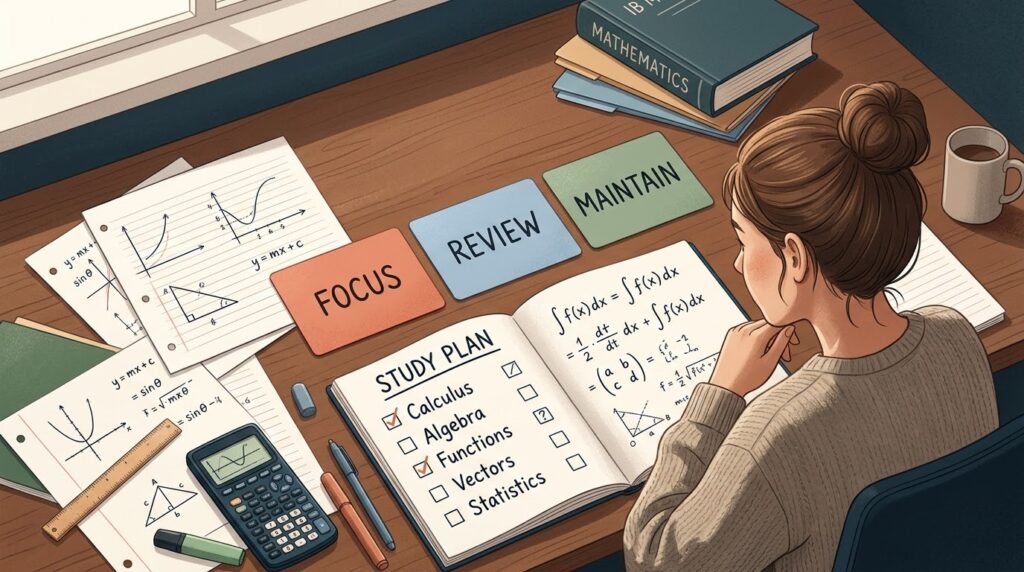
Try placing each topic into one of these groups:
| Priority | When it belongs here | What to do |
|---|---|---|
| High | It is relevant soon, and your recent work shows a clear gap | Practise it early in your next study session |
| Medium | You understand the basics, but make occasional errors or need more fluency | Schedule focused practice and review |
| Maintain | You can solve questions reliably, but need to keep the skill fresh | Include a short check in your weekly revision |
This is a guide for making your own decision, not a fixed score. Revisit the list as you complete more questions and learn where you are improving.
5. Turn a topic into a specific practice goal
“Revise calculus” is too broad to guide a study session. A more useful goal names the skill you want to practise.
For example:
- Identify which differentiation rule a question requires.
- Set up an integration problem correctly before using a calculator.
- Explain what a value means in the context of a question.
- Show the algebraic steps that connect a method to the final answer.
Choose a goal that matches the errors you have actually made. Then practise questions that let you test that skill.
6. Review the work, not just the answer
After attempting a question, check where your method succeeded and where it broke down. If you got the final answer wrong, identify the first step that caused the problem. If you got it right, check whether you could explain the method and repeat it on a different question.
This is where feedback can help. Mathzem’s AI Tutor can guide you through the question you are working on, while AI Examiner reviews submitted work and provides structured feedback. The feedback is intended to support your learning, not to predict an official IB mark.
Use the feedback to decide what to do next: practice the same skill again, review a concept, or move on to a related topic.
7. Keep strong topics in your plan
It can feel productive to spend all your time on the hardest topic. But ignoring topics you already understand can make your revision unbalanced.
Give your highest priority topics more time, while keeping shorter review sessions for skills you can already use. As your accuracy and confidence improve, lower the priority of a topic and give more time to another one.
The goal is steady progress across the material you need to know, not perfection in one area at the expense of everything else.
Use your practice history to choose the next step
Mathzem’s dashboard summarizes performance and recent attempts. The Weakness Map can help you identify topics that need attention, while the Mistake Journal helps you notice recurring errors. IB Practice lets you work by course, topic, and focus area.
Use these tools alongside your own assessment plan. Choose a specific skill, practice it, review the feedback, and then test whether you can apply it again.
Your next revision topic should come from a clear reason, not just habit. When you know what needs work and why, it becomes easier to use each study session well.
Explore Mathzem at https://mathzem.com.