Introduction
One of the biggest frustrations for IB Math students is not knowing why marks were lost.
After completing a practice question, students often compare their answer with a marks scheme and discover that it is wrong. However, the mark scheme rarely explains exactly where the mistake occurred, which marks were lost, or what should be improved next.
This creates a common problem.
Students know that something went wrong, but they do not know why.
As a result, they often repeat the same mistakes in future questions and exams.
Effective learning requires more than knowing the correct answer. Students need feedback that explains their performance and provides clear guidance for improvement.
This is where AI examiner feedback for IB Math can play an important role.
Table of Contents
Why Feedback Matters in IB Math
Feedback is one of the most powerful influences on learning.
In mathematics, feedback helps students understand:
- What was done correctly
- What mistakes occurred
- Why marks were lost
- Which skills need improvement
- What to practise next
Without meaningful feedback, revision often becomes inefficient.
Students may spend hours revising topics that are already strong while ignoring the areas that are actually reducing their scores.
The Problem With Traditional Answer Checking
Many students revise using a simple process:
- Attempt a question.
- Check the answer.
- Move on.
While this confirms whether the answer is correct, it does not provide much insight into performance.
For example, answer checking cannot always reveal the following:
- Missing method marks
- Weak mathematical communication
- Algebra mistakes hidden within longer solutions
- Calculator errors
- Recurring weaknesses across multiple topics
This limits the learning value of each practice session.
Understanding How IB Math Marks Are Awarded
One reason feedback is important is that IB Math exams reward more than just final answers.
Examiners often award marks for:
- Correct methods
- Mathematical reasoning
- Clear working
- Appropriate notation
- Accurate calculations
A student can sometimes receive marks even if the final answer is incorrect.
Likewise, a correct answer may still lose marks if sufficient working is not shown.
Understanding this distinction helps students improve exam technique and maximise scoring opportunities.
What Is AI Examiner Feedback?
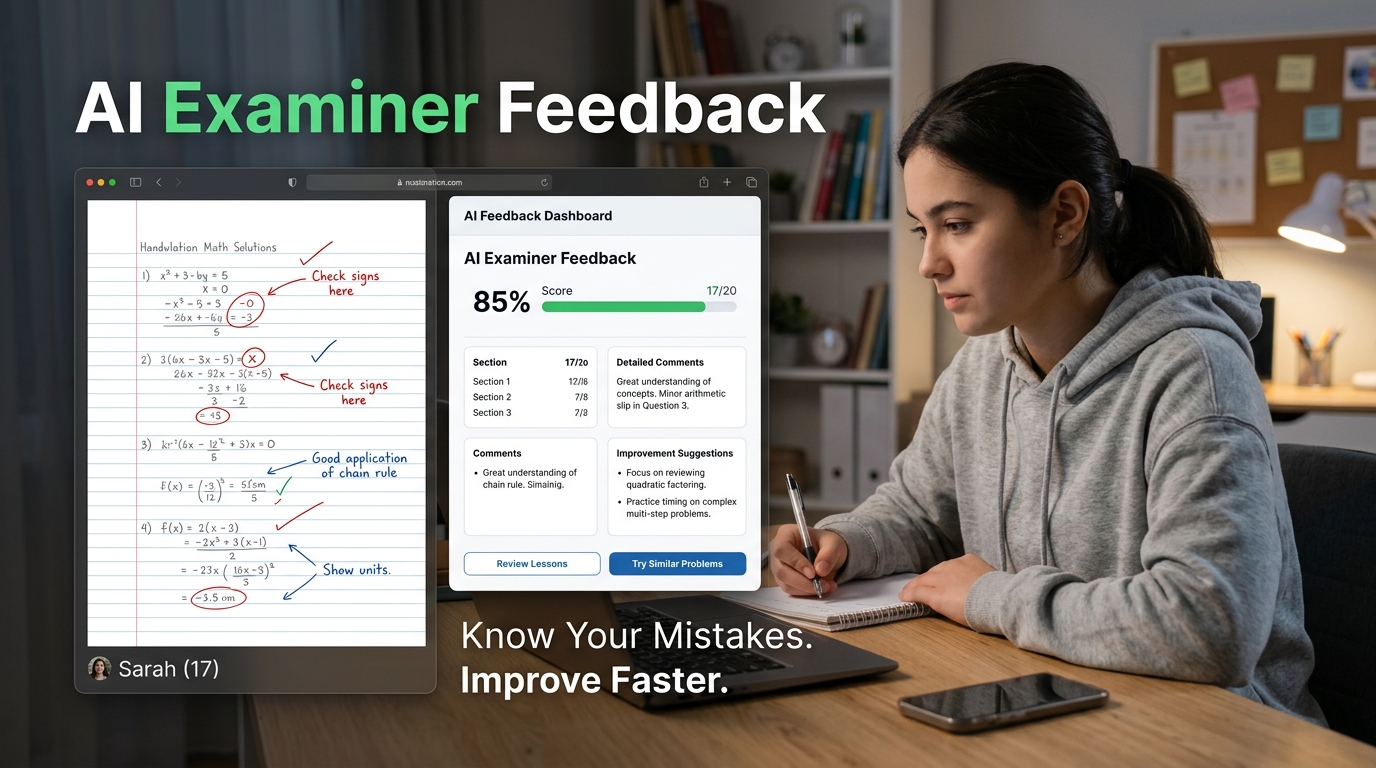
AI examiner feedback is designed to analyse a student’s complete solution rather than simply checking the final answer.
Instead of asking:
“Is this correct?”
The system asks:
“How would an examiner evaluate this work?”
The goal is to help students understand both strengths and weaknesses within their solution.
What Students Can Learn From AI Examiner Feedback
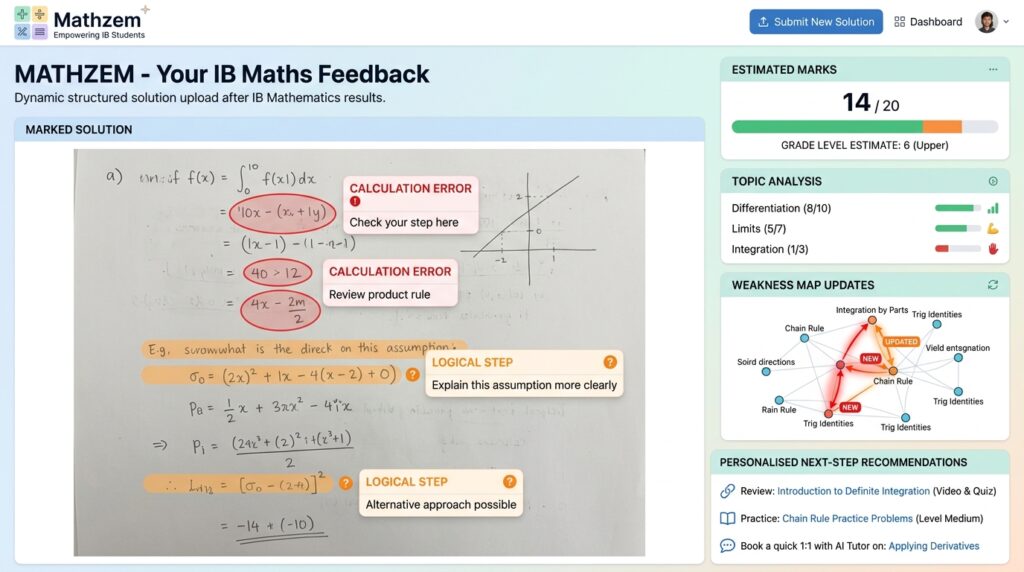
Estimated Marks
Students can see how their solution may perform under exam conditions.
This helps build a better understanding of how marks are awarded.
Mistake Analysis
The feedback identifies specific mistakes within the solution.
Examples include:
- Algebra errors
- Incorrect probability calculations
- Calculus mistakes
- Notation issues
- Missing steps
This makes revision more focused and effective.
Method Feedback
Students learn whether their mathematical approach was correct, even if the final answer was incorrect.
This is especially important because method marks contribute significantly to IB Math scores.
Next-Step Recommendations
Knowing what went wrong is useful.
Knowing what to do next is even more valuable.
Effective feedback should help students identify the next topic, skill, or question type that requires practice.
Why Immediate Feedback Supports Faster Improvement
Traditional feedback often arrives days or weeks after work is completed.
By that point, students may have forgotten their thinking process.
Immediate feedback allows students to
- Review mistakes while they are fresh
- Correct misunderstandings quickly
- Reinforce learning more effectively
- Adjust revision plans sooner
This creates a more efficient learning cycle.
How Mathzem Uses AI Examiner Feedback
Mathzem is designed around the idea that every question attempt should provide learning opportunities.
When students practice IB-style questions and upload their working, they receive AI examiner-style feedback that focuses on the following:
- Estimated marks
- Mistake analysis
- Lost method marks
- Topic performance
- Revision recommendations
This allows students to understand how their work might be evaluated and where improvements are needed.
Beyond Marks: Understanding Why Mistakes Happen
Many students focus only on scores.
However, understanding mistakes often leads to greater long-term improvement.
For example, a student may repeatedly lose marks in calculus.
At first glance, this appears to be a calculus weakness.
However, feedback may reveal that the real issue is algebra simplification.
Without detailed analysis, this important distinction can be missed.
How Feedback Updates the Weakness Map
One of the advantages of detailed performance analysis is that it helps build a clearer picture of student strengths and weaknesses.
As students complete more questions, feedback contributes to the Mathzem Weakness Map.
The map helps students identify:
- Strong topics
- Developing topics
- Weak topics
- Areas requiring immediate revision
This makes revision more strategic.
How the Mistake Journal Supports Long-Term Improvement
Many mistakes are repeated because students forget them.
The Mistake Journal helps students track the following:
- Recurring errors
- Exam technique issues
- Lost method marks
- Common misconceptions
Over time, patterns become easier to identify.
Students can then focus on preventing these mistakes from reappearing in future assessments.
From Feedback to a Personal Revision Plan
The ultimate purpose of feedback is improvement.
Strong revision plans are built from performance data rather than assumptions.
By combining:
- AI examiner feedback
- Weakness Map insights
- Mistake Journal records
- Topic performance analysis
Students can create targeted revision plans that focus on areas with the greatest potential impact.
The Practice → Upload → Review → Improve Workflow
The most effective learning process is often the simplest.
Practise
Attempt IB-style questions.
Upload
Submit the complete working.
Review
Analyse feedback and mistakes.
Improve
Focus revision on identified weaknesses.
This cycle ensures that every question contributes to future progress.
Conclusion
Feedback is one of the most valuable tools available to IB Math students.
While answer checking can confirm whether a solution is correct, detailed feedback helps students understand why marks were lost and how improvement can occur.
AI examiner feedback provides insights into methods, mistakes, strengths, weaknesses, and future revision priorities.
By combining feedback with practice questions, weakness maps, mistake journals, and personalised revision recommendations, students can build a more effective path toward IB Math success.
Start Improving With Mathzem
Discover your strongest and weakest IB Math topics:
Practise IB-style questions:
Access AI examiner feedback, weakness maps, mistake journals, and personalized revision support:
FAQ About AI Examiner Feedback for IB Math
What is AI examiner feedback?
AI examiner feedback analyses a student’s solution and provides insights into marks, mistakes, methods, and areas for improvement.
How is AI examiner feedback different from answer checking?
Answer checking focuses on the final answer, while AI examiner feedback reviews the entire solution process and identifies specific strengths and weaknesses.
Can AI feedback help improve IB Math scores?
Yes. Feedback helps students identify mistakes, understand lost marks, and focus revision on areas that need improvement.
What information does Mathzem’s feedback provide?
Mathzem provides estimated marks, mistake analysis, method feedback, topic insights, and personalised next-step recommendations.
How does feedback support revision planning?
Feedback helps students identify weak topics and recurring mistakes, allowing them to create more targeted and effective revision plans.