Introduction to Turn IB Math Mistakes Into a Smart Study Plan
Every IB Math student gets questions wrong.
Making mistakes is a normal part of learning mathematics.
The real difference between students who improve quickly and those who stay stuck is not the number of mistakes they make. It is what they do after making them.
Many students simply check the correct answer, understand where they went wrong, and continue to the next question.
Unfortunately, this often leads to the same mistakes appearing again in future practice sessions and exams.
A more effective approach is to treat every incorrect answer as useful information.
Each mistake can reveal weaknesses, highlight gaps in understanding, and guide future revision.
Mathzem is built around this idea. Instead of letting wrong answers go to waste, the platform helps students turn them into a personalized study plan that evolves as they continue practicing.
Table of Contents
Why Wrong Answers Are Valuable
Many students feel discouraged when they answer a question incorrectly.
However, mistakes provide information that correct answers cannot.
Every incorrect solution can answer questions such as the following:
- Which topic needs more revision?
- Which step caused marks to be lost?
- Was the mathematical method correct?
- Was the mistake caused by algebra, notation, or misunderstanding the question?
- Is this a recurring problem?
Students who regularly analyse these questions often make faster progress than students who focus only on correct answers.
Why Most Revision Plans Don’t Work
A common revision plan looks something like this:
Monday: Calculus
Tuesday: Functions
Wednesday: Probability
Thursday: Statistics
While organised, this approach assumes every topic deserves equal attention.
In reality, every student has different strengths and weaknesses.
One student may need additional calculus practice.
Another may lose most marks because of algebra errors across multiple topics.
Without performance data, revision plans are often based on guesswork.
A Better Way to Build an IB Math Study Plan
An effective revision plan should answer three questions:
What am I already good at?
Strong topics require maintenance rather than intensive revision.
What consistently costs me marks?
Weak topics deserve additional practice.
What should I study next?
Revision should always be guided by recent performance.
This creates a personalised learning experience instead of a generic timetable.
Step 1: Practice IB-Style Questions
The process begins with meaningful practice.
Students should regularly attempt IB-style questions under realistic conditions.
Practice helps students:
- Apply mathematical concepts
- Improve exam technique
- Develop confidence
- Reveal genuine strengths and weaknesses
However, practice alone does not guarantee improvement.
Learning happens during the review process.
Step 2: Upload Your Working
IB Math assessments reward more than correct answers.
Examiners also award marks for:
- Mathematical reasoning
- Methods
- Working shown
- Communication
- Accuracy
By uploading complete solutions instead of only checking answers, students gain a clearer understanding of how their work would be assessed.
Step 3: Receive AI Examiner Feedback
After uploading their work, students receive AI examiner-style feedback.
Rather than simply reporting whether an answer is correct, the feedback explains:
- Estimated marks
- Correct methods
- Mistakes within the solution
- Missing working
- Lost method marks
- Areas requiring improvement
This transforms every completed question into a valuable learning opportunity.
How the Student Dashboard Builds a Smarter Revision Plan
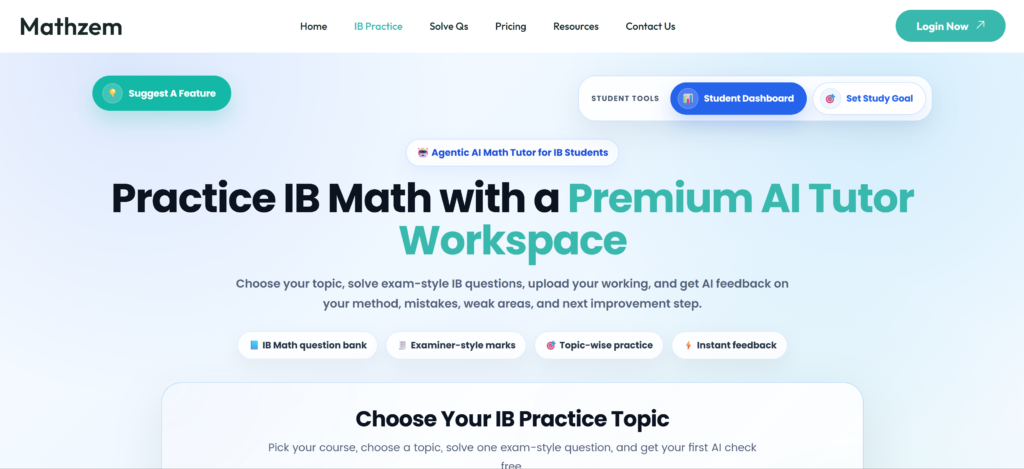
Every completed question contributes new information.
Inside the Mathzem Student Dashboard, this information is organised into practical learning tools that help students make better revision decisions.
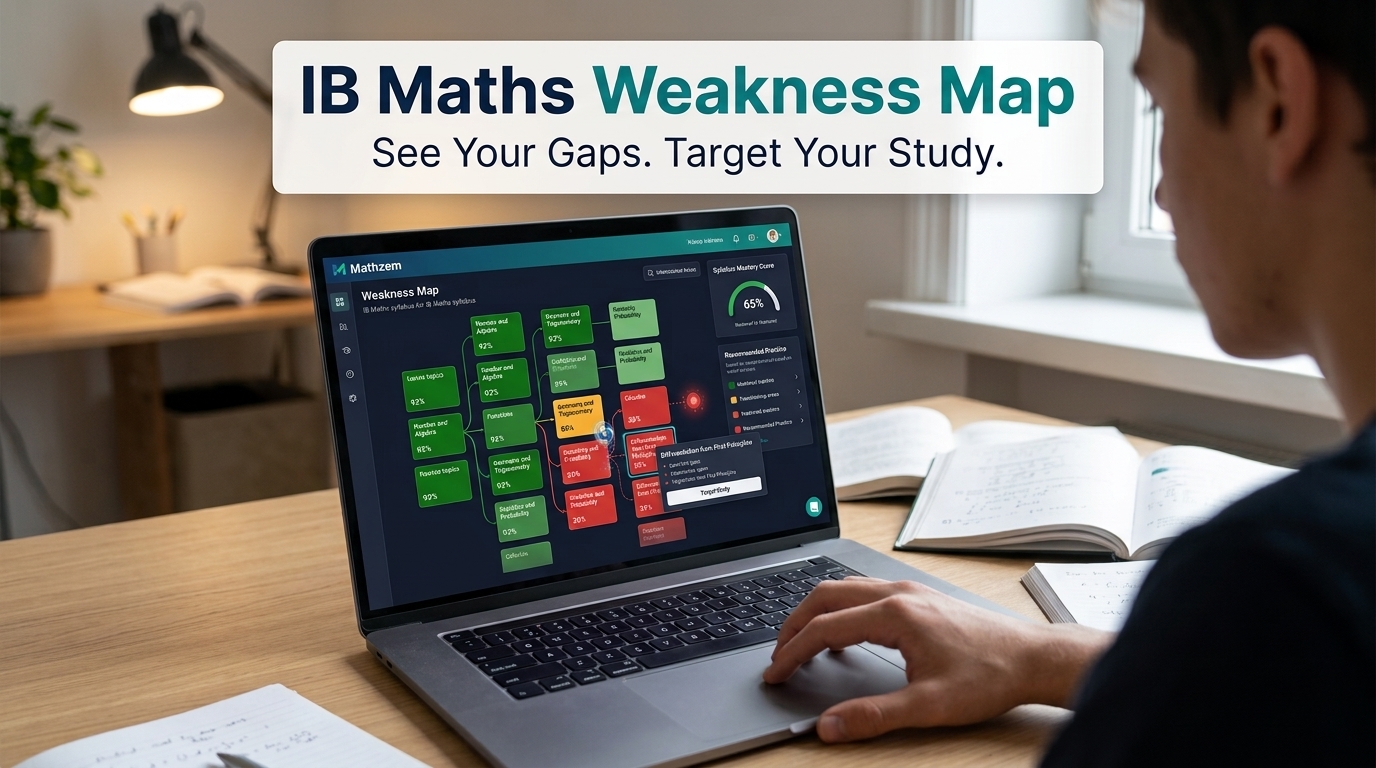
Weakness Map
The Weakness Map identifies topics where marks are consistently being lost.
Instead of guessing what to revise, students receive evidence-based guidance.
For example, the dashboard may reveal the following:
- Strong performance in functions
- Developing understanding of calculus
- Weak probability skills
- Frequent algebra mistakes affecting several topics
This helps students prioritize revision more effectively.
Strong and Weak Topic Analysis
As more questions are completed, the dashboard builds a clearer picture of performance across the IB syllabus.
Students can quickly identify the following:
- Strong topics requiring occasional review
- Topics that are improving
- Areas needing immediate attention
This helps create balanced revision rather than focusing only on favorite topics.
Mistake Journal
One incorrect answer may not reveal much.
Twenty similar mistakes usually reveal a pattern.
The Mistake Journal records recurring issues such as:
- Algebra mistakes
- Incorrect notation
- Missing method steps
- Calculator errors
- Misreading questions
Instead of forgetting mistakes after each practice session, students build a long-term record that supports continuous improvement.
Turning Feedback Into Action
Feedback only becomes valuable when students use it.
After analysing performance, students can build targeted revision plans by asking:
- Which topic appears most often in my Weakness Map?
- Which mistakes keep appearing in my Mistake Journal?
- Which skills are improving?
- Which question types should I practise next?
Instead of randomly selecting revision topics, students make informed decisions based on evidence.
From Wrong Answers to Personalised Revision
Every incorrect solution contributes to a larger picture.
As students continue practising, the dashboard continuously updates:
- AI examiner feedback
- Estimated marks
- Weakness Map
- Topic performance
- Mistake Journal
- Revision recommendations
Over time, these insights become a personalised study plan based entirely on the student’s own learning.
No two students receive exactly the same guidance because no two students make exactly the same mistakes.
The Practice → Upload → Review → Improve Cycle
The most effective IB Math revision follows a continuous learning cycle.
Practise
Attempt realistic IB style questions.
Upload
Submit your complete working.
Review
Study AI examiner feedback and mistake analysis.
Improve
Revise weak topics before attempting new questions.
Repeating this process consistently helps students build confidence and improve exam performance throughout the course.
Why This Approach Supports Better Long Term Learning
Students often believe success comes from completing the highest number of questions.
In reality, improvement comes from learning something new after every question.
When every mistake becomes part of a structured revision plan, students spend less time repeating errors and more time developing stronger mathematical understanding.
This makes revision more efficient and more rewarding.
Conclusion
Wrong answers are not the end of the learning process.
They are the beginning.
Students who understand their mistakes, identify patterns, and revise strategically are more likely to improve than students who simply check answers and move on.
Mathzem helps make this process easier by combining IB-style practice questions, AI examiner feedback, weakness maps, mistake journals, and personalized revision recommendations into one connected learning system.
Instead of asking, “What did I get wrong?” students can begin asking, “What should I learn next?”
That small change in approach can make a significant difference over the course of the IB program.
Start Improving With Mathzem
Discover your strongest and weakest IB Math topics
Practice official-style IB Math questions
Receive AI examiner-style feedback, build your Weakness Map, and create a personalised revision plan
FAQ About Turn IB Math Mistakes Into a Smart Study Plan
Why should I analyse wrong answers in IB Math?
Analysing wrong answers helps you identify recurring mistakes, understand why marks were lost, and focus your revision on the topics that need the most improvement.
What is a personalised IB Math study plan?
A personalised study plan is based on your own practice results, highlighting the topics and skills that need the most attention instead of following a generic timetable.
How does the Mathzem Weakness Map help?
The Weakness Map tracks where you consistently lose marks, making it easier to prioritise your revision and improve efficiently.
What is the benefit of uploading my work instead of checking final answers?
Uploading your working allows AI examiner feedback to review your methods, reasoning, and mathematical communication, not just the final answer.
How does Mathzem help students improve in IB Math?
Mathzem helps students practise IB style questions, upload their working, receive AI examiner style feedback, track recurring mistakes through the Mistake Journal, identify strong and weak topics with the Weakness Map, and turn every practice session into a personalised revision plan.