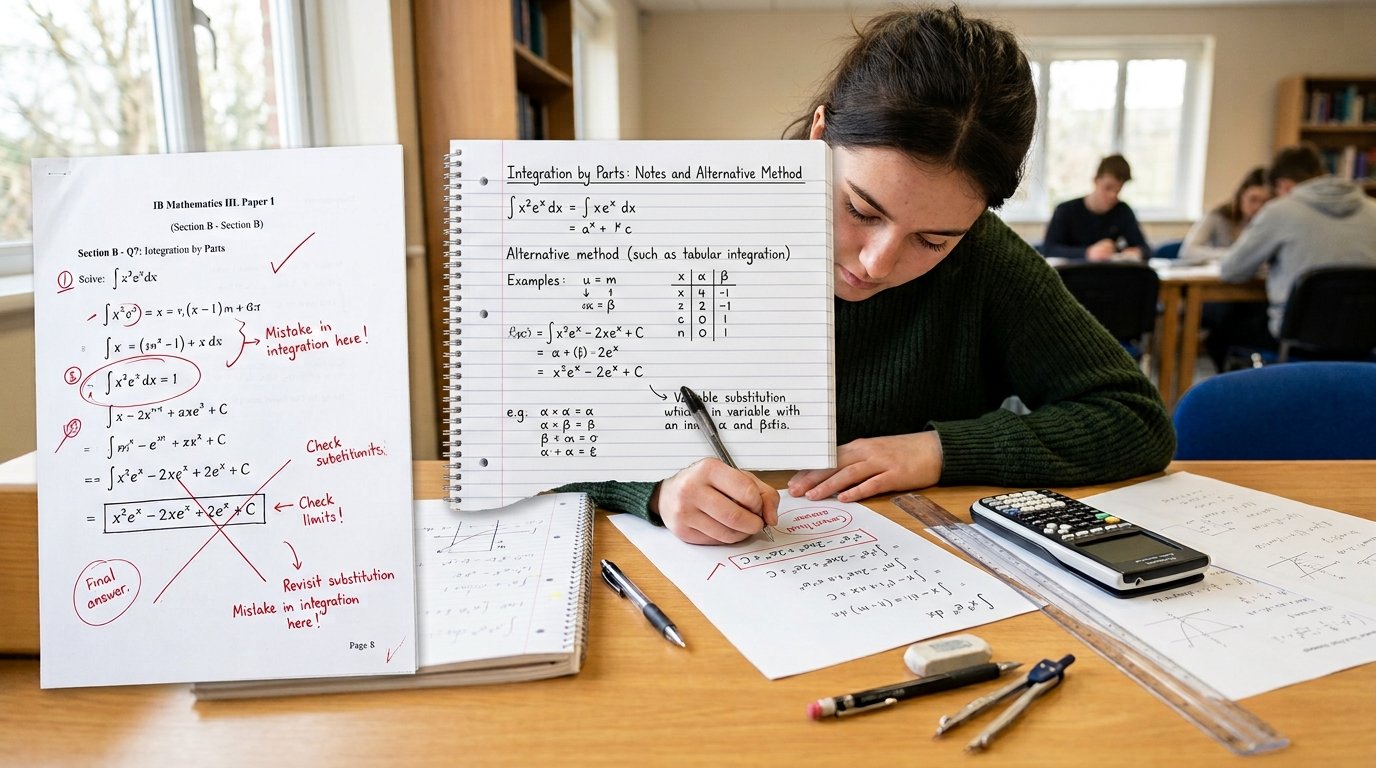
Functions are one of the most important topics in IB Maths AA HL functions practice. They appear throughout the syllabus and are closely connected to calculus, algebra, graph sketching, and mathematical modeling.
Students who develop a strong understanding of functions often find later topics much easier because many calculus questions rely on function behavior and graph interpretation.
This guide explains the key concepts, common mistakes, effective revision strategies, and how to practice functions successfully for the IB exams.
Table of Contents
Why Functions Matter in IB Maths AA HL
Functions are more than just equations.
They help describe relationships between variables and provide the foundation for many mathematical models.
In the IB Maths AA HL course, you’ll use functions to:
- Analyse graphs
- Solve equations
- Model real situations
- Prepare for differentiation and integration
- Understand transformations
- Investigate mathematical behaviour
Because functions appear in multiple syllabus areas, mastering them early can improve your performance across the entire course.
Topics You Need to Know
The AA HL functions topic includes several important concepts.
Types of Functions
You should recognise and work confidently with:
- Linear functions
- Quadratic functions
- Cubic functions
- Polynomial functions
- Rational functions
- Exponential functions
- Logarithmic functions
- Trigonometric functions
Each type has unique properties, graphs, and applications.
Domain and Range
One of the first skills you should master is identifying the domain and range of a function.
Questions may ask you to:
- Find restrictions
- Interpret graphical information
- Determine valid inputs and outputs
- Explain answers mathematically
Always consider where a function is undefined before giving your final answer.
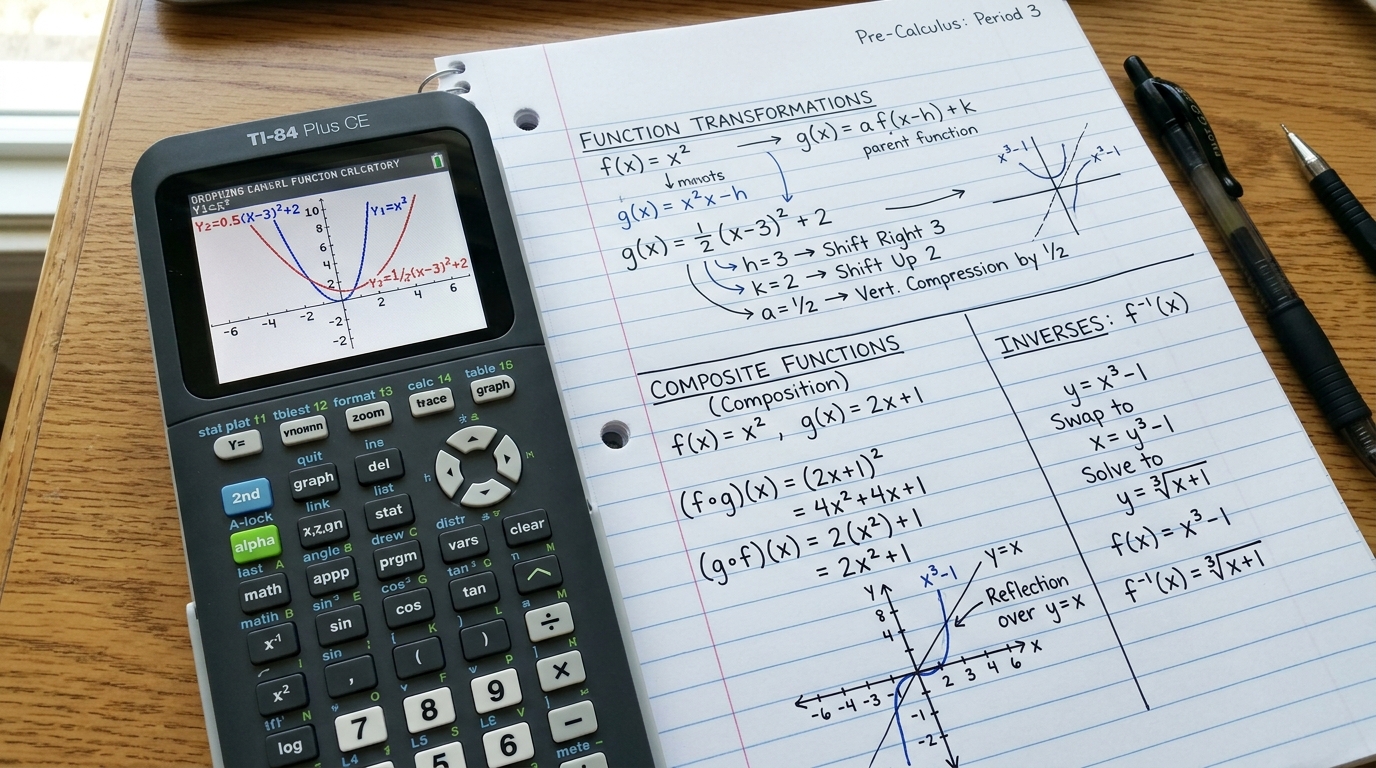
Composite Functions
Composite functions combine two functions into one.
For example:
[
(f \circ g)(x)
]
Students should be able to:
- Evaluate composite functions
- Simplify expressions
- Interpret notation
- Determine domains
Take each substitution step carefully to avoid algebra mistakes.
Inverse Functions
Inverse functions appear regularly in IB examination questions.
You should know how to:
- Find inverse functions algebraically
- Verify inverse relationships
- Determine restricted domains
- Interpret inverse graphs
Remember that not every function has an inverse over its entire domain.
Graph Transformations
Transformation questions test both algebraic understanding and graphical interpretation.
Be confident with:
- Vertical shifts
- Horizontal shifts
- Reflections
- Stretches
- Compressions
Understanding how equations affect graphs is more important than memorising rules.
Function Modelling
The IB often includes modelling questions where students choose an appropriate function for a given situation.
Examples include:
- Population growth
- Radioactive decay
- Financial growth
- Cooling models
Always consider whether the chosen function makes sense in the context of the question.
Common Function Questions in IB Exams

Function questions may ask you to:
- Sketch graphs
- Solve equations graphically
- Find intersections
- Determine maximum or minimum values
- Evaluate composite functions
- Find inverse functions
- Interpret transformations
- Analyse function behaviour
Many of these skills also appear later in calculus questions.
Common Mistakes Students Make
Confusing Domain and Range
Many students reverse these definitions.
Remember:
- Domain refers to possible input values.
- Range refers to possible output values.
Incorrect Function Notation
Students sometimes ignore notation such as:
- (f(x))
- (g(x))
- (f^{-1}(x))
- ((f \circ g)(x))
Understanding notation is essential before attempting calculations.
Algebra Errors
Even when students understand the concept, algebra mistakes often lead to incorrect answers.
Common errors include:
- Expanding brackets incorrectly
- Incorrect substitution
- Sign mistakes
- Simplification errors
Misinterpreting Graph Transformations
Students frequently confuse horizontal and vertical transformations.
A simple sketch before calculating often helps prevent mistakes.
Forgetting Domain Restrictions
Inverse functions often require restricted domains.
Ignoring this can produce mathematically incorrect answers.
How to Practice Functions Effectively
Simply reading notes is not enough.
A stronger revision strategy includes the following steps.
Step 1: Learn One Concept at a Time
Focus on one function type before combining multiple ideas.
Step 2: Sketch Graphs Regularly
Drawing graphs improves visual understanding and supports later calculus topics.
Step 3: Solve Mixed Questions
Once you understand individual concepts, practice questions that combine the following:
- Graphs
- Algebra
- Transformations
- Composite functions
This reflects the style of IB examinations.
Step 4: Review Every Mistake
After each practice session, ask yourself:
- Did I misunderstand the notation?
- Was the mistake algebraic?
- Did I choose the wrong method?
- Could I explain my reasoning clearly?
The answers will guide your future revision.
Practice Checklist
Before your exams, make sure you can confidently:
- Identify different function types
- Determine domain and range
- Evaluate composite functions
- Find inverse functions
- Sketch graphs accurately
- Apply graph transformations
- Solve function equations
- Interpret graphs in context
Exam Tips for Function Questions
Read the Entire Question:
Some questions build on earlier parts.
Avoid making assumptions before reading all instructions.
Show Your Working
Even when using a graphing calculator, include important mathematical steps.
Method marks are valuable.
Label Graphs Clearly
Axes, intercepts, turning points, and asymptotes should be labelled where appropriate.
Clear communication helps examiners follow your reasoning.
Check Your Final Answer
Before moving on, confirm:
- Domain restrictions
- Graph accuracy
- Algebra
- Calculator input
- Units, where applicable
How Mathzem Helps You Improve Function Questions
Many students complete dozens of function questions but never discover why they lose marks.
Mathzem analyses your complete solution, providing AI examiner style feedback based on your working.
After uploading a question, you’ll receive:
- Marks awarded
- Missing method marks
- Algebra mistakes
- Graph interpretation feedback
- Topic specific weaknesses
- Suggested next steps
Your personalised dashboard also includes the following:
- A weakness map across the AA HL syllabus
- A personalised revision plan
- Progress tracking
- A mistake journal
- Topic performance insights
Instead of practising blindly, you can focus on the function skills that need the most improvement.
Frequently Asked Questions About AA HL Functions Practice
Are functions important in IB Maths AA HL?
Yes. Functions are one of the core topics in AA HL and provide the foundation for calculus, graph analysis, and mathematical modelling.
Which function topics appear most often?
Composite functions, inverse functions, graph transformations, and graph interpretation appear regularly in IB examinations.
Should I use my calculator for function questions?
Graphing calculators are useful for checking answers, but you should understand the underlying mathematics and show appropriate working.
How can I improve at functions?
Practise regularly, sketch graphs by hand, review mistakes carefully, and focus on understanding relationships between equations and graphs.
Conclusion
Functions are one of the building blocks of IB Maths AA HL. A strong understanding of graphs, transformations, composite functions, and inverses will make many other topics easier, especially calculus.
Rather than memorising procedures, focus on understanding how functions behave and why different methods work. Regular practice combined with careful review of mistakes is one of the most effective ways to improve.
Want to discover which function topics need the most attention? Start with the Math Skill Scanner:
Then upload your function solutions to Mathzem IB Practice and receive AI examiner style feedback, identify weak areas, and build a personalised revision plan based on your own performance: