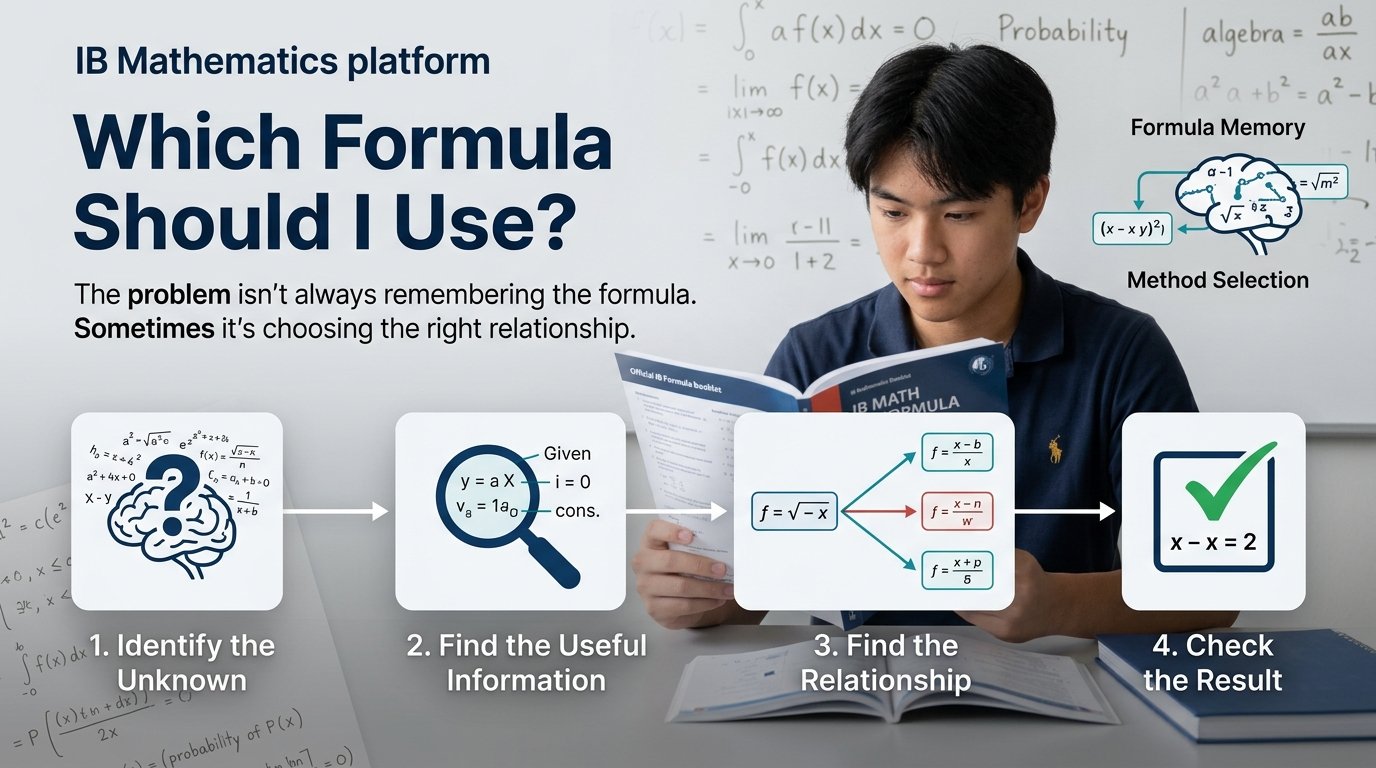
You look at the question.
You know the formulas.
You have revised the topic.
But then you freeze.
Which formula to use in IB Math
This is a common IB Mathematics problem.
It can feel like a memory problem, but often it is something different.
You may know several formulas perfectly well.
The difficult part is recognising which mathematical structure the question is describing.
That is a method selection skill.
And it becomes especially important when the question does not tell you exactly what to do.
Table of Contents
Quick answer
Do not start by scanning your formula booklet for a familiar looking equation.
Start with the information in the question.
Ask:
What am I trying to find?
What information has been given?
What mathematical relationship connects those pieces of information?
Then choose a formula or method that connects the known information to the unknown.
Finally, check whether your result makes sense in the context of the question.
The IB’s current mathematics framework explicitly includes selecting appropriate methods and tools, carrying out computations, and evaluating results for accuracy and relevance.
So knowing formulas is only part of the skill.
Knowing when to use them matters too.
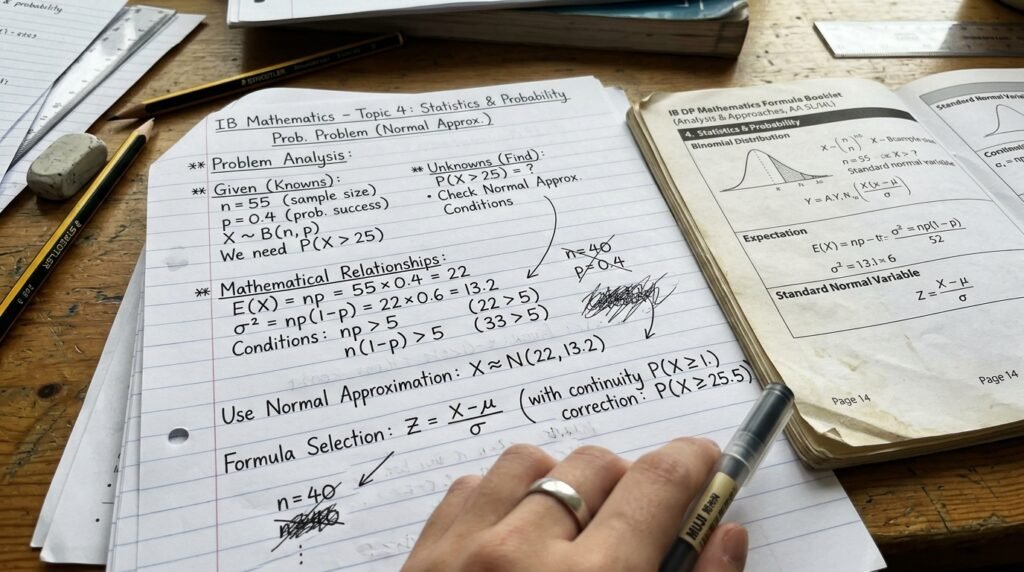
Knowing formulas and selecting formulas are different skills
Suppose you know the quadratic formula.
You can write:
You may be able to substitute values correctly.
But imagine an exam question where the quadratic equation is hidden inside a longer problem.
The challenge is no longer:
“Do you remember the quadratic formula?”
It becomes:
“Is this actually a quadratic problem, and is the quadratic formula the appropriate method here?”
That second question requires recognition.
This is why a student can score well on formula based exercises and still struggle with unfamiliar exam questions.
The formula was not the hardest part.
Choosing the route was.
The IB formulas booklet does not remove the problem
IB Mathematics students have access to a clean formula booklet during examinations. The IB’s guidance recommends that students become familiar with the booklet rather than treating it as something completely unfamiliar during the exam.
That changes the revision question.
You do not necessarily need to memorise every formula.
You need to know:
Where the formula is.
What each part means.
What information it requires.
When it applies.
What the resulting value represents.
What assumptions or conditions matter.
If you can do those things, the formula booklet becomes a tool.
If you cannot, having the formula available may not help much.
Start with the unknown
One of the simplest ways to choose a formula is to begin with the quantity you need.
Suppose a question asks for the probability of an event.
Do not immediately search for a probability formula.
First ask:
What exactly is the question asking me to calculate?
Is it:
A single probability?
A conditional probability?
A binomial probability?
An expected value?
A parameter?
A confidence interval?
A probability from a normal distribution?
The wording helps identify the mathematical object.
Once you know the object, the possible methods become much narrower.
Then identify the information you have
Suppose a question gives you:
A mean.
A standard deviation.
A sample size.
A particular value.
You now have clues about the mathematical model involved.
The same applies across mathematics.
If you are given:
A function.
A derivative.
A stationary point.
A domain.
You should start thinking about relationships between these quantities.
If you are given:
Two coordinates.
A gradient.
A geometric relationship.
You can start identifying the relevant analytical structure.
The numbers are not just values to substitute.
They are clues.
Look for relationships, not keywords
This is where students often get stuck.
They learn that certain words mean certain formulas.
For example:
“average” → mean.
“rate of change” → derivative.
“area under the curve” → integration.
“perpendicular” → negative reciprocal gradient.
These associations can be useful.
But they are not enough.
IB questions can combine ideas.
A question may never use the exact phrase you memorised.
Instead, you need to recognise the underlying relationship.
That is why practising only questions that announce the topic can create a false sense of confidence.
You know the formula because the question told you what chapter you are in.
An exam question may not.
A better question to ask yourself
Instead of asking:
“Which formula do I remember?”
ask:
“What relationship am I trying to represent?”
That small change can make a big difference.
Consider a simple example.
A function describes the position of an object over time.
The question asks for the object’s instantaneous velocity at a particular time.
You could search through a list of formulas.
Or you could ask:
What is velocity in terms of position?
It is the rate of change of position.
That points towards differentiation.
The relationship gives you the method.
You did not need to memorise a sentence saying:
“Whenever the question mentions instantaneous velocity, differentiate the position function.”
You recognised the mathematical relationship.
Use the units as a clue
Units can help you reject unsuitable formulas.
Suppose the question asks for an area.
Your final answer should have units of area.
If your calculation produces a value with units of length, something needs checking.
Units can also help when deciding between possible quantities.
For example:
Distance might be measured in metres.
Time in seconds.
Velocity in metres per second.
Acceleration in metres per second squared.
If your formula produces the wrong dimensions for the quantity you are trying to find, reconsider your method.
This is not a replacement for mathematical reasoning.
It is a useful check.

Use the structure of the question
Look at how the information is connected.
Suppose you have a triangle.
You know two sides and an included angle.
You need the third side.
The structure suggests a relationship involving those quantities.
You do not need to begin by searching every trigonometric formula.
Ask:
What formula connects the quantities I know with the quantity I need?
That question narrows the search.
The same principle works for:
Functions.
Sequences.
Probability.
Statistics.
Vectors.
Calculus.
Geometry.
Financial mathematics.
The specific mathematics changes.
The decision process remains similar.
Do not choose a formula simply because it contains the numbers
This is a common exam mistake.
Suppose a question gives you three values.
You find a formula containing all three.
That does not prove it is the right formula.
You need to ask:
Does the formula describe the relationship in the question?
Are the conditions satisfied?
Does the resulting quantity answer what was actually asked?
Would another method represent the situation more naturally?
Formula selection is not a matching game.
It is mathematical modelling.
The IB describes mathematical inquiry as involving the selection of appropriate methods, tools or data, followed by computation and evaluation of the result.
A four step formula selection method
When you are unsure, use this sequence.
Step 1: Identify the unknown
Write down exactly what you need to find.
For example:
or
or
Be precise.
Step 2: List the useful information
Ignore information that does not help you yet.
Write down the quantities and relationships that matter.
Step 3: Find the relationship
Ask:
Which mathematical relationship connects what I know to what I need?
This is the key step.
Step 4: Check the result
Ask:
Does the answer have sensible units?
Is the magnitude reasonable?
Does it answer the actual question?
Does it fit the context?
This final check is important because a technically correct calculation can still produce an answer that is inappropriate for the problem.
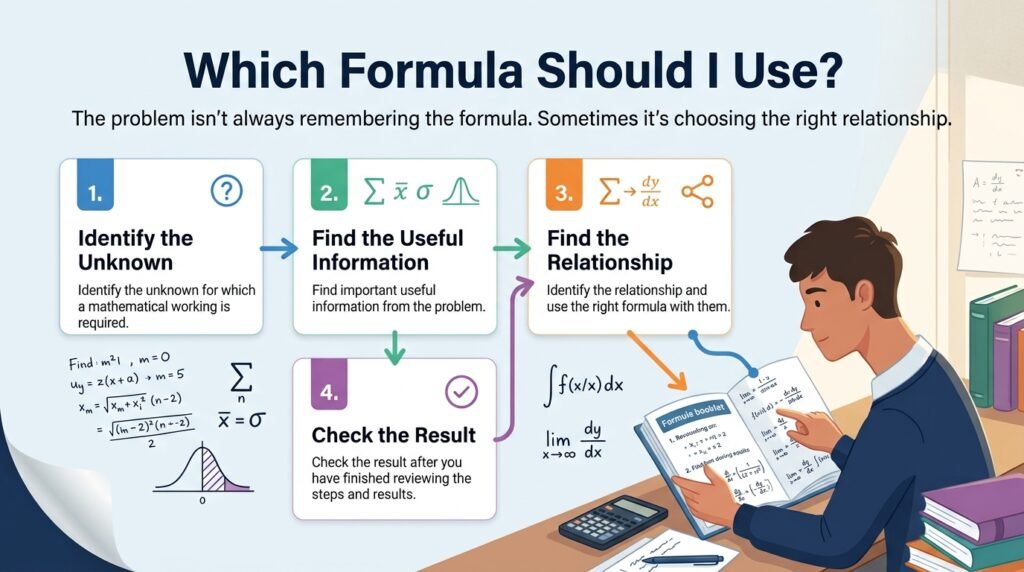
Example: choosing a formula in statistics
Suppose you are given a normally distributed variable with a known mean and standard deviation.
You are asked for the probability that the variable is greater than a particular value.
A student who is thinking only in terms of formulas might start searching through the formula booklet.
A student who is thinking structurally might ask:
What is the distribution?
What quantity is being requested?
What standardisation relationship connects the original value to the standard normal distribution?
That reasoning points towards a standardisation step and then the appropriate probability calculation.
The formula becomes part of the method.
It is not the method by itself.
Example: choosing a method in calculus
Imagine a question gives a function and asks where its gradient is zero.
You know several calculus techniques.
You could integrate.
You could evaluate the function.
You could differentiate.
The wording and mathematical relationship matter.
Gradient zero corresponds to:
That gives you the first step.
The key skill was not remembering that differentiation exists.
It was recognising what the question was asking mathematically.
Example: choosing between similar methods
Sometimes the difficulty is not knowing one formula.
It is choosing between two reasonable approaches.
Suppose a question involves a triangle and gives side lengths and an angle.
Several trigonometric relationships may be available.
Do not ask:
“Which formula have I practised most?”
Ask:
“Which relationship contains the quantities I know and the quantity I need?”
Then check whether the arrangement of the known values satisfies the formula.
This makes the decision deliberate rather than random.
Why mixed practice matters
If every question in your revision session comes from one chapter, you already know the general method.
That is useful when learning a skill.
But it is not enough for exam preparation.
Eventually, mix the questions.
For example:
Question 1: Functions.
Question 2: Probability.
Question 3: Calculus.
Question 4: Statistics.
Question 5: Functions again.
Do not label the method.
Now you have to decide.
That changes the task.
You are no longer practising only:
“Can I perform this method?”
You are also practising:
“Can I recognise when this method is appropriate?”
That is closer to what happens in an exam.
Keep a method selection mistake log.
If you repeatedly choose the wrong formula, do not simply write:
“I forgot the formula.”
That may not be the real problem.
Instead write:
Question: What was I trying to find?
My choice: What formula did I use?
Correct choice: What relationship should I have recognised?
Reason: What clue did I miss?
Retest: Can I identify the method in a new question?
For example:
Mistake: Used a formula involving independent events.
Actual problem: The question involved conditional probability.
Missed clue: The wording described the probability of one event given that another had occurred.
Next practice: Mixed probability questions without topic labels.
That is much more useful than memorising another page of formulas.
How Mathzem can help with this problem
One of the recurring problems in Mathzem’s customer research is:
“I did not know which formula to use.”
The research also identifies students who understand mathematical concepts but struggle to identify what a question is asking, know how to begin, or connect several concepts in an exam style problem.
That is why Mathzem’s core practice loop is built around the student’s own attempt.
The current product positioning is:
Choose an IB style question.
Solve it independently.
Upload your actual working.
Receive examiner style feedback on marks and mistakes.
Identify weak areas.
Use that evidence to decide what to practise next.
This matters for formula selection because your wrong formula is part of your working.
If you chose the wrong method but calculated correctly from that point, the final answer alone does not tell the full story.
The working does.
Your mistake may be method selection, not formula memory
This distinction is worth remembering.
Suppose you have access to the formula booklet.
You still choose the wrong relationship.
That is not primarily a memory problem.
You may need to practise:
Reading the question.
Identifying the unknown.
Recognising mathematical relationships.
Connecting known information to the unknown.
Rejecting unsuitable methods.
Checking whether the result answers the question.
That is a different kind of revision.
And it is often much closer to the real problem students experience in unfamiliar IB questions.
What to do when you genuinely do not know
Sometimes you will read a question and have no idea.
Do not immediately open the solution.
Try a structured reset.
First, rewrite the question in mathematical language
What is known?
What is unknown?
What conditions are given?
Second, identify the topic
Is this mainly:
Algebra?
Functions?
Calculus?
Probability?
Statistics?
Geometry?
Vectors?
Third, write down possible relationships
Do not calculate yet.
List the formulas or methods that could plausibly connect the information.
Fourth, eliminate
Which options do not contain the quantities you need?
Which require information you do not have?
Which do not match the situation?
Fifth, test the most plausible method
Carry out the first step.
Then evaluate.
This prevents random formula selection.
Formula selection is a skill you can practise
You do not need to wait for an exam to practise this.
Take ten questions from different topics.
Before solving each one, write only:
What am I finding?
What information do I have?
What method or relationship might connect them?
Then solve.
This separates method selection from calculation.
It also lets you identify exactly where you struggle.
Perhaps you know the formula once someone tells you.
Then your weakness is recognition.
Perhaps you choose correctly but make errors during substitution.
Then your weakness is execution.
Perhaps you calculate correctly but interpret the result incorrectly.
Then your weakness is evaluation or communication.
Those require different practice.
The formula booklet should become familiar, not intimidating
The IB guidance recommends that students become familiar with the formula booklet from the beginning of the course, and students are required to have access to a clean copy during the examination.
So use it during revision.
Open it.
Find the formulas.
Look at how they are organised.
Understand the notation.
Practise locating a formula quickly.
But do not stop there.
For each important formula, ask:
What does it calculate?
What information does it need?
When would I use it?
When would I not use it?
What does the answer mean?
That is a much stronger relationship with the formula booklet.
A useful formula practice exercise
Pick one topic.
Choose five formulas.
For each formula, create three questions.
Question type 1: Direct
The formula is clearly applicable.
Question type 2: Indirect
The formula is useful, but the question does not explicitly tell you to use it.
Question type 3: Distractor
Another formula looks tempting but does not actually apply.
This third type is particularly useful.
It trains you to reject a method, not simply recognise one.
What better exam preparation looks like
Good formula revision is not
Memorize the IB math formula.
Substitute numbers.
Repeat.
A stronger process is:
Recognise the mathematical structure.
Identify the unknown.
Select the relationship.
Apply it accurately.
Interpret the result.
Check whether it makes sense.
This matches the broader problem solving process described by the IB, which includes choosing appropriate methods and tools, carrying out computations and evaluating results for accuracy and relevance.
FAQs About Which Formula to Use in IB Math
Do I need to memorise every IB Math formula?
Not necessarily. IB Mathematics students have access to a formula booklet during examinations. You should still understand the formulas, know what they represent, know when they apply, and be able to locate them efficiently.
Why do I know the formulas but still get questions wrong?
You may have a method selection problem rather than a formula memory problem. The difficulty may be recognising the mathematical relationship described by the question.
How can I get better at choosing IB math formula?
Practise mixed questions without being told the topic or method. Before calculating, identify the unknown, list the relevant information and state the relationship you think connects them.
Should I use the formula booklet while practising?
Yes. It can help you become familiar with its organisation and notation. The goal is to use it as a mathematical reference rather than depending on memory alone.
What if two formulas seem possible?
Compare the information each formula requires with what the question actually gives you. Then consider whether the relationship represented by the formula matches the situation.
Can Mathzem help with choosing the right formula?
Mathzem is designed around students solving IB style questions independently and submitting their actual working for examiner style feedback. Its current feedback can identify mistakes and methods, weak areas and suggested next steps.
Final takeaway
The question:
“Which formula to use in IB Math?”
is often really asking:
“What mathematical relationship is this question describing?”
That is a more useful question.
Start with the unknown.
Look at the information.
Identify the relationship.
Choose the method.
Then check whether the result makes sense.
The goal is not to memorise a longer list of formulas.
It is to become better at recognising which mathematics the question requires.
That is the skill that turns a formula booklet from a collection of equations into a useful exam tool.