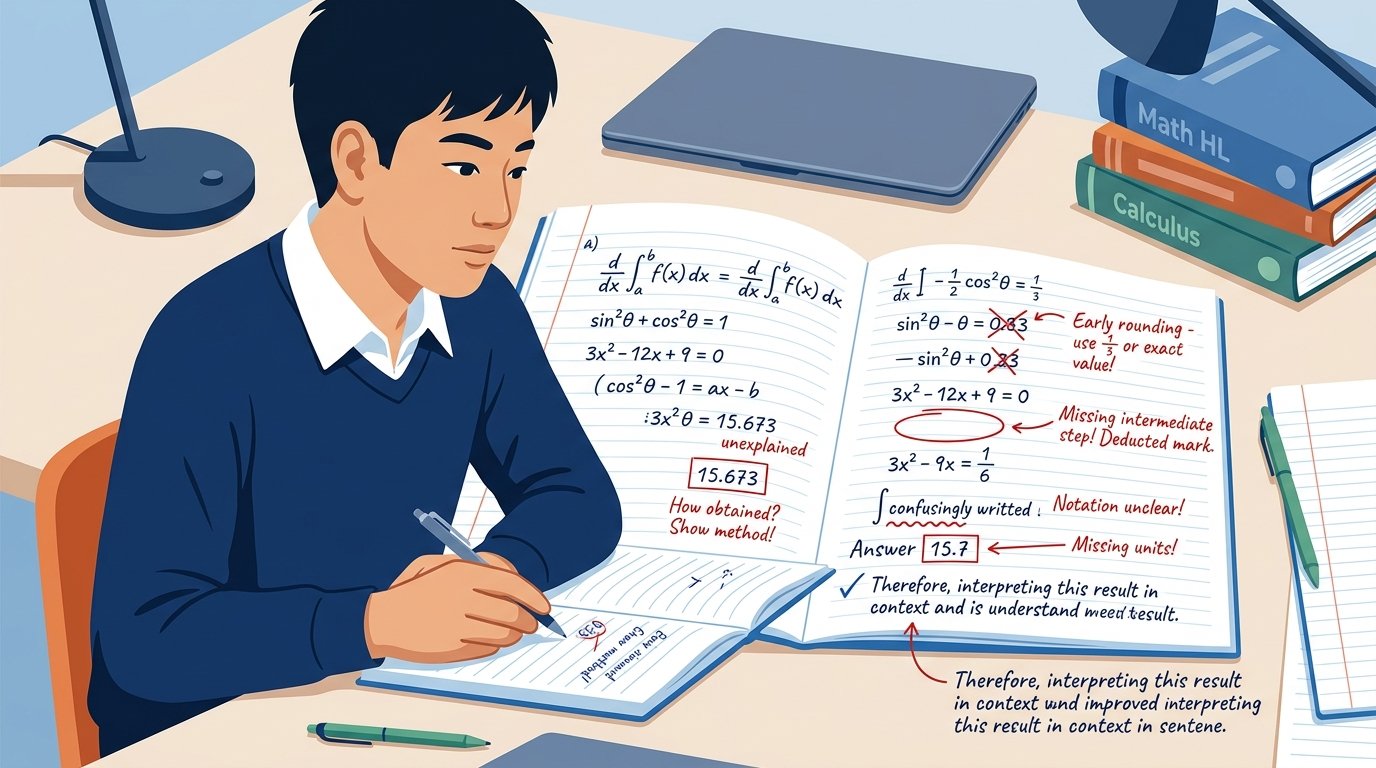
IB Math students have more revision resources available to them than ever before. You can practise past paper questions, use question banks, watch worked solutions, ask ChatGPT to explain a concept, check an official mark scheme, work with a tutor, or use an AI tool that reviews your mathematical working.
The problem isn’t finding a resource.
The problem is knowing which resource you actually need at a particular stage of revision.
If you don’t understand integration, doing another twenty integration questions probably isn’t the best first step. If you understand the topic but keep losing method marks, watching another explanation may not solve the problem. If you can solve questions at home but struggle with unfamiliar exam questions, simply completing more familiar exercises may not address the real weakness.
Different resources solve different problems.
Revision Village, ChatGPT, official mark schemes, tutors, traditional question banks, and AI examiner tools can all be useful. But they aren’t interchangeable.
The most effective IB Math revision strategy is therefore not about choosing one tool and using it for everything. It’s about understanding what each resource does well, recognising its limitations, and using the right resource for the problem you’re trying to solve.
Table of Contents
What Makes a Good IB Math Practice Resource?
Before comparing different resources, it’s useful to define what “good practice” actually means.
A strong IB Math practice system needs more than a large collection of questions. Students need opportunities to apply mathematical concepts, work through unfamiliar problems, check their solutions, understand mistakes, and decide what to practise next.
The International Baccalaureate’s mathematics curriculum places emphasis on mathematical knowledge and understanding, problem solving, reasoning, communication, interpretation, and applying mathematics in different contexts.
That means a resource can be excellent for one part of the learning process while being less useful for another.
A question bank may be excellent for getting more practice.
A mark scheme may be excellent for checking how marks are awarded.
A tutor may be excellent for diagnosing a conceptual misunderstanding.
ChatGPT may be useful for explaining a difficult idea in different ways.
An AI examiner may be useful for analysing the student’s actual working and identifying where marks were lost.
The important question is not simply, “Which is best?”
It’s:
“Best for what?”
Revision Village: Strong for Structured Question Practice
Revision Village is widely used by IB students as a practice resource. Its main strength is the quantity and organisation of IB-focused questions and revision material.
For a student who already understands a topic and needs more opportunities to practise, a large question bank can be very useful.
You can work through questions by topic, difficulty, or course area and become familiar with the types of mathematical problems that can appear in IB assessments.
This is particularly useful during the middle and later stages of revision, when you already have a reasonable understanding of the syllabus and want to increase the amount of exam style practice you complete.
The limitation is that more questions don’t automatically solve every learning problem.
If you repeatedly make the same mistake and simply move to another question, you may continue making the same mistake.
A question bank can give you opportunities to practise.
It doesn’t necessarily tell you why your particular working went wrong or which weakness should determine your next practice question.
That distinction becomes important as students move from learning mathematics to improving exam performance.
When Revision Village Makes the Most Sense
Revision Village is particularly useful when you need structured practice and exposure to a wide range of IB Math questions.
For example, suppose you’ve just revised differentiation and understand the main procedures. You now want to practise applying those techniques to increasingly challenging questions.
A question bank can give you the volume and variety you need.
It can also be useful when preparing for a specific topic test or when you want to identify whether you can solve different variations of problems rather than one familiar example.
But if you repeatedly get questions wrong, don’t assume that the answer is simply to complete more questions.
At that point, you need to investigate why you’re getting them wrong.

ChatGPT: Useful for Explanations and Interactive Questions
ChatGPT has a different strength.
Instead of primarily providing a structured question bank, it can interact with you.
You can ask for an explanation of a concept, request another example, ask why a particular method works, or describe where you became confused.
For students who struggle with a textbook explanation, this can be helpful because you can ask follow up questions immediately.
For example, you might ask:
“Explain integration by substitution as if I’ve never studied it.”
Then you might ask:
“Why do we choose this substitution?”
Then:
“Show me another example.”
This conversational structure can make difficult concepts easier to explore.
ChatGPT can also help you brainstorm approaches to a problem or explain mathematical terminology.
However, there is an important limitation.
A general AI assistant isn’t automatically an IB examiner.
It may explain a solution, but that doesn’t mean its assessment of your work perfectly reflects the official marking requirements for a particular IB question.
It also shouldn’t be treated as an unquestionable authority. Mathematical AI systems can make errors, misunderstand a student’s working, or provide an explanation that doesn’t match the precise expectations of a particular assessment.
For high stakes exam preparation, students should verify important information against official IB materials, teachers, tutors, and appropriate mark schemes.
When ChatGPT Is Most Useful
ChatGPT is particularly useful when your main problem is understanding or explaining mathematics.
If you don’t understand why a differentiation rule works, you can ask for another explanation.
If you understand the concept but don’t understand a particular step in a solution, you can ask about that step.
If you’re revising a topic and want additional examples, you can ask for them.
You can also use it as a study partner by asking it to quiz you or give you a question and then discussing your reasoning.
But there is a difference between asking:
“Explain this question.”
and asking:
“Review my working and tell me exactly where I lost marks according to the relevant IB marking expectations.”
The second task requires much more specialised assessment.
Official IB Mark Schemes: Essential for Understanding Marks
Official mark schemes serve a different purpose from question banks and AI assistants.
They show how marks are allocated for particular questions and help students understand what mathematical evidence is associated with the available marks.
They are especially useful after you have attempted a question independently.
Instead of reading the solution first, compare your working with the mark scheme and identify where your approach diverged.
This can reveal whether your issue was a calculation error, incorrect method, missing reasoning, or incomplete conclusion.
But mark schemes can feel frustratingly brief.
That’s because they are designed for marking rather than teaching.
A mark scheme may show the essential mathematical steps without explaining every underlying concept.
This is why students should use mark schemes as part of a feedback process rather than expecting them to function like a textbook.
You can read more about this in the previous Mathzem article, IB Math Mark Schemes: Why They Feel Too Brief and How to Learn From Them.
Tutors: Best When You Need Human Diagnosis
A good IB Math tutor can do something that a static question bank cannot.
They can observe how you think.
A tutor can ask why you selected a particular method, notice hesitation, identify a misconception, and adapt the explanation immediately.
For a student who has a significant conceptual gap, this can be extremely valuable.
A tutor can also help with broader issues such as exam strategy, time management, course selection, and confidence with unfamiliar problems.
The limitation is accessibility.
Tutoring can be expensive, scheduling can be difficult, and the quality of feedback depends heavily on the tutor.
A tutor may also have limited time to review every line of every practice question you complete independently.
This is where digital feedback tools can complement tutoring rather than necessarily replace it.
AI Examiners: Focused on Your Actual Working
An AI examiner takes a different approach from a general AI assistant.
The key idea is to analyse the student’s solution, not simply provide another solution.
For example, imagine you submit a handwritten answer to an IB Math question.
The useful questions are not only whether the final answer is correct.
You also want to know whether your method was appropriate, where your working went wrong, whether you demonstrated enough reasoning, whether you lost potential marks, and what you should practise next.
That is the type of problem an examiner style feedback system is designed to address.
Mathzem focuses on this practice and feedback cycle. Through Mathzem IB Practice, students can practise IB Math questions, upload their working, and receive feedback focused on marks, mistakes, weak areas, and next steps.
The important distinction is that the purpose isn’t simply to generate another explanation.
It’s to turn the student’s own attempt into useful feedback.
How an AI Examiner Differs From ChatGPT
The two can appear similar because both use AI, but the learning experience can be quite different.
Suppose you have a calculus question and your final answer is incorrect.
You could ask ChatGPT:
“Can you solve this calculus question?”
You’ll probably receive a solution.
That can be useful for understanding the correct approach.
But it doesn’t necessarily tell you what happened in your solution.
An examiner style workflow starts with your working.
The question becomes:
“What did I do correctly?”
“Where did my method stop being correct?”
“Which marks were affected?”
“What weakness does this reveal?”
“What should I practise next?”
That’s a much more feedback oriented approach.
Which Tool Should You Use When You Don’t Understand a Topic?
If you genuinely don’t understand a mathematical concept, start with learning rather than testing.
A textbook, teacher, tutor, lesson, or conversational AI such as ChatGPT may be more useful because you need an explanation.
Once you understand the concept, move into practice.
At that stage, a structured question bank can provide the repetition and variety needed to build competence.
After completing questions, use mark schemes or examiner style feedback to evaluate your working.
This creates a natural progression from learning to practising to reviewing.
Which Tool Should You Use When You Keep Getting Questions Wrong?
This is where you need to slow down.
If you’re repeatedly getting questions wrong, doing more random questions may not solve the problem.
First identify the pattern.
If you don’t understand the concept, go back to learning.
If you understand the concept but don’t recognise which method to use, practise application and unfamiliar questions.
If your method is correct but your calculations are unreliable, work on accuracy.
If your answer is correct but you keep losing marks, examine your working and communication.
If you understand everything during practice but struggle under exam conditions, work on timed papers and exam technique.
Feedback should determine the next step.
Which Tool Is Best for Exam Preparation?
Exam preparation requires several types of practice.
You need topic practice to strengthen individual skills.
You need mixed questions to test whether you can select methods independently.
You need unfamiliar questions to develop problem solving.
You need past papers to experience exam conditions.
You need mark schemes to understand marking.
You need feedback to understand your own weaknesses.
You may also need a teacher or tutor when a particular concept isn’t clear.
No single resource is likely to perform all of these roles equally well.
The strongest strategy is therefore a combination of resources, with each one used for the task it handles best.
A Practical IB Math Revision Workflow
A student might begin a revision session by reviewing a topic they know they struggle with.
They could then complete several questions from a structured practice resource. Instead of immediately moving on after each answer, they review their working using a mark scheme or feedback system.
If they identify a conceptual misunderstanding, they return to an explanation or ask a teacher, tutor, or AI assistant for clarification.
If they identify a recurring application problem, they practise another question testing the same skill.
If they discover that their mathematics is correct but their working is incomplete, they focus specifically on mathematical communication and method marks.
After several sessions, they can review their mistakes and identify which topics or skills continue to cause problems.
This is much more efficient than randomly switching between revision websites.
Why the Best Tool Depends on Your Weakness
Consider two students.
Student A understands the syllabus but has completed very little exam style practice.
Student B has completed hundreds of questions but repeatedly makes the same mistakes.
They shouldn’t use the same revision strategy.
Student A probably needs more structured question practice.
Student B needs better feedback and diagnosis.
Another student might understand the mathematics but struggle with unfamiliar questions.
That student needs more problem solving practice.
Another may have strong mathematical knowledge but weak exam communication.
That student needs to focus on working, justification, notation, and conclusions.
The resource should match the weakness.
Where Mathzem Fits Into the IB Math Ecosystem
Mathzem isn’t designed around the idea that students need another place to find thousands of questions.
Its focus is the gap between attempting a question and knowing what to do differently afterward.
A student can practise a question, submit their working, receive examiner style feedback, identify mistakes and weak areas, and use that information to guide the next stage of revision.
The Mathzem student dashboard is built around this broader idea of tracking weaknesses and turning practice results into more targeted revision.
The Math Skill Scanner can also help students identify areas where their mathematical skills need attention.
This makes Mathzem most relevant when the question isn’t simply:
“Where can I find another IB Math question?”
but:
“I’ve done the question. What does my working tell me about what I should practise next?”
Don’t Choose a Resource Based Only on Popularity
A common mistake is choosing a revision resource because everyone else uses it.
Popularity doesn’t automatically mean it’s the right tool for your current problem.
A student who needs more questions should use a good question bank.
A student who needs explanations can benefit from a teacher, tutor, textbook, or conversational AI.
A student who needs to understand marking should study official mark schemes.
A student who needs personalised analysis of their working can benefit from examiner style feedback.
The best resource is the one that addresses the bottleneck in your learning.
The Bigger Problem With “More Practice”
The phrase “just practise more” sounds sensible.
But practice without feedback can become inefficient.
Imagine driving a car around the same route while repeatedly making the same wrong turn. Driving more doesn’t automatically teach you where the mistake is.
You need information that changes your behaviour.
IB Math works in a similar way.
Questions give you opportunities to perform.
Feedback tells you what happened.
Correction changes your approach.
A new question tests whether the change worked.
That cycle is what turns practice into improvement.
FAQs About IB Math Practice
Is Revision Village better than ChatGPT for IB Math?
Neither is universally better. They serve different purposes. A structured question bank can be useful for organised IB Math practice, while ChatGPT can be useful for explanations, examples, and interactive learning. Your choice should depend on what you need at that moment.
Can ChatGPT mark my IB Math work?
ChatGPT can review mathematical working and provide feedback, but students should not assume that an AI response is identical to official IB marking. For important exam preparation, use official mark schemes and qualified teacher or tutor guidance where appropriate.
What is an AI examiner?
An AI examiner is an AI system designed to evaluate a student’s submitted work with a focus on assessment style feedback. Depending on the system, this can include analysis of methods, mistakes, marks, and areas for improvement.
Are IB Math mark schemes enough for revision?
No. Mark schemes are valuable for checking solutions and understanding how marks are awarded, but they’re designed for marking rather than comprehensive teaching.
Should I use several IB Math revision resources?
Usually, yes. Different resources are useful for different stages of learning. A sensible combination can include teaching resources, question banks, past papers, mark schemes, and feedback tools.
What should I use if I keep making the same IB Math mistakes?
Don’t immediately do more random questions. First identify the recurring mistake. Once you know whether the problem is conceptual understanding, method selection, calculation, interpretation, or communication, choose practice that directly targets it.
Conclusion
There isn’t one universally best IB Math revision resource.
Revision Village can be valuable for structured practice and exposure to a wide range of questions. ChatGPT can be useful for explanations, examples, and interactive learning. Official mark schemes help you understand how answers are assessed. Tutors can provide personalised human guidance and diagnose complex misunderstandings.
AI examiner tools address another part of the process: analysing the student’s actual working and turning an attempted question into feedback.
The important thing is not to ask which resource is the most popular.
Ask which resource solves the problem you currently have.
If you don’t understand the topic, learn it.
If you need more practice, practise.
If you don’t understand the marking, study the mark scheme.
If you keep making mistakes, analyse your working.
If you need human guidance, work with a teacher or tutor.
And if you want a more structured way to connect practice, working, feedback, weaknesses, and next steps, an examiner style feedback workflow can fill an important gap.
The goal isn’t to use more revision tools. The goal is to use the right tool at the right stage of learning.
Quick Takeaway
Question banks give you questions. Mark schemes show you expected marking. ChatGPT can explain. Tutors can diagnose. AI examiner tools can analyse your working.
The strongest IB Math revision strategy combines these resources according to your specific weakness rather than relying on one tool for everything.




One Response