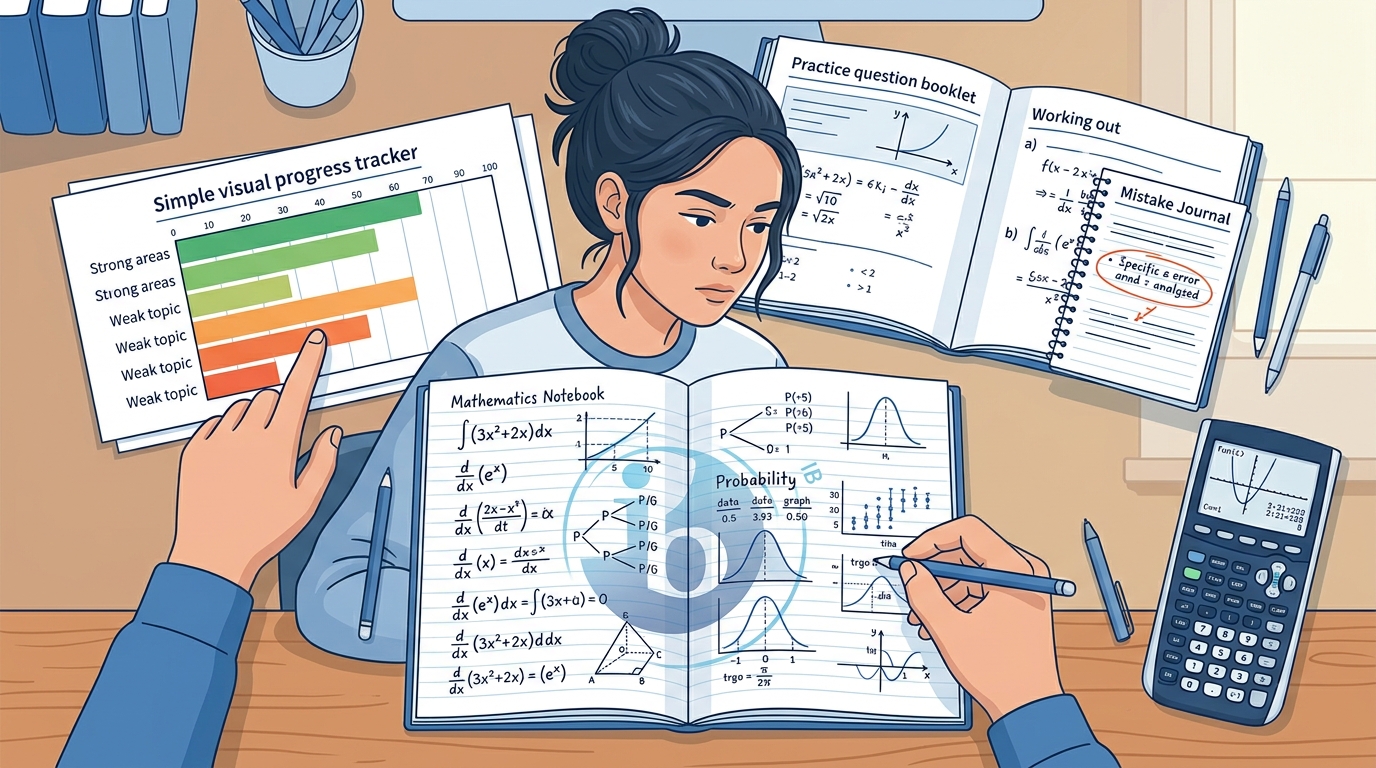
IB Math Revision Is More Than Rereading Your Notes
You can spend hours revising IB Math and still feel unprepared when you open an exam paper.
You may recognise the formulas.
You may understand the examples from class.
You may even remember solving similar questions before.
Then an unfamiliar question appears and you don’t know where to start.
This happens because effective IB Math revision involves more than reviewing information. You need to develop the ability to recall mathematical ideas, select appropriate methods, solve problems, communicate your reasoning, use technology appropriately, and learn from mistakes.
The International Baccalaureate states that its mathematics courses aim to develop mathematical knowledge, logical and creative thinking, and students’ ability to use abstraction and generalisation. The current DP mathematics offering includes AA SL, AA HL, AI SL, and AI HL.
The IB also describes problem solving as central to learning mathematics, including solving non routine, open ended, and real world problems.
That has an important implication for revision:
You shouldn’t spend your entire revision time trying to remember mathematics. You need to practise using it.
This guide shows you how to build an IB Math revision strategy that moves from understanding to application, feedback, and exam readiness.
Table of Contents
What Should IB Math Revision Actually Include?

A balanced revision plan should contain several different activities.
You should spend time on:
- Concept review
- Formula and method recall
- Topic based practice
- Mixed practice
- Unfamiliar questions
- Mistake correction
- Past papers
- Timed practice
- Working and communication
- Progress tracking
The exact balance depends on where you are in your preparation.
A student who has just started the course needs more concept learning.
A student two weeks before an exam needs much more exam style practice and mistake correction.
So don’t ask:
“What’s the best IB Math revision method?”
Ask:
“What type of revision does my current level require?”
Step 1: Start With a Revision Diagnosis
Before creating a revision timetable, find out where you actually stand.
This is one of the most important steps because students often revise what they remember rather than what they need.
Create a simple topic list for your course.
For example:
| Topic | Confidence | Evidence |
|---|---|---|
| Functions | Green | Can solve mixed questions |
| Calculus | Yellow | Basic questions are fine |
| Probability | Red | Struggle to choose methods |
| Statistics | Green | Strong in calculations |
| Vectors | Yellow | Weak with unfamiliar applications |
Use three categories:
Green
You understand the topic and can solve exam style questions independently.
Yellow
You understand the basics but make errors or struggle with harder applications.
Red
You have significant gaps in understanding or cannot solve questions independently.
This gives you a weakness map.
Your revision plan should then give more time to yellow and red topics.
You don’t need to completely ignore green topics, but you shouldn’t spend most of your revision time repeatedly practising what you already know.
Step 2: Find Out Why You’re Losing Marks
A topic label isn’t always specific enough.
Suppose you write:
“Calculus is weak.”
What does that actually mean?
Perhaps you understand differentiation but struggle with optimisation.
Or perhaps you understand the concepts but make algebra errors.
Or perhaps you can solve standard calculus questions but struggle when calculus is combined with functions.
Those problems require different solutions.
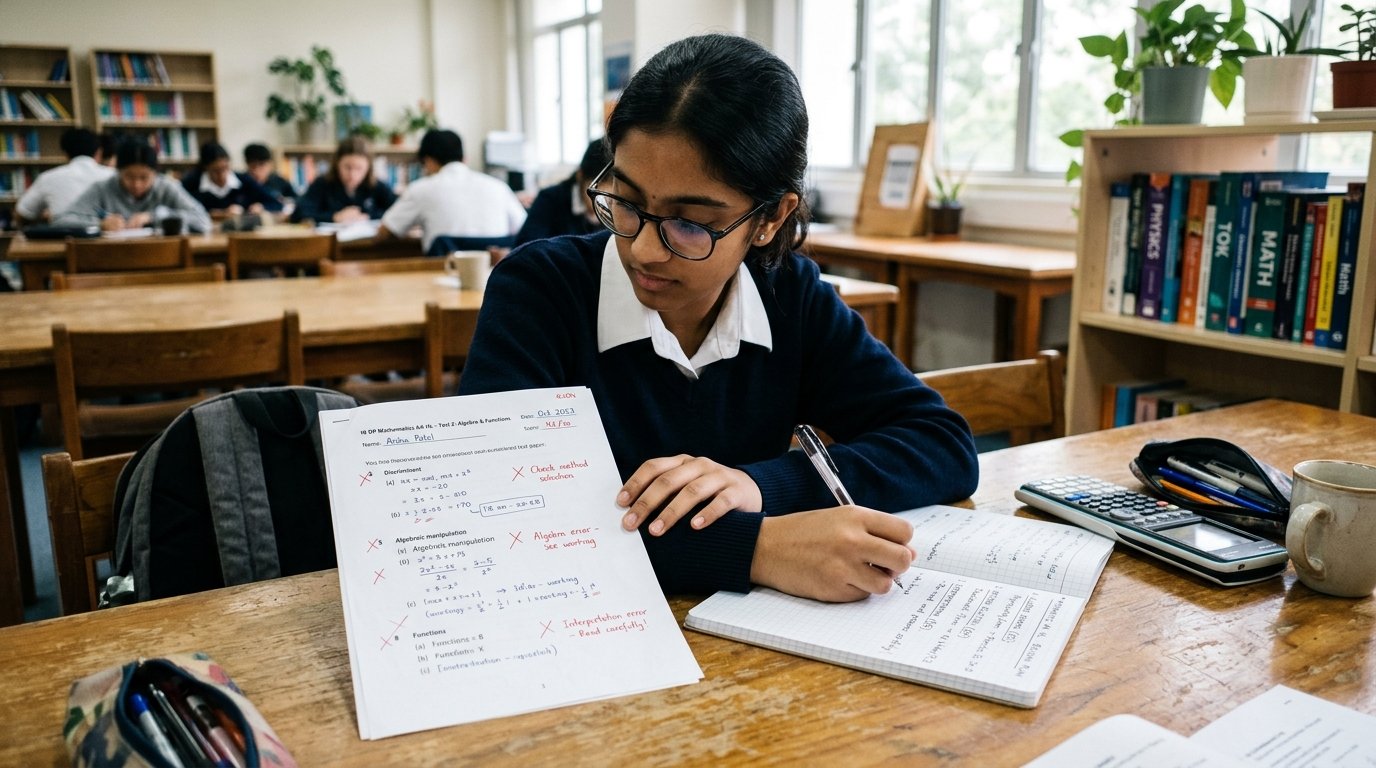
When reviewing a practice question, classify the error.
Knowledge error
You didn’t know or understand the mathematical concept.
Method error
You understood the topic but selected the wrong method.
Accuracy error
Your approach was correct but you made an algebra, arithmetic, or calculator mistake.
Interpretation error
You calculated something correctly but didn’t explain what the result means.
Communication error
Your working didn’t clearly show the mathematical reasoning.
Exam technique error
You lost marks because of timing, rushing, or poor question management.
This makes revision much more precise.
Instead of:
“Revise probability.”
you might write:
“Practise recognising when conditional probability is required.”
That’s a much better revision target.
Step 3: Don’t Start With a Giant Revision Timetable
A common approach is to create a timetable like:
Monday: Functions
Tuesday: Calculus
Wednesday: Statistics
Thursday: Probability
It looks organised.
But it doesn’t necessarily reflect what you need.
A better plan combines topics and skills.
For example:
Monday: Conditional probability + unfamiliar questions
Tuesday: Differentiation + algebra accuracy
Wednesday: Functions + mixed practice
Thursday: Statistics + interpretation
This means you’re not simply moving through a list of topics.
You’re working on specific weaknesses.
Step 4: Use the Learn, Practise, Review Cycle
A strong IB Math revision session can follow a simple cycle:
Learn → Practise → Review → Correct → Retest
Learn
Review the concept or method you need.
Keep this part focused.
Don’t spend 45 minutes reading notes if you only need to clarify one concept.
Practise
Solve questions without looking at the solution.
Start with manageable questions.
Review
Check your working and final answer.
Don’t just look at whether the number matches.
Correct
Identify the first point where your reasoning went wrong.
Understand why.
Retest
Solve the question again later, preferably without looking at your previous work.
This final step matters because recognising a solution is easier than producing one independently.
Step 5: Use Active Recall for IB Math
Active recall means trying to retrieve information from memory instead of simply looking at it.
For mathematics, this can include:
- Writing a formula from memory
- Explaining a concept without notes
- Recreating a worked example
- Listing the conditions for a method
- Explaining when a particular formula applies
- Solving a short problem without help
For example, instead of reading your notes on normal distribution, close them and ask yourself:
What information do I need before I can calculate a probability involving a normal distribution?
Then write your answer.
This quickly exposes gaps.
If you can’t remember something, check your notes.
Then try again.
Step 6: Use Questions to Test Understanding
Active recall becomes even more useful when combined with questions.
Suppose you’re revising functions.
Don’t just reread the definitions.
Ask:
- What does the domain represent?
- How can I determine whether a function has an inverse?
- What is the relationship between a function and its inverse?
- How do transformations affect a graph?
- Can I solve a question where the method isn’t explicitly stated?
You’re testing whether the knowledge is usable.
That is closer to what you need in an exam.
Step 7: Move From Easy Questions to Unfamiliar Questions
Your revision difficulty should increase gradually.
A useful progression is:
Level 1: Basic questions
You know the method.
Goal: Accuracy.
Level 2: Similar questions
The question looks different but uses familiar mathematics.
Goal: Fluency.
Level 3: Mixed questions
You don’t know which topic or method applies immediately.
Goal: Method selection.
Level 4: Unfamiliar questions
The structure or context is less familiar.
Goal: Problem solving.
Level 5: Timed exam questions
You need to solve accurately under pressure.
Goal: Exam performance.
Don’t jump straight from learning a concept to full past papers.
Build the skill progressively.
Step 8: Practise Mixed IB Math Questions
Topic based practice is useful.
But eventually you need to remove the labels.
Imagine you’ve been practising calculus all afternoon.
You know every question is going to involve calculus.
Your brain has already been given an important clue.
An exam doesn’t usually provide that clue.
A mixed practice set could contain:
- Functions
- Calculus
- Probability
- Statistics
- Algebra
- Geometry
- Sequences
Now you have to decide what mathematics is relevant.
That is a different skill.
If you can solve questions only when someone tells you the topic, mixed practice should become a larger part of your revision.
Step 9: Practise the Questions You Don’t Immediately Recognise
Unfamiliar questions are where many students lose confidence.
They see something that doesn’t look like the examples from class and assume:
“I don’t know this.”
Sometimes the issue isn’t knowledge.
It’s recognition.
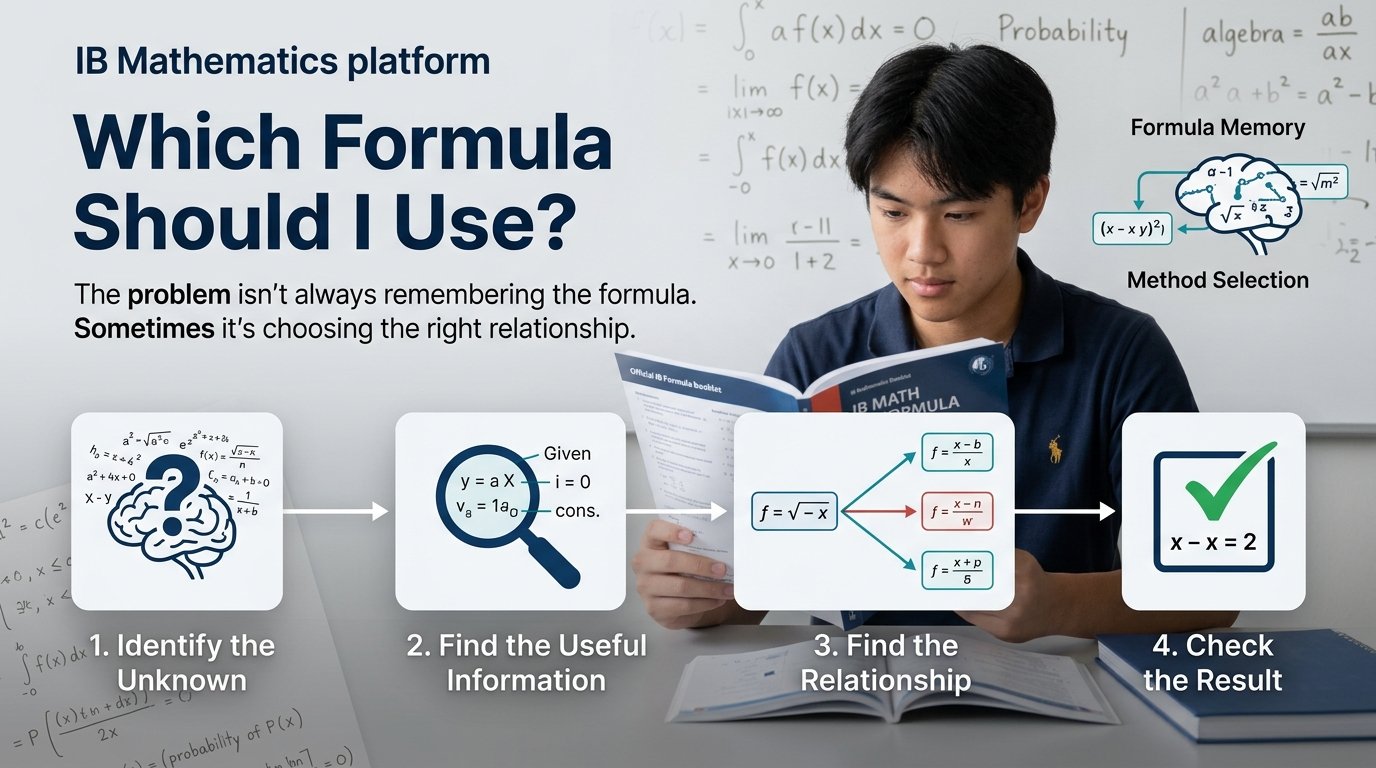
When you encounter an unfamiliar question, use a structured approach:
1. What information do I have?
Write down the important values, variables, equations, or relationships.
2. What do I need to find?
Identify the exact requirement.
3. What mathematical ideas might connect these?
Think broadly before calculating.
4. What is the first useful statement I can write?
Start with something you know is true.
5. Can I build from there?
Don’t expect the complete solution to appear immediately.
Problem solving often involves making a useful first move and then using the resulting information to continue.
The IB’s mathematics framework explicitly places problem solving at the centre of learning and includes non routine and open ended situations.
Step 10: Make Your Mistakes Part of Your Revision Plan
This is where many students waste valuable revision time.
They get a question wrong.
They look at the solution.
They understand it.
Then they move on.
A week later, they make the same mistake.
Instead, turn the mistake into a revision task.
Use this cycle:
Wrong answer → Identify error → Understand cause → Redo → Similar question → Revisit
For example:
Mistake: Forgot to consider the second solution.
Cause: Stopped after finding the first numerical answer.
Correction: Check whether the equation has additional valid solutions.
Next practice: Complete three similar questions.
Now the mistake has created a specific revision task.
Step 11: Keep a Mistake Journal
A mistake journal doesn’t need to be complicated.
Use a simple structure.
| Date | Topic | Mistake | Why? | Next action |
|---|---|---|---|---|
| Aug 5 | Probability | Used wrong condition | Misread wording | Practise conditional probability |
| Aug 7 | Calculus | Wrong stationary point conclusion | Skipped interpretation | Practise optimisation |
| Aug 9 | Algebra | Sign error | Rushed | Slow checking |
Over time, you’ll see patterns.
Perhaps you repeatedly lose marks because you:
- round too early
- forget units
- don’t state assumptions
- misread wording
- choose the wrong method
- skip important working
- make algebra mistakes
Those patterns should directly influence your revision.
Step 12: Review Your Working, Not Just Your Answers
This is particularly important for IB Math.
The IB assessment framework includes skills such as applying standard methods, analysing information, and solving problems creatively.
Your final answer therefore isn’t the only thing worth reviewing.
After a question, ask:
Did I choose a sensible method?
Did I show enough working?
Did I use appropriate notation?
Did I make any unjustified assumptions?
Did I interpret my answer correctly?
Did I round appropriately?
Did I answer the exact question?
This helps you identify marks that could be lost even when the mathematics looks mostly correct.
Step 13: Use Feedback to Decide What to Practise Next
Your revision should respond to evidence.
Imagine you complete 20 questions and receive these results:
- 90% on basic functions
- 80% on standard differentiation
- 60% on optimisation
- 55% on probability applications
- 85% on statistics calculations
Your next revision session shouldn’t be another hour of basic functions.
You have evidence that optimisation and probability applications deserve more attention.
Better still, examine the working.
If most probability errors came from misreading the question, your next task shouldn’t simply be “do more probability.”
It should be:
Practise identifying the probability model and relevant information before calculating.
That distinction can save a lot of revision time.
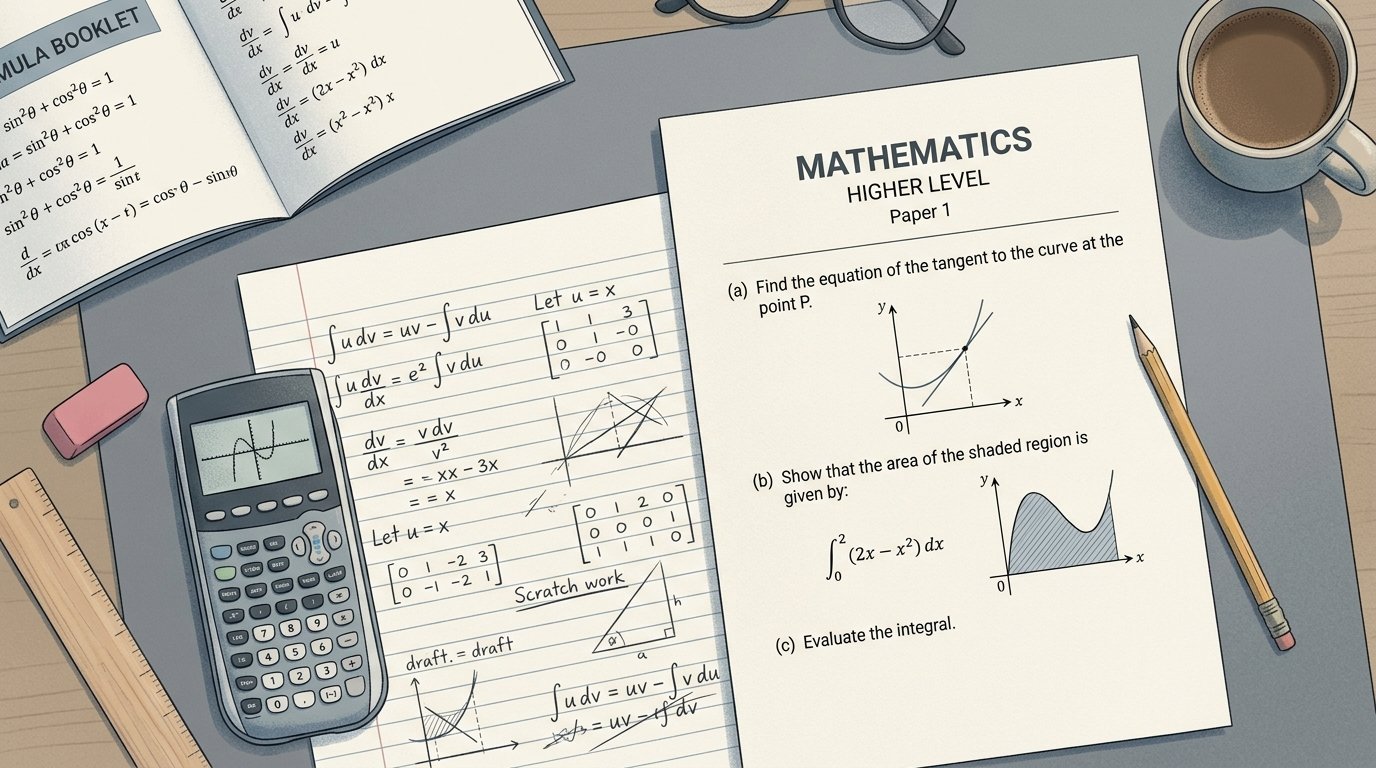
Step 14: Use Past Papers as a Diagnostic Tool
Past papers are important, but don’t treat them as just another collection of questions.
Use them to measure whether your revision is working.
A good sequence is:
Topic practice → Mixed practice → Past paper sections → Full timed papers
After completing a paper, record:
Score
How many marks did you achieve?
Lost marks
Which questions caused problems?
Error type
What caused the lost marks?
Topic
Which mathematical area was involved?
Next action
What should you practise now?
A past paper becomes much more valuable when it changes your next revision session.
Step 15: Build a Revision Schedule That Changes Over Time
Your IB Math revision should not look identical eight weeks before an exam and three days before it.
Eight or more weeks before the exam
Focus on:
- Understanding weak topics
- Topic based practice
- Correcting foundational errors
- Building confidence
Four to eight weeks before
Increase:
- Mixed practice
- Unfamiliar questions
- Exam style questions
- Mistake review
Two to four weeks before
Increase:
- Timed sections
- Past papers
- Weakness focused practice
- Working and communication
Final two weeks
Focus on:
- Full papers
- Repeated mistakes
- Weak topics
- Time management
- Exam technique
Final few days
Don’t try to relearn the entire course.
Review:
- Key formulas
- Common mistakes
- Weak areas
- Important methods
- Past errors
- Exam strategy
The goal is consolidation, not panic.
A Practical 8 Week IB Math Revision Plan
Here’s a simple framework you can adapt.
| Week | Main focus | Practice |
|---|---|---|
| 1 | Diagnose weaknesses | Mixed diagnostic questions |
| 2 | Repair foundations | Targeted topic practice |
| 3 | Build fluency | Topic question sets |
| 4 | Method selection | Mixed questions |
| 5 | Problem solving | Unfamiliar questions |
| 6 | Exam application | Past paper sections |
| 7 | Exam simulation | Full timed papers |
| 8 | Final correction | Weaknesses and mistakes |
You can shorten or extend this depending on your exam date.
The important principle is progression.
Your revision should gradually move from learning mathematics toward performing mathematics under exam conditions.
How Long Should You Revise IB Math Each Day?
There isn’t a universal number of hours.
A student who studies for three focused hours may learn more than a student who sits with a textbook for five hours while repeatedly rereading the same material.
Instead, think in terms of productive blocks.
A 60 minute session could look like:
10 minutes: Active recall
20 minutes: Targeted practice
15 minutes: Unfamiliar or mixed question
10 minutes: Mistake analysis
5 minutes: Plan the next session
For a longer session, repeat the cycle with a different topic.
Your concentration, school workload, other subjects, and exam timeline should influence the total amount of study.
How Many IB Math Questions Should You Do?
Don’t use question count as your only measurement.
Twenty questions can be productive if you:
- attempted them independently
- reviewed your working
- understood mistakes
- corrected errors
- retested important skills
But 50 questions can be inefficient if you:
- rushed
- checked only final answers
- skipped difficult questions
- copied solutions
- repeated questions you already mastered
Ask:
What did these questions help me improve?
That is a better measure of revision quality.
A Better 60 Minute IB Math Revision Session
Here’s a practical template.
0 to 10 minutes: Recall
Close your notes.
Write down what you remember about the target topic.
10 to 30 minutes: Targeted practice
Complete questions addressing your weakness.
30 to 45 minutes: Application
Attempt a mixed or unfamiliar question.
45 to 55 minutes: Review
Analyse mistakes and compare your reasoning with the expected solution.
55 to 60 minutes: Next step
Write down:
- What improved?
- What remains weak?
- What should I practise next?
That final question keeps your revision connected from one session to the next.
Common IB Math Revision Mistakes
1. Rereading notes for hours
Reading creates familiarity, but familiarity isn’t the same as recall or application.
Better: Use notes briefly, then close them and practise.
2. Revising every topic equally
Some topics will be strong. Others will be weak.
Better: Use practice results to prioritise.
3. Doing only topic questions
Topic labels give you clues that you won’t necessarily receive in an exam.
Better: Gradually introduce mixed practice.
4. Avoiding unfamiliar questions
They can feel frustrating.
Better: Use them to identify gaps in problem solving.
5. Checking only the final answer
You may miss problems with your reasoning.
Better: Review the working.
6. Never returning to mistakes
Understanding a correction once doesn’t guarantee long term learning.
Better: Revisit important errors later.
7. Taking too many notes
Writing pages of revision notes can consume time without improving problem solving.
Better: Keep concise summaries and spend more time retrieving and applying the mathematics.
8. Starting full papers too early
A poor early score may simply reflect topics you haven’t learned yet.
Better: Use diagnostic questions first, then move toward full papers as your knowledge develops.
How Mathzem Can Support Your IB Math Revision
A revision plan becomes more useful when it connects practice results to the next action.
This is the basic process:
Choose a topic → Practise → Upload your working → Review feedback → Identify mistakes → Find weaknesses → Choose the next practice task
This is different from simply completing questions and checking whether the final answer is correct.
With Mathzem’s practice workflow, students can use examiner style feedback to understand their marks and mistakes, then use that information to guide further practice.
You can start with Mathzem IB Practice.
If you’re unsure which areas need attention, the Math Skill Scanner can help you identify skills to focus on.
The goal isn’t to make revision more complicated.
It’s to make each practice session produce useful information.
IB Math Revision Checklist
Before an exam, make sure your revision includes:
- A clear list of syllabus topics
- A diagnosis of strong and weak areas
- Active recall
- Topic based practice
- Mixed practice
- Unfamiliar questions
- Mistake analysis
- Redoing incorrect questions
- A mistake journal or similar record
- Past paper practice
- Timed practice
- Review of written working
- Time management practice
- A final review of recurring mistakes
You don’t need a complicated system.
You need a system that tells you what to do next.
FAQs About IB Math Revision
How should I start revising for IB Math?
Start by diagnosing your current level. Review the major topics in your course and use practice questions to identify which areas are strong, developing, or weak. Then build your revision around those results.
How many hours a day should I revise IB Math?
There is no fixed number that works for every student. Focus on productive study sessions rather than total hours. A focused 60 minute session involving recall, practice, feedback, and correction can be very effective.
Is doing past papers the best way to revise IB Math?
Past papers are valuable, particularly closer to the exam, but they shouldn’t be your only revision method. Combine them with concept review, targeted topic practice, mixed questions, unfamiliar problems, and mistake correction.
Should I revise IB Math by topic?
Yes, particularly when you’re repairing weaknesses. However, as the exam approaches, increase mixed practice so you have to identify which mathematical method is appropriate without being told the topic.
How can I remember IB Math formulas?
Use active recall rather than repeatedly rereading formulas. Try writing formulas from memory, explaining what they mean, and using them in questions. Understanding when a formula applies is as important as remembering its appearance.
Why do I forget IB Math after revising it?
You may be relying too heavily on passive review. Try retrieving information without notes and returning to important concepts and mistakes over multiple sessions.
Conclusion: Make Your IB Math Revision Respond to Your Weaknesses
Effective IB Math revision isn’t about sitting at a desk for as many hours as possible.
It’s about knowing what you need to improve and choosing practice that addresses it.
Start by diagnosing your weaknesses.
Use active recall to strengthen understanding.
Use topic questions to build fluency.
Use mixed questions to practise method selection.
Use unfamiliar questions to develop problem solving.
Use past papers to test exam readiness.
And most importantly, use your mistakes as information.
A useful revision cycle is:
Diagnose → Learn → Practise → Review → Correct → Retest → Improve
The IB’s current mathematics framework places strong emphasis on mathematical knowledge, logical and critical thinking, problem solving, and the appropriate use of technology.
Your revision should reflect that.
Don’t simply ask:
“Have I revised this topic?”
Ask:
“Can I use this mathematics independently when the question doesn’t tell me what to do?”
That’s a much better test of exam readiness.
If you want to turn practice into a more structured feedback cycle, start with Mathzem IB Practice, then use the results and feedback to decide what you should practise next.


One Response