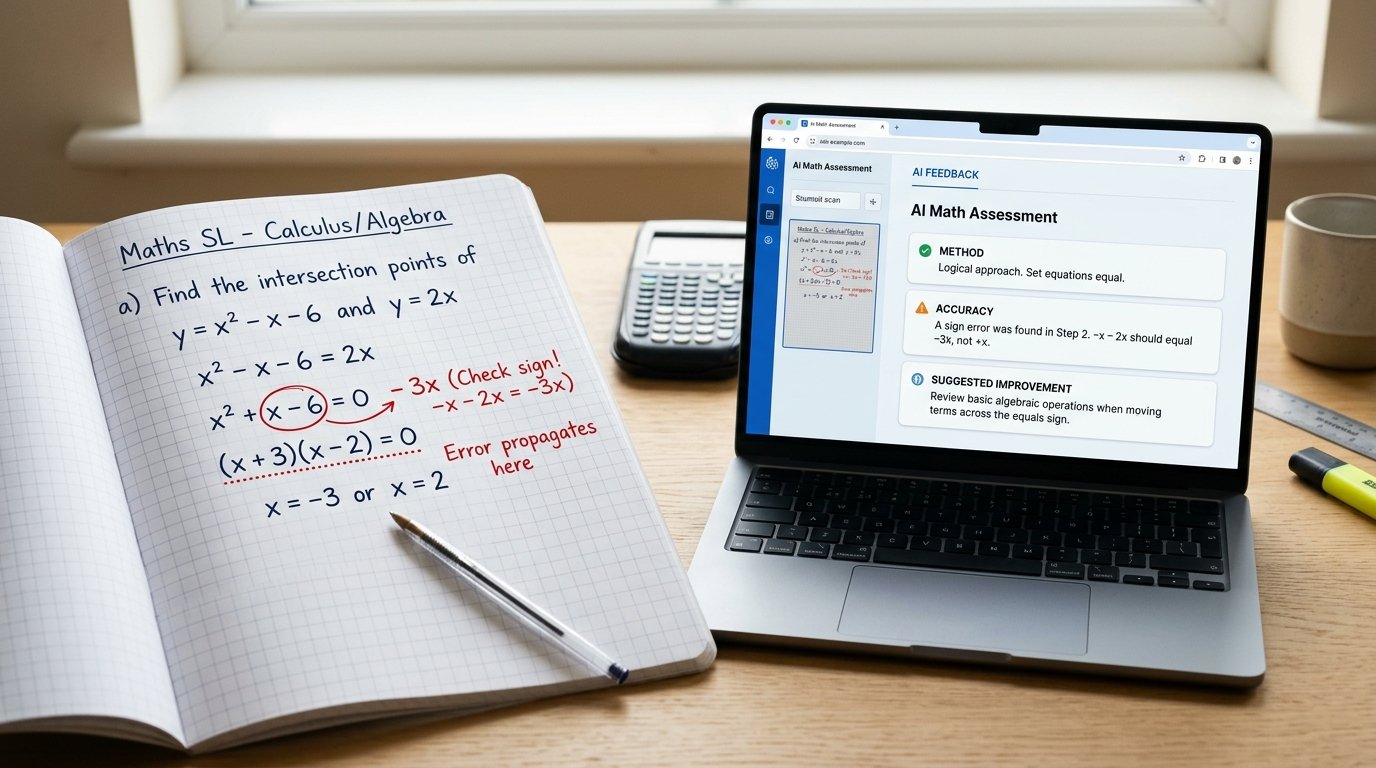
Calculus is usually where IB Maths AA HL calculus revision students either pull ahead or start losing confidence. It’s not that the ideas themselves are unreasonable; it’s that HL calculus asks you to combine several rules fluently, under time pressure, often inside a longer modelling or proof question. Students who struggle with it are rarely missing one big concept. More often, they’re missing the automatic recall that lets the rest of the question move forward without friction.
This guide sets out what to master first, in the order it tends to show up on exams, based on patterns seen repeatedly in AA HL papers and mark schemes.
Table of Contents
Why Does IB Maths AA HL Calculus Revision Feel Harder Than It Should?
Most IB maths AA HL calculus questions aren’t testing one rule in isolation. A single question might ask you to differentiate a composite function, apply the product rule to the result, and then interpret the answer in context all before reaching what the question is actually testing. If any one rule isn’t automatic, the whole chain slows down or breaks.
That’s the real skill gap: not knowing the rules exist but applying two or three of them back-to-back without hesitating over which one comes first.
The Essential Toolkit
Before anything else, these need to be automatic and have no working out, no hesitation:
| Rule | Formula | Where it shows up |
|---|---|---|
| Power rule | d/dx(xⁿ) = nxⁿ⁻¹ | Almost every question, as a building block |
| Chain rule | d/dx[f(g(x))] = f'(g(x))·g'(x) | Composite functions, modelling contexts |
| Product rule | d/dx[uv] = u’v + uv’ | Anywhere two expressions are multiplied |
| Quotient rule | d/dx[u/v] = (u’v − uv’)/v² | Rational functions |
| Implicit differentiation | Differentiate both sides, treat y as a function of x | Curves not solved for y |
HL adds a second layer SL students don’t need: derivatives of tan x, sec x, arcsin x, arccos x, arctan x, and exponential/logarithmic functions with bases other than e. These appear more often than students expect, particularly in Paper 1 short-answer questions where there’s no calculator to lean on.
Where Marks Are Most Often Lost
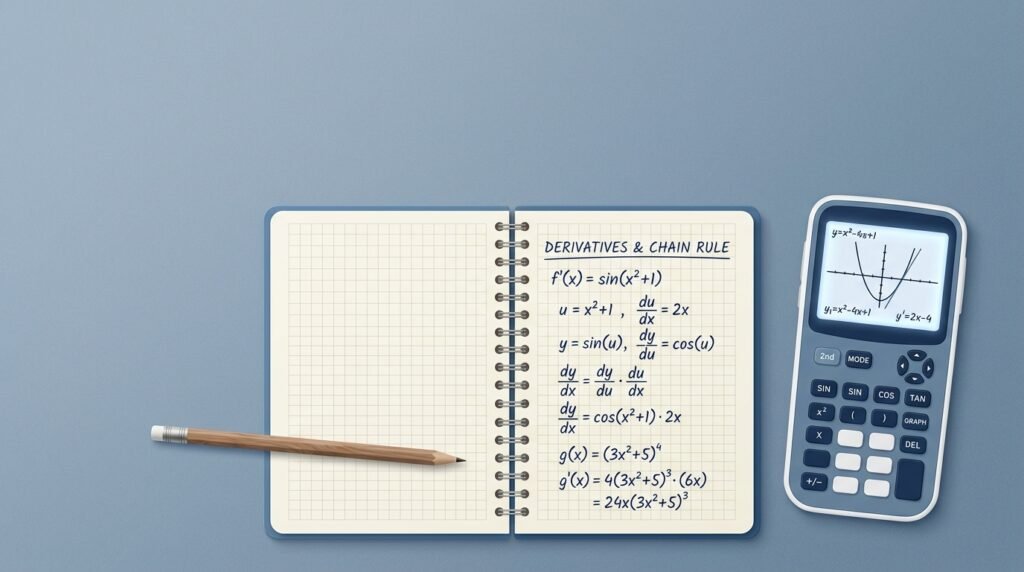
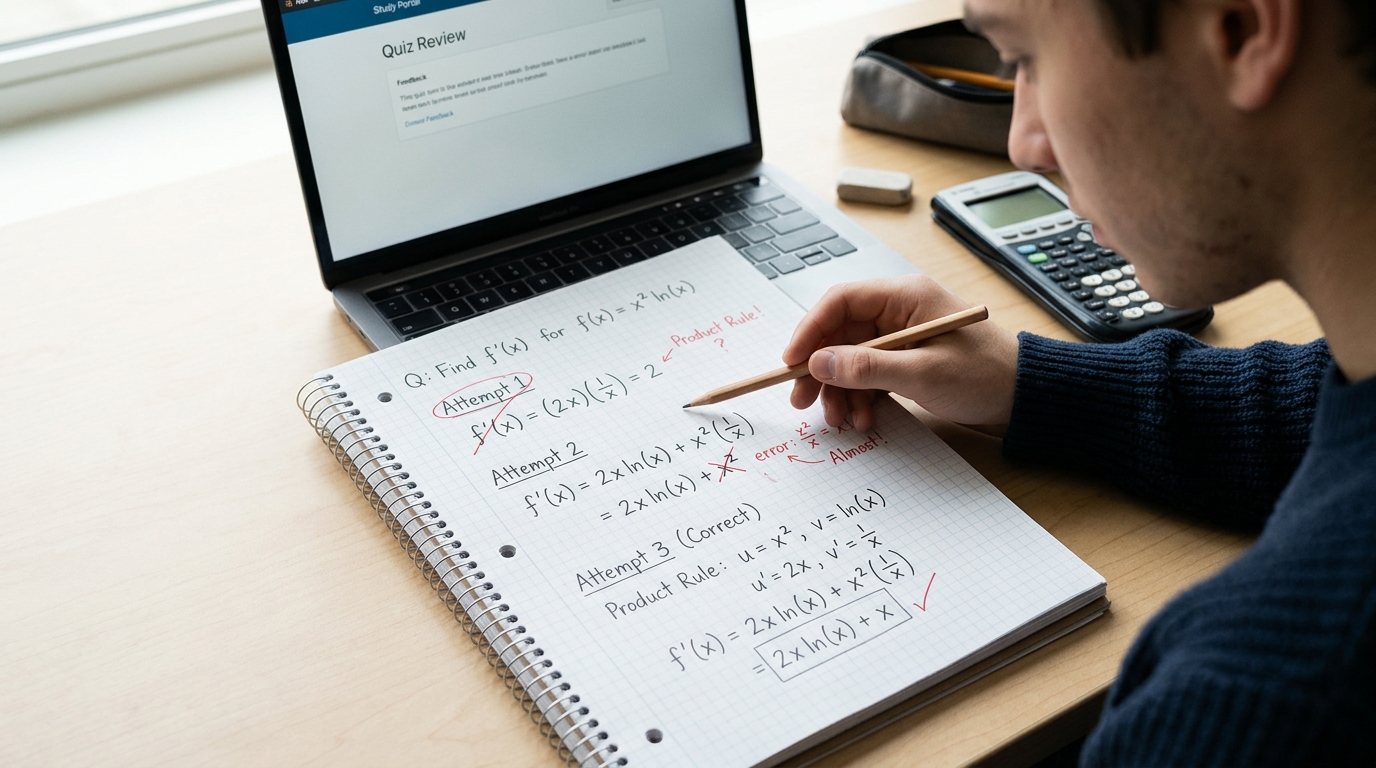
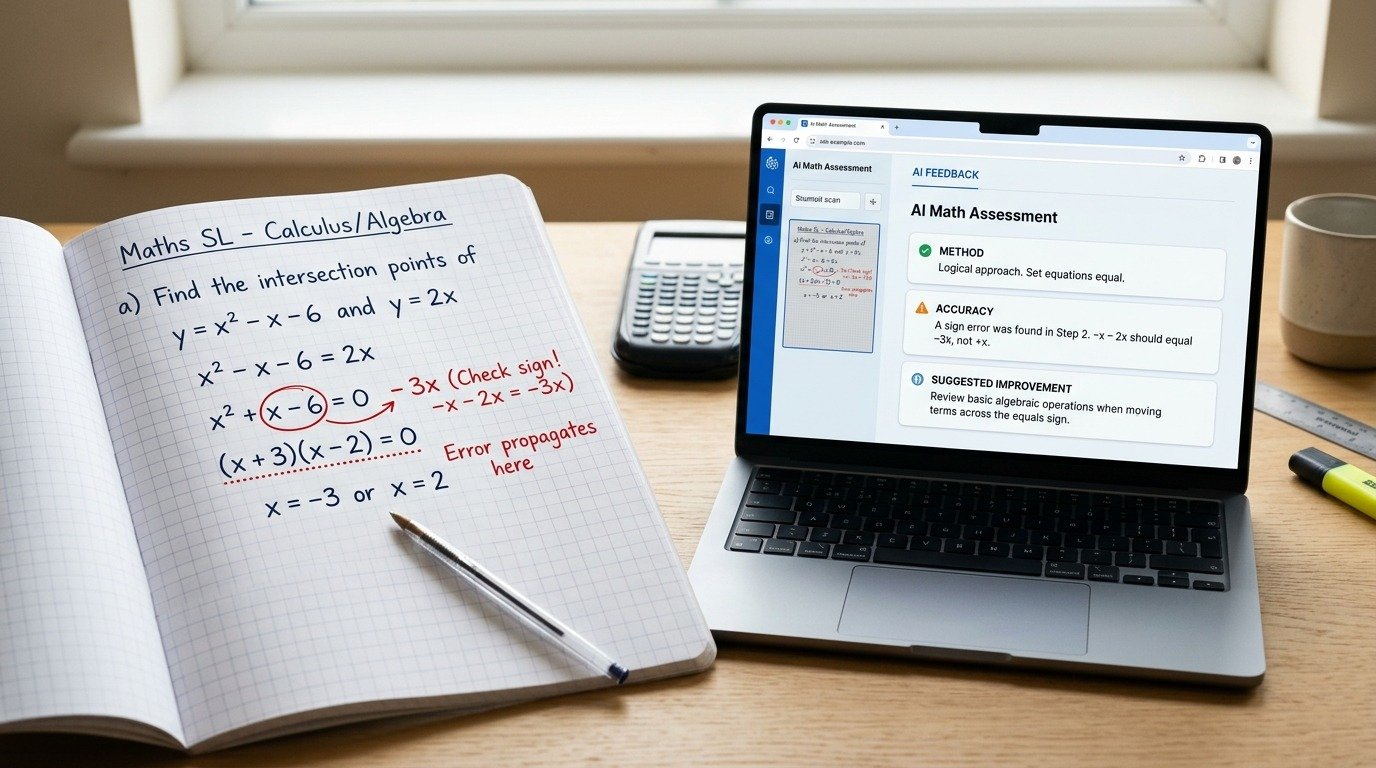
Looking at how AA HL calculus questions are marked, the pattern is fairly consistent: students lose marks less on the calculus itself and more on the algebra around it. Simplifying after the chain rule, factoring before setting a derivative to zero, and substituting correctly back into the original function these steps carry method marks too, and they’re where partial credit tends to disappear.
The second most common loss is skipping the “state your rule” step. Mark schemes often award a mark for correctly identifying which rule applies before it’s used. Jumping straight to the answer can cost that mark even when the final result is correct.
Reviewing a mix of past differentiation questions with Mathzem’s Skill Scanner is a useful way to see whether lost marks are coming from algebra, rule selection, or something else entirely rather than guessing at it.
A Study Method for Today
- Rebuild the rule table from memory. Not by copying it, but by writing it blank and filling it in. Any rule you hesitate on is a priority.
- Work one example per rule, narrating which rule is being used and why.
- Attempt three mixed problems without a calculator. HL Paper 1 won’t allow one, so today’s practice shouldn’t either.
- Check working against the method marks, not just the final answer. A correct answer with a skipped stated step is still a gap worth fixing.
Once the rules feel automatic, working through a set of AA HL calculus practice questions shows whether that fluency holds up under exam-style conditions rather than isolated drills.
Recognising Question Patterns
- “Find the rate of change of…” → differentiate, usually involving the chain rule
- “Show that dy/dx = …” → implicit differentiation, often followed by a second derivative question
- “Find the equation of the tangent/normal at…” → differentiate, substitute the point, apply straight-line formulas
- Two expressions multiplied or divided together → product or quotient rule, almost always followed by a simplification step worth its own mark
Spotting the pattern before writing anything down saves time that’s usually needed later in the question.
Where to Go From Here
Calculus fluency builds by noticing which specific rule or step causes trouble and drilling that gap rather than redoing everything from scratch. That’s the difference between three hours of general revision and fixing the one recurring two-mark leak that shows up on every past paper.
For students who want that kind of targeted feedback built into their revision, a Mathzem membership includes topic-by-topic diagnostics and mistake tracking, so it’s always clear where to focus next.
FAQs About IB Maths AA HL Caculus Revision
What calculus topics are covered in IB Maths AA HL?
AA HL calculus covers differentiation and integration in depth, including the chain, product, and quotient rules, implicit differentiation, related rates, optimisation, and the calculus of trigonometric, exponential, and logarithmic functions. HL also introduces further techniques not required at SL, such as differentiating inverse trig functions.
How is AA HL calculus different from AA SL?
HL calculus goes further in both scope and depth. Students are expected to differentiate a wider range of functions (including tan x, sec x, and inverse trig functions), work with more complex implicit differentiation, and apply calculus in longer, multi-step problems, particularly in Paper 3.
Which calculus rule should I revise first?
The chain rule is usually the highest-priority rule to master first, since it appears inside most other calculus questions, including product rule and implicit differentiation problems. Without it being automatic, later steps in a question become much harder to complete accurately.
Why do students lose marks on calculus questions even when they know the rules?
Most lost marks come from algebra after the calculus step simplifying, factoring, or substituting incorrectly rather than from applying the wrong rule. Skipping the step of stating which rule is being used can also cost a method mark, even with a correct final answer.
How much calculus revision is needed before starting practice papers?
A solid grasp of the core rules (power, chain, product, quotient, and implicit differentiation) plus fluency with HL-specific derivatives is usually enough to start attempting past paper questions. From there, practice papers reveal which specific gaps in algebra, rule selection, or interpretation need further review.