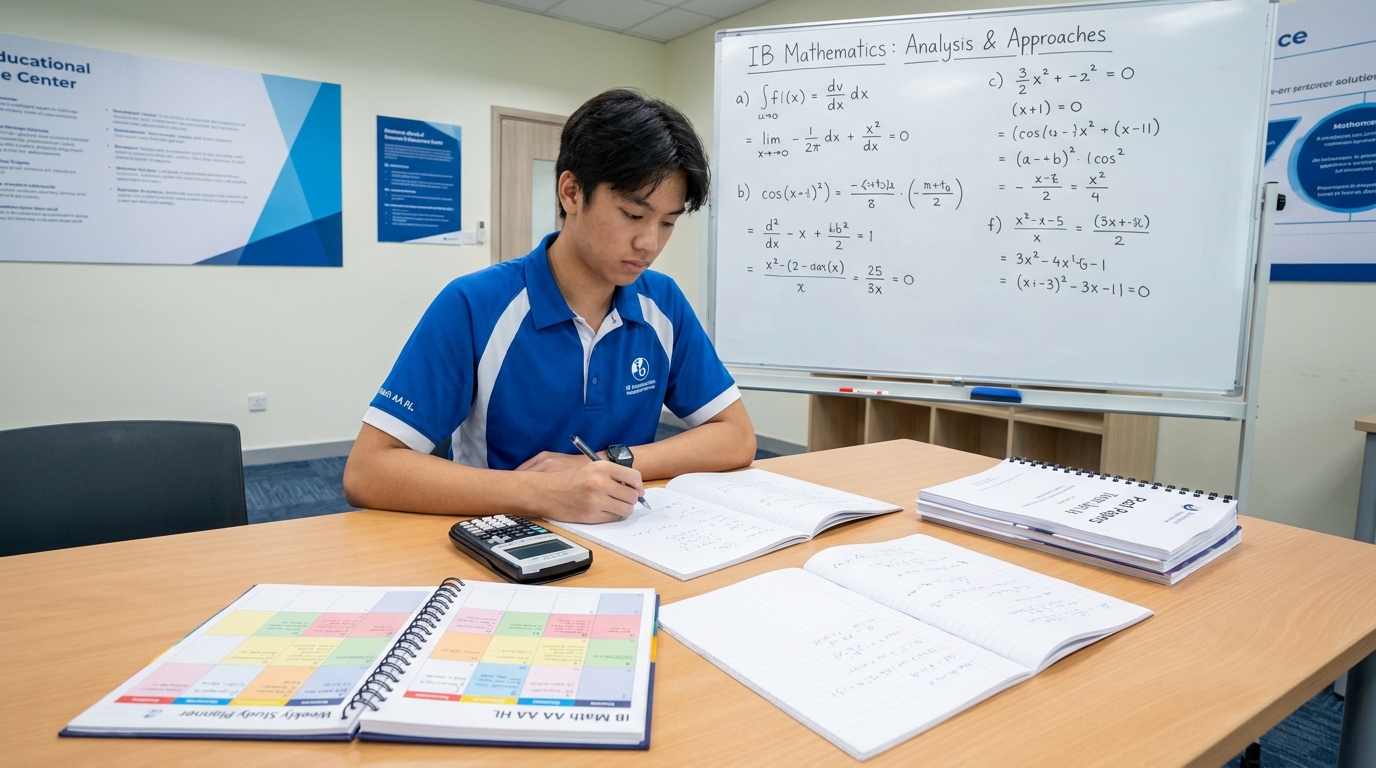
A well-structured IB Maths study plan helps students revise consistently, focus on weak topics, and improve exam performance. The most effective plans combine concept review, targeted question practice, and timed past papers.
At Mathzem, we have seen that students who follow a realistic weekly schedule gain confidence faster and avoid last-minute cramming.
Table of Contents
Why You Need an IB Maths Study Plan

IB Mathematics is demanding because it tests both conceptual understanding and problem-solving under time pressure. Whether you are studying Analysis and Approaches (AA) or Applications and Interpretation (AI), success depends on consistent practice over time.
Many students work hard but feel overwhelmed because they revise without a clear system. They jump between topics, spend too much time rereading notes, and neglect the areas that need the most attention.
An effective IB Maths study plan solves this problem by giving you a structured roadmap.
A strong plan helps you:
- Prioritize your weakest topics
- Build regular study habits
- Balance schoolwork and revision
- Track progress over time
- Reduce stress before exams
Start by Assessing Your Current Level
Before creating your schedule, identify where you stand.
Review:
- Recent tests and quizzes
- Homework assignments
- Mock exam results
- Teacher feedback
Rank each topic as:
- Strong
- Moderate
- Weak
This self-assessment makes your study plan far more effective.
Find Your Weak Areas First
Not sure which topics need the most attention? Use the Math Skill Scanner to quickly identify your strengths and weaknesses and build a more targeted study plan.
The Best Weekly IB Maths Study Plan
Monday to Thursday: Focused Topic Practice
Study one topic each day for 60 to 90 minutes:
- Review core concepts
- Solve topic-specific questions
- Check solutions carefully
- Record mistakes in an error log
Friday: Mixed Review
Revisit the topics studied earlier in the week and correct recurring mistakes.
Saturday: Timed Past Paper Practice
Complete one full paper or selected sections under exam conditions.
Sunday: Reflection and Planning
Analyze your performance and prepare next week’s study goals.
How Much Should You Study?
The right amount depends on your current grade and target score.
During the School Term
- 4 to 6 hours per week
Three Months Before Exams
- 6 to 10 hours per week
One Month Before Exams
- 8 to 14 hours per week, depending on other commitments
Consistency matters more than occasional long study sessions.
How to Study for AA vs AI
Analysis and Approaches (AA)
AA emphasises algebra, functions, calculus, and rigorous reasoning. Your plan should include regular non-calculator practice and symbolic manipulation.
Applications and Interpretation (AI)
AI focuses more on statistics, probability, modelling, and calculator-based problem-solving. Students should dedicate time to mastering graphing calculator functions.
The Most Common Study Plan Mistakes
Creating an Unrealistic Schedule
Plans that require several hours every day are difficult to maintain.
Ignoring Weak Topics
Students often avoid challenging chapters, even though those areas offer the greatest opportunity for improvement.
Focusing Only on Theory
Understanding concepts is important, but exam success depends on solving questions accurately and efficiently.
Skipping Past Papers
Past papers reveal the true structure and timing of IB exams.
Use Practice Questions Strategically
Studying is most effective when you apply concepts repeatedly.
Practice with Real IB-Style Questions
Once your study plan is in place, strengthen your understanding with IB practice questions. This resource provides targeted practice to help you master each topic and prepare confidently for exams.
A Four-Week Intensive Study Plan
Week 1
Assess your level and review your weakest topics.
Week 2
Complete focused practice sets and strengthen conceptual understanding.
Week 3
Work through timed past papers and review mistakes.
Week 4
Consolidate formulas, revisit the error log, and refine exam technique.
How an Error Log Improves Your Results
An error log is one of the most effective study tools.
For each mistake, record:
- Topic
- Question type
- Cause of error
- Correct method
- Key lesson learned
Students who review their mistakes regularly tend to improve faster than those who simply complete more questions.
Exam-Day Preparation Tips
- Review your formula booklet
- Bring approved calculators and materials
- Read questions carefully
- Show all working
- Manage time deliberately
A strong study plan builds confidence and reduces anxiety.
Frequently Asked Questions About IB Maths Study Plan
When should I start my IB Maths study plan?
Ideally, begin several months before your exams. Early preparation allows time to strengthen weak topics gradually.
Is one hour a day enough?
Yes, if the study is focused and consistent. Regular targeted practice is more effective than occasional long sessions.
Should I study differently for HL and SL?
Higher-level students generally need more practice and deeper conceptual understanding, but the overall planning strategy remains the same.
Ready To Improve Your IB Maths Results?
A structured study plan can transform your preparation, but having the right tools makes the process much easier.
Start by identifying your weak areas with the Math Skill Scanner, then reinforce every topic with IB Practice Questions.
With the right strategy and consistent practice, you can approach your IB Maths exams with clarity and confidence.





One Response