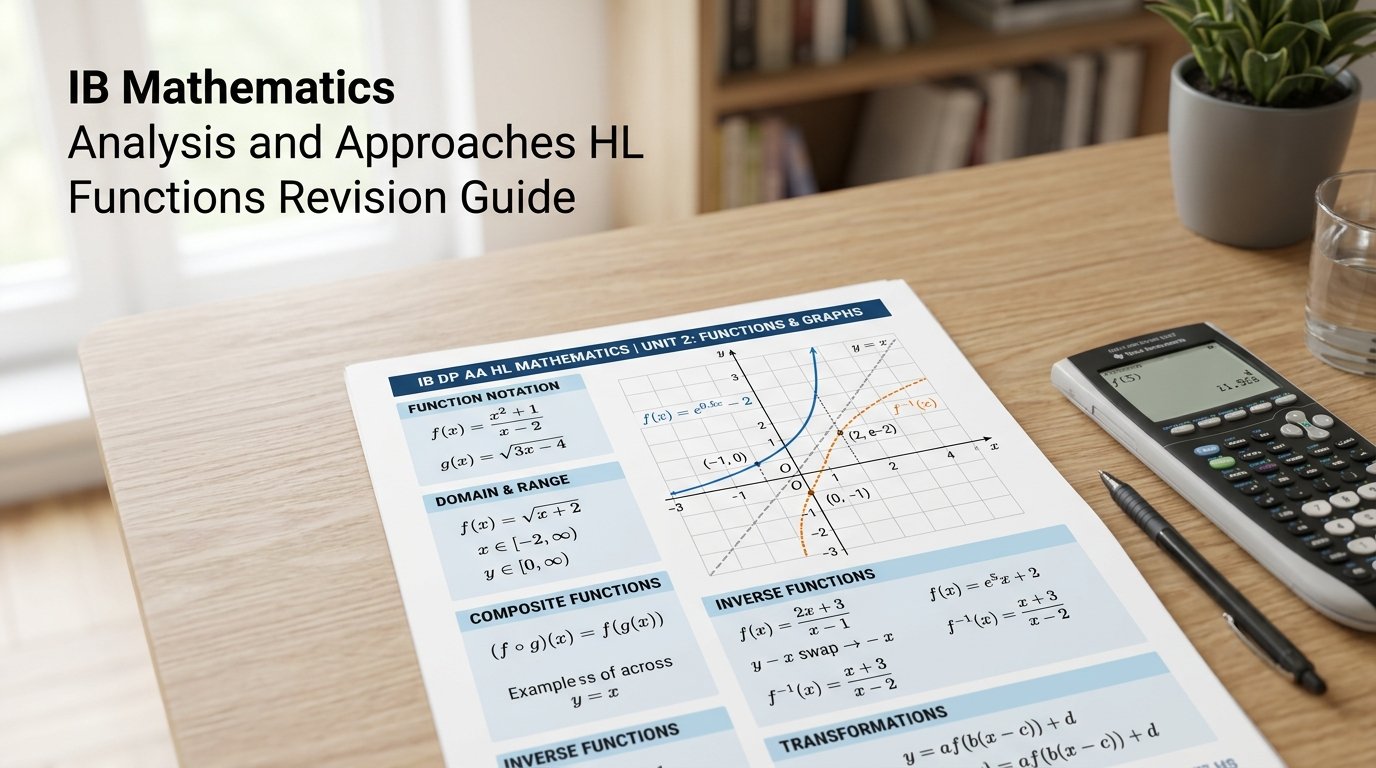
Functions are one of the areas of IB Maths AA HL Functions where students can know the mathematics but still lose marks.
The problem is often not the calculation.
It’s recognising what the question is asking you to do.
A function question might ask you to find a composite function, determine an inverse, describe a transformation, identify a domain restriction, interpret a graph, or solve an equation involving functions.
These questions can look very different, even when they rely on the same underlying concepts.
That’s why effective functions revision isn’t just about memorising definitions.
You need to learn how to read the question, identify the function structure, choose the right method, and check whether your answer makes sense.
This guide explains how to approach the main types of IB Maths AA HL functions questions.
Table of Contents
What Do You Need to Know About Functions in IB Maths AA HL?
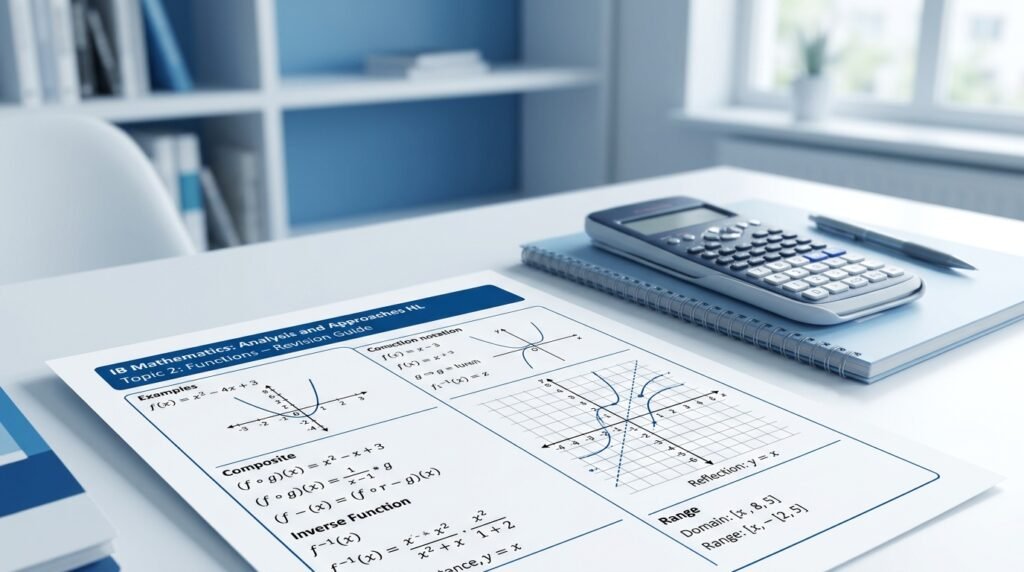
Before working on exam questions, make sure you’re comfortable with the fundamental language of functions.
You should understand:
- Function notation
- Domain
- Range
- Composite functions
- Inverse functions
- Graph transformations
- One to one functions
- Function equations
- Graphical interpretation
- Restrictions on functions
You should also be comfortable moving between algebraic and graphical representations.
For example, if you’re given: f(x)=x²−4
You shouldn’t only know how to calculate f(3).
You should also be able to think about what the function’s graph looks like, its domain and range, its intercepts, and how it behaves under transformations.
1. Start by Reading the Function Notation Carefully
Function notation tells you exactly what input is being used.
If f(x)=2x+5
Then f(3)=2(3)+5=11
This looks simple, but more complicated questions can make students rush.
For example: f(x)=x²+3x
If you’re asked to find f(a+1)
You need to substitute the entire expression a+1 wherever x appears: f(a+1)=(a+1)²+3(a+1)
A common mistake is replacing only one occurrence of x or forgetting brackets.
Exam habit
Whenever the input contains more than one term, put it inside brackets before substituting.
This small habit prevents many avoidable algebra mistakes.
2. Understand Domain and Range
Domain and range questions test whether you understand what values a function can accept and produce.
The domain is the set of permitted input values.
The range is the set of possible output values.
For example: f(x)=x−2
requires: x−2≥0
So: x≥2
Therefore, the domain is x≥2.
and because a square root cannot produce a negative result: f(x)≥0
So the range is: y≥0
Don’t treat domain and range as an afterthought
They become particularly important when working with inverse functions.
A function may need a restricted domain before an inverse can exist as a function.
3. Learn How to Recognise Function Transformations
Transformations are often easier when you know what to look for.
Start with a basic function: y=f(x)
Now consider: y=f(x)+3
This moves the graph 3 units upward.
Compare that with: y=f(x−3)
which moves the graph 3 units to the right.
The distinction is important.
Useful transformation patterns
f(x)+a
Vertical translation upward by a f(x)−a
Vertical translation downward by a. f(x−a)
Horizontal translation right by a. f(x+a)
Horizontal translation left by a.
You should also know how multiplication affects the graph.
For example: 2f(x)
changes the vertical scale, while f(2x)
changes the horizontal scale.
Exam strategy
Don’t rely entirely on memory.
If you’re uncertain, choose a simple point on the original graph and see where it moves.
4. Composite Functions
Composite functions are another common source of errors.
If f(x)=2x+1
and g(x)=x²
then: f(g(x))
means that the output of g becomes the input of f.
Since g(x)=x²
We substitute x² into f: f(g(x))=2x²+1.
But: g(f(x))
is different.
Now the output of f becomes the input of g: g(f(x))=(2x+1)².
Therefore: f(g(x))=g(f(x))
in general.
A simple way to think about it
Imagine the functions as machines.
For: f(g(x))
The input goes through G first, then F.
So: x→g→f
For: g(f(x))
It’s x→f→g.
This mental model can make composite functions much easier to understand.
5. How to Approach Composite Function Questions
When you see: f(g(x))
don’t try to calculate everything at once.
Use a three step process.
Step 1
Write down g(x).
Step 2
Take that entire expression and substitute it into f.
Step 3
Simplify carefully.
For example, if: f(x)=x²+1
and g(x)=3x−2
then: f(g(x))=(3x−2)²+1
Expand only if the question requires it.
This approach reduces substitution errors.
6. Inverse Functions
An inverse function reverses the original function.
If f(x)=2x+5
then the inverse reverses the process.
Start with: y=2x+5
Swap x and y: x=2y+5
Then solve for y: y=2x−5
Therefore: f⁻¹(x)=2x−5
Always check your inverse
A useful check is: f(f−1(x))=x
If this doesn’t work, go back through your algebra.
7. Why Domain Restrictions Matter for Inverses
Not every function has an inverse that is also a function over its entire domain.
Consider: f(x)=x2
If the domain is all real numbers, both: f(2)=4
and: f(−2)=4
So reversing the function would give two possible inputs for the same output.
To make the inverse a function, we can restrict the domain.
For example: x≥0
Then: f(x)=x2
has the inverse: f−1(x)=x
This is why domain restrictions shouldn’t be ignored when solving inverse function questions.
8. Understand the Graph of an Inverse Function
A function and its inverse have an important graphical relationship.
Their graphs are reflections of one another across: y=x
This gives you a useful visual check.
If you graph: f(x)
and: f−1(x)
they should show this reflection relationship, assuming the inverse is defined appropriately.
Calculator tip
Your graphing calculator can be useful here.
Graph both functions and also graph: y=x
This lets you visually check whether the inverse relationship makes sense.
Remember that graphical checking doesn’t replace the mathematical method required by the question.
9. Function Questions Can Become Algebra Questions
One reason students sometimes struggle with functions is that the question appears to be about functions, but the actual difficulty is algebra.
For example: f(x)=x−2x+1
You might be asked to find an inverse.
The function knowledge tells you what to do.
But solving the resulting equation requires careful algebra.
This means your function revision should also include:
- Expanding
- Factoring
- Rearranging
- Working with fractions
- Solving equations
- Simplifying expressions
If you’re repeatedly getting function questions wrong because of algebra errors, doing more function theory alone won’t fix the problem.
10. Learn to Read Function Graphs
Some exam questions give you a graph rather than an equation.
You might be asked to identify:
- Roots
- Intercepts
- Maximum or minimum values
- Domain
- Range
- Increasing intervals
- Decreasing intervals
- Transformations
- Intersections
Before calculating anything, inspect the graph.
Ask:
What information can I read directly?
You shouldn’t automatically start using algebra when the answer can be obtained directly from the graph.
11. Recognise What the Question Is Really Asking
This is one of the most important functions of exam skills.
Consider the following question types.
“Find f(3)”
Think:
Substitution.
“Find f⁻¹(x).”
Think:
Inverse function.
“Find f(g(x))”
Think:
Composition.
“Describe the transformation”
Think:
Compare the new function with f(x).
“State the domain”
Think:
Which inputs are allowed?
“State the range”
Think:
Which outputs are possible?
“Find the intersection”
Think:
Set the relevant functions equal to each other, or use graphical methods where appropriate.
Learning these patterns helps you identify the method faster.
12. Don’t Start Calculating Immediately
A useful habit for IB Maths AA HL questions is to spend the first few seconds identifying the structure.
Ask yourself:
- What information am I given?
- What am I being asked to find?
- Is this algebraic, graphical, or both?
- Is there a domain restriction?
- Is there a function inside another function?
- Is an inverse involved?
- Do I need technology?
- What should my answer look like?
This short pause can prevent you from using the wrong method.
13. Use Your Calculator as a Checking Tool
Your calculator can be useful for function questions, especially when graphs or numerical solutions are involved.
Practise using it to:
- Graph functions.
- Find intersections.
- Check roots.
- Explore transformations.
- Verify inverse relationships.
- Solve numerical equations.
But don’t enter everything into the calculator immediately.
If a question asks you to demonstrate a mathematical method, your written reasoning still matters.
Good calculator habit
Use:
Mathematical reasoning → calculator check
rather than:
Calculator → guess what the answer means
14. Common IB Maths AA HL Functions Mistakes
Mistake 1: Confusing f(g(x)) and g(f(x))
The order matters.
Mistake 2: Forgetting brackets
Especially when substituting expressions such as: x−2
into a squared function.
Mistake 3: Ignoring domain restrictions
This can produce an invalid inverse.
Mistake 4: Confusing horizontal and vertical transformations
Remember that changes inside f(x) behave differently from changes outside it.
Mistake 5: Using a graph without explaining the mathematics
A calculator graph can support your answer, but it shouldn’t replace required reasoning.
Mistake 6: Making algebra errors
A correct function method can still lead to an incorrect answer because of poor algebra.
Mistake 7: Not checking the answer
Functions often give you easy opportunities to verify your result.
15. A Better Way to Practice Functions
Don’t complete 30 questions that all look identical.
Use three levels.
Level 1: Basic Skills
Practice:
- Function notation
- Substitution
- Domain and range
- Simple transformations
Level 2: Application
Practice:
- Composite functions
- Inverse functions
- Restricted domains
- Graph interpretation
Level 3: Mixed Exam Questions
Remove the topic labels.
Now ask yourself:
What concept is this question testing?
This final stage is important because real exams don’t always tell you which technique to use.
16. Track Your Functions Mistakes
When you finish a practice session, don’t simply record your score.
Create a mistake log.
| Question | Error Type | What Went Wrong? | Next Action |
|---|---|---|---|
| 1 | Algebra | Expanded incorrectly | Practise expansion |
| 2 | Concept | Confused composition order | Review composites |
| 3 | Domain | Forgot restriction | Practise inverse functions |
| 4 | Graph | Misread transformation | Review graph shifts |
After several practice sessions, patterns will appear.
You might discover that your functions knowledge is actually strong, but you’re losing marks through algebra.
Or you might find that inverse functions are consistently causing problems.
That information should determine what you practise next.
17. Turn Functions Practice Into Targeted Revision
Once you’ve identified your mistakes, avoid simply doing another random worksheet.
Instead:
Identify the weakness
↓
Review the concept
↓
Complete targeted questions
↓
Review your working
↓
Reattempt the original mistake
↓
Test yourself with a new question
This gives your revision a clear purpose.
If you want to identify which mathematical skills need more attention before choosing your next practice set, try the Math Skill Scanner.
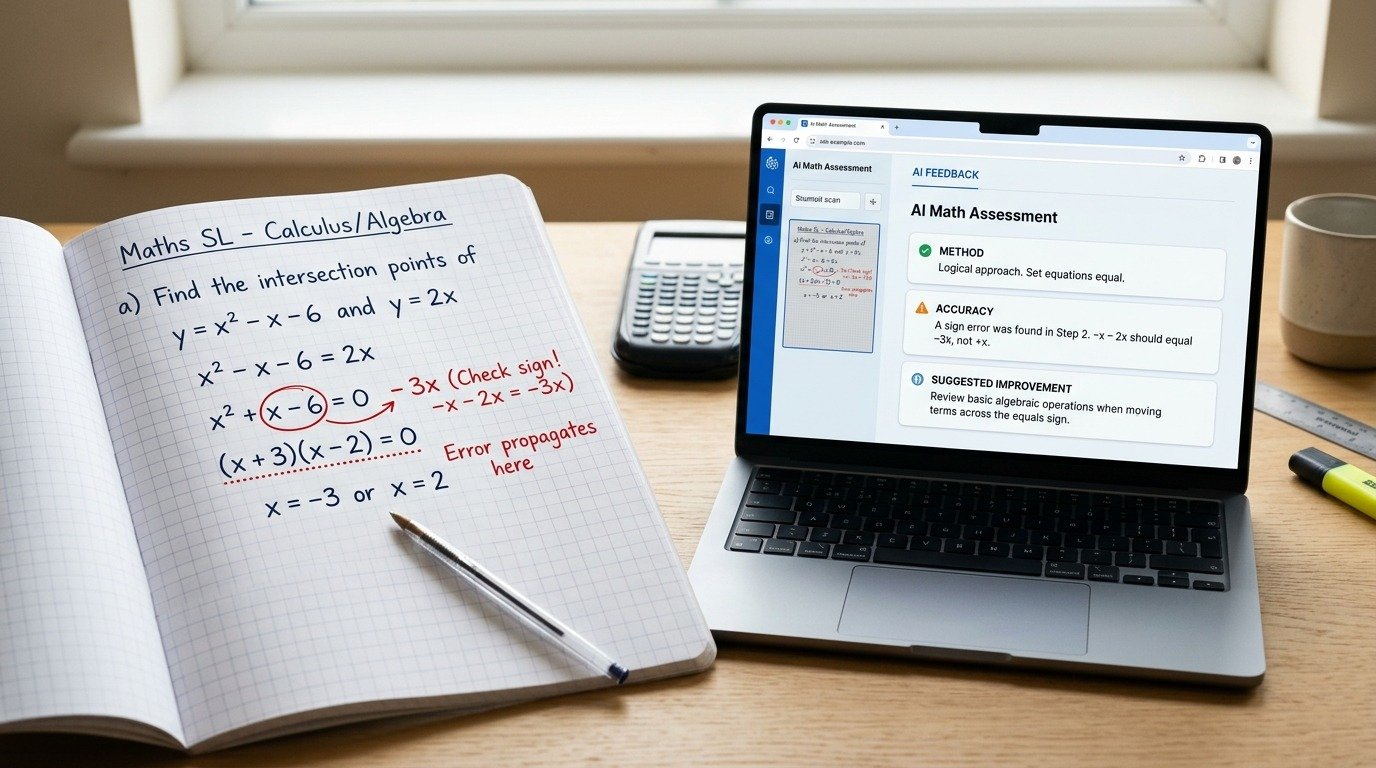
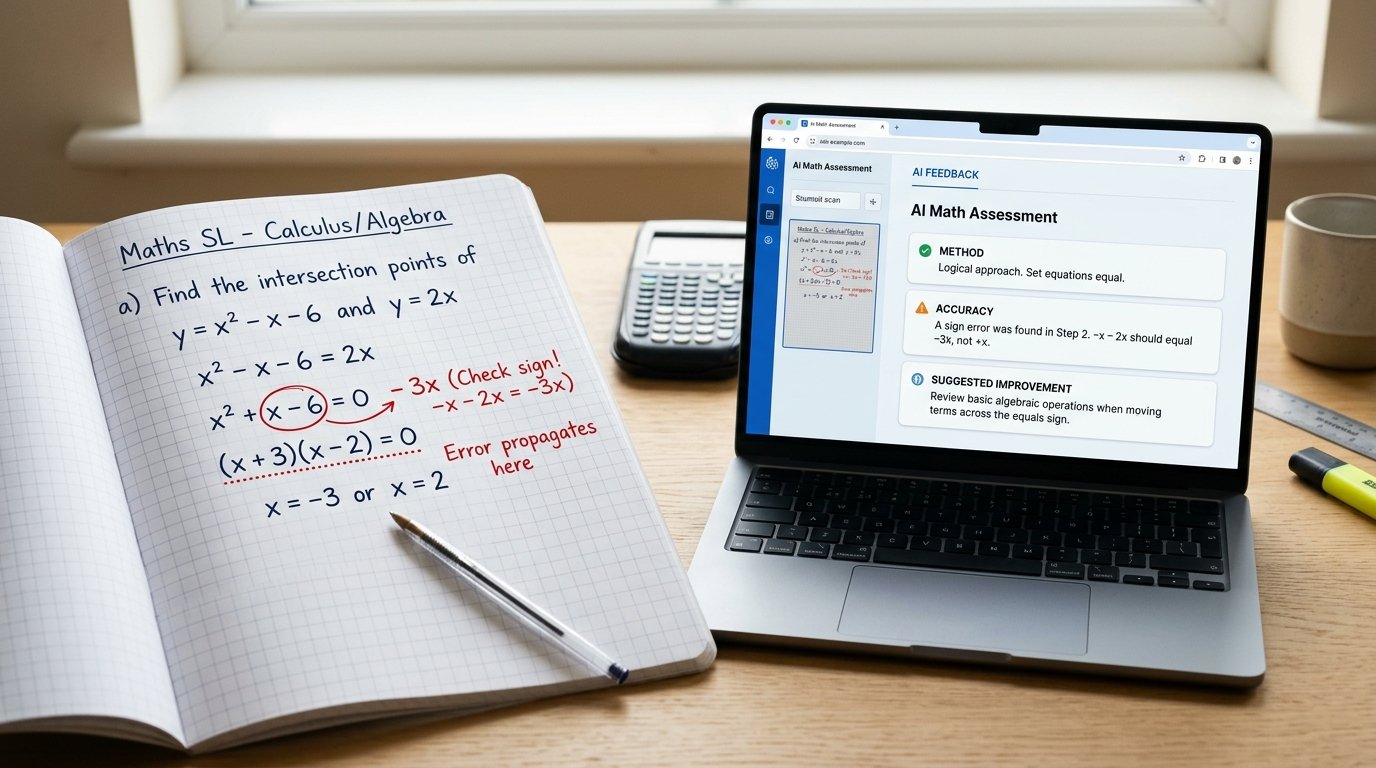
18. Use Feedback, Not Just Answers
An answer key can tell you whether your final answer is correct.
But your working contains much more information.
Suppose your final answer is wrong.
The important question is:
Where did the solution go wrong?
Maybe you:
- Misread the question.
- Chose the wrong method.
- Made a substitution error.
- Made an algebra mistake.
- Used the wrong domain.
- Entered something incorrectly into your calculator.
- Failed to interpret the result.
This is why detailed feedback is useful during functions revision.
When you practise IB Maths questions, focus on reviewing the complete solution process, not just comparing your final answer with a mark scheme.
19. A 75 Minute Function Revision Session
Here’s a practical session you can use when preparing for an assessment.
10 minutes: Concept Review
Review:
- Function notation
- Transformations
- Composite functions
- Inverse functions
- Domain and range
20 minutes: Skill Questions
Complete several short questions.
Focus on accuracy.
25 minutes: Exam Questions
Complete 3 to 5 questions without looking at solutions.
10 minutes: Marking
Identify every lost mark.
10 minutes: Error Review
For each mistake, write:
What happened?
Why did it happen?
How will I avoid it next time?
This is more productive than spending the entire session completing questions.
20. Functions Revision Checklist
Before considering the topic secure, ask yourself:
Function Basics
- Can I use function notation correctly?
- Can I evaluate functions?
- Can I identify the domain and range?
Transformations
- Can I recognise horizontal translations?
- Can I recognise vertical translations?
- Can I recognise stretches and reflections?
Composite Functions
- Can I find f(g(x))?
- Can I find g(f(x))?
- Do I understand why they aren’t generally equal?
Inverse Functions
- Can I find an inverse algebraically?
- Can I identify appropriate domain restrictions?
- Can I verify an inverse?
- Can I interpret the graph of an inverse?
Exam Technique
- Can I identify what a question is testing?
- Can I choose an appropriate method?
- Can I use my calculator efficiently?
- Can I check my answer?
- Can I explain my reasoning clearly?
Final Thoughts
Strong performance in IB Maths AA HL functions requires more than knowing definitions and formulas.
You need to recognise the structure of a question.
When you see a composite function, you should immediately think about the order of the functions.
When you see an inverse function, you should think about reversing the relationship and checking the domain.
When you see a transformed function, you should compare it carefully with the original.
And when you see a graph, don’t automatically start calculating. First ask what information you can already read from it.
Most importantly, use your mistakes to guide your revision.
If you repeatedly make errors with inverse functions, practice inverse functions.
If your function methods are correct but your algebra is causing lost marks, work on the algebra.
If you know the methods but struggle to recognise them in unfamiliar questions, move from topic based practice to mixed practice.
That’s how function revision becomes targeted rather than repetitive.
You can practise IB Maths questions to test your understanding, use the Math Skill Scanner to identify weaknesses, and explore Mathzem membership options if you want a more structured way to support your IB Maths revision.
FAQs About IB Maths AA HL Functions
1. What topics are included in IB Maths AA HL functions?
Important areas include function notation, domain and range, transformations, composite functions, inverse functions, graphical interpretation, and function equations.
2. How can I get better at IB Maths AA HL functions questions?
Start with basic skills, then practise application questions, and finally mixed exam questions where you aren’t told which method to use.
3. Why do I understand functions but still lose marks?
You may be losing marks through algebra, incorrect substitution, domain restrictions, calculator use, or failure to interpret your answer. Analyse your working to identify the actual cause.
4. How do I remember function transformations?
Learn the effect of changes inside and outside the function separately, then use simple test points or a graph to check your understanding.
5. How do I know when to use an inverse function?
Look for questions involving reversing a function, finding an input from a given output, or explicitly finding f−1(x). Always check whether a domain restriction is required.