You know the formulas. You can solve textbook exercises. You have practised past paper questions. Then you open an unfamiliar IB Mathematics Higher Level problem, and suddenly you are unsure where to begin.
This is a common difficulty with IB math paper 3 questions. The challenge is not always a lack of mathematical knowledge. Sometimes, the difficult part is recognising which ideas to connect, deciding what to try first, and building a clear solution when the method is not immediately obvious.
The answer is not to memorise more solutions. It is to develop a repeatable approach to unfamiliar problems.
In this guide, you will learn how to break down a complex question, choose a sensible starting point, show your reasoning, and use practice to improve your problem solving skills.
Table of Contents
What makes IB Math Paper 3 challenging?
Paper 3 is associated with Higher Level Mathematics and tests students through extended problem solving. Questions can require you to connect mathematical concepts, recognise patterns, make deductions, and use earlier results to solve later parts.
The difficulty often comes from having to decide what to do, rather than simply applying a method you already recognise.
For example, you might understand differentiation and functions separately. A question could require you to use a function to model a situation, differentiate it, interpret a condition, and then use your result to establish a further relationship.
Each individual skill may be familiar. Connecting them is the challenge.
The International Baccalaureate describes problem solving as an important part of its mathematics courses, including work with non routine and open ended problems. That is why practising only familiar question types can leave gaps in your preparation.

A five step method for approaching unfamiliar questions
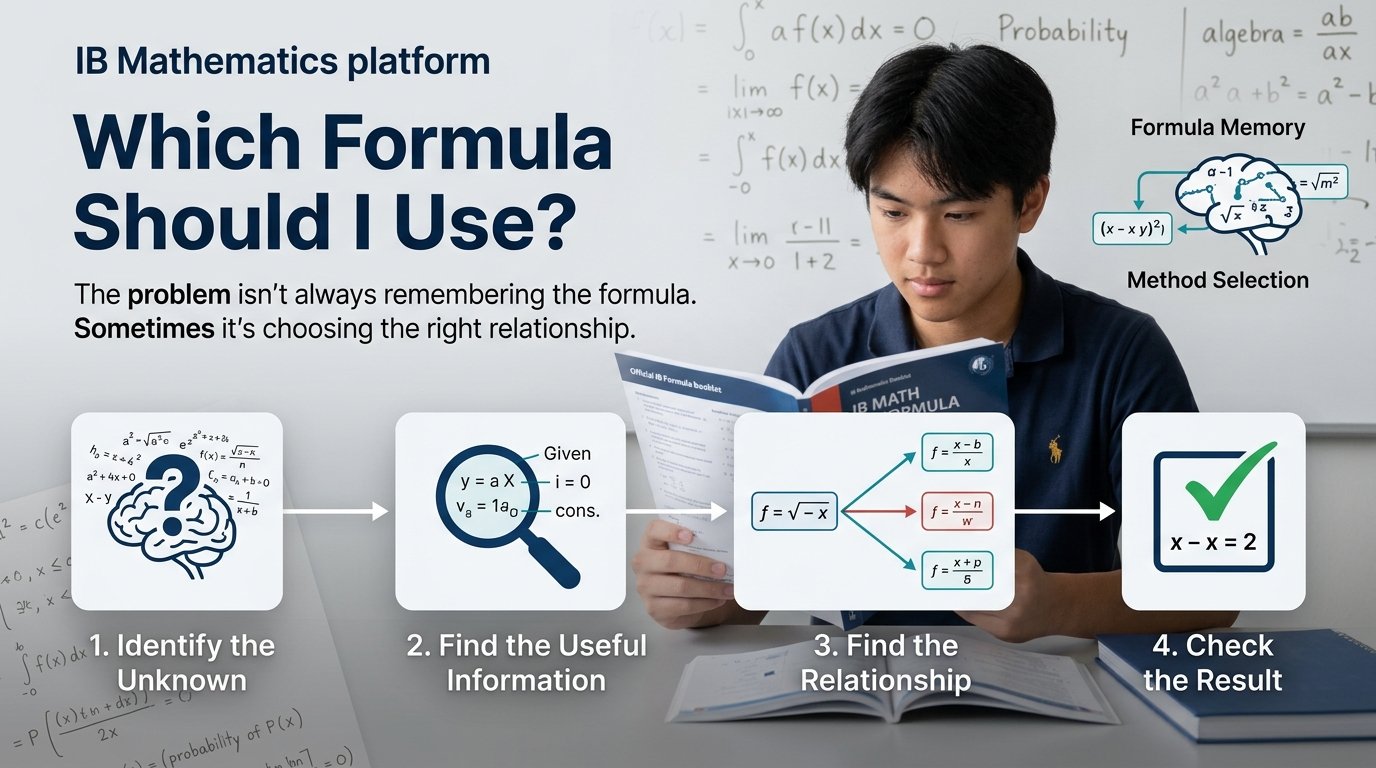
Step 1: Read the question to understand the goal
Before calculating, identify exactly what the question asks you to find or prove.
Look for the command word. Does the question ask you to determine a value, show a relationship, justify a result, or establish a general statement?
Then identify the information you have been given.
Write down the important details, such as:
- Known values and variables.
- Equations, functions, or conditions.
- Restrictions on the variables.
- The result you need to establish.
- Any earlier result that a later part may depend on.
Do not start performing calculations just because you recognise a formula. First, make sure the calculation will help answer the question.
Step 2: Identify the mathematical ideas involved
Ask yourself which topics might be relevant.
A question involving a changing quantity could involve differentiation. A question involving a repeated pattern might involve sequences or algebra. A problem about a curve and a tangent could connect functions, gradients, and equations of lines.
You do not need to identify the entire solution immediately. Finding one relevant mathematical idea is a useful starting point.
Try asking:
- What information have I been given?
- What mathematical relationship connects this information to the result?
- Have I solved a simpler problem with a similar structure?
- Can I rewrite the information in a more useful form?
The aim is to turn an unfamiliar question into smaller tasks that you can recognise.
Step 3: Start with what you know
If you cannot see the full solution, do not wait for inspiration. Begin with a valid mathematical step.
You might define a variable, rearrange an equation, substitute a known expression, calculate a derivative, or sketch a diagram.
A useful first step should move you closer to the required result. Random calculations rarely help because they do not connect to a clear objective.
Consider a simple example.
Suppose a function is defined by
(f(x)=x^2+ax)
where (a) is a constant. You are told that the gradient of the curve at (x=2) is 7, and you need to determine (a).
You know that the gradient of a curve is given by its derivative.
Differentiate:
(f'(x)=2x+a)
Use the condition at (x=2):
(f'(2)=4+a=7)
Therefore,
(a=3)
This is a straightforward example, but it illustrates a useful habit: connect the information in the question to a mathematical relationship, then use that relationship to obtain the required result.
A more demanding Paper 3 problem may require several such connections, with each result supporting the next step.
Step 4: Use earlier results to build the solution
In a multi part question, later parts may depend on results from earlier parts. Read the question carefully and keep track of what you have established.
If you have found an expression in part (a), ask whether it can help with part (b). If a later part asks you to establish a general result, look for a pattern in the values or relationships you have already obtained.
Keep your working organised. State the relationship you are using, show the relevant calculation, and make the conclusion clear.
If you reach a dead end, return to the required result. Ask what would need to be true immediately before that result could be established.
This can help you work backwards from the goal without guessing at every possible method.
Step 5: Check whether your result makes sense
A calculation is not the end of the problem.
Check whether your result satisfies the original conditions. Substitute it back into an equation when appropriate. Consider whether the sign, size, units, or mathematical meaning is reasonable.
For example, a probability must lie between 0 and 1. A length in a real world problem cannot be negative. A proposed solution may also need to satisfy a stated domain restriction.
If the question asks you to justify a result, make sure your working actually establishes the required statement rather than simply presenting a numerical answer.
What should you do when you get stuck?
Getting stuck is part of solving unfamiliar problems. The important question is what you do next.
Avoid immediately opening a complete worked solution. Try the following sequence instead.
First, restate the goal. Write down what you are trying to find or prove.
Second, list the useful information. Separate what is given from what you still need to establish.
Third, try a smaller version of the problem. Use a simpler value, a special case, or a sketch if it helps you see the structure.
Fourth, look for a connection. Consider whether a formula, identity, derivative, graph, or earlier result links the known information to the goal.
Fifth, use a hint if necessary. A small hint may reveal the relevant direction without removing the thinking that makes the problem valuable.
If you still cannot progress, study the next step of a worked solution rather than reading the whole thing at once. Close the solution and attempt that step independently.
This turns a difficult question into a learning opportunity rather than an exercise in copying.
Common mistakes in IB Math Paper 3
Trying to guess the intended method
Students sometimes search their memory for a familiar question and try to force the same method onto a new problem.
Instead, begin with the information and the required result. Choose a method because it creates a useful mathematical connection, not merely because it looks familiar.
Doing too much mental work
Keeping several equations and possible methods in your head makes it harder to notice relationships.
Write down intermediate results. A clear line of working can reveal a useful pattern that is difficult to see mentally.
Abandoning a question too early
Not seeing the complete solution does not mean you cannot make progress. A relevant diagram, equation, substitution, or first deduction may help you move forward.
Give yourself time to explore a sensible starting point before deciding that you cannot solve the problem.
Reading solutions without attempting the reasoning
A solution can look obvious once someone has shown you the method. That does not mean you would recognise the same method independently.
After studying a solution, close it and reproduce the reasoning from the original question. Then try a different question that uses a similar idea.
Ignoring the meaning of the final result
A correct calculation may still leave an incomplete response if the question requires an explanation or a justification.
Return to the command word and make sure your final line answers what was asked.
How to practise for IB Math Paper 3 effectively
Practising more questions can help, but the way you review them matters.
Use a simple routine for each challenging problem.
- Attempt it independently. Give yourself time to understand the structure and try a reasonable approach.
- Record where you became stuck. Was the issue recognising a topic, choosing a method, carrying out algebra, or connecting two results?
- Review the missing step. Compare your reasoning with a reliable worked solution or seek targeted help.
- Redo the question without looking. Reconstruct the method from the original question.
- Practise a related problem. Check whether you can recognise and use the same underlying idea in a different setting.
Keep a record of repeated difficulties. You may discover that your main problem is not calculus or algebra itself, but recognising when to use a particular technique.
That distinction matters because it changes what you should practise next.
If your algebra is accurate but you repeatedly struggle to begin unfamiliar questions, repeating routine algebra exercises is unlikely to address the main gap. You need more practice interpreting problem structure and choosing methods.
How Mathzem can support your Paper 3 preparation
Mathzem is designed to connect IB Mathematics practice with feedback on your actual working.
You can select IB style questions, attempt them independently, and submit your written working for AI Examiner feedback. This can help you review where your reasoning went wrong, which steps may need improvement, and what to focus on in your next practice session.
A useful way to apply this to challenging Higher Level questions is to:
- Attempt the question before requesting help.
- Upload your working and review the feedback.
- Identify whether the difficulty came from choosing a method, applying it, or explaining the reasoning.
- Correct the original attempt.
- Practise a related question to test whether you can use the idea independently.
AI Examiner feedback provides an estimate and learning guidance. It is not official IB marking, so use it alongside your course materials, teacher guidance, and reliable mark schemes.
You can explore Mathzem IB Practice to practise questions and develop a more consistent feedback routine. You may also find the guide on reviewing incorrect IB Math questions useful.
Final advice
The most important skill for IB Math Paper 3 is not knowing every possible question in advance. It is learning how to make progress when the method is not obvious.
Read carefully, identify the goal, connect the information to relevant mathematics, and work through manageable steps. When you get stuck, examine the precise point where your reasoning stopped. After reviewing a solution, attempt the problem again without help.
Over time, this process can make unfamiliar questions feel more manageable because you are building a method for thinking, not just a collection of remembered answers.
Ready to improve your IB Mathematics practice? Start with a challenging question, attempt it independently, and use the feedback to decide what to practise next.
Frequently asked questions about IB math paper 3 questions
1. What is IB Math Paper 3?
Paper 3 is an assessment paper associated with Higher Level IB Mathematics. It focuses on extended problem solving and can require students to connect mathematical ideas across several parts of a question. Check the assessment information for your course and examination session.
2. How do I start an unfamiliar Paper 3 question?
Identify what the question asks you to find or prove. List the information you have, identify a relevant mathematical relationship, and write down a valid first step. You do not need to see the complete solution before beginning.
3. How long should I spend on a difficult question?
Use the time allowed for your examination session and the marks available as a guide. If you cannot progress after trying a sensible approach, record what you know, move on when appropriate, and return later if time permits. Practise this decision during timed sessions.
4. Should I memorise Paper 3 solutions?
Memorising a solution can help you remember a mathematical technique, but it is not enough on its own. Focus on why each step works, what information makes the method useful, and how the same idea could appear in a different question.
5. How can I improve at unfamiliar IB Math questions?
Practise a range of challenging questions, review exactly where you get stuck, and redo questions without looking at solutions. Track whether your difficulty comes from understanding the question, selecting a method, carrying out calculations, or justifying your result. Then choose practice that addresses that specific gap.