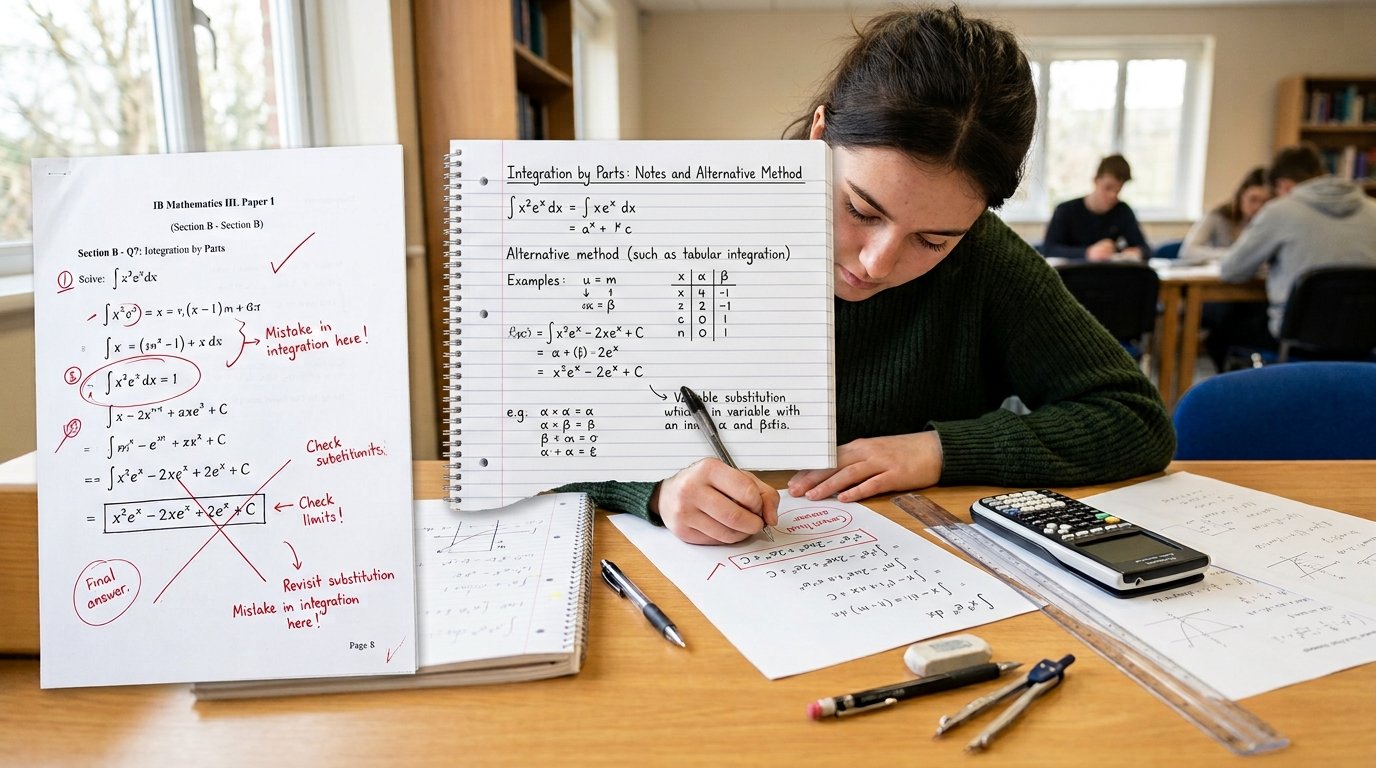
Most IB Mathematics students already know that practice matters.
They solve questions.
They revise topics.
They work through past papers.
They check answers.
Yet many students still reach a frustrating point.
They understand much of the mathematics taught in class, but their exam marks do not consistently show it.
The problem is not always a lack of effort.
Sometimes the problem is what happens after a student attempts a question.
You solve it.
You check the answer.
You discover that something went wrong.
Then what?
Do you know exactly where the mistake happened?
Do you know whether you lost method marks?
Do you know whether the problem was mathematical knowledge, method selection, algebra, interpretation or accuracy?
And most importantly, do you know what you should practise IB mathematics next?
This is the problem Mathzem is being built around.
Not simply giving students more questions.
But making each question more useful.
Table of Contents
The problem with traditional IB Math practice
A typical revision session can look like this:
Choose a question.
Solve it.
Check the answer.
Move to the next question.
Repeat.
There is nothing wrong with this process.
Practice questions are essential for IB Mathematics because students need to apply mathematics, not simply recognise formulas from notes.
But there is a missing part.
The learning value of a question does not end when you discover whether the final answer is correct.
Consider two students who both get an answer wrong.
One student misunderstood the mathematical concept.
The other understood the concept but made an algebra error in the middle of the solution.
They both have an incorrect final answer.
But they do not need the same revision.
This is why the quality of feedback matters.
The question is only the beginning
Mathzem is being built around a simple idea:
An attempt should create information that helps determine what happens next.
The process starts with a real IB style question.
The student chooses a course and topic.
They solve the question themselves.
They show their working.
They upload that working.
Then the system looks at the solution, not simply the final answer.
The current Mathzem IB Practice workflow supports this process across AA HL, AA SL, AI HL and AI SL. Students can choose a course and topic, solve an exam style question, upload their working and receive marks, mistake information, weak area information and next step guidance.
That changes the role of practice.
The question is no longer just something to complete.
It becomes a source of evidence about how the student is performing.
Why handwritten working matters
IB Mathematics is not an examination where only the final answer matters.
Working can show the method used, the reasoning behind a decision and the point where an error entered the solution.
That means a final answer alone often does not contain enough information to understand what happened.
Imagine a student solving a calculus question.
The final answer is incorrect.
There are several possible explanations.
The student may have differentiated incorrectly.
They may have selected the wrong method.
They may have used the correct calculus method but made an algebra error.
They may have calculated correctly but interpreted the result incorrectly.
Those are very different learning problems.
Mathzem’s current workflow allows students to upload handwritten working so the AI Examiner can inspect the solution process and provide examiner style feedback on marks, mistakes, weak areas and next steps.
The important part is not simply that AI is involved.
The important part is what information the AI is given.
A handwritten solution contains evidence about the student’s thinking.
From answer checking to mistake diagnosis
An answer checker asks:
Is the answer correct?
That can be useful.
But a student often needs a different question:
What happened in my solution?
Suppose the answer is wrong because of an algebraic rearrangement.
If the student only sees the correct answer, they may decide that they need to revise the entire calculus topic.
That could waste time.
If the feedback instead shows that the calculus method was appropriate but the algebra failed during rearrangement, the student has a more precise problem to work on.
That distinction is central to how Mathzem is being developed.
The current AI Examiner experience is designed to identify where marks may have been lost, explain mistakes and provide next step guidance rather than simply returning a correct answer.
The learning loop Mathzem is built around
The broader idea can be expressed as a simple loop:
Attempt → Feedback → Diagnosis → Correction → Targeted practice → Retest
The attempt gives information.
The feedback explains what happened.
The diagnosis identifies the underlying issue.
The correction gives the student something to work on.
Targeted practice develops that skill.
The retest checks whether the improvement transfers.
This approach is also reflected in Mathzem’s recent content about reviewing incorrect questions and using feedback to decide what to practise next.
The goal is not to make every question easier.
The goal is to make the next learning decision more useful.
Why the next question matters
Imagine a student has just made three repeated algebra mistakes.
They finish reviewing their work.
Then they open a question bank and choose a random statistics question.
They solve it correctly.
Then they complete a straightforward calculus question.
Again, correct.
The student has completed several questions.
But the original algebra problem remains.
This is where practice can become disconnected from learning.
The next question should sometimes be selected because of what the previous question revealed.
If a student repeatedly loses marks through algebra manipulation, more focused algebra practice may be appropriate.
If the student understands the mathematics but struggles to identify the correct method, mixed questions may be more useful.
If the student solves individual skills correctly but struggles with unfamiliar exam questions, the next step may need to involve more varied application.
The current Mathzem product already provides next step guidance based on practice feedback, alongside weak area and mistake tracking.
Personalisation should be based on evidence
Personalised learning can sound complicated.
It does not have to be.
At its simplest, personalisation means that the student’s own work influences what they do next.
That evidence can include:
Repeated mistakes.
Weak topics.
Marks earned.
Method problems.
Incomplete reasoning.
Calculation errors.
Difficulty with unfamiliar questions.
A student should not be treated as weak at an entire topic simply because of one difficult question.
Patterns matter.
This is why Mathzem’s Student Dashboard includes areas for checked work, weak areas, repeated mistakes and practice guidance.
The aim is to build a picture of performance over time rather than judge a student from one attempt.
A better practice system is not just a bigger question bank
There are already many places where students can find mathematics questions.
Adding more questions does not automatically solve the learning problem.
A student can have access to hundreds of questions and still ask:
Which one should I do?
Why did I lose those marks?
Was my method actually correct?
What should I revise now?
Have I fixed the mistake I made yesterday?
These are questions about learning, not simply content availability.
That is why Mathzem is being built as more than a question collection.
The current product combines IB practice questions with handwritten solution uploads, AI Examiner feedback, weak area tracking, repeated mistake information and next step guidance.
The purpose is to connect these parts.
What Mathzem should help a student understand
A useful practice session should leave the student knowing more than their score.
Ideally, they should understand:
What did I do well?
Perhaps the student selected the correct method and showed enough reasoning.
Where did I lose marks?
Perhaps the error appeared during algebraic manipulation.
Why did I lose those marks?
Perhaps the student rushed the rearrangement or used an incorrect sign.
What weakness does this reveal?
Perhaps algebra accuracy is affecting performance across several topics.
What should I practise next?
Perhaps a focused algebra question is more useful than another random calculus problem.
Did I actually fix it?
That requires another attempt.
This is the difference between collecting results and learning from results.
What Mathzem is building towards
The current product is already built around several parts of this loop.
Students can practise by IB course and topic.
They can solve questions on paper.
They can upload their working.
They can receive AI Examiner feedback.
They can see marks and mistakes.
They can identify weak areas.
They can track repeated mistakes.
They can receive next step guidance.
The Student Dashboard brings these elements together so that practice results can be connected to progress and revision decisions.
But the broader direction is not simply to keep adding features.
The aim is to make the learning loop more useful.
That means helping students move from:
I got this question wrong.
to:
I know why I got it wrong.
Then:
I know what skill needs work.
Then:
I know what to practise next.
And eventually:
I can solve the same type of problem independently.
That is a much more useful definition of progress.
The role of AI should be practical
AI in education can easily become focused on generating answers.
For mathematics students, that can create a problem.
If the student sees the solution before making a genuine attempt, they may understand the explanation without developing the ability to produce the solution independently.
Mathzem takes a different starting point.
The student attempts the question first.
The working is then reviewed.
The feedback is used to understand the attempt.
This keeps the student’s own problem solving at the center of the process.
The current Mathzem workflow explicitly asks students to solve the question and upload their working before receiving AI Examiner feedback.
That distinction matters.
The technology should support the learning process rather than remove the part of the process that creates learning.
What a better IB Math practice session can look like

Imagine a student has thirty minutes.
Instead of trying to complete as many questions as possible, they could work through a smaller loop.
Step 1: Attempt
Choose an appropriate IB style question and solve it independently.
Step 2: Inspect
Look carefully at the working rather than only the final answer.
Step 3: Get feedback
Identify marks, mistakes and areas that need attention.
Step 4: Diagnose
Ask what actually caused the problem.
Was it knowledge?
Method selection?
Algebra?
Accuracy?
Interpretation?
Step 5: Target
Choose practice that addresses the specific issue.
Step 6: Retest
Try another question and see whether the improvement transfers.
That session may contain fewer questions.
But each question has a clearer purpose.
What Mathzem is not trying to promise
A better practice system should not promise that every student will automatically reach a particular grade.
It should not pretend that AI can replace teachers.
It should not suggest that completing a certain number of questions guarantees exam readiness.
And it should not turn every mistake into a reason to practise the same topic repeatedly.
Learning is more complicated than that.
Students still need lessons, explanations, independent thinking, examination experience, and sustained practice.
Mathzem’s role is narrower and more practical.
It is being built to make the practice and feedback part of that process more useful.
The bigger idea
The future of IB Mathematics practice does not need to be about giving students more things to click.
It can be about making each attempt more informative.
A student solves a question.
Their working provides evidence.
Feedback explains what happened.
Repeated patterns reveal weaknesses.
Those weaknesses influence future practice.
Another attempt provides new evidence.
The cycle continues.
That is the idea behind Mathzem.
Not simply:
Question → Answer
But:
Question → Attempt → Feedback → Diagnosis → Practice → Retest
The difference may look small.
For a student who repeatedly asks, “Why am I still losing marks when I understand the topic?”, it can be much more important.
FAQs About Practise IB Mathematics
What is Mathzem?
Mathzem is an IB Mathematics practice platform built around exam style questions, handwritten working, AI Examiner feedback, weak area tracking and next step guidance.
How is Mathzem different from a normal IB Math question bank?
A question bank mainly gives you questions. Mathzem connects the question attempt with feedback on your working, mistakes, marks, weak areas and what to practise next.
Does Mathzem check handwritten IB Math working?
Yes. Students can solve questions on paper and upload a clear image of their working. The current workflow is designed to assess the method and reasoning rather than only the final answer.
Does Mathzem give official IB marks?
No. Mathzem provides AI Examiner style feedback and estimated marks. It is not an official IB examiner or official IB marking service.
Can Mathzem identify weak areas?
The current Student Dashboard tracks topic performance and repeated mistakes and provides information about areas that need attention.
What should I do after getting an IB Math question wrong?
Do not immediately move on. First identify where the solution went wrong, understand why, decide what skill needs attention, practise that skill and then retest it with another question.
Try the learning loop yourself.
If your current IB Mathematics revision feels like question after question without a clear idea of what to do next, start with one genuine attempt.
Choose your IB course and topic.
Solve the question on paper.
Upload your working.
Review the feedback.
Then use what you learned to decide what deserves your attention next.
That is the practice loop Mathzem is building around.
Because better IB Mathematics practice is not simply about doing more questions.
It is about learning more from each one.