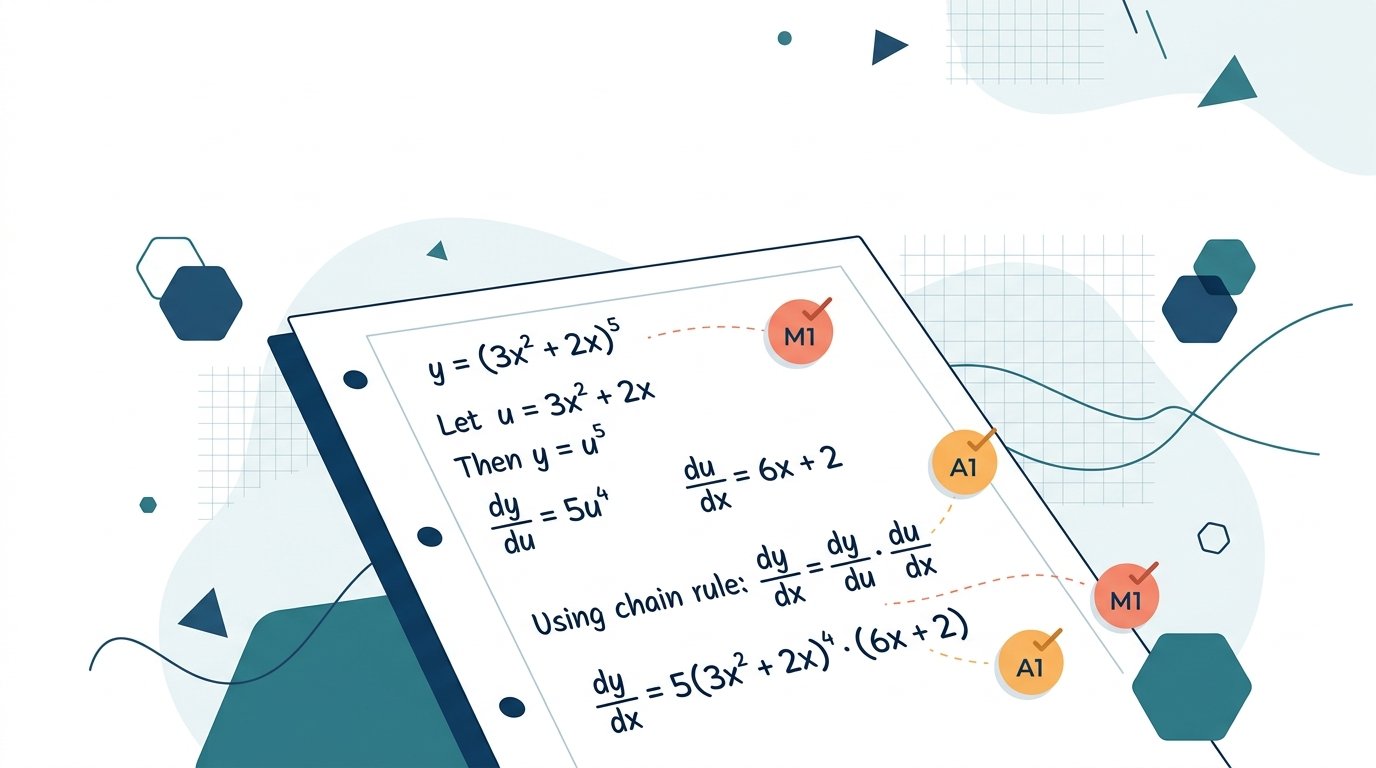
You finish an IB Maths question, look at the IB maths mark scheme, and see something like
M1 A1 R1
Or perhaps:
M1 A1 FT
It can look like another language.
You might know that you got the final answer wrong but still wonder whether you should have received some marks.
Or perhaps your answer is correct, but the mark scheme seems to expect working that you did not show.
Understanding IB Maths mark schemes can help you answer a much more useful question after practice:
Where did I actually lose the marks?
The IB mark scheme is not simply a list of correct answers. It tells examiners what evidence in a student’s work can earn particular marks.
The codes such as M, A, R, AG, and FT make that marking process more precise.
Table of Contents
IB Maths Mark Scheme Are Built for Marking, Not Teaching
A mark scheme is written primarily for examiners.
That means it can look extremely compressed to a student.
For example, an examiner may see:
M1 A1
A student may look at this and wonder what it means.
In general, M marks relate to method, A marks relate to answers or accuracy, R marks relate to reasoning, AG means the answer is given in the question, and FT means follow through.
These codes allow examiners to apply the marking criteria consistently.
They are not designed to explain every mathematical step to a learner.
This is why you should learn to unpack the mark scheme.
Instead of reading:
M1 A1
Read it as
“There are marks for using the appropriate method, followed by a mark for obtaining the required accurate result.”
That interpretation is much more useful for revision.
Decoding the Mark Codes
M1: Method Mark
An M mark is awarded for attempting to use an appropriate mathematical method.
For example, suppose a question asks you to solve
A student writes:
This demonstrates the correct method.
Even if the student subsequently makes an arithmetic mistake, the method may still be worth a mark where the mark scheme allows it.
The important idea is that an M mark is about what mathematical process you attempted.
The IB describes M marks as marks awarded for attempting to use a correct method.
A1: Answer or Accuracy Mark
A marks are generally associated with the answer or accuracy.
They can depend on the method marks that come before them.
For example:
followed by:
may receive an M mark for the appropriate method and an A mark for the correct result, depending on the specific mark scheme.
The important lesson is that an A mark does not necessarily stand alone.
The exact dependency is determined by the mark scheme.
The IB specifically notes that A marks often depend on preceding M marks.
R1: Reasoning Mark
An R mark is awarded for clear mathematical reasoning.
This becomes particularly important in questions involving explanations, proofs, interpretations, or logical conclusions.
For example, a student might calculate a value correctly but fail to explain why that value proves the required statement.
The calculation alone may not demonstrate the reasoning the question requires.
An R mark therefore tells you something important:
Knowing what to calculate is not always enough. You may need to explain why the calculation leads to the required conclusion.
AG: Answer Given
AG means Answer Given.
This is used when the relevant answer is already provided in the question.
In such circumstances, the mark scheme may not award a separate mark simply for reproducing that answer.
For example, if a question says “show that the value of is 4,” the mark scheme may contain an AG notation associated with the given result.
The key point is that AG is not another type of mathematical method.
It tells the examiner that the answer has already been supplied by the question.
The current IB mark scheme instructions define AG as “Answer given in the question, and so no marks are awarded.”
FT: Follow Through
FT stands for Follow Through.
This is one of the most useful codes for students to understand.
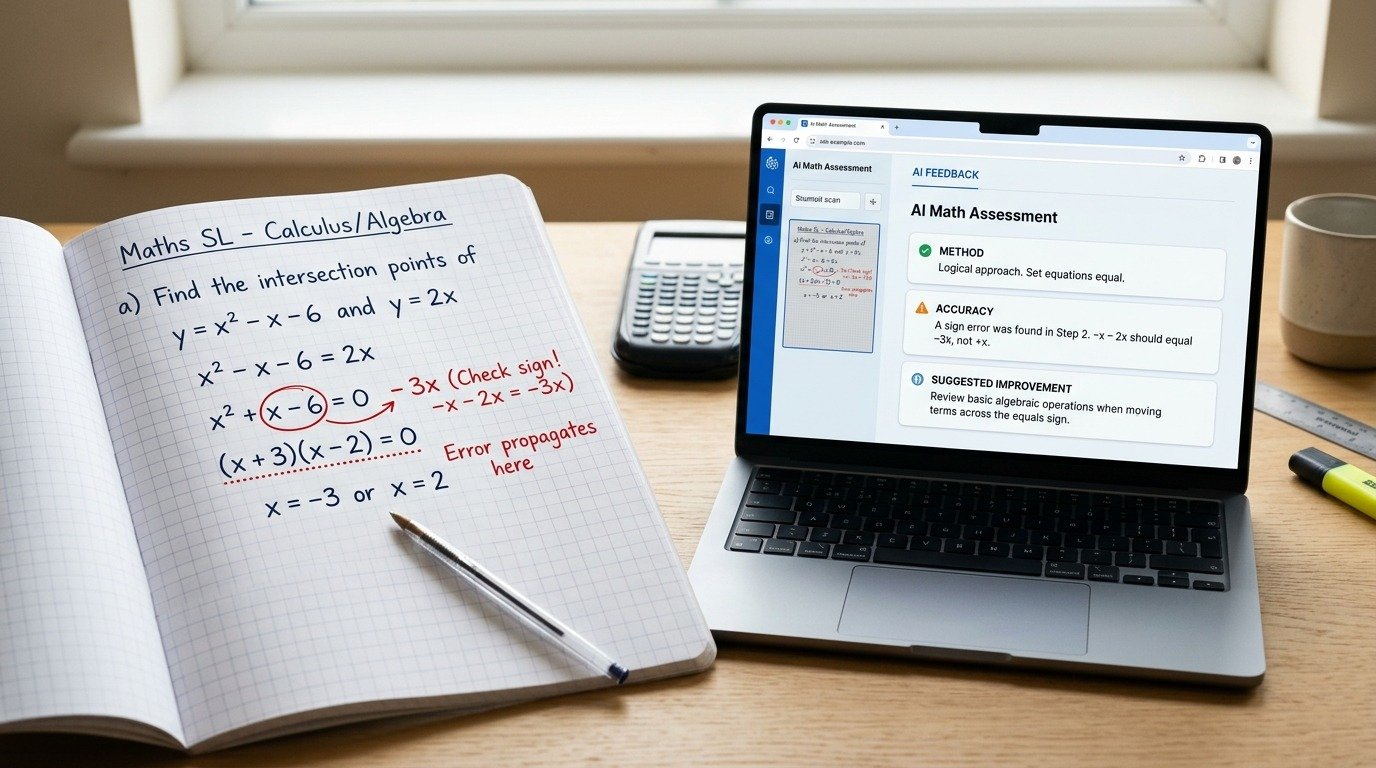
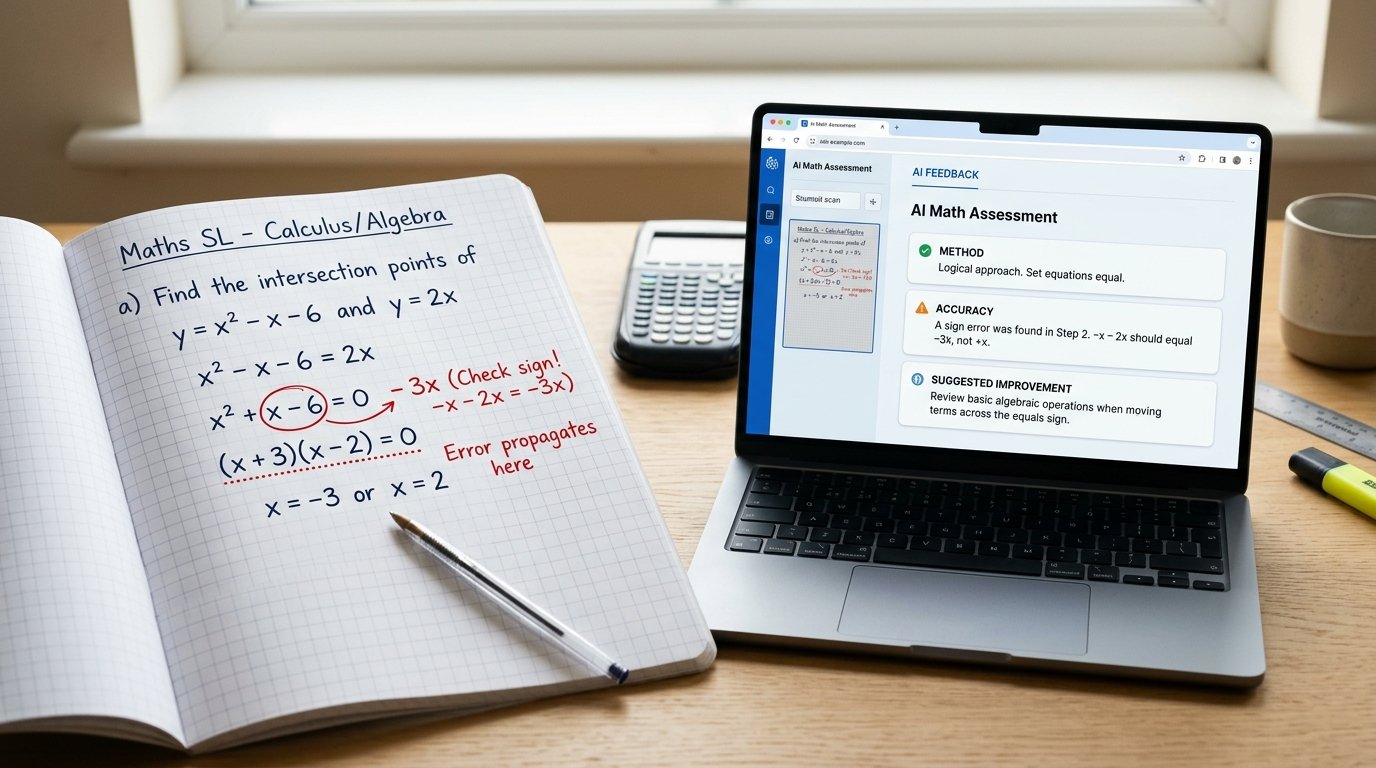
Imagine that you make an error in part (a), producing an incorrect value.
Then part (b) tells you to use the result from part (a).
If you use your incorrect value correctly in part (b), you may still receive a follow-through mark where the mark scheme allows it.
The IB describes FT as awarding marks for correct methods or answers that use an incorrect result from an earlier part.
For example:
You calculate:
but the correct value is actually:
You then correctly use your value of 12 in the next calculation.
You might lose the original accuracy mark but still receive credit for correctly applying the method to your own result.
This is why one mistake does not necessarily destroy your entire question.
Quick Reference: IB Maths Mark Codes
| Code | Meaning | What it generally rewards |
|---|---|---|
| M | Method | Attempting an appropriate mathematical method |
| A | Answer or Accuracy | Correct answer or accurate mathematical work |
| R | Reasoning | Clear mathematical reasoning |
| AG | Answer Given | The answer is already supplied in the question |
| FT | Follow Through | Correct work using an incorrect earlier result |
Always read the specific mark scheme notes because the exact conditions for awarding a mark can vary between questions.
How to Unpack a Mark Scheme Into Full Reasoning
Suppose a mark scheme shows:
M1 A1 R1
A student should not simply memorise those three letters.
Instead, translate them into questions.
M1: What method did I need to use?
A1: What accurate result did that method need to produce?
R1: What reasoning did I need to communicate?
This creates a much more useful revision process.
For example, imagine a question asks you to determine the coordinates of a stationary point and classify it.
The mark scheme might effectively reward:
M1: Differentiate and set the derivative equal to zero.
A1: Obtain the correct coordinate.
R1: Correctly explain why the point is a maximum or minimum.
Now you can see exactly what the examiner is looking for.
The mark scheme has become a learning tool.
Why a Correct Final Answer Does Not Always Mean Full Marks
This is one of the most important lessons to understand.
A correct final answer does not automatically guarantee every available mark.
The IB’s examiner instructions explicitly state that examiners should not automatically award full marks for a correct answer. They must check the working and award marks according to the mark scheme.
Imagine that a question is worth four marks.
You somehow obtain the correct final answer but provide no mathematical working.
Depending on the question and mark scheme, you may not receive all four marks.
This is why showing appropriate working matters.
Your working provides evidence of your mathematical method and reasoning.
Why Method Marks Matter So Much
Students sometimes think:
“If I get the final answer wrong, the whole question is lost.”
That is not necessarily true.
Suppose you correctly identify the method but make a calculation error.
You may still earn method credit.
This is one reason you should never abandon a question simply because your first calculation does not produce the expected result.
Continue with the mathematics you can justify.
If a later part uses your earlier result, apply your result consistently.
That can allow you to earn follow through marks.
What “Follow Through” Really Means
Following through is not a free mark for making an error.
There are conditions.
The later work must use the incorrect result appropriately.
The mathematical method still needs to be correct.
The error cannot make the later question substantially simpler in a way that changes the nature of the task.
The IB examiner guidance explains that FT is applied after an error and normally requires working rather than simply presenting a final answer based on an incorrect previous result.
This gives you an important exam strategy:
If you make an earlier mistake, keep working carefully rather than giving up.
What Does This Mean for Your Exam Technique?
Understanding mark schemes should change how you practise.
Do not only compare your final answer with the mark scheme.
Compare your working.
Ask:
Did I use the correct method?
Did I show enough working?
Did I make an accuracy error?
Did I explain my reasoning?
Did I interpret the result?
Did I use an earlier answer correctly?
Did I lose a mark because I misunderstood the question?
These questions tell you much more about your performance than a simple percentage score.
Turn Mark Scheme Feedback Into a Weakness Map
Suppose you complete five past paper questions and notice a pattern.
You consistently get the correct method but lose accuracy marks.
That suggests an accuracy weakness.
Another student may consistently reach the correct numerical result but lose reasoning marks.
That suggests a communication or reasoning weakness.
A third student may make an error in an early part and then stop working.
That suggests the student needs to improve their understanding of follow through opportunities.
These are very different problems.
Your revision should therefore respond to the type of mark you are losing, not simply the number of marks.
This is where a weakness map can be useful.
Instead of writing:
“Calculus is weak.”
You might record:
“Calculus method is usually correct, but I lose accuracy marks when simplifying algebra.”
That is much more actionable.
How Mathzem Can Help You Analyse Your Working
Practising questions is only one part of improving your IB Maths performance.
You also need useful feedback on the work you submit.
Mathzem is designed around this practice, upload, review, and improve process.
You can practise IB Maths questions, submit your working, and use examiner style feedback to understand your marks, mistakes, weak areas, and next steps.
The objective is not simply to tell you whether your answer is right or wrong.
It is to help you understand why you earned the marks you did and what you should improve next.
How to Read a Mark Scheme After Every Practice Question
After completing a question, do not immediately move to the next one.
Spend a few minutes comparing your working with the mark scheme.
First, identify every mark you earned.
Then identify every mark you missed.
Next, determine why you missed it.
Was it a method error?
An accuracy error?
A reasoning error?
A missing explanation?
An incorrect interpretation?
An earlier mistake that affected later work?
Once you know the reason, decide what you will do differently next time.
This transforms the mark scheme from an answer sheet into a revision tool.
The Best Question to Ask After Losing a Mark
Do not ask:
“Why did I get this wrong?”
Ask:
“What evidence did the mark scheme require that my solution did not provide?”
That question is much more precise.
Perhaps you calculated the correct value but did not show the required method.
Perhaps your method was correct but your final answer was inaccurate.
Perhaps the question required reasoning and you only provided a calculation.
Perhaps you made an early error but failed to use your result consistently afterwards.
Each situation requires a different response.
Final Thoughts
IB Maths mark schemes can look confusing when you first encounter codes such as M1, A1, R1, AG, and FT.
But once you understand what they represent, they become extremely useful.
M marks help you understand method.
A marks help you understand accuracy and answers.
R marks highlight reasoning.
AG identifies an answer already given in the question.
FT shows where correct later work can still receive credit after an earlier error.
Most importantly, stop using mark schemes only to check whether your final answer matches.
Use them to study how marks are earned.
Your goal is not simply to produce answers.
Your goal is to produce mathematical working that provides the evidence an examiner needs to award those marks.
That shift can make your practice much more effective.
Frequently Asked Questions About the IB Maths Mark Scheme
Can I still get marks if my final answer is wrong?
Yes, potentially. If your method is correct but you make an error later, the mark scheme may award method marks or other appropriate marks. The exact outcome depends on the question and its marking instructions.
What does “follow through” mean in IB Maths marking?
Follow through means that you may receive credit for correct work that uses an incorrect result from an earlier part. The later method must be appropriate, and the specific mark scheme determines whether FT applies.
Does every valid method get full marks?
Not automatically. Examiners assess the method and answer against the mark scheme. However, a method does not necessarily have to look identical to the printed solution if it is mathematically valid and satisfies the marking requirements.
What does M1 mean in an IB Maths mark scheme?
M1 generally means one mark is available for attempting an appropriate mathematical method. The exact method required is determined by the individual mark scheme.
Why did I lose marks even though my final answer was correct?
A correct final answer does not automatically mean that every available mark has been earned. Depending on the question, the mark scheme may require evidence of method, reasoning, accuracy, or other mathematical work.