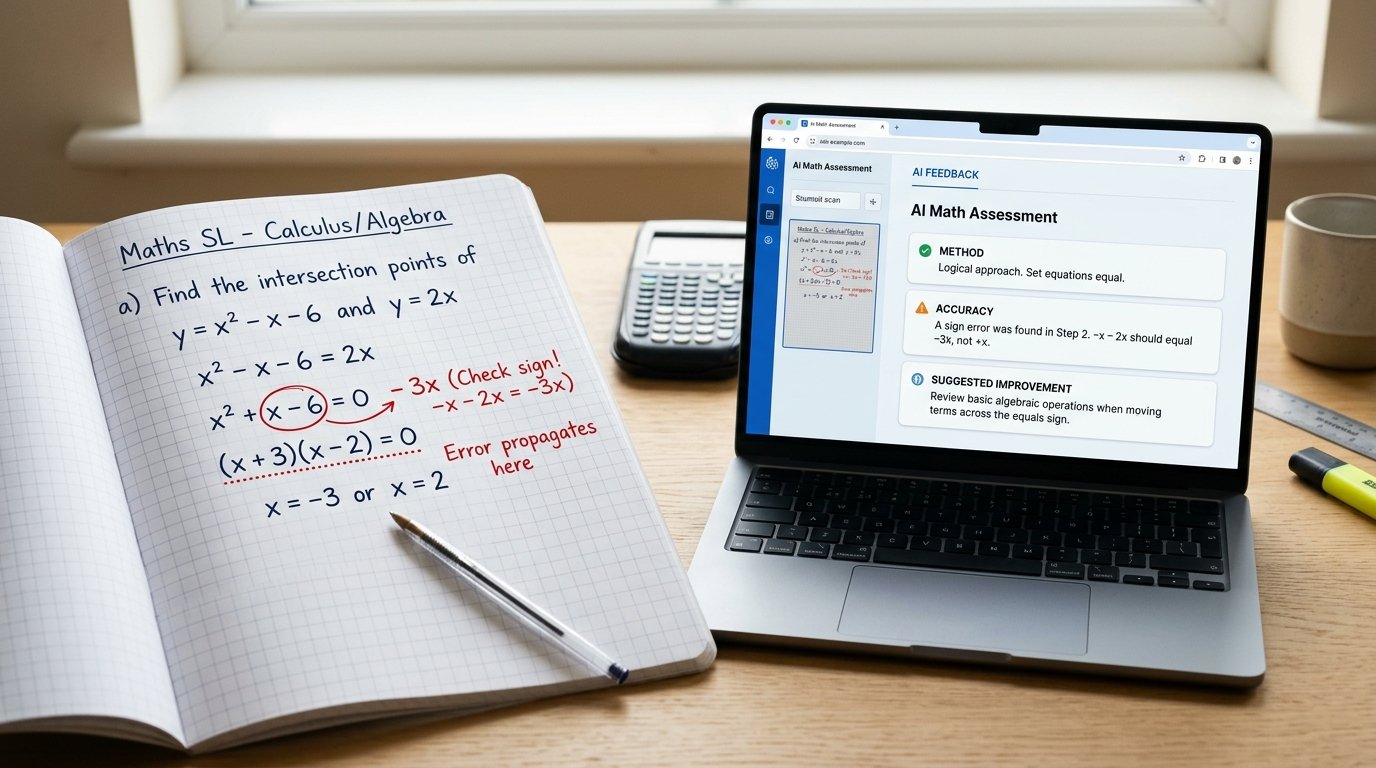
Calculus is one of the most important areas to get under control when preparing for the IB Maths AA HL Calculus Revision.
But effective calculus revision isn’t about completing hundreds of random questions.
You need to understand how the different calculus skills connect.
A student might know how to differentiate a function but struggle when asked to use the derivative in an optimisation problem. Another student might know integration rules but lose marks because they don’t interpret the area correctly.
That’s why your revision should move beyond memorising formulas.
You need to master the method, application, interpretation, and exam technique behind each major calculus skill.
This guide explains what to revise first, how the topics connect, which mistakes to watch for, and how to turn practice questions into a targeted revision plan.
Table of Contents
What Does IB Maths AA HL Calculus Include?
Calculus in IB Maths AA HL covers several connected ideas.
The exact emphasis can vary between questions, but your revision should include areas such as
- Limits and continuity
- Differentiation
- Applications of differentiation
- Integration
- Applications of integration
- Differential equations
- Numerical methods and technology where relevant
- Modelling and interpretation
The important point is that these aren’t isolated topics.
For example:
Differentiation → stationary points → optimisation
and
Integration → definite integrals → area
and
Differential equations → rates of change → modelling
Understanding these connections makes unfamiliar exam questions much easier to approach.
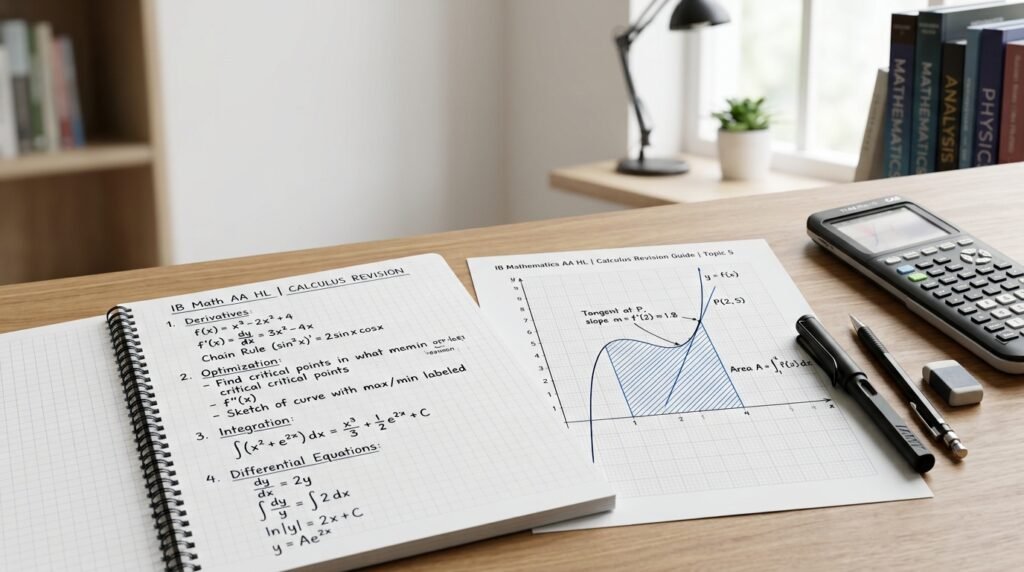
1. Start With Differentiation
Differentiation should be one of your first priorities because it supports many later calculus questions.
You should be comfortable differentiating common functions without hesitation.
For example: f(x)=xn
gives f′(x)=nxn−1
You should also be familiar with derivatives involving functions such as: ex,lnx,sinx,cosx
as well as more complicated expressions that require appropriate differentiation techniques.
What should you be able to do?
By the end of your differentiation revision, you should be able to:
- Find the first derivative.
- Find higher derivatives when required.
- Evaluate a derivative at a particular value.
- Find the gradient of a curve.
- Find tangent and normal equations.
- Interpret a derivative in context.
- Recognise when differentiation is required in an unfamiliar question.
That final skill matters a lot.
Knowing a differentiation rule isn’t enough if you can’t recognise when to use it.
2. Master Stationary Points
Once you’re comfortable differentiating, move into applications.
A common application is finding stationary points.
At a stationary point: f′(x)=0
You can then use the resulting x values to find the corresponding coordinates.
But don’t stop at finding the coordinates.
You should also understand whether the point represents a local maximum, local minimum, or another type of stationary point.
A good revision sequence
Try this progression:
Step 1: Differentiate the function.
Step 2: Set the derivative equal to zero.
Step 3: Solve for x.
Step 4: Find the corresponding y values.
Step 5: Classify the stationary points.
Step 6: Interpret the result using the graph.
This gives you a repeatable method for exam questions.
3. Learn Optimisation as a Process
Optimisation questions can look intimidating because they’re usually written as long word problems.
The calculus itself might be relatively straightforward.
The difficult part is often setting up the mathematics correctly.
For example, a question might ask you to find the maximum area of a shape subject to a particular constraint.
Don’t immediately start differentiating.
First ask:
What quantity am I trying to maximise or minimise?
Then identify the variables and constraints.
A typical optimisation process is Word problem
↓ Define variables
↓ Create an equation
↓ Build the objective function
↓ Differentiate
↓ f′(x)=0
↓ Find candidate values
↓ Check and interpret
This is why optimisation should be revised after you have a solid understanding of differentiation.
4. Don’t Ignore Related Rates
Related rates questions require you to connect changing quantities.
The key idea is that several variables can depend on time.
For example, you might have: A=πr²
If the radius changes with time, then the area changes with time too.
Differentiating with respect to t gives dtdA=2πrdtdr.
The challenge isn’t simply taking the derivative.
You need to identify:
- What is changing?
- What information is given?
- What rate are you being asked to find?
- What relationship connects the variables?
- What values should be substituted?
This makes related rates a good example of why calculus revision needs to include problem setup, not just calculations.
5. Revise Integration After Differentiation
Integration is closely connected to differentiation.
You should be able to recognise integration as the reverse process of differentiation.
For example: ∫3x2dx=x3+C
because dxd(x3)=3×2
Start with basic integration rules before moving into more complicated applications.
Your integration checklist
Make sure you can:
- Find indefinite integrals.
- Use the constant of integration correctly.
- Evaluate definite integrals.
- Find areas.
- Interpret definite integrals.
- Work with integration in context.
- Check an integration result by differentiating it.
That final check is particularly useful during revision.
If you integrate a function and aren’t sure about your answer, differentiate your result.
If you don’t get back to the original function, something went wrong.
6. Understand Definite Integrals and Area
A definite integral isn’t just a calculation.
It has a geometric meaning.
For example: ∫abf(x)dx
can represent the signed area between a curve and the x axis over the interval [a,b].
This distinction matters.
If part of the graph is below the x axis, the definite integral can be negative even though the geometric area is positive.
So before calculating, look at the graph and ask:
What exactly does this integral represent?
You may need to split an area into separate sections depending on where the function crosses the axis.
7. Revise Differential Equations Carefully
Differential equations can feel difficult because you’re working with a relationship involving a function and one or more of its derivatives.
The important thing is to understand the structure of the problem rather than memorising isolated procedures.
When revising, ask:
- What derivative information is given?
- What variables are involved?
- Can the equation be rearranged?
- What integration step is required?
- What initial condition is available?
- How should the final solution be interpreted?
Practice should include both straightforward questions and contextual modelling problems.
8. Learn to Connect the Calculus Topics
One of the best ways to prepare for AA HL calculus is to stop treating each topic as a separate chapter.
Consider this chain:
Differentiation
You find: f′(x)
Stationary points
You solve: f′(x)=0.
Optimisation
You use the derivative to find a maximum or minimum.
Graph analysis
You use derivatives to understand how a function behaves.
Now consider integration:
Integration
You find: ∫f(x)dx
Definite integration
You calculate: ∫abf(x)dx
Area
You interpret the result geometrically.
When you understand these relationships, a long exam question becomes easier to break into smaller mathematical steps.
9. Don’t Revise Calculus Only by Formula
A common mistake is spending revision time copying formulas into a notebook and assuming the topic is understood.
Formula knowledge matters.
But IB questions often test whether you can apply that knowledge.
For every formula or method you revise, ask:
What does it do?
When should I use it?
What information do I need before using it?
How do I interpret the answer?
For example, knowing that: f′(x)=0
can help you find stationary points.
But that doesn’t automatically tell you whether the point is a maximum or minimum.
You need to continue the reasoning.
10. Practice Questions in Three Stages
A useful calculus revision system is to divide practice into three stages.
Stage 1: Skill Practice
Start with focused questions.
For example:
- Differentiate five functions.
- Integrate five functions.
- Find three stationary points.
The goal is accuracy.
Stage 2: Application Practice
Move to questions where you have to decide how to use the skill.
For example:
- Optimisation.
- Related rates.
- Area problems.
- Tangent and normal questions.
The goal is method selection.
Stage 3: Mixed Practice
Finally, remove the topic label.
Give yourself several IB style questions without knowing which calculus technique you’ll need.
The goal is recognition.
This is where many students discover that they can perform a method but struggle to identify when it should be used.
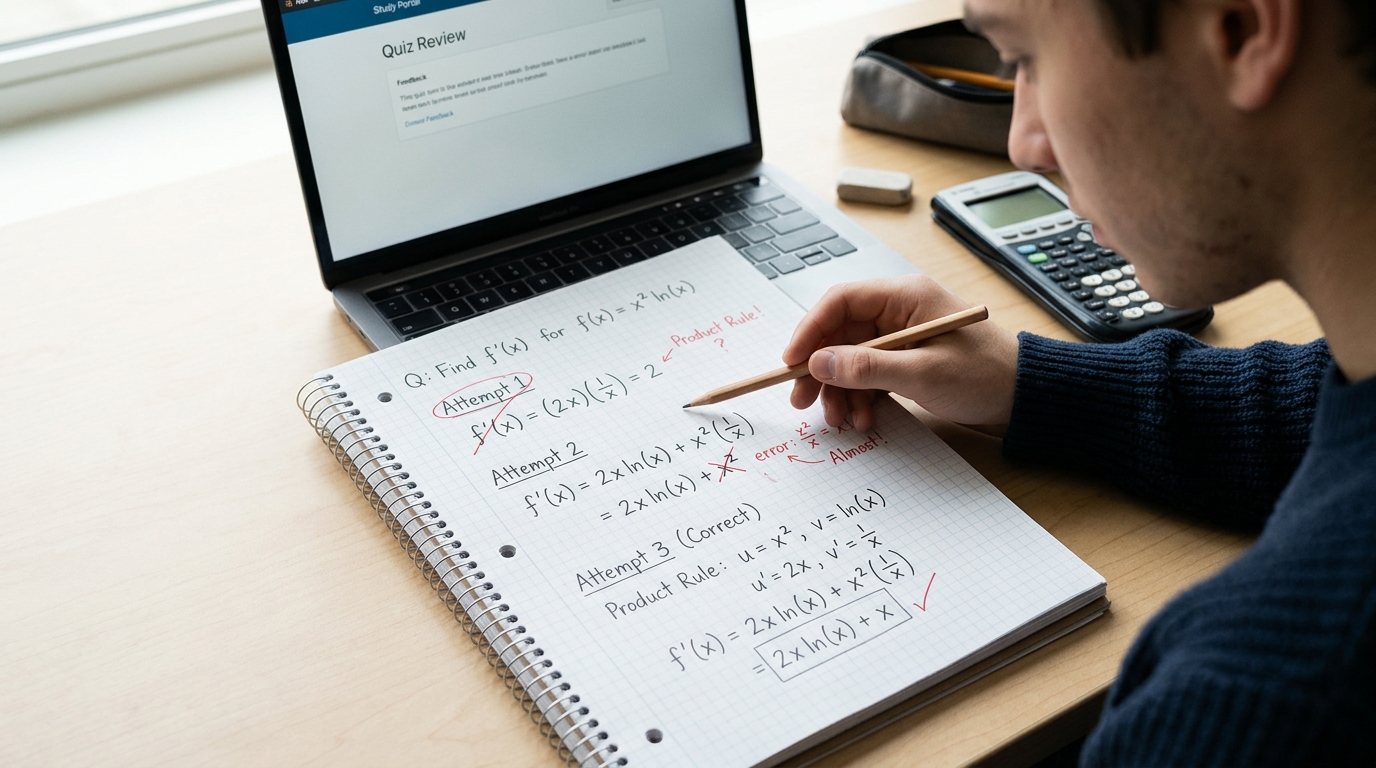
11. Use Your Mistakes to Guide Revision
Your score alone doesn’t tell you what to revise next.
Suppose you complete 20 calculus questions and score 15 out of 20.
You could simply do another 20 questions.
A better approach is to analyse the five lost marks.
Were they caused by:
- Not knowing a formula?
- Differentiation errors?
- Algebra mistakes?
- Incorrect calculator use?
- Choosing the wrong method?
- Misreading the question?
- Poor interpretation?
- Rounding too early?
This distinction matters.
If your problem is algebra, doing another 20 calculus questions may not solve it.
You need targeted practice.
Build a calculus weakness map:
| Skill | Confidence | Common Error | Next Action |
|---|---|---|---|
| Differentiation | 🟢 | None | Mixed practice |
| Stationary points | 🟡 | Classification | 5 targeted questions |
| Optimisation | 🔴 | Setting up function | Review examples |
| Integration | 🟢 | None | Exam questions |
| Area | 🟡 | Sign errors | Targeted practice |
| Differential equations | 🔴 | Setup | Guided practice |
This is much more useful than simply writing “revise calculus” on your study plan.
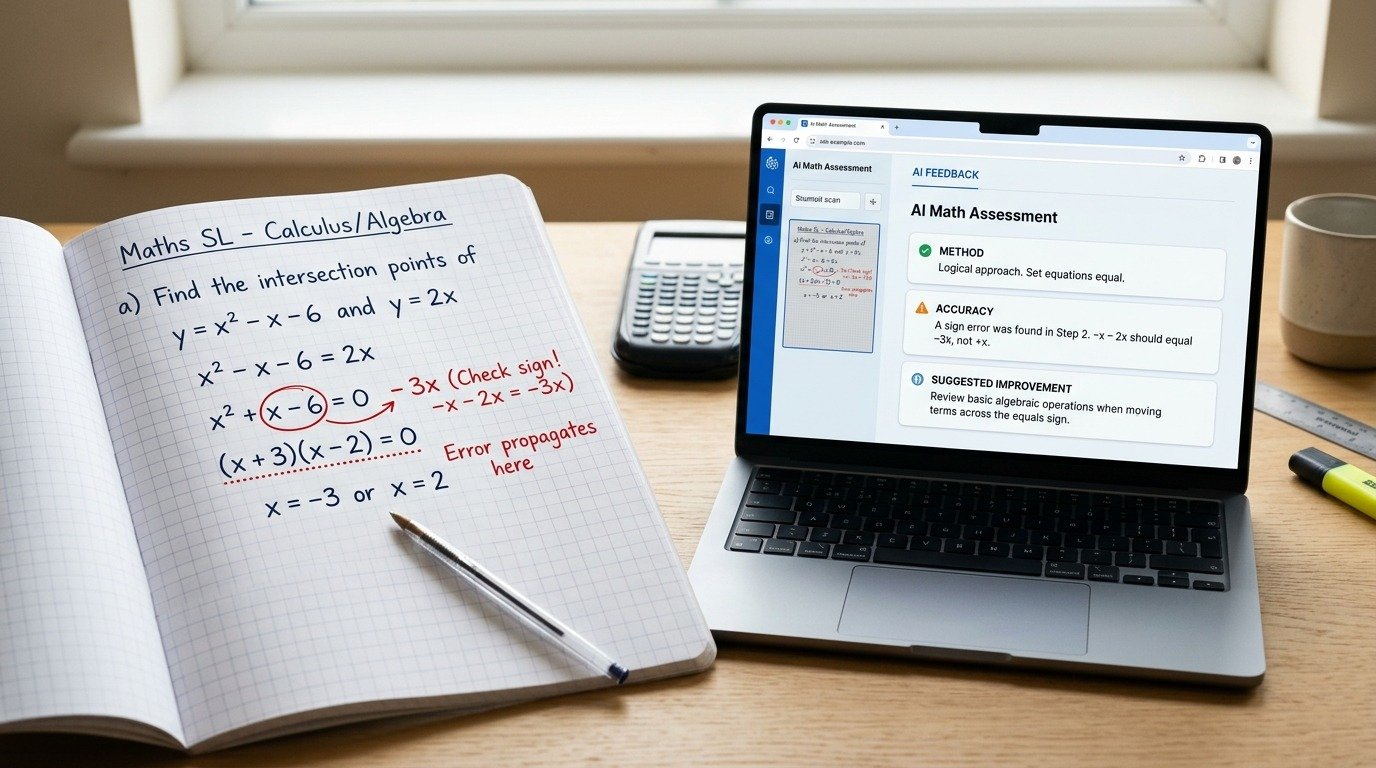
12. Use AI Examiner Feedback to Improve Calculus
Getting an answer wrong tells you what happened.
Feedback can help you understand why it happened and what to do next.
For example, instead of simply seeing that an optimisation answer is incorrect, useful examiner style feedback should help you identify whether you:
- Defined the variables incorrectly.
- Built the wrong objective function.
- Differentiated incorrectly.
- Solved the derivative equation incorrectly.
- Failed to justify the maximum or minimum.
- Gave an answer without interpreting it.
This turns practice into a cycle:
Practise → Submit your working → Review feedback → Identify the mistake → Practise the weak skill → Reattempt
You can use the IB Maths practice workspace to make this type of practice and review part of your revision routine.
13. Find Your Weakest Calculus Skills First
Before starting a large calculus revision session, spend a few minutes assessing yourself.
Rate each area:
Green: I can solve exam questions independently.
Yellow: I understand the topic but make occasional mistakes.
Red: I don’t know how to approach many questions.
Then prioritise your red topics.
You can also use the Math Skill Scanner to identify areas where your mathematical skills need more attention.
The aim isn’t to spend equal amounts of time on every calculus topic.
Your revision time should reflect your weaknesses.
14. A 90 Minute AA HL Calculus Revision Session
If you have 90 minutes available, try this structure.
First 15 minutes: Review
Review the formulas and methods for one calculus area.
Don’t copy everything.
Focus on what you forget.
Next 25 minutes: Guided Practice
Complete several straightforward questions.
Focus on accuracy.
Next 30 minutes: Exam Questions
Move to more challenging IB style questions.
Work without looking at solutions.
Final 20 minutes: Feedback
Mark your work.
For every error, write:
What did I do?
Why was it wrong?
What should I do next time?
This final stage is often more valuable than immediately starting another set of questions.
15. Calculus Calculator Tips
Your calculator can save time, but only if you know when to use it.
Practise using your calculator for:
- Graphing functions.
- Checking intersections.
- Numerical solutions.
- Numerical integration.
- Evaluating complicated expressions.
- Checking numerical answers.
But don’t use it as a substitute for mathematical reasoning.
For example, if you’ve been asked to find a derivative analytically, getting a numerical derivative from your calculator doesn’t demonstrate the required mathematical method.
Use technology to support your reasoning and check your work.
16. The Most Common AA HL Calculus Revision Mistakes
Watch for these problems during your preparation.
Mistake 1: Memorising Without Understanding
You know the derivative rule but don’t know when to use it.
Mistake 2: Skipping the Setup
You start calculating before identifying what the question is asking.
Mistake 3: Ignoring the Context
You obtain a numerical answer but don’t explain what it means.
Mistake 4: Rounding Too Early
You use rounded values in later calculations and create unnecessary errors.
Mistake 5: Doing Only Easy Questions
You become comfortable with procedures but struggle with unfamiliar exam questions.
Mistake 6: Not Reviewing Wrong Answers
You mark the question wrong and immediately move on.
Mistake 7: Revising Everything Equally
You spend an hour on a topic you already understand while ignoring a major weakness.
17. Your IB Maths AA HL Calculus Revision Checklist
Before moving on from calculus, ask yourself:
Differentiation
- Can I differentiate common functions?
- Can I find tangent and normal equations?
- Can I interpret derivatives?
Applications
- Can I find and classify stationary points?
- Can I solve optimisation problems?
- Can I handle related rates questions?
Integration
- Can I find indefinite integrals?
- Can I evaluate definite integrals?
- Can I calculate and interpret areas?
Differential Equations
- Can I recognise the structure of a differential equation?
- Can I apply the appropriate method?
- Can I use initial conditions?
Exam Skills
- Can I identify when calculus is required?
- Can I break long questions into stages?
- Can I interpret my final answer?
- Can I check whether an answer is reasonable?
- □ Can I explain my working clearly?
Final Thoughts
Effective IB Maths AA HL calculus revision isn’t about trying to memorise every formula the night before an exam.
You need to build a connected understanding of the subject.
Start with differentiation and integration fundamentals. Then move into applications such as stationary points, optimisation, related rates, area, and differential equations.
Once you understand the methods, practise using them in unfamiliar questions.
Most importantly, analyse your mistakes.
If you repeatedly lose marks in the same type of question, that mistake is giving you useful information about what to revise next.
The goal isn’t simply to complete more questions.
It’s to make each practice session tell you what you understand, what you don’t understand, and what you should practice next.
If you want to turn your calculus practice into a more structured revision process, you can practise IB Maths questions and review your working, scan your maths skills to identify weaknesses, and explore Mathzem membership options.
FAQs About IB Maths AA HL Calculus Revision
1. What should I revise first in IB Maths AA HL calculus?
Start with differentiation and integration fundamentals. Once those are secure, move into applications such as stationary points, optimisation, related rates, area, and differential equations.
2. Is calculus difficult in IB Maths AA HL?
Calculus can be challenging because questions often require students to apply several mathematical skills together. Strong algebra, differentiation, integration, and problem solving skills make the topic much more manageable.
3. How should I practise AA HL calculus?
Begin with focused skill questions, then move to application questions and finally mixed exam questions where you must identify the appropriate method yourself.
4. How can I improve my calculus exam marks?
Analyse your incorrect questions carefully. Identify whether each lost mark came from mathematical knowledge, algebra, method selection, calculator use, or interpretation. Then practise the specific weakness.
5. How much time should I spend revising AA HL calculus?
A focused 60 to 90 minute session can be effective. Spend part of the session reviewing concepts, most of it solving questions, and the final part analysing mistakes and feedback.