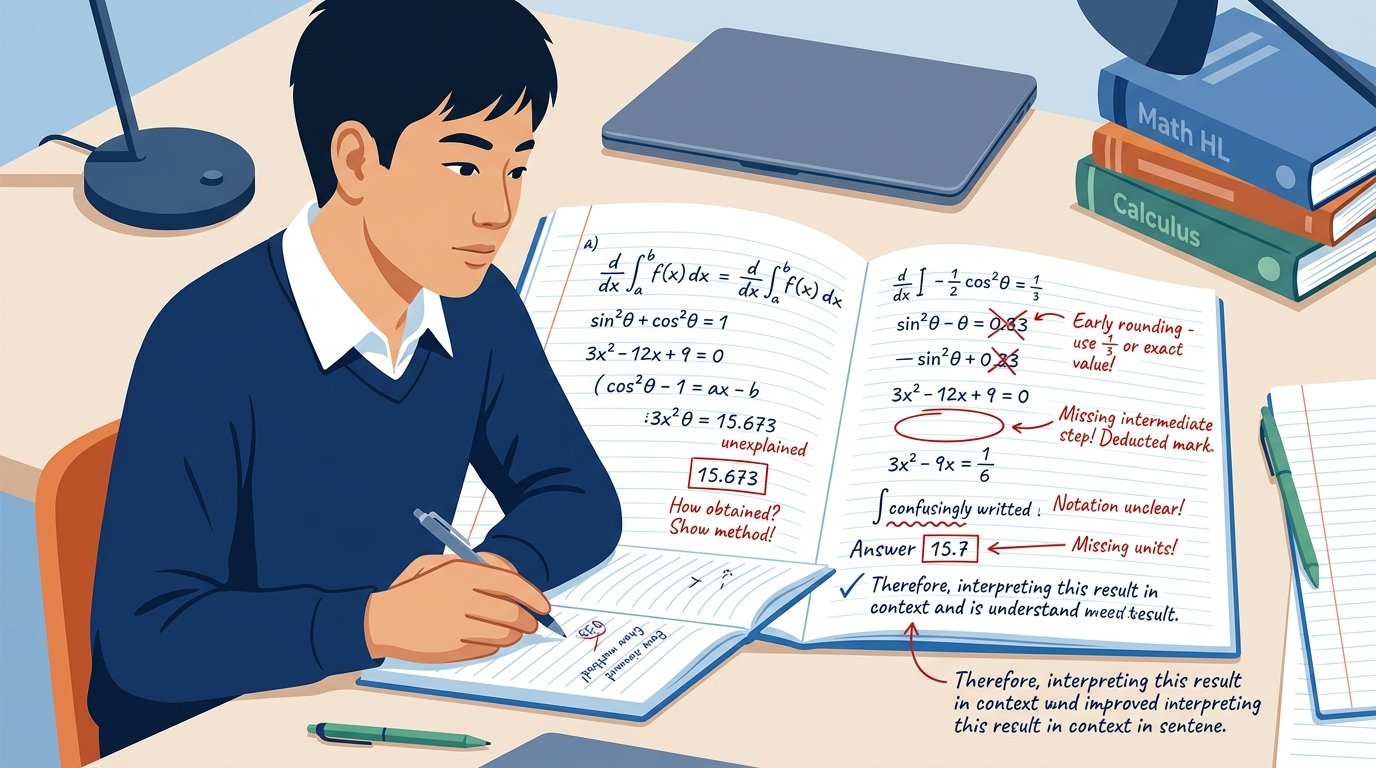
You can understand the mathematics, know which formula to use, and still lose marks in an IB Math exam.
For many students, this is one of the most frustrating parts of exam preparation. You leave a question thinking you understood it, only to discover when checking the mark scheme that your answer didn’t receive as many marks as you expected.
Sometimes the problem is a calculation error. But sometimes the mathematics itself isn’t the main issue.
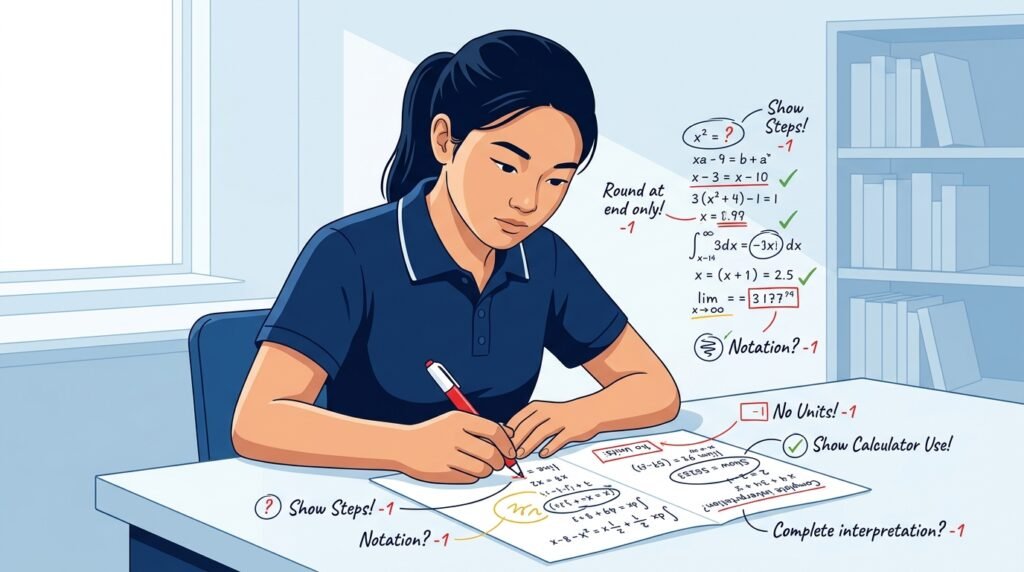
You may have skipped an important step, written an unexplained calculator result, rounded too early, used unclear notation, forgotten units, or given an answer without properly interpreting it.
These details matter because the IB Mathematics assessment isn’t simply about producing a final number. Students are assessed on their ability to apply mathematics, solve problems, communicate mathematical reasoning, and interpret results. The exact marks available depend on the individual question and its mark scheme.
That means your working is part of your answer.
Understanding how method marks can be lost is therefore an important part of improving your IB Math exam performance.
Table of Contents
What Are Method Marks in IB Mathematics?
Method marks are marks associated with demonstrating an appropriate mathematical method or process. The exact meaning and allocation of marking symbols depend on the question and the official mark scheme, so students shouldn’t assume that every M mark works identically in every situation.
The important idea is that an examiner may be able to award credit for correct mathematical progress even when the final answer isn’t correct.
This is one reason you should never think of your working as something you only write because the teacher told you to.
Your working provides evidence.
It shows the examiner what you understood, what method you selected, and how you progressed through the problem.
If your working doesn’t show that evidence, you may make it difficult for the examiner to award the marks associated with that mathematical process.
Why Students Lose Marks Even When They Understand the Topic
A student can understand differentiation perfectly and still lose marks on a calculus question.
They might differentiate correctly but fail to explain what a stationary point represents.
A student can understand probability but use the wrong probability relationship because they misread the wording.
A student can know exactly how to use a normal distribution but round an intermediate value too early and produce an inaccurate final result.
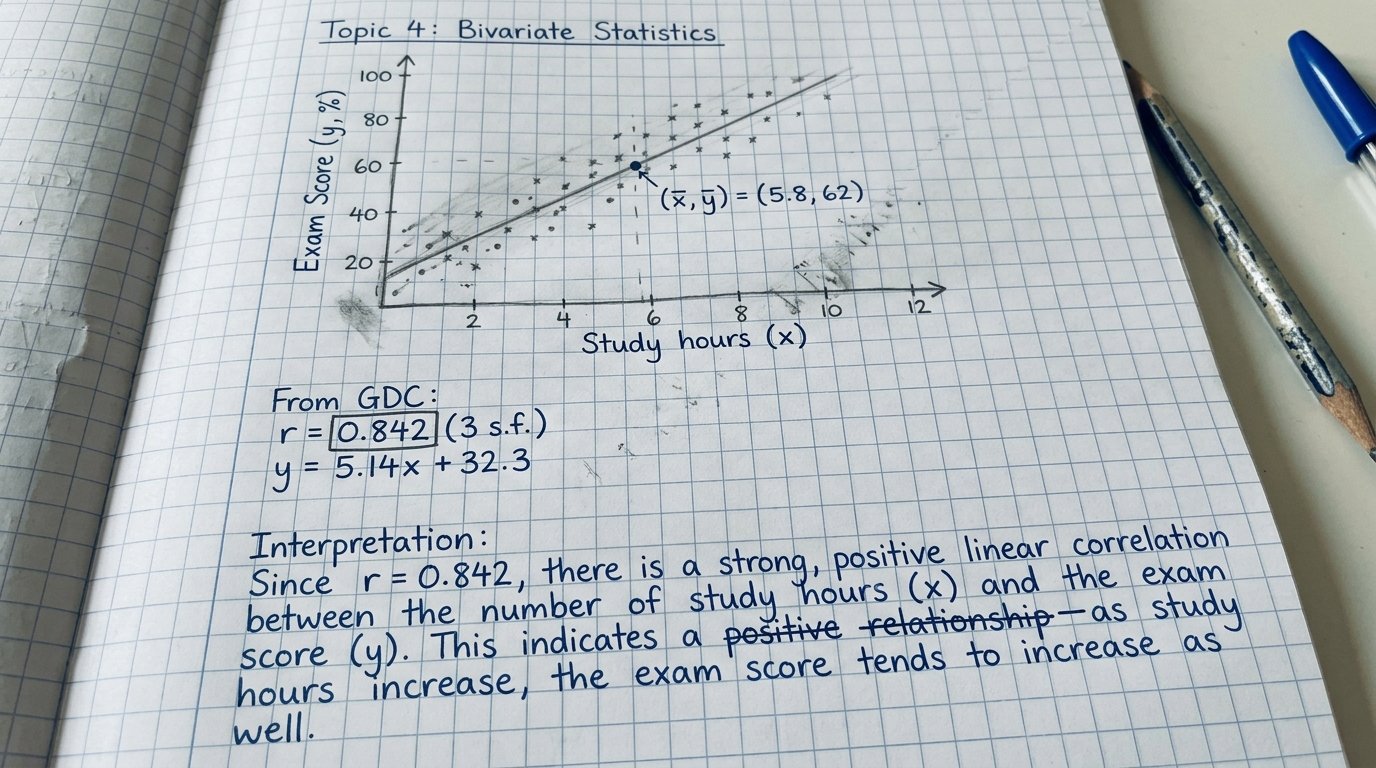
Another student might calculate a correct value but fail to state what that value means in the context of the question.
These aren’t necessarily failures of mathematical knowledge.
They are failures in application, accuracy, communication, or interpretation.
That distinction matters because the solution to each problem is different.
If you don’t know the quadratic formula, you need to review the formula and how it works.
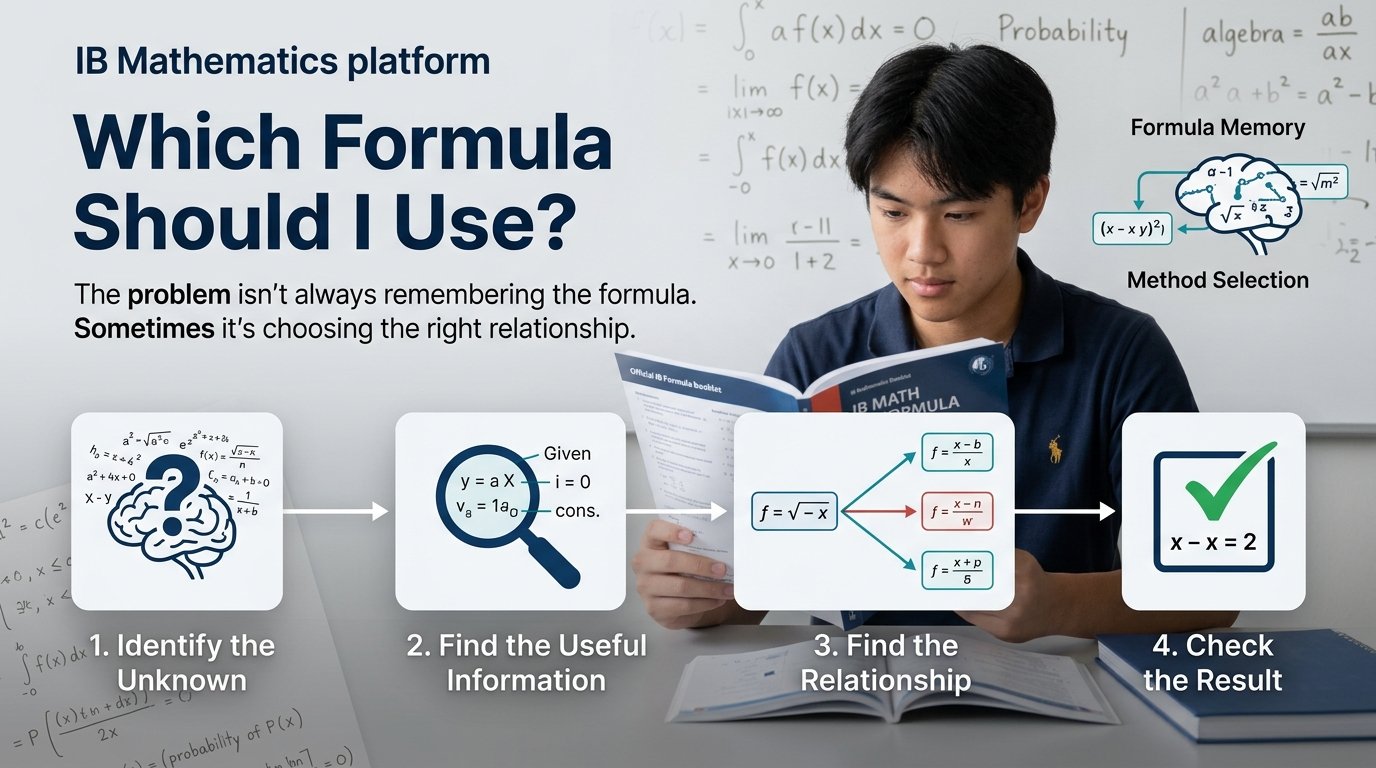
If you know the formula but choose it when the question requires a different approach, you need to practise method selection.
If your method is correct but your calculator entry is wrong, you need to improve accuracy and checking.
If your mathematics is correct but your conclusion is incomplete, you need to improve mathematical communication.
Good revision starts by identifying the actual problem.
Skipping Important Working
One of the most common problems is writing too little.
Students sometimes assume that if they can obtain the answer using their calculator, there is no reason to show the calculation.
For example, a student might write: x=4.73
without showing how they obtained the value.
In some questions, that may be enough for a particular answer mark. In others, it may not demonstrate the method required for the available marks.
The correct amount of working depends on the question.
The safest approach is to show the key mathematical steps that explain how you moved from the information given to your conclusion.
This doesn’t mean writing every tiny calculator operation.
It means making the mathematical method visible.
If you’re solving an equation, show the equation you’re solving.
If you’re differentiating, show the derivative.
If you’re applying a probability formula, show the relationship you’re using.
If you’re using a statistical calculation, make clear what quantities you’re calculating and why.
Your solution should allow someone reading it to follow your mathematical reasoning.
Relying Too Heavily on the Calculator
Technology is an important part of IB Mathematics, but there is a difference between using a calculator as a mathematical tool and using it as a replacement for mathematical communication.
Suppose you enter an expression into your calculator and obtain 0.3748291.
Writing only that number doesn’t necessarily communicate what you calculated.
A stronger solution might show the relevant expression first and then give the numerical result.
For example: P(X>12)=1−P(X≤12)
followed by the calculator result.
Now the mathematical method is visible.
This is especially useful in statistics and probability questions where several calculator functions might produce a numerical answer, but the examiner still needs to see how that result relates to the mathematical problem.
Notation That Is Too Vague
Mathematical notation is a form of communication.
When your notation is unclear, the examiner may have difficulty determining what you mean.
This doesn’t mean your handwriting needs to look like a textbook.
It means mathematical symbols should be used consistently and appropriately.
For example, distinguish between an equation and an expression. Make clear which variable you’re solving for. Use brackets where necessary. Label coordinates and variables clearly when a question involves multiple quantities.
A small notation problem can become much more serious when a solution contains several variables or several stages of reasoning.
Clear notation makes your mathematical thinking easier to follow.
Rounding Too Early
Early rounding is another common source of lost marks.
Suppose a calculator gives x=3.847261…
You decide to use x=3.85.
for the next calculation.
That might seem harmless.
But if the next calculation uses the rounded value, and the result is then rounded again, the final answer can move further away from the expected value.
This is particularly important in multi-step calculations.
Unless the question specifically requires an intermediate rounded value, it’s generally better to keep sufficient calculator precision throughout the calculation and round the final answer appropriately.
The exact rounding instruction in the question should always take priority.
Forgetting Units
A numerical answer without units can be incomplete when the quantity being calculated has a physical or contextual unit.
If you’re calculating a distance, the answer may need a unit of length.
If you’re calculating time, the answer may need a unit of time.
If you’re calculating area, the unit should reflect square units.
If you’re calculating volume, the unit should reflect cubic units.
The mathematical calculation might be correct, but the final response should still answer the question as it was asked.
Units also provide a useful self-check.
If a question asks for an area and your final answer has units of metres rather than square metres, that should immediately make you pause.
Giving a Number Without Interpreting It
Some IB Math questions don’t simply ask: x=…
They ask you to interpret a result in a particular situation.
This is common in statistics, probability, modelling, and applied problems.
Suppose a calculation gives: P(X>20)=0.073
If the question asks you to interpret this probability in context, writing only 0.073 may not fully answer the question.
A contextual conclusion might explain that there is approximately a 7.3% probability of the relevant event occurring, depending on the exact wording and assumptions of the problem.
The calculation and the interpretation are different parts of the mathematical response.
Don’t stop when the calculator gives you a number.
Ask:
What does this number mean?
Weak Justification
Sometimes students reach the right answer but don’t explain why it is valid.
This often happens with calculus questions involving maximum and minimum values.
Finding a stationary point using f′(x)=0
doesn’t automatically tell you whether the point is a maximum or minimum.
The question may require additional reasoning.
Similarly, in geometry, probability, statistics, and functions, you may need to justify why a particular result follows from the mathematics.
A short explanation can sometimes be enough.
The goal isn’t to write an essay.
The goal is to provide the mathematical reasoning that supports your conclusion.
Incomplete Conclusions
Students sometimes do all the difficult mathematics correctly and then finish with a vague or incomplete statement.
Imagine the question asks for the number of people expected to meet a certain condition.
You calculate: 37.4
and stop.
But people aren’t normally counted as 37.4 individuals.
The appropriate interpretation might require rounding or explaining what the expected value represents, depending on the question.
This is why the final line deserves attention.
Before moving to the next question, read the original question again.
Ask:
Have I actually answered what it asked?
Not just:
Did I calculate something?
Using the Correct Method for the Wrong Question
This is one of the more subtle causes of lost marks.
You may recognize a topic and immediately use a familiar formula.
But the question might be testing whether you can choose the appropriate method rather than simply recall a procedure.
For example, seeing a probability question doesn’t mean you should immediately use a particular probability formula.
First understand what the question is describing.
What information is given?
What relationship is being asked for?
Are events independent?
Is the probability conditional?
Does the question involve a binomial model?
Does it require a normal approximation?
The same topic can contain very different mathematical tasks.
Taking a few seconds to identify the problem before calculating can prevent a lot of unnecessary work.
Misreading the Question
Sometimes the mathematics you’ve written is perfectly correct.
It’s just answering the wrong question.
A question might ask for the value of x, but you calculate y.
It might ask for a percentage increase, but you calculate the final value.
It might ask for the probability of at least five events, but you calculate exactly five.
It might ask for a value to three significant figures, but you give two decimal places.
These are not necessarily mathematical knowledge problems.
They’re reading problems.
A useful exam habit is to underline or mentally identify the key instruction in the question before starting the calculation.
Words such as exactly, at least, at most, approximately, hence, show that, and interpret can change what the question requires.
Ignoring the Given Information
IB Math questions often provide information for a reason.
Students sometimes start calculating before considering what has already been given.
For example, a question may give a value of f(2), a gradient, a probability, a point on a graph, or a parameter.
That information may be essential for the next step.
If you ignore it, you can end up doing unnecessary calculations or choosing an inefficient method.
Before starting, read the entire question.
Identify what you know.
Then identify what you need.
Then choose the mathematical connection between the two.
This simple habit can make unfamiliar questions much easier to approach.
When Your Final Answer Is Wrong but Your Method Is Right
This is where showing working becomes particularly valuable.
Suppose you correctly set up a mathematical model but make an arithmetic error in the final calculation.
Your final answer may be wrong.
But your working can demonstrate that the underlying method was appropriate.
This is one reason students shouldn’t erase all their working when they realise the final result is wrong.
Leave your mathematical process visible.
If you identify an error, correct it clearly rather than destroying the evidence of the original approach.
Your working can help both you and the examiner understand what happened.
How to Protect Your Method Marks
The best way to protect method marks isn’t to write more for the sake of writing more.
It’s to make the important mathematics visible.
Show the equation you’re using.
Show the important substitution.
Show key transformations.
Use clear notation.
Keep sufficient precision during calculations.
Include units when required.
Justify important conclusions.
Interpret numerical answers in context.
And read the question again before moving on.
These habits make your solution easier to follow without turning every question into a long written explanation.
A Better Way to Review Lost Marks
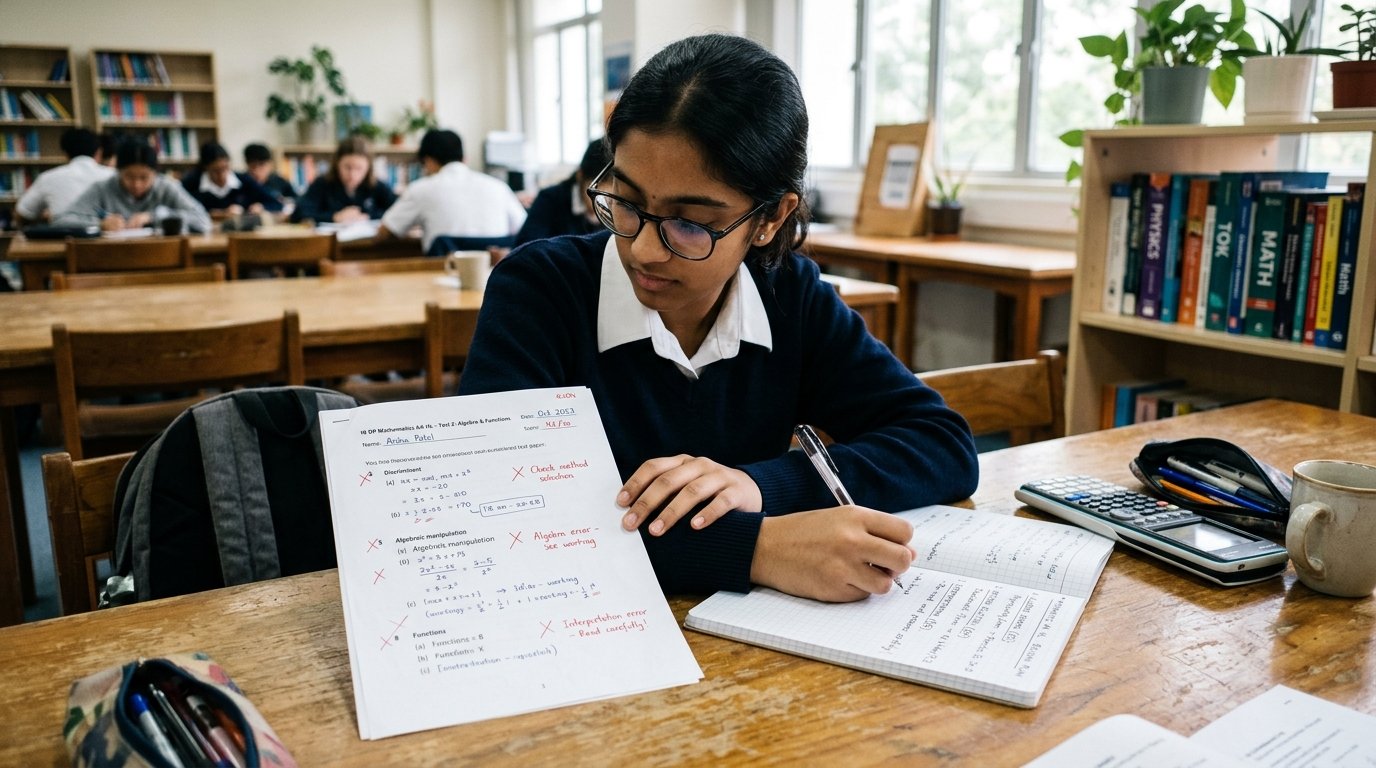
After a practice paper, don’t simply calculate your percentage and close the mark scheme.
Look at every question where you lost marks.
Then identify what actually caused the loss.
Was it a knowledge gap?
A method selection problem?
An algebra error?
A calculator error?
A notation problem?
A missing explanation?
A missing unit?
An incomplete conclusion?
An interpretation problem?
This creates a much more useful picture of your performance.
For example, if you lost eight marks across a paper but six came from incomplete explanations, your next revision session shouldn’t necessarily involve learning six new mathematical topics.
You may need to practise communicating the mathematics you already understand.
Turn Lost Marks Into a Personal Revision Plan
This is where exam feedback becomes more powerful than a score.
Suppose your last three practice papers reveal that you repeatedly lose marks through early rounding and incomplete conclusions.
That’s a pattern.
Your revision plan can now include specific actions.
You can practise keeping full calculator precision, check rounding instructions carefully, and spend more time reviewing the final line of applied questions.
If another student repeatedly loses marks because they don’t recognise which method to use, their plan should look different.
This is why revision should be based on evidence from your own working rather than simply following a generic list of topics.
How Mathzem Can Help You Review Your Working
This is also where Mathzem’s practice workflow can be useful.
With Mathzem IB Practice, students can choose an IB Math question, complete their solution, upload their working, and receive examiner style feedback focused on the mathematical response.
Instead of treating practice as simply getting a final answer, the workflow helps students examine marks, mistakes, weak areas, and possible next steps.
That can be particularly useful when you know the topic but aren’t sure why your exam performance isn’t improving.
The Math Skill Scanner can also help students identify areas where their mathematical skills need more attention.
The purpose isn’t to replace learning or teacher guidance. It’s to make practice more informative so that students can make better decisions about what to practise next.
How to Build Better Exam Habits Before the Real Paper
Method marks aren’t something you should start thinking about on exam day.
They should become part of your normal practice routine.
When solving practice questions, write the kind of working you would be comfortable submitting in an exam.
Don’t practise with a calculator and then assume you’ll remember how to communicate the method later.
Don’t skip steps because you’re working at home.
Don’t ignore units because it’s only practice.
Don’t round early because you’re not sitting the real exam yet.
Your practice habits become your exam habits.
If your normal practice solutions are incomplete, you may find yourself producing incomplete solutions under time pressure.
If your practice solutions consistently show clear mathematical reasoning, that behaviour becomes much more natural during the exam.
Final Checklist Before Moving to the Next Question
Before you leave a completed question, take a few seconds to look at the solution as a whole.
Have you shown the important mathematical method?
Have you used clear notation?
Have you avoided unnecessary early rounding?
Have you included units where appropriate?
Have you justified any conclusion that needs justification?
Have you interpreted your result if the question requires interpretation?
Most importantly, have you actually answered the question that was asked?
These checks don’t take long, but they can prevent avoidable mark losses.
FAQs About IB Math Method Marks
What are method marks in IB Math?
Method marks are marks associated with demonstrating an appropriate mathematical method or process. The precise marking depends on the individual question and its official mark scheme.
How can I get more method marks in IB Math?
Show the important mathematical steps behind your answer. Make your method visible, use appropriate notation, explain relevant reasoning, and avoid relying solely on unexplained calculator outputs.
Can I lose marks for not showing working?
You can lose marks when insufficient working means the required mathematical method or reasoning isn’t demonstrated. The exact impact depends on the question and its mark scheme.
Should I show every calculator step?
No. You don’t need to document every button press. Instead, show the mathematical expression, method, or reasoning that makes your calculation understandable.
Does rounding cause lost marks in IB Math?
It can. Early rounding may affect subsequent calculations. Unless an intermediate rounding instruction is given, maintaining sufficient precision and rounding the final result appropriately is generally safer.
Why do I lose marks even when my answer is correct?
A correct final answer doesn’t necessarily mean the complete solution meets every requirement of the question. Depending on the question, marks can also relate to method, reasoning, communication, or interpretation.
Conclusion
Losing IB Math marks isn’t always a sign that you don’t understand the topic.
Sometimes the mathematics is there, but your solution doesn’t communicate it clearly enough.
You may skip the method, rely on an unexplained calculator result, round too early, use unclear notation, forget units, provide weak justification, or stop before interpreting the answer.
These are small habits, but they can have a meaningful effect on exam performance.
The solution isn’t to write enormous amounts of working.
It’s to make the important mathematics visible.
Show the method. Keep your notation clear. Protect your numerical accuracy. Justify important conclusions. Interpret answers when necessary. And always check that your final response actually answers the question.
Most importantly, use your lost marks as information.
If the same mistake keeps appearing, it isn’t just a mark you’ve lost. It’s a signal about what you should practise next.
Your goal isn’t simply to make fewer mistakes. Your goal is to understand exactly why you’re losing marks and change your practice accordingly.
Quick Takeaway
IB Math method marks are often lost not because students know nothing, but because their working doesn’t clearly demonstrate what they know.
Make your mathematical thinking visible, review your lost marks carefully, and turn repeated mistakes into targeted revision.