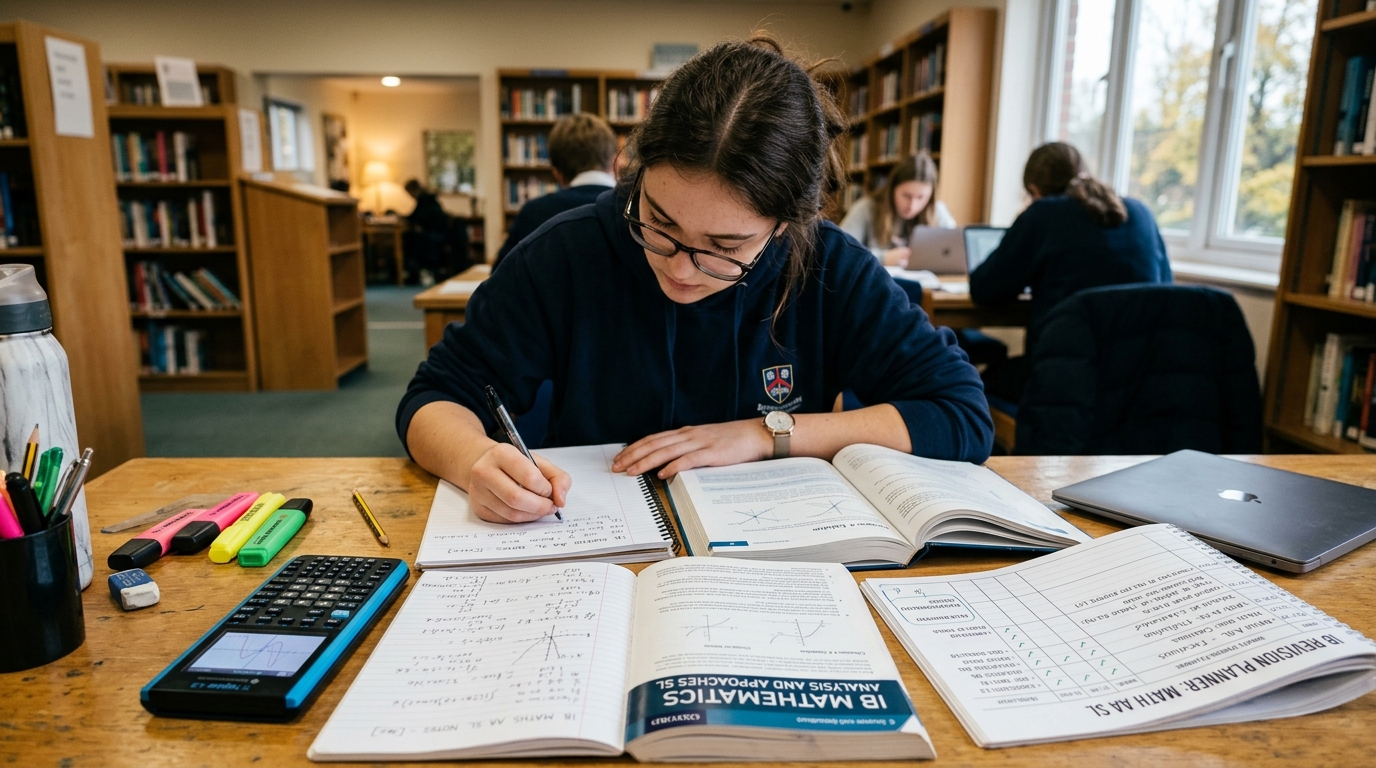
Understanding the IB Maths AA SL syllabus is the first step towards effective revision. Many students begin preparing for exams without knowing exactly which topics they need to master or how those topics connect.
Instead of studying randomly, a clear understanding of the syllabus allows you to create a revision plan, identify weak areas, and monitor your progress throughout the course.
In this guide, we’ll explain every major topic in the IB Maths AA SL syllabus and share practical tips for studying each one.
Table of Contents
What Is IB Maths AA SL?
IB Mathematics: Analysis and Approaches Standard Level (AA SL) is designed for students who enjoy analytical thinking, algebra, and mathematical reasoning.
The course focuses on developing strong mathematical foundations through logical problem-solving rather than mathematical modelling.
Students are expected to explain their reasoning clearly, solve unfamiliar problems, and communicate mathematics using correct notation.
IB Maths AA SL Syllabus Overview
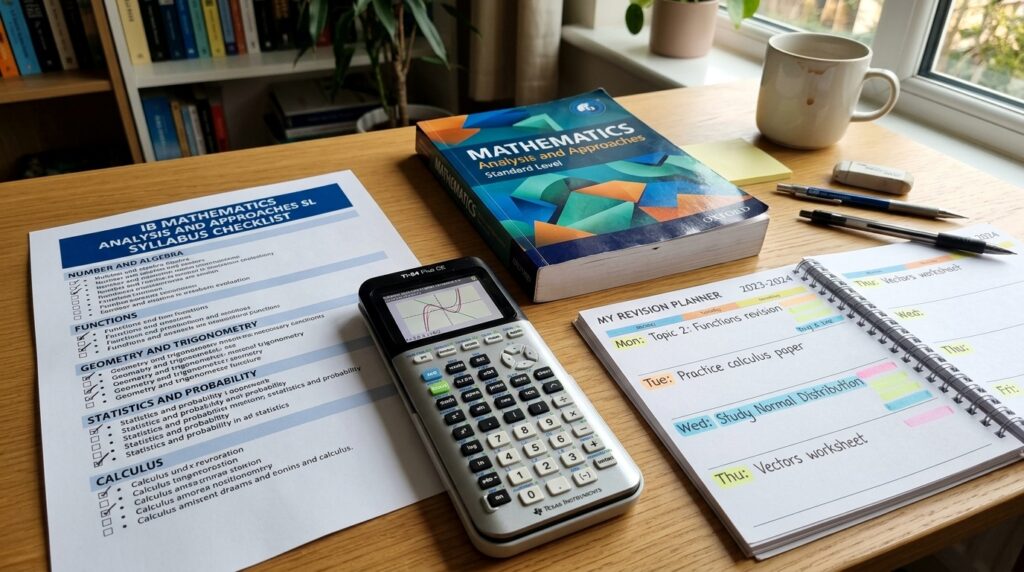
The syllabus is organised into five main content areas.
- Number and Algebra
- Functions
- Geometry and Trigonometry
- Statistics and Probability
- Calculus
Each topic builds on previous knowledge, making consistent study important throughout the course.
1. Number and Algebra
This topic develops the algebraic skills used across the entire syllabus.
You’ll study:
- Laws of indices
- Logarithms
- Sequences and series
- Financial mathematics
- Algebraic manipulation
These skills are used repeatedly in functions, calculus, and probability.
Revision Tips
- Practise algebra every week.
- Simplify expressions without using a calculator.
- Review common algebra mistakes regularly.
2. Functions
Functions form one of the most important sections of the course.
You’ll learn:
- Linear functions
- Quadratic functions
- Polynomial functions
- Rational functions
- Exponential functions
- Logarithmic functions
- Composite functions
- Inverse functions
- Graph transformations
Strong function skills also make calculus much easier.
Revision Tips
- Sketch graphs by hand.
- Understand how equations affect graph shapes.
- Practise composite and inverse functions frequently.
3. Geometry and Trigonometry
This topic combines graphical understanding with algebraic reasoning.
Students study:
- Angles in radians
- Trigonometric functions
- Trigonometric identities
- Trigonometric equations
- Coordinate geometry
Many examination questions require both diagrams and calculations.
Revision Tips
- Learn the unit circle thoroughly.
- Draw diagrams before solving problems.
- Check calculator settings carefully when working with angles.
4. Statistics and Probability
Statistics helps students interpret and analyse data.
Topics include:
- Data collection
- Measures of central tendency
- Dispersion
- Probability
- Probability distributions
- Correlation
Many questions require correct use of the graphing calculator.
Revision Tips
- Understand probability notation.
- Practise calculator functions regularly.
- Interpret results instead of relying only on calculations.
5. Calculus
Calculus introduces students to mathematical change.
Key topics include:
- Limits
- Differentiation
- Applications of derivatives
- Integration
- Area under curves
Calculus questions often combine algebra, functions, and graph interpretation.
Revision Tips
- Strengthen algebra first.
- Show every important step.
- Practise application questions as well as routine calculations.
Assessment Structure
IB Maths AA SL includes two written examination papers and one internal assessment.
| Assessment | Weight | Description |
|---|---|---|
| Paper 1 | 40% | Non calculator examination |
| Paper 2 | 40% | Calculator examination |
| Internal Assessment | 20% | Individual mathematical exploration |
Each assessment measures mathematical understanding, reasoning, and communication.
Skills You’ll Develop
Throughout the course, you’ll learn how to:
- Solve unfamiliar mathematical problems.
- Communicate mathematical reasoning clearly.
- Apply mathematics in different contexts.
- Interpret graphs and data.
- Choose appropriate solution methods.
These skills are valuable beyond the IB Diploma Programme and prepare students for many university courses.
Common Challenges
Students often struggle with:
- Algebra errors
- Function notation
- Calculus applications
- Probability wording
- Time management
Most of these challenges improve through regular practice and careful review of mistakes.
How to Revise the AA SL Syllabus
Instead of revising topics randomly, organise your study into manageable sections.
A simple approach is
Step 1
Review one syllabus topic.
Step 2
Complete several IB style questions.
Step 3
Mark your answers carefully.
Step 4
Record every mistake.
Step 5
Return to difficult topics the following week.
Repeating this cycle builds long term understanding.
Weekly Revision Plan
Here’s an example of a balanced revision schedule.
| Day | Focus |
| Monday | Number and Algebra |
| Tuesday | Functions |
| Wednesday | Geometry and Trigonometry |
| Thursday | Statistics and Probability |
| Friday | Calculus |
| Saturday | Mixed IB questions |
| Sunday | Review mistakes and weak topics. |
A structured routine helps ensure every topic receives regular attention.
How Mathzem Supports Every AA SL Topic
Knowing the syllabus is important, but understanding your own strengths and weaknesses is even more valuable.
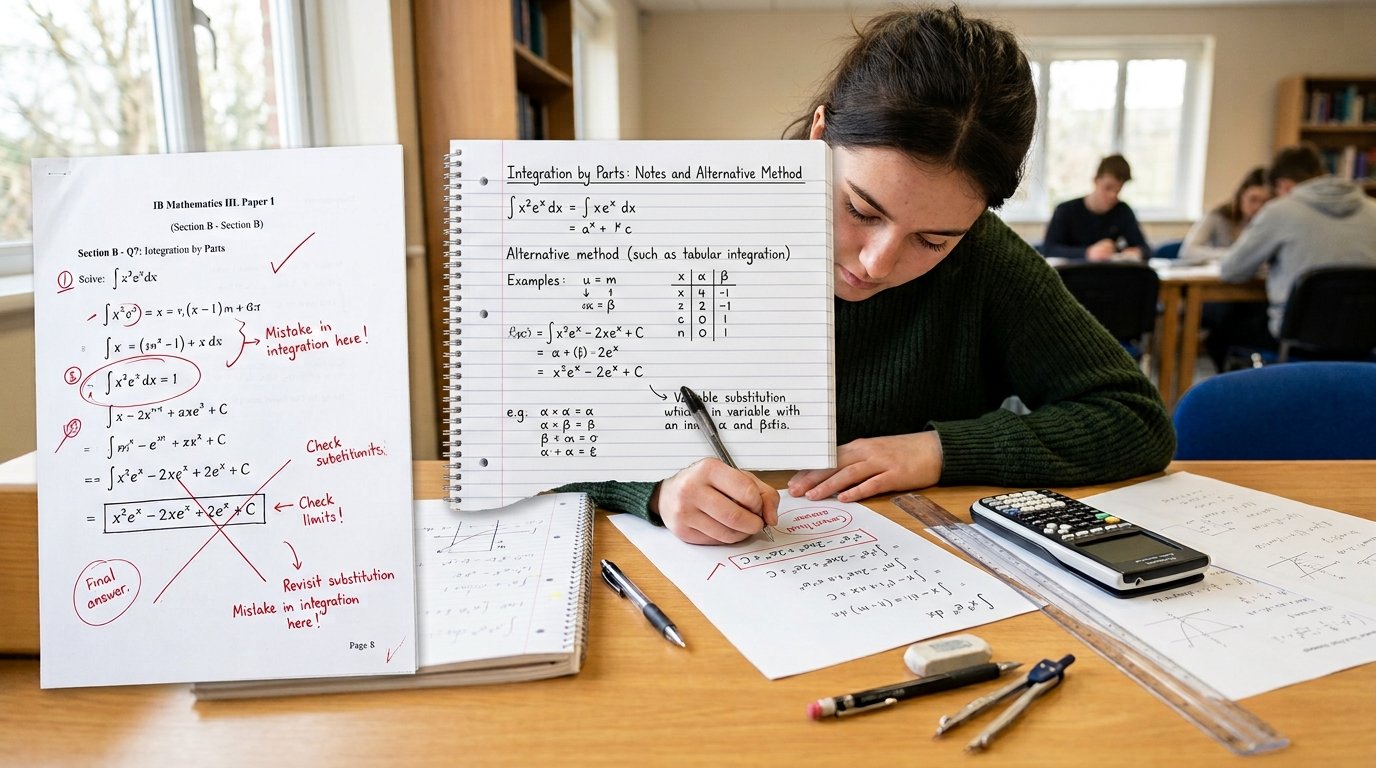
Mathzem helps you revise more effectively by analysing your complete mathematical working after every practice question.
Upload your solutions and receive AI examiner style feedback showing:
- Marks awarded
- Missing method marks
- Mathematical errors
- Topic specific weaknesses
- Suggested next steps
Your personalised student dashboard also includes:
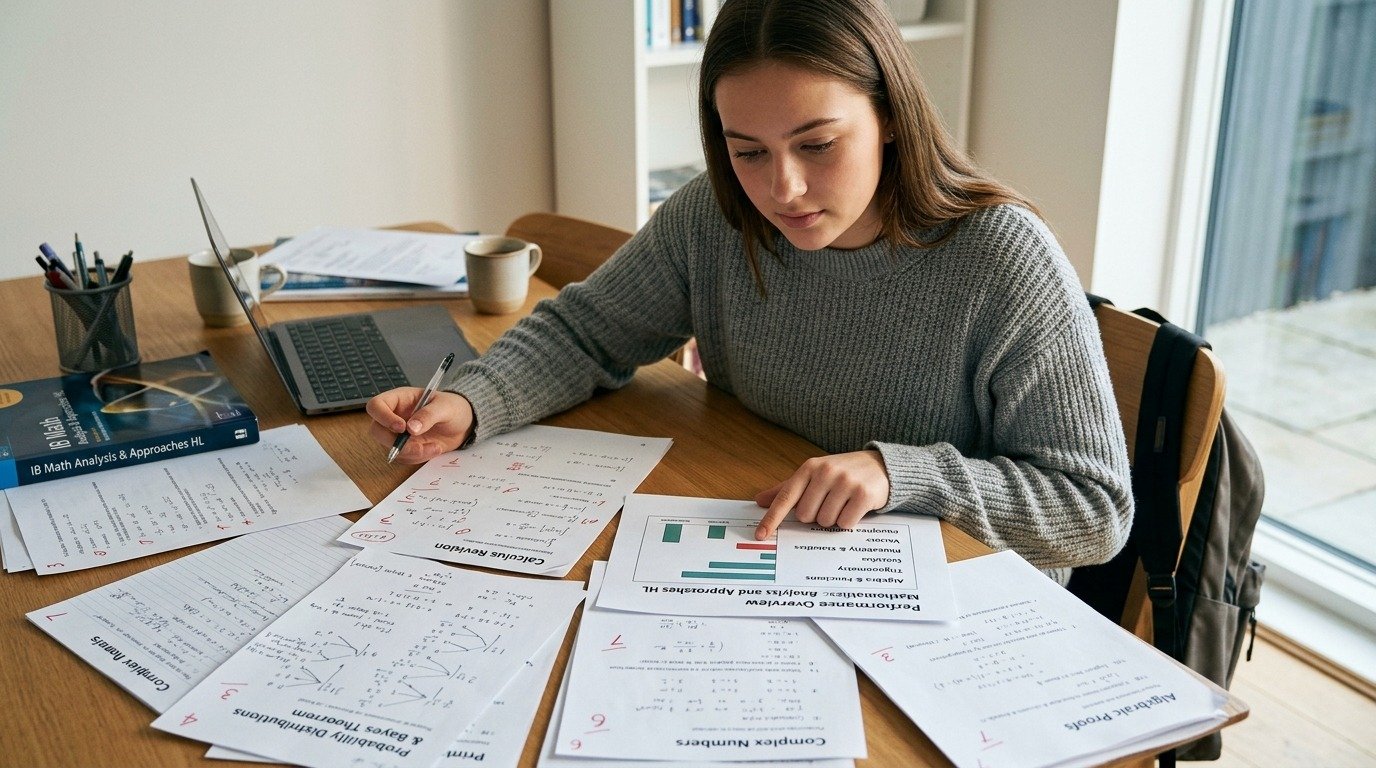
- A weakness map across the AA SL syllabus
- A personalised revision plan
- A mistake journal
- Progress tracking
- Topic performance analysis
Instead of guessing what to revise next, you’ll know exactly where to focus your time.
Frequently Asked Questions About IB Maths AA SL Sylabus
How many topics are in the IB Maths AA SL syllabus?
The course contains five major content areas: Number and Algebra, Functions, Geometry and Trigonometry, Statistics and Probability, and Calculus.
Does AA SL include calculus?
Yes. Calculus is an important part of the course, although it is less extensive than the Higher Level syllabus.
Is the syllabus the same every year?
The IB may occasionally update course content and assessment details. Always use the syllabus provided by your school and the latest official IB guidance.
What is the best way to revise the syllabus?
Study one topic at a time, complete Ib style questions, review your mistakes carefully, and regularly revisit weaker areas.
Conclusion
The IB Maths AA SL syllabus provides a strong foundation in algebra, functions, calculus, probability, and mathematical reasoning.
By understanding each topic, following a structured revision plan, and reviewing mistakes consistently, you’ll be better prepared for both classroom assessments and final IB examinations.
If you’re unsure which syllabus topics need the most attention, start with the Math Skill Scanner:
Then upload your solutions to Mathzem IB Practice to receive AI examiner style feedback, identify weak topics, and build a personalised revision plan that helps you improve throughout your IB Maths AA SL journey.