If you are studying IB Math AA paper 1 vs paper 2, you already know that paper 1 and paper 2 test your mathematical knowledge.
But preparing for both papers in exactly the same way is not the best approach.
The main difference is calculator use.
Table of Contents
Paper 1 is a non calculator examination. Paper 2 requires access to a graphic display calculator (GDC).
That difference changes how you should approach calculations, choose methods, check answers, and practise questions.
A student who relies heavily on calculator functions during revision may struggle when those functions are unavailable in Paper 1.
Likewise, a student who only practises manual calculations may not make effective use of technology in Paper 2.
In this guide, we will look at the differences between the two papers and how you can prepare for each one.
1. What is the difference between Paper 1 and Paper 2?
Both papers assess your understanding of the IB Mathematics AA syllabus. However, they create different conditions for demonstrating that understanding.
| Feature | Paper 1 | Paper 2 |
|---|---|---|
| Calculator | Not permitted | Graphic display calculator required |
| Main focus | Analytical mathematical work | Mathematical work with access to technology |
| Calculations | Completed without a calculator | Calculator may support calculations |
| Working | Important throughout | Important throughout |
| Technology | No calculator assistance | Appropriate calculator use |
The IB expects students to demonstrate mathematical understanding, reasoning, and communication in both papers.
Having a calculator available does not mean you can skip your working. A correct answer without sufficient mathematical evidence may not receive full marks.
Similarly, Paper 1 is not simply a test of mental arithmetic. It assesses whether you can select and apply mathematical methods without relying on a calculator.
2. How to prepare for Paper 1
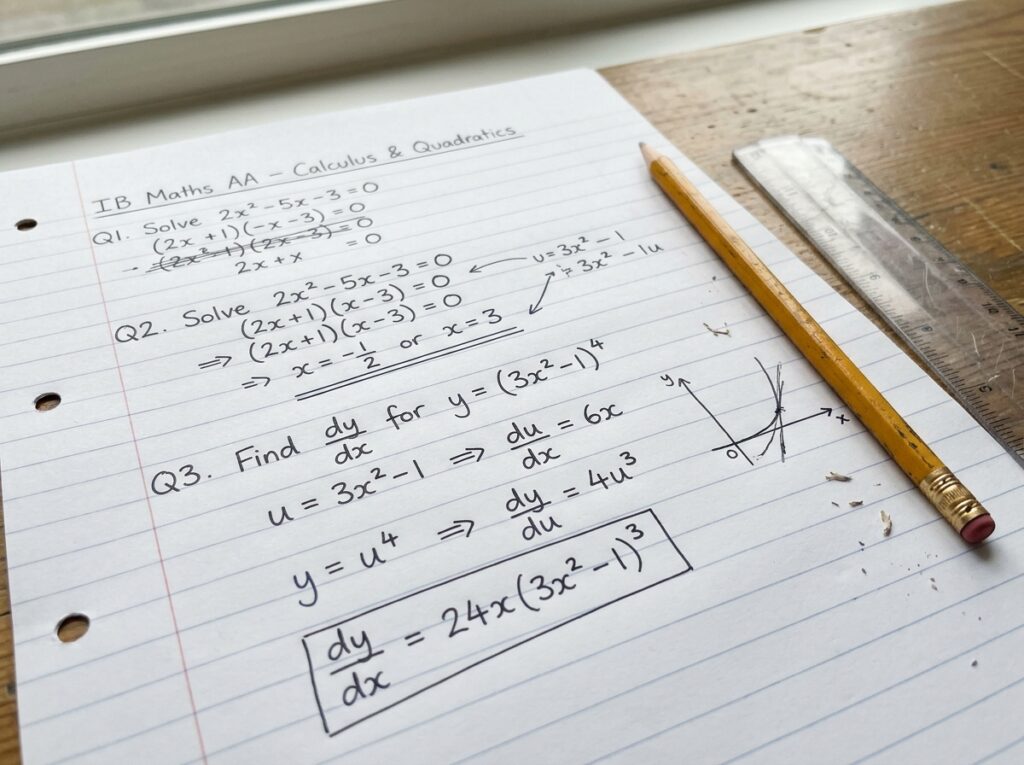
Paper 1 requires you to work without a calculator.
This means you need to become comfortable with the mathematical processes behind your calculations.
You should be able to manipulate expressions, recognise useful identities, solve equations, and carry out calculations accurately.
Here are four areas to focus on.
A. Improve algebraic accuracy
Algebra appears throughout IB Mathematics AA.
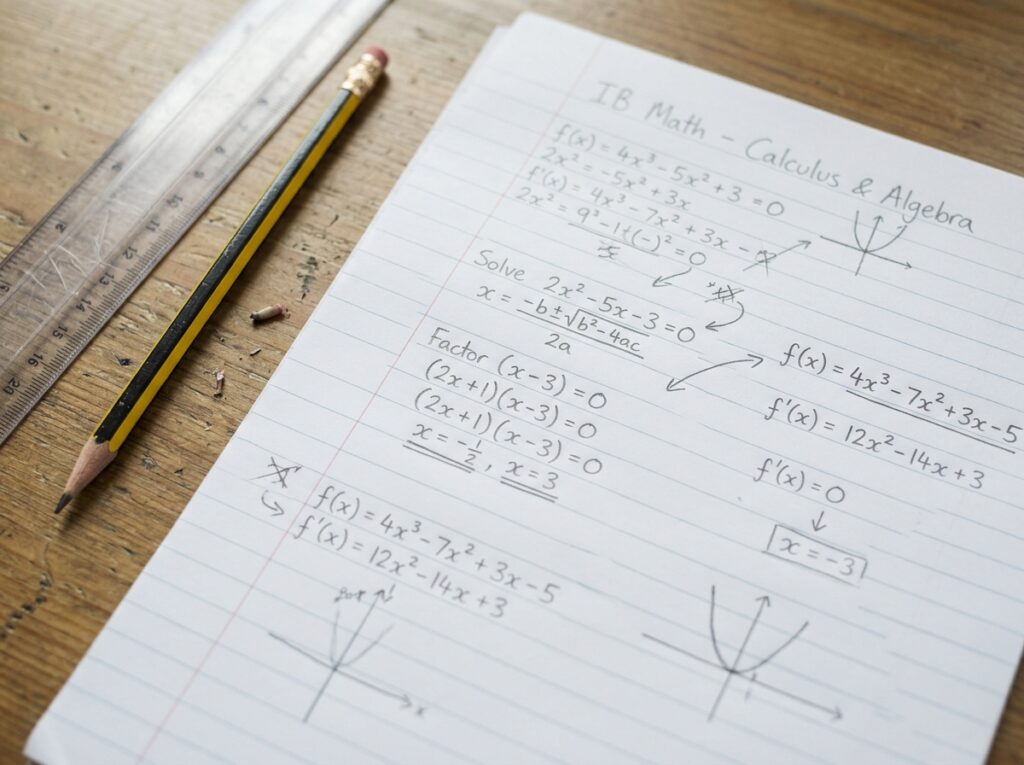
You may need to rearrange equations, factorise expressions, simplify fractions, solve equations, or manipulate functions.
For example, consider:
[
2x^2-7x+3=0
]
You should be able to factorise the expression:
[
(2x-1)(x-3)=0
]
Therefore:
[
x=\frac{1}{2}\quad \text{or}\quad x=3
]
You should understand why the factorisation works rather than depend on a calculator to find the roots.
Practise algebraic manipulation until you can complete common operations confidently.
B. Learn to recognise mathematical relationships
Without a calculator, recognising the right mathematical relationship can save time.
For example, if a question involves a quadratic function, ask yourself:
- Can I factorise the expression?
- Is completing the square more useful?
- Can I use the discriminant?
- Is the question asking for roots, a vertex, or an intersection?
The important skill is choosing an appropriate method before starting lengthy calculations.
C. Show your working clearly
Paper 1 is not just about reaching the correct answer.
Your working demonstrates how you reached it.
For example, when solving an equation, show the important algebraic steps instead of jumping directly to the result.
This makes your reasoning easier to follow and gives the examiner evidence of your mathematical method.
D. Practise calculations without technology
Do not use your calculator while practising questions intended to develop your Paper 1 skills.
Work through the calculations yourself.
When you make an error, identify whether it came from algebra, arithmetic, an incorrect formula, or a misunderstanding of the question.
This will help you develop accuracy without calculator support.
3. How to prepare for Paper 2
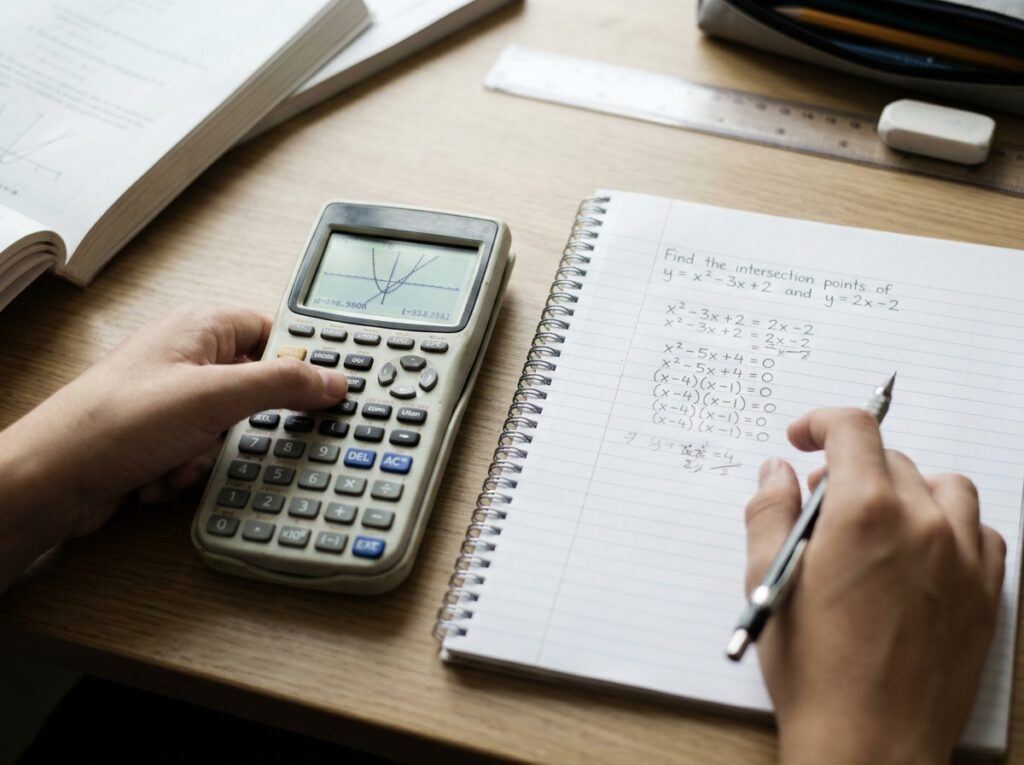
Paper 2 requires access to a graphic display calculator.
However, having a calculator available does not mean every question requires one.
You need to know when technology is useful and when a mathematical method is more appropriate.
Focus on these four areas.
A. Learn your calculator functions
You should know how to use the functions relevant to your course and calculator model.
Depending on the question, these may include:
- Graphing functions
- Finding intersections
- Solving equations numerically
- Evaluating numerical expressions
- Using statistical functions
- Working with probability distributions
Do not wait until exam week to learn these functions.
Practise them regularly so that using your calculator becomes familiar.
B. Know when to use technology
A calculator can help you check a result, explore a graph, or perform a numerical calculation.
But using it for every step can waste time.
Consider a question involving the intersection of two functions.
You may be able to find the intersection algebraically, or use your calculator to locate it numerically.
Your choice should depend on the question and the mathematical method required.
Ask yourself:
- Does the question require an exact answer?
- Is a numerical approximation acceptable?
- Can the calculator help me check my result?
- Do I need to explain the mathematical reasoning?
A calculator should support your solution, not replace your understanding.
C. Understand what the calculator output means
Getting a number from your calculator is not the same as understanding the answer.
Suppose a calculator gives you a solution of:
[
x=2.347
]
You still need to understand what that value represents.
Is it a root? An intersection? A maximum? A probability? A parameter?
You must connect the numerical result to the question.
If the question asks you to interpret a result in context, make sure your final statement answers that question.
D. Practise showing the method alongside calculator use
Even when you use technology, show the important mathematical steps.
For example, if you use a calculator to find a solution to an equation, identify the equation you entered and explain what the resulting value represents.
Do not assume that the calculator display provides all the evidence needed for your answer.
4. Common mistakes students make in Paper 1
Some students perform well in calculator based practice but struggle when they cannot use technology.
Watch out for these mistakes.
Depending on the calculator for basic algebra
If you use technology to solve every equation, you may become less confident with algebraic manipulation.
Skipping important steps
Jumping from the question to the final answer makes it harder to demonstrate your reasoning.
Making avoidable arithmetic errors
Small errors can affect later steps. Practise checking your calculations as you work.
Choosing an unnecessarily complicated method
A long calculation is not always the best solution. Look for a simpler mathematical relationship where appropriate.
5. Common mistakes students make in Paper 2
Paper 2 creates a different set of challenges.
Using the calculator without understanding the question
Entering numbers before identifying what you need can lead to irrelevant results.
Trusting every calculator output
A calculator can give you a numerical result, but you must still check whether it answers the question.
Rounding too early
Rounding intermediate values can affect later calculations. Keep suitable precision during your working and round the final answer as instructed.
Ignoring mathematical reasoning
A calculator result does not automatically explain why a method works.
Show the important reasoning and interpret the result clearly.
Using unfamiliar calculator functions during the exam
If you have not practised a function before, an exam is not the right time to learn it.
6. How to practise both papers during the week
You should not prepare for Paper 1 and Paper 2 as completely separate subjects.
They test the same course, so your revision should connect the mathematical concepts with both methods of working.
Here is a practical weekly structure.
| Day | Practice focus | Suggested activity |
|---|---|---|
| Monday | Paper 1 skills | Algebra and functions without a calculator |
| Tuesday | Paper 2 skills | Graphs and numerical solutions using your GDC |
| Wednesday | Paper 1 skills | Calculus and equation manipulation |
| Thursday | Paper 2 skills | Statistics, probability, and calculator practice |
| Friday | Mixed practice | Questions from different topics |
| Saturday | Timed practice | Complete a section under exam conditions |
| Sunday | Review | Analyse mistakes and practise weak areas |
You can adjust this structure according to your course level, upcoming assessments, and current weaknesses.
The important thing is to practise both conditions regularly.
7. Try the same mathematical topic in both papers
One useful way to prepare is to study a topic through both calculator and non calculator questions.
Consider differentiation.
For Paper 1, you might be asked to differentiate a function algebraically and use the derivative to find a stationary point.
For Paper 2, you might encounter a question where graphing technology helps you explore a function or check a numerical result.
The underlying mathematical topic is related, but the way you approach the question can differ.
Try this method:
- Choose one topic, such as functions, calculus, or trigonometry.
- Complete a question without a calculator.
- Review your algebra and mathematical reasoning.
- Complete a related question where calculator use is permitted.
- Compare the methods and results.
- Identify which skills need more practice.
This helps you develop flexibility instead of memorising one approach to a question.
8. How Mathzem can help you practise
Mathzem supports IB Math practice across AA HL, AA SL, AI HL, and AI SL.
You can choose your course and topic, attempt an exam style question, and upload a picture of your handwritten working.
The AI Examiner reviews your submitted work and provides feedback on your method, marks, mistakes, and areas that need attention.
This can be useful when preparing for both Paper 1 and Paper 2.
For example:
When practising Paper 1:
Work through the question without a calculator. Upload your handwritten solution and review the feedback on your algebra, method, and reasoning.
When practising Paper 2:
Use your calculator where appropriate. Show your working and include the important mathematical steps behind your numerical results.
After each attempt, review the feedback and decide what to practise next.
You can also use your Student Dashboard to review your topic performance and repeated mistakes.
Remember that Mathzem provides AI generated learning feedback and estimated marks. It is not official IB marking.
9. A checklist before your next exam
Use this checklist to assess your preparation.
Paper 1
- I can manipulate algebraic expressions confidently.
- I can solve relevant equations without a calculator.
- I understand the mathematical methods I use.
- I show enough working to explain my reasoning.
- I can check my calculations independently.
Paper 2
- I know how to use the relevant calculator functions.
- I can decide when calculator use is appropriate.
- I understand the numerical results I obtain.
- I avoid rounding too early.
- I show the mathematical reasoning behind my answers.
Both papers
- I practise questions from across the syllabus.
- I can apply methods to unfamiliar questions.
- I review mistakes rather than only checking final answers.
- I complete timed practice.
- I know which topics need more attention.
Frequently Asked Questions About IB Math AA Paper 1 vs Paper 2
Is a calculator allowed in IB Math AA Paper 1?
No. IB Mathematics AA Paper 1 is a non calculator examination.
Can I use a calculator in IB Math AA Paper 2?
Yes. Students must have access to a graphic display calculator during Paper 2. However, not every question requires calculator use.
Is Paper 1 harder than Paper 2?
Not necessarily. They test mathematical skills under different conditions. Your experience will depend on your strengths, preparation, and confidence with the question types.
Should I practice Paper 1 and Paper 2 separately?
You should practise both conditions, but do not study them as unrelated subjects. The mathematical concepts overlap, so practise applying the same knowledge with and without calculator support.
Does Paper 2 mean I do not need to show working?
No. You should still show the important mathematical steps and explain your reasoning. Calculator access does not remove the need to demonstrate mathematical understanding.
Does this difference apply to AA HL and AA SL?
Yes. Both AA levels have a non calculator Paper 1 and a calculator Paper 2. AA HL also has an additional Paper 3, so HL students should include that paper in their wider preparation.
Prepare for both papers with confidence
The best way to prepare for IB Math AA is to become comfortable solving questions with and without calculator support.
Do not let your calculator become a substitute for mathematical understanding. Equally, do not ignore the technology skills you need for Paper 2.
Practise both conditions, review your working, and pay attention to the mistakes you make.
If you want to make your practice more useful, try Mathzem. Choose your IB Mathematics course, attempt a question, upload your handwritten solution, and use the AI Examiner feedback to decide what to improve next.