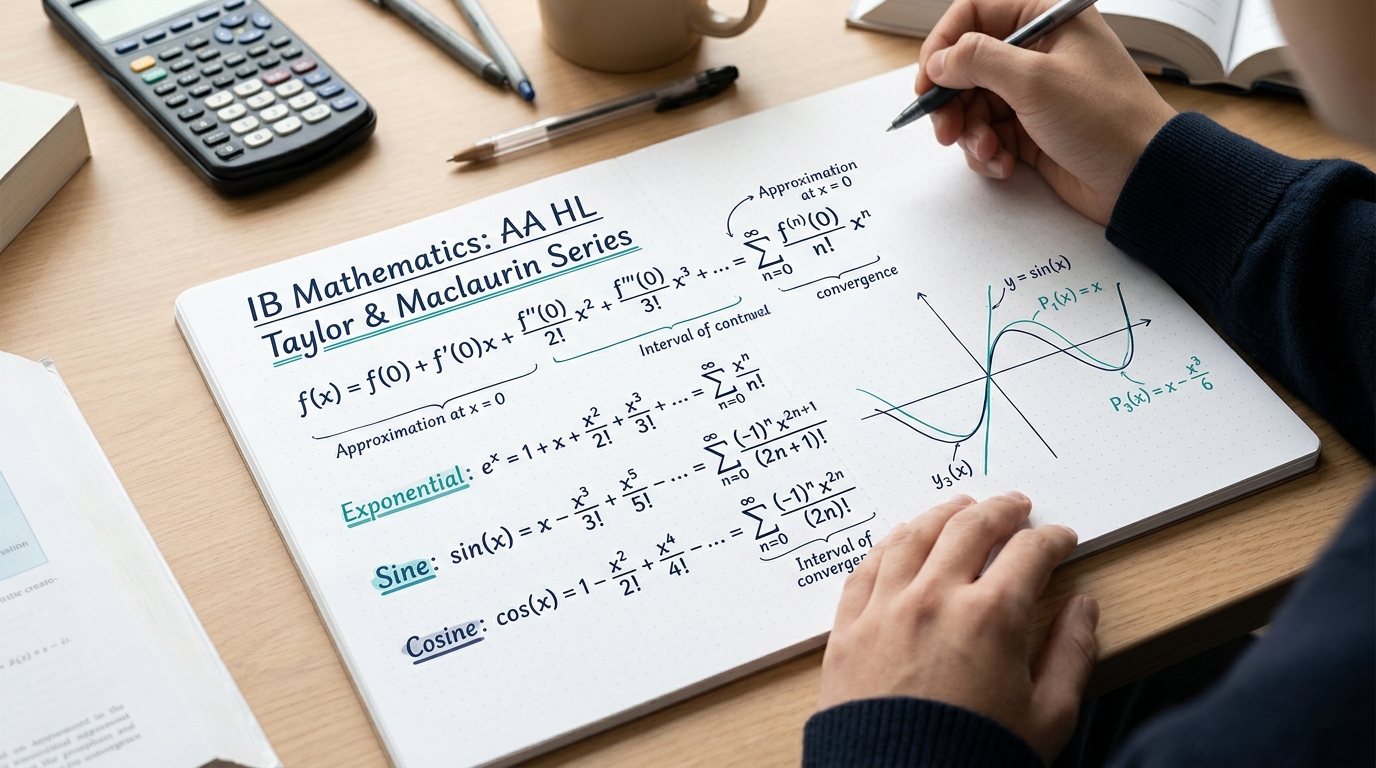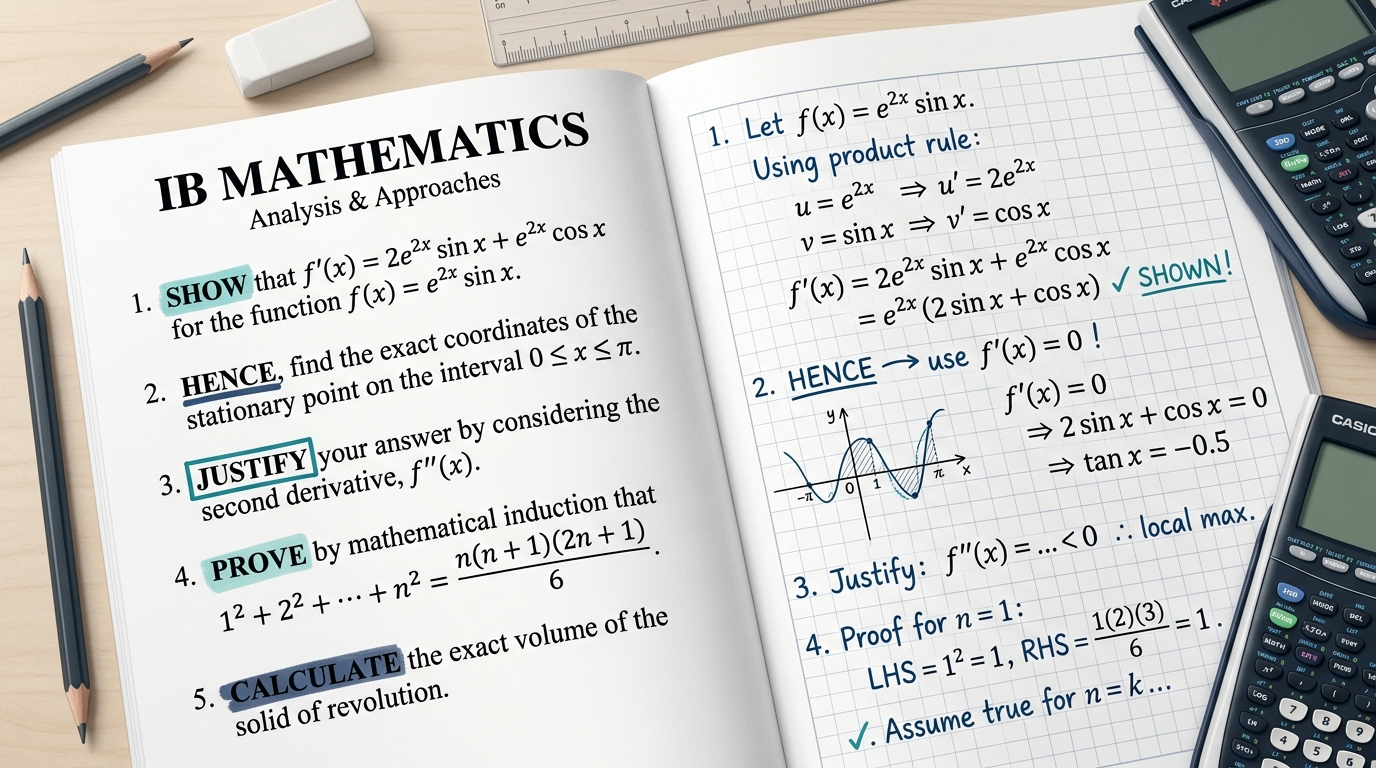
You can understand the mathematics in an IB exam question and still lose marks because you have not answered the question in the way it asks.
For example, imagine you calculate the correct value of a variable. The question then asks you to justify your answer, but you only write the number.
Or perhaps the question says “hence,” but you solve the problem using a completely different method instead of using the result from the previous part.
These mistakes are not always caused by weak mathematical knowledge. Sometimes, the problem is understanding what the examiner expects you to demonstrate.
IB Mathematics uses command terms to communicate the type of response required. Words such as show, show that, hence, deduce, justify, prove, determine, calculate, and interpret each have a specific purpose.
Understanding these instructions helps you organise your work, communicate mathematical reasoning, and avoid unnecessary mistakes.
This guide explains the most important IB Maths command terms, gives worked examples, and shows how to respond to them in an exam.
Table of Contents
1. What are IB Maths command terms?
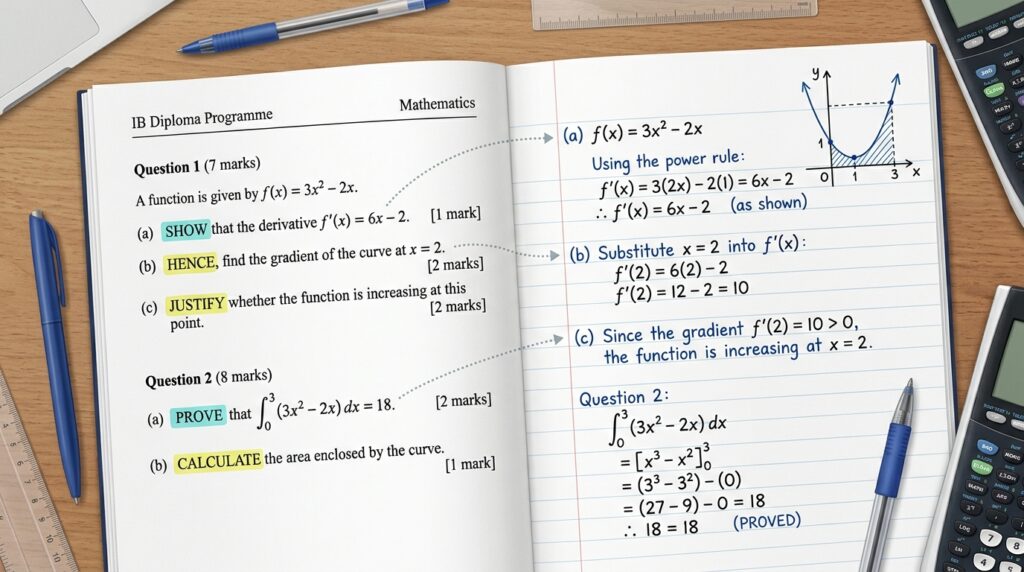
A command term is an instruction that tells you what to do in a question.
It may ask you to:
- Give a numerical answer.
- Show the stages of a calculation.
- Explain why a result is correct.
- Use a previous result.
- Construct a formal mathematical proof.
- Interpret a result in context.
- Draw or sketch a mathematical diagram.
For example, compare these two instructions:
Question A: Find the value of (x).
Question B: Justify that (x=3) gives a maximum value.
Both involve mathematics, but they require different responses.
In Question A, you need to calculate the value.
In Question B, calculating (x=3) is not enough. You must provide mathematical evidence that the point is a maximum.
The command term tells you what kind of evidence your answer needs.
The official IB Mathematics guide includes a glossary of command terms. You can also review the IB Maths AA HL syllabus guide to understand the wider course expectations.
2. The most important IB Maths command terms
Here is a quick reference to common command terms and what they generally require.
| Command term | What you need to do |
|---|---|
| State | Give a specific answer without explanation |
| Write down | Extract or provide the required information |
| Calculate | Perform a calculation and show relevant working |
| Find | Obtain the required result using an appropriate method |
| Determine | Establish the required value or conclusion |
| Show | Present the stages of a calculation or derivation |
| Show that | Derive the result supplied in the question |
| Hence | Use a result from an earlier part |
| Deduce | Reach a conclusion from the information provided |
| Justify | Give valid mathematical reasons or evidence |
| Prove | Construct a logical mathematical argument |
| Verify | Provide evidence that a stated result is correct |
| Sketch | Draw the general shape and relevant features |
| Solve | Find the value or values satisfying an equation or inequality |
| Interpret | Explain the mathematical result in context |
| Explain | Give reasons for a mathematical result or conclusion |
These are practical summaries. Always read the complete question because the surrounding instructions and mark allocation also affect what you need to include.
3. What does “state” mean in IB Maths?
State means give a specific answer without providing a detailed explanation or calculation.
For example:
Given:
[
f(x)=x^2+4x+7
]
State the value of (f(2)).
Substitute (x=2):
[
f(2)=2^2+4(2)+7
]
[
=4+8+7
]
[
=19
]
Your answer is:
[
\boxed{19}
]
In an actual question asking you to state a value that can be read directly from a graph or given information, you may not need to show a calculation.
Common mistake: Writing a long explanation when the question only needs a short answer. This can waste valuable examination time.
4. What does “Write down” mean?
“Write down” usually means provide the answer directly from information already available.
Little or no calculation is normally required.
For example:
The function is:
[
f(x)=3x^2-5x+8
]
Write down the coefficient of (x^2).
The answer is
[
\boxed{3}
]
You do not need to differentiate the function or explain how polynomial coefficients work.
Another example:
A graph shows that the maximum value of a function is 12.
Write down the maximum value.
[
\boxed{12}
]
Exam tip: Look for information that is already provided. Do not introduce unnecessary calculations.
5. What does “Calculate” mean?
Calculate means perform the required mathematical operations to obtain a numerical or algebraic result.
You should normally show enough working to make your method clear.
Consider:
Calculate:
[
\int_0^2 3x^2,dx
]
Integrate:
[
=\left[x^3\right]_0^2
]
Apply the limits:
[
=2^3-0^3
]
Therefore:
[
\boxed{8}
]
Your working demonstrates how you obtained the result.
Common mistake: Giving only the final number when the question requires evidence of the calculation.
6. What does “Show” mean?
Show asks you to present the steps in a calculation or mathematical derivation.
The examiner wants to see how you reached the result.
For example:
Show that:
[
(x+2)(x+3)=x^2+5x+6
]
Start with the left-hand side:
[
(x+2)(x+3)
]
Expand the brackets:
[
=x^2+3x+2x+6
]
Collect like terms:
[
=x^2+5x+6
]
Therefore:
[
\boxed{(x+2)(x+3)=x^2+5x+6}
]
The important part is the mathematical working.
You should not simply write the expression on the right hand side because the question asks you to demonstrate how the result is obtained.
7. What does “Show that” mean?
Show that is one of the most important instructions in IB Mathematics.
The question provides a result and asks you to demonstrate that it follows from the given information.
For example:
Show that:
[
\frac{x^2-9}{x-3}=x+3
]
for (x\neq3).
Start with the left hand side:
[
\frac{x^2-9}{x-3}
]
Factorise the numerator:
[
=\frac{(x-3)(x+3)}{x-3}
]
Cancel the common factor, noting that (x\neq3):
[
=x+3
]
Therefore:
[
\boxed{\frac{x^2-9}{x-3}=x+3}
]
What should you avoid?
Do not simply start with the result that the question asks you to prove and manipulate it until you reach the original expression.
For an identity or derivation, work from the given information or one side of the expression towards the required result.
This makes your reasoning clear.
Exam tip: In a show that question, the supplied answer is not the main achievement. The marks are generally attached to the mathematical steps that establish it.
For more practice with formal mathematical reasoning, see the IB Maths AA HL mathematical induction guide.
8. What does “Hence” mean?
Hence means use a result from an earlier part of the question to obtain the next result.
This is especially important in multi part questions.
Consider:
Part (a): Factorise:
[
x^2-5x+6
]
We obtain:
[
x^2-5x+6=(x-2)(x-3)
]
Part (b): Hence solve:
[
e^{2x}-5e^x+6=0
]
The word “hence” tells you to use the factorisation from Part (a).
Notice that:
[
e^{2x}=(e^x)^2
]
Therefore, using the factorisation:
[
(e^x-2)(e^x-3)=0
]
So:
[
e^x=2\quad\text{or}\quad e^x=3
]
Taking natural logarithms:
[
x=\ln2\quad\text{or}\quad x=\ln3
]
Therefore:
[
\boxed{x=\ln2\text{ or }x=\ln3}
]
Hence versus hence or otherwise
These instructions are different.
Hence: Use the preceding result.
Hence or otherwise: You are encouraged to use the preceding result, but another valid method may also be acceptable.
Common mistake: Ignoring the previous part and solving the next part from scratch when the question specifically says “hence”.
9. What does “Deduce” mean?
Deduce means reach a conclusion using information already provided.
The answer should follow logically from the given facts.
For example:
Given:
[
\int_0^2 f(x),dx=5
]
Deduce the value of:
[
\int_0^2(3f(x)+1),dx
]
Use the linearity of integration:
[
=3\int_0^2f(x),dx+\int_0^2 1,dx
]
Substitute the given result:
[
=3(5)+[x]_0^2
]
[
=15+2
]
Therefore:
[
\boxed{17}
]
You did not need to know the original function (f(x)).
The information in the question was enough to obtain the result.
Exam tip: Before starting a deduce question, identify exactly which facts or earlier results you are expected to use.
10. What does “Justify” mean?
Justify means provide valid mathematical reasons or evidence to support an answer or conclusion.
A numerical result alone may not be enough.
Consider:
[
f(x)=-x^2+4x+1
]
A question asks you to justify that the stationary point is a maximum.
Differentiate:
[
f'(x)=-2x+4
]
At a stationary point:
[
-2x+4=0
]
Therefore:
[
x=2
]
Now find the second derivative:
[
f”(x)=-2
]
Since:
[
f”(2)=-2<0
]
the stationary point is a maximum.
Therefore, the stationary point is a maximum because the second derivative is negative.
Why is the explanation important?
If you only write (x=2), you have found the stationary point’s horizontal coordinate.
You have not explained why the point is a maximum.
That additional reasoning is what the instruction requires.
For more practice with differentiation and stationary points, see the IB Maths AA HL calculus revision guide.
11. What does “Prove” mean?
Prove requires a formal logical argument showing that a mathematical statement is always true under the stated conditions.
Checking a few examples is not a proof.
For example:
Prove that the sum of two odd integers is even.
Let the first odd integer be:
[
2m+1
]
Let the second odd integer be:
[
2n+1
]
where (m) and (n) are integers.
Their sum is:
[
(2m+1)+(2n+1)
]
Simplify:
[
=2m+2n+2
]
Factorise:
[
=2(m+n+1)
]
Since (m) and (n) are integers, (m+n+1) is also an integer.
Therefore, the sum is divisible by 2.
Hence, the sum of two odd integers is even.
[
\boxed{\text{Proved}}
]
Justify versus prove
A justification provides valid reasons for a particular answer or conclusion.
A proof establishes a mathematical statement through a complete logical argument.
A proof generally needs a more formal structure, especially when the statement applies to all integers or all values in a specified domain.
12. What does “Verify” mean?
Verify means provide evidence that a stated result is correct.
One common method is substitution.
For example:
Verify that (x=3) is a solution of:
[
x^2-5x+6=0
]
Substitute (x=3):
[
3^2-5(3)+6
]
[
=9-15+6
]
[
=0
]
Therefore, the equation is satisfied.
[
\boxed{x=3\text{ is a solution}}
]
Notice that you did not need to solve the quadratic equation from the beginning.
You only needed to check the given value.
13. What does “Solve” mean?
Solve means find the value or values that satisfy an equation or inequality.
For example:
Solve:
[
x^2-5x+6=0
]
Factorise:
[
(x-2)(x-3)=0
]
Therefore:
[
x=2\quad\text{or}\quad x=3
]
The final answer is:
[
\boxed{x=2,\ 3}
]
Remember to check for all solutions
A common mistake is finding one solution and stopping.
For quadratic equations, check whether there is another root.
For trigonometric equations, check the specified interval and make sure you have included every valid solution.
For equations involving logarithms or square roots, check that the final values satisfy the original restrictions.
14. What does “Interpret” mean?
Interpret asks you to explain what a mathematical result means in the context of the question.
A numerical answer alone may not be sufficient.
For example, suppose a model gives the rate of change of the temperature of an object:
[
T'(t)=-2.5
]
at a particular time.
Interpret this value.
A suitable response is:
At that time, the temperature of the object is decreasing at a rate of (2.5) degrees per unit of time.
The negative sign indicates that the temperature is decreasing.
You have translated a mathematical result into its meaning in the situation.
What should you include?
Depending on the question, your interpretation may need to mention:
- What the numerical value represents.
- The relevant units.
- Whether the quantity is increasing or decreasing.
- What the result means in the real situation.
Common mistake: Repeating the numerical answer without explaining what it represents.
15. What does “Sketch” mean?
Sketch means draw the general shape of a graph or diagram and include its important mathematical features.
A sketch does not usually need to be perfectly accurate or drawn to scale.
For example:
Sketch:
[
y=x^2-4
]
The graph is an upward opening parabola.
Its (y) intercept is:
[
y=-4
]
Its (x) intercepts satisfy:
[
x^2-4=0
]
[
x=\pm2
]
So the intercepts are:
[
(-2,0),\quad(2,0)
]
The turning point is:
[
(0,-4)
]
A suitable sketch should show the general parabolic shape and label these important points.
What should you include in a sketch?
Depending on the function, include:
- Intercepts.
- Turning points.
- Asymptotes.
- End behaviour.
- Relevant domain restrictions.
- Important points or transformations.
Do not spend too much time making a sketch look artistic. Mathematical accuracy and relevant features matter more.
16. How to use command terms with mark schemes
Understanding the command term is only one part of exam preparation.
You should also understand how the examiner awards marks for your working.
For example, a question may contain:
[
\text{M1}\quad\text{A1}\quad\text{R1}
]
These are marking codes that indicate different types of mathematical evidence.
| Code | General meaning |
|---|---|
| M | Method |
| A | Accuracy or answer |
| R | Reasoning |
| AG | Answer given in the question |
| FT | Follow through |
The exact marking conditions depend on the question.
For example, a question asking you to justify a maximum may require a correct stationary point calculation and a reason explaining why the point is a maximum.
Getting the stationary point alone may not provide all the evidence required.
Read the IB Maths mark scheme explained guide to understand how these codes work and how to use mark schemes when reviewing your answers.
17. Common command term mistakes that cost marks
Here are some mistakes to watch for during practice.
Mistake 1: Giving an answer without the required reasoning
A question asks you to justify a maximum, but you only give the stationary point.
Better approach: Include the second derivative test or an appropriate sign analysis.
Mistake 2: Ignoring the previous part
A question says “hence”, but you use an unrelated method.
Better approach: Identify the result from the previous part and show how it leads to the next result.
Mistake 3: Working backwards in a show that question
You begin with the supplied answer and try to manipulate it into the original expression.
Better approach: Start with the given information or one side of the expression and derive the required result.
Mistake 4: Checking examples instead of proving a statement
You test several values and conclude that a statement is always true.
Better approach: Construct a logical argument that covers every value in the stated domain.
Mistake 5: Giving a numerical answer without interpretation
You calculate a rate of change but do not explain what it means.
Better approach: Include the meaning, direction, and units where relevant.
Mistake 6: Giving too much working for a simple instruction
You write several lines when the question only asks you to state a value.
Better approach: Match the length of your response to the instruction.
Mistake 7: Forgetting units and restrictions
You calculate a length or rate but omit its units, or ignore the allowed domain.
Better approach: Check the context and mathematical restrictions before presenting the final answer.
18. A practical method for reading IB Maths questions
Before you begin solving a question, take a moment to identify what it is asking.
Use this sequence:
Step 1: Find the command term
Underline the instruction, such as calculate, show that, hence, or justify.
Step 2: Identify the required result
Ask yourself what the final response needs to contain.
Step 3: Check the information provided
Look for equations, diagrams, earlier results, graphs, and numerical values.
Step 4: Choose the appropriate mathematical method
Decide whether you need algebra, calculus, probability, statistics, geometry, or another topic.
Step 5: Write the required evidence
Show calculations, explain reasoning, use previous results, or interpret the answer as requested.
Step 6: Check your final response
Make sure you have answered the actual instruction, not just completed a calculation.
This method is particularly useful when questions combine several topics.
If you find it difficult to recognise which mathematical approach to use, read how to start an unfamiliar IB Math question.
19. Practise these IB Maths command term questions
Try the following questions without looking at the solutions immediately.
The purpose is to practise identifying what each instruction requires.
Question 1: State
Given:
[
f(x)=2x^2-3x+5
]
State the value of (f(1)).
Question 2: Show that
Show that:
[
(x-4)(x+2)=x^2-2x-8
]
Question 3: Hence
Given:
[
x^2-7x+12=(x-3)(x-4)
]
Hence solve:
[
e^{2x}-7e^x+12=0
]
Question 4: Justify
Given:
[
f(x)=x^2-6x+10
]
Justify that the stationary point is a minimum.
Question 5: Prove
Prove that the sum of two even integers is even.
Question 6: Interpret
The derivative of a distance function is:
[
s'(t)=4
]
at a particular time.
Interpret this result, including its units if the distance is measured in metres and time in seconds.
20. Answer guide
Try the questions independently before checking your work.
Question 1
[
f(1)=2(1)^2-3(1)+5
]
[
=2-3+5
]
[
\boxed{4}
]
Question 2
[
(x-4)(x+2)
]
[
=x^2+2x-4x-8
]
[
\boxed{x^2-2x-8}
]
Question 3
Use the factorisation from the question:
[
(e^x-3)(e^x-4)=0
]
Therefore:
[
e^x=3\quad\text{or}\quad e^x=4
]
Taking natural logarithms:
[
\boxed{x=\ln3\text{ or }x=\ln4}
]
Question 4
Differentiate:
[
f'(x)=2x-6
]
Set the derivative equal to zero:
[
2x-6=0
]
[
x=3
]
Find the second derivative:
[
f”(x)=2
]
Since:
[
f”(3)=2>0
]
the stationary point is a minimum.
Question 5
Let the two even integers be:
[
2m\quad\text{and}\quad2n
]
Their sum is:
[
2m+2n=2(m+n)
]
Since (m+n) is an integer, the sum is divisible by 2.
Therefore, the sum of two even integers is even.
Question 6
The distance is increasing at a rate of (4) metres per second at that particular time.
21. How to improve your command term technique with regular practice
Knowing the definitions is useful, but you need to apply them when solving actual questions.
A simple revision routine can help.
| Practice session | Focus | What to do |
|---|---|---|
| Session 1 | Command term recognition | Identify the instruction in different questions |
| Session 2 | Showing working | Practise show and show that questions |
| Session 3 | Linked questions | Practise hence and deduce |
| Session 4 | Mathematical reasoning | Practise justify and prove |
| Session 5 | Interpretation | Explain results in context |
| Session 6 | Mixed questions | Combine different command terms |
| Session 7 | Timed practice | Attempt exam questions and review your responses |
When checking your answers, do not only ask whether the final result is correct.
Ask whether you provided the evidence the command term requested.
For additional exam practice, use the IB Maths AA HL past papers guide to structure your past paper sessions.
22. How Mathzem can help you review your mathematical working
A student may understand a topic but still struggle to communicate the solution correctly.
For example, you might:
- Calculate a stationary point correctly but fail to justify its nature.
- Obtain the correct answer but omit important working.
- Solve a later part without using the result requested by “hence”.
- Give a numerical result without interpreting it.
These problems are easier to address when you review the actual working rather than checking the final answer alone.
Mathzem connects IB Mathematics practice with handwritten solution review.
You can select a relevant practice question, solve it on paper, and upload your working for AI Examiner feedback.
The feedback can help you review your method, identify errors, and understand where your written solution needs improvement. It can also provide estimated marks where supported by the submitted work.
Mathzem feedback is a learning aid, not official IB marking.
The aim is to help you understand not only whether your answer is correct, but whether your working demonstrates the mathematics the question asks for.
Frequently Asked Questions About IB Maths Command Terms
What are command terms in IB Maths?
Command terms are instructions that tell you what type of mathematical response is expected. Examples include calculate, show, hence, justify, prove, and interpret.
What is the difference between show and show that?
Show asks you to present the stages of a calculation or derivation. Show that gives you the required result and asks you to demonstrate how it follows from the given information.
What does hence mean in IB Maths?
Hence means you should use a result from an earlier part of the question to obtain the next result.
What is the difference between hence and hence or otherwise?
Hence requires you to use the preceding result. Hence or otherwise allows another valid method, although using the previous result is often the most direct approach.
What is the difference between justify and prove?
Justify asks you to give valid reasons or evidence for a particular conclusion. Prove requires a formal logical argument establishing that a statement is true under the stated conditions.
Do I need to show working for every IB Maths question?
The amount of working depends on the command term and the question. State and write down usually need little or no working. Calculate, show, show that, justify, and prove generally require mathematical evidence.
Can I use a calculator for a show that question?
It depends on the question and the examination rules. A calculator result alone generally does not demonstrate the required derivation. Follow the instructions and show the mathematical reasoning needed.
How can I stop losing marks because of command terms?
Identify the command term before solving. Understand what evidence it requires, present the appropriate working, and review your response against the mark scheme.
Conclusion: Answer the Instruction, Not Just the Mathematics
Understanding a mathematical topic is only part of answering an IB exam question.
You also need to understand what the question expects you to demonstrate.
When you see calculate, show the relevant calculation.
When you see show that, derive the supplied result.
When you see hence, use the earlier result.
When you see justify, provide a mathematical reason.
When you see prove, construct a logical argument.
When you see interpret, explain what the result means.
These differences may look small, but they change how you should structure your answer.
Make command term recognition part of your regular revision. Practise with past papers, compare your working with mark schemes, and learn from the marks you lose.
The goal is not simply to get the correct answer. It is to communicate your mathematics clearly enough to demonstrate why that answer is correct.