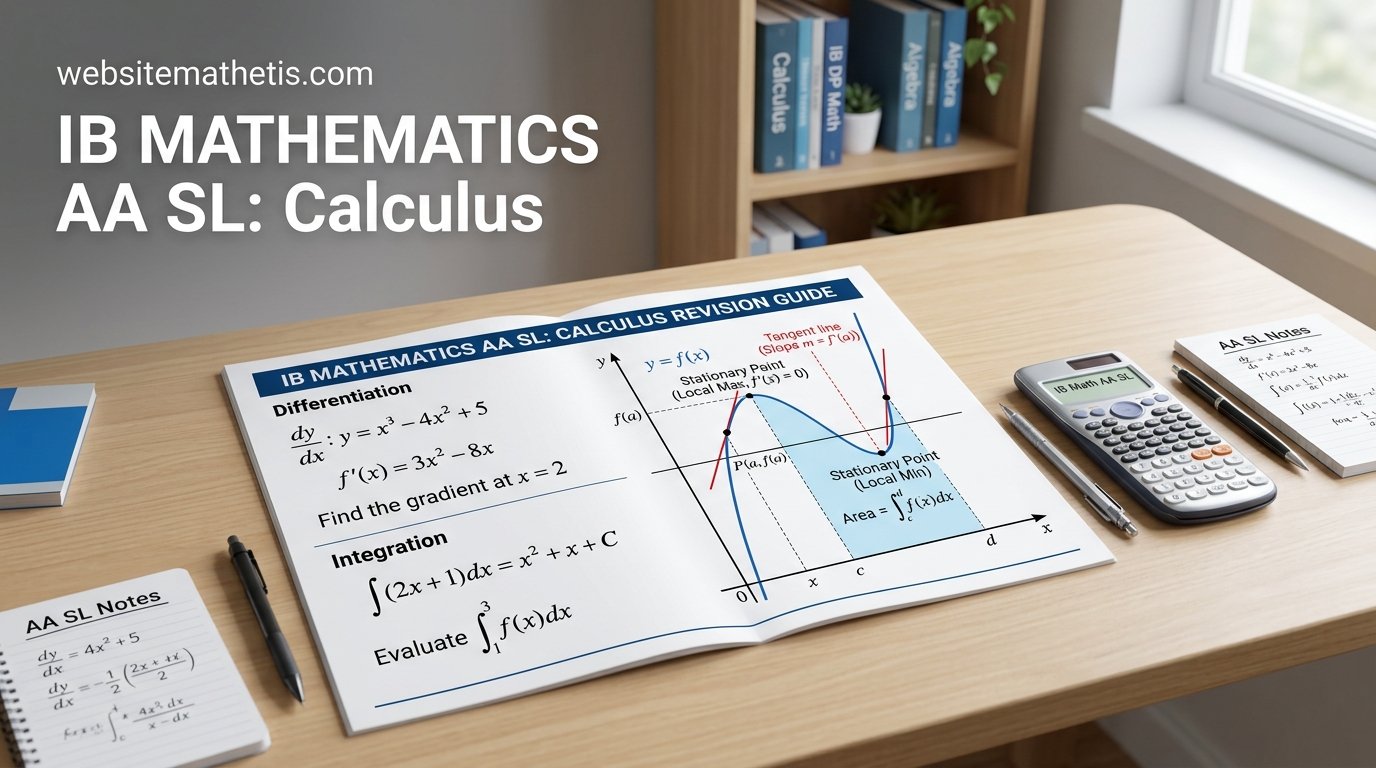
Calculus can feel like one of the biggest topics in IB Maths AA SL Calculus Revision.
You have derivatives, stationary points, tangents, optimisation, integration, areas, and applications to learn. Then exam questions combine these skills in ways that aren’t always obvious at first.
The good news is that calculus becomes much easier when you revise it in the right order.
Instead of treating every formula as a separate item to memorise, focus on the relationship between the ideas.
You can think of your calculus revision as a progression:
Functions→Differentiation→Applications
and:
Integration→Definite Integrals→Area and Applications
Once the foundations are secure, the more complicated questions become much easier to approach.
This guide takes you through the main areas to revise and shows you how to practise them effectively.
Table of Contents
What Should You Revise First in AA SL Calculus?
Don’t start by randomly choosing difficult calculus questions.
Begin with the fundamental skills.
Your revision should broadly move through:
- Understanding derivatives
- Differentiation rules
- Tangents and normals
- Stationary points
- Applications of differentiation
- Integration
- Definite integrals
- Area under curves
- Applications and interpretation
- Mixed exam questions
The order matters.
For example, there’s little value in spending a long time on optimisation if you’re still making basic differentiation errors.
Build the underlying skill first.
Then practise applying it.
1. Understand What a Derivative Represents
Before memorising differentiation rules, make sure you understand what a derivative means.
If: y=f(x)
then: f′(x)
represents the instantaneous rate of change of f(x) with respect to x.
Graphically, it represents the gradient of the tangent to the curve.
This gives you an important connection: Derivative=gradient
So if you’re asked for the gradient at a particular point, differentiation is usually central to the solution.
Why this matters
Understanding the meaning of a derivative helps you recognise when differentiation is needed.
You aren’t simply remembering:
“Use this formula because the question says derivative.”
You’re recognising a mathematical situation involving rate of change or gradient.
2. Master the Basic Differentiation Rules
The next step is becoming comfortable with common differentiation rules.
For example: dxd(xn)=nxn−1
So: dxd(x5)=5×4
and dxd(3×4)=12×3
You should also be comfortable with derivatives of common functions included in your course.
The goal isn’t simply to memorise them.
You should be able to recognise the function and apply the appropriate rule quickly.
Practice progression
Start with x2, x3, x5.
Then move to 3×4−2×2+7x.
Then practise questions where the derivative must be used for another purpose.
That final step is important.
3. Practise Tangents and Normals
Once you can differentiate, you can use derivatives to find tangent lines.
Suppose: f(x)=x2+2x
and you’re asked to find the tangent at x=1.
First find: f′(x)
Then evaluate: f′(1)
to obtain the gradient.
Next find the corresponding point: (1,f(1))
Then use the straight line equation: y−y1=m(x−x1)
This process is worth practising until it becomes automatic.
Normal lines
For a normal, remember that the gradient is the negative reciprocal of the tangent gradient, assuming the tangent gradient is nonzero.
Don’t try to calculate the normal gradient from memory every time.
Think about the perpendicular relationship.
4. Stationary Points
Stationary points are another major application of differentiation.
At a stationary point: f′(x)=0
So the general process is: f′(x)
then: f′(x)=0
then solve for x.
After that, find the corresponding y coordinates.
But you’re not necessarily finished.
The question may ask you to determine whether each stationary point is a maximum or minimum.
This is where your understanding of the graph becomes important.
5. Learn to Classify Stationary Points
Finding a stationary point and identifying what type it is are different tasks.
You may be able to use the second derivative where appropriate.
For example, if: f′(x)=0
and: f′′(x)>0
at the stationary point, this indicates a local minimum.
If: f′′(x)<0
it indicates a local maximum.
You should also understand the graphical meaning.
A good revision exercise is to find stationary points algebraically and then graph the function to see whether your classification makes sense.
6. Practise Optimisation
Optimisation questions often appear more complicated than they really are because they’re presented as word problems.
The key is to translate the words into mathematics.
Suppose you’re asked to find the maximum area of a rectangle under a curve.
Don’t immediately differentiate.
First determine:
What am I trying to maximise?
Then:
What variables are involved?
Then:
What equation describes the quantity?
Only after creating the appropriate function should you differentiate.
A useful structure is: Understand the situation ↓ Define variables ↓ Create objective function ↓ Differentiate ↓ f′(x)=0 ↓ Check and interpret
This is much safer than jumping straight into calculations.
7. Understand the Meaning of Integration
Integration is often introduced as the reverse of differentiation.
For example: dxd(x3)=3×2
therefore: ∫3x2dx=x3+C
The C is important for indefinite integrals because differentiating a constant gives zero.
When revising integration, don’t just memorise the rules.
Practise checking your answers.
If you believe: ∫f(x)dx=F(x)+C
differentiate F(x).
If you get f(x), your integration is consistent.
8. Don’t Forget the Constant of Integration
One of the simplest mistakes in calculus is also one of the easiest to avoid.
For an indefinite integral: ∫f(x)dx
you normally need: +C
For example: ∫4x3dx=x4+C
If you leave out C, you haven’t represented the full family of antiderivatives.
Make this a habit during practice.
9. Definite Integrals
Definite integration introduces limits.
For example: ∫abf(x)dx
You first find an antiderivative and then evaluate it at the upper and lower limits.
If: F′(x)=f(x)
then: ∫abf(x)dx=F(b)−F(a)
This is one of the core procedures you should be able to perform accurately.
Common error
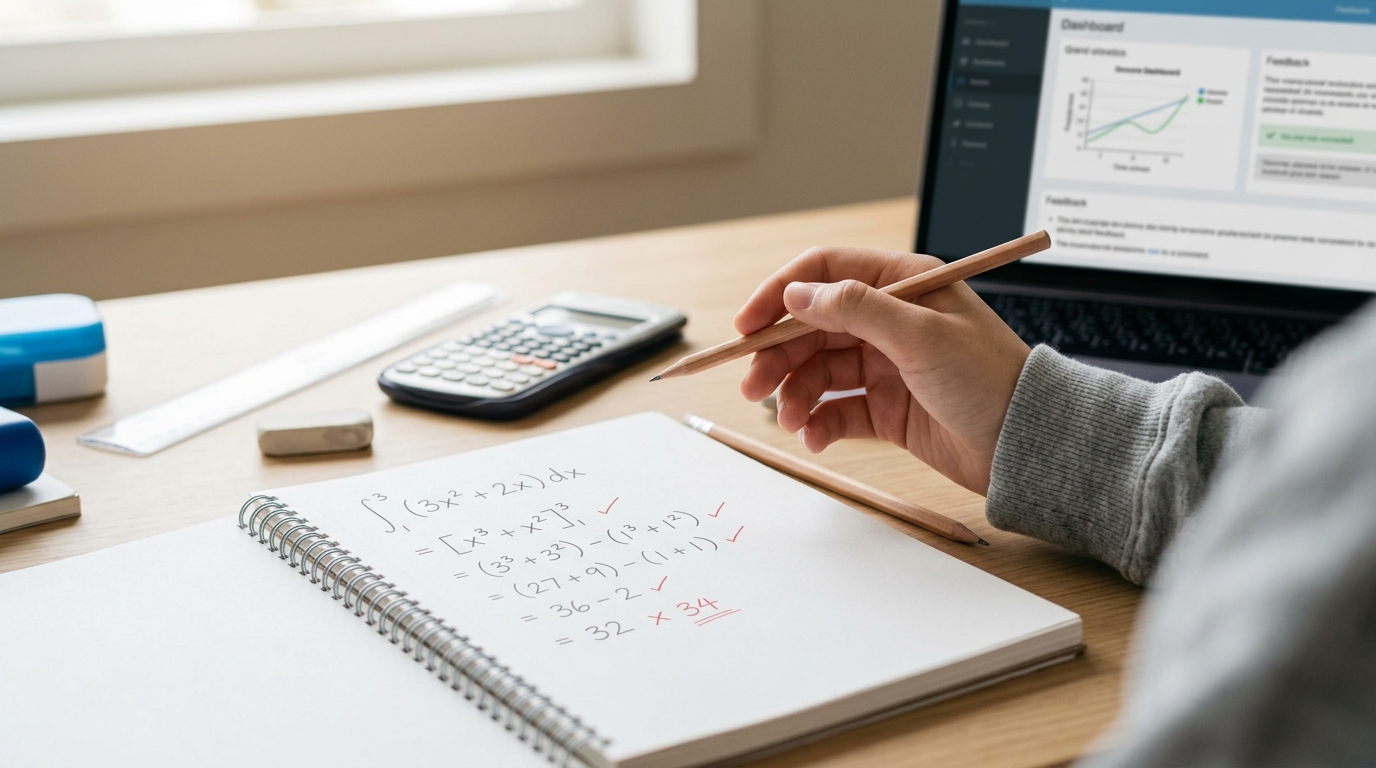
Students sometimes substitute into F(a) and F(b) incorrectly.
Write the subtraction clearly: F(b)−F(a)
rather than trying to do everything mentally.
10. Area Under a Curve
A definite integral can represent the signed area between a curve and the x axis.
If: f(x)≥0
on the interval, then: ∫abf(x)dx
gives the area between the curve and the axis.
But if the graph falls below the x axis, the integral can be negative.
That’s why you should inspect the graph before interpreting the result.
Ask yourself:
Is the question asking for:
Signed area?
or:
Geometric area?
These aren’t always the same thing.
11. Areas Between Curves
You may also need to calculate the area between two functions.
If the upper function is: f(x)
and the lower function is: g(x)
then the area between them can be represented by: ∫ab[f(x)−g(x)]dx
The important step is identifying which function is above the other.
Don’t assume.
Check the graph or compare values within the interval.
A wrong order can produce a negative result even when the question asks for a positive area.
12. Use Graphs to Support Your Calculus
Graphing technology is particularly useful during calculus revision.
Suppose you’re asked to find the stationary points of a function.
You can:
- Differentiate analytically.
- Solve f′(x)=0.
- Find the coordinates.
- Graph the original function.
- Check whether the stationary points appear where expected.
The graph doesn’t replace the mathematical solution.
It gives you an independent check.
This is particularly useful when you’re revising and trying to identify mistakes.
13. Calculator Skills You Should Practise
Your calculator can help with many calculus tasks.
Depending on the question and permitted technology, practise using it for:
• Graphing functions
• Finding intersections
• Numerical solutions
• Evaluating expressions
• Numerical derivatives
• Numerical integration
Don’t wait until exam week to learn these functions.
A calculator feature that takes you several minutes to figure out during a timed paper can cost valuable time.
Important habit
Before using a trigonometric function or interpreting a graph, check your calculator settings.
Incorrect mode settings can produce completely incorrect results.
14. Calculus Questions Often Test Algebra Too
This is an important point for AA SL students.
You can understand calculus and still lose marks because of algebra.
For example, after differentiating you might need to solve: 3×2−12x=0
If you can’t factorise or rearrange the expression correctly, the calculus method won’t help you.
So if you repeatedly lose calculus marks because of:
• Factorisation
• Expanding brackets
• Fractions
• Rearranging equations
• Indices
then part of your calculus revision should target those algebra skills.
15. Learn to Recognise the Type of Calculus Question
Exam questions don’t always announce:
“This is an optimisation question.”
Instead, you need to recognise the mathematical structure.
If the question asks for a gradient
Think: f′(x)
If it asks for a tangent
Think:
Derivative + point + straight line equation
If it asks for a stationary point
Think: f′(x)=0
If it asks for a maximum or minimum
Think:
Differentiation + stationary point + classification
If it asks for accumulated area
Think:
Integration
If it asks for the area between curves
Think: ∫(upper−lower)dx
Recognising these patterns will make your exam preparation much more effective.
16. Don’t Do Only Easy Calculus Questions
There’s a place for straightforward questions.
They help you build accuracy.
But once you’ve mastered the basic method, you need to move into application questions.
A good progression is:
Level 1: Skill
Differentiate: f(x)=4×3−7x
Level 2: Application
Find the stationary points of the function.
Level 3: Interpretation
Determine the nature of the stationary points.
Level 4: Mixed Problem
Use the function in a contextual optimisation problem.
Each stage tests a different skill.
17. Use Your Mistakes as Revision Data
Suppose you complete 20 calculus questions.
You get 16 correct.
Your first reaction might be:
“I need more calculus practice.”
But that’s too general.
Look at the four incorrect questions.
Maybe:
Question 1: Differentiation error.
Question 2: Algebra error.
Question 3: Correct method but wrong interpretation.
Question 4: Calculator entry error.
Now you know what to work on.
Your revision becomes: Mistake→Cause→Targeted practice→Reattempt
This is much more useful than simply completing another random worksheet.
18. Build a Calculus Weakness Map
A simple weakness map can show you where your revision time should go.
| Skill | Confidence | Common Problem | Next Action |
|---|---|---|---|
| Differentiation | 🟢 | None | Mixed questions |
| Tangents | 🟡 | Finding point | Targeted practice |
| Stationary points | 🟢 | None | Exam questions |
| Optimisation | 🔴 | Setting up function | Guided questions |
| Integration | 🟡 | Algebra | Algebra review |
| Area | 🔴 | Upper and lower functions | Targeted practice |
Don’t spend equal amounts of time on every row.
If differentiation is green and optimisation is red, your next session should focus more heavily on optimisation.
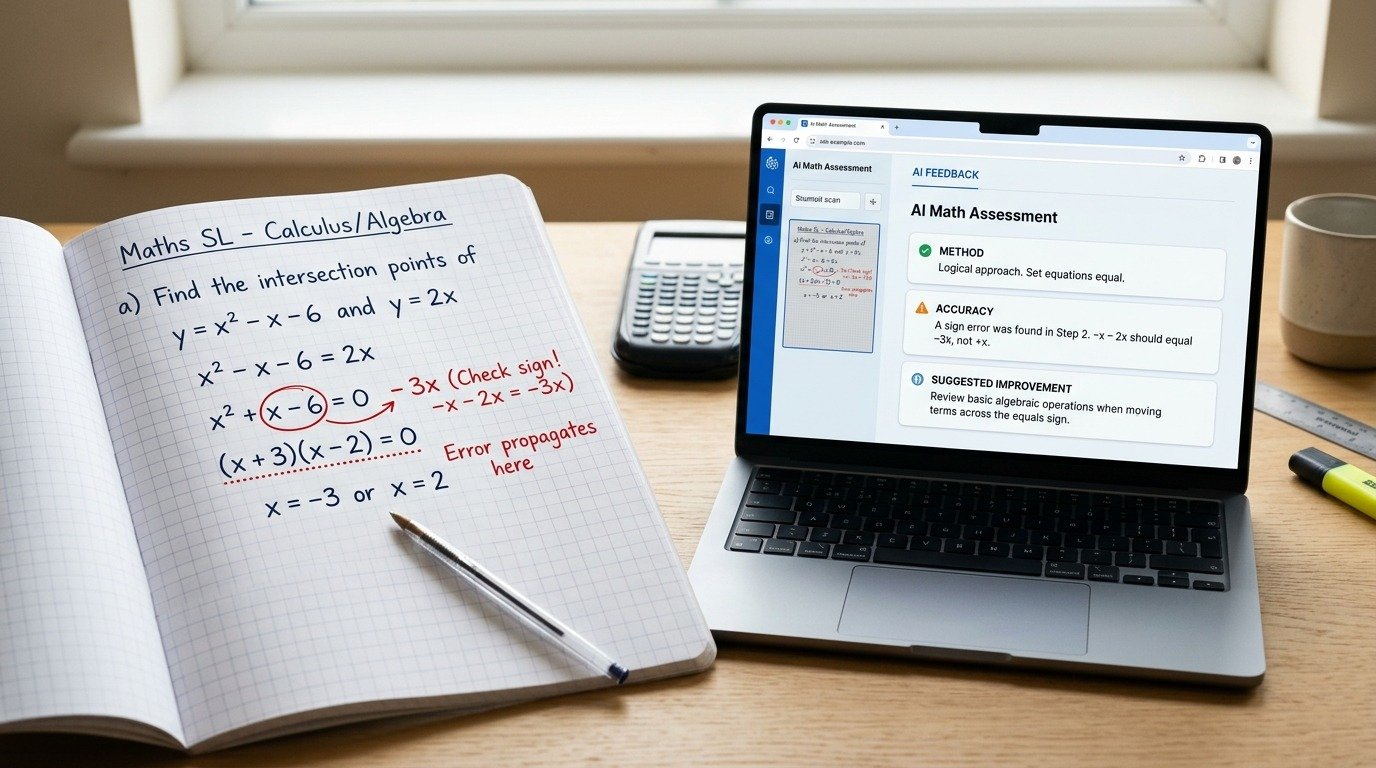
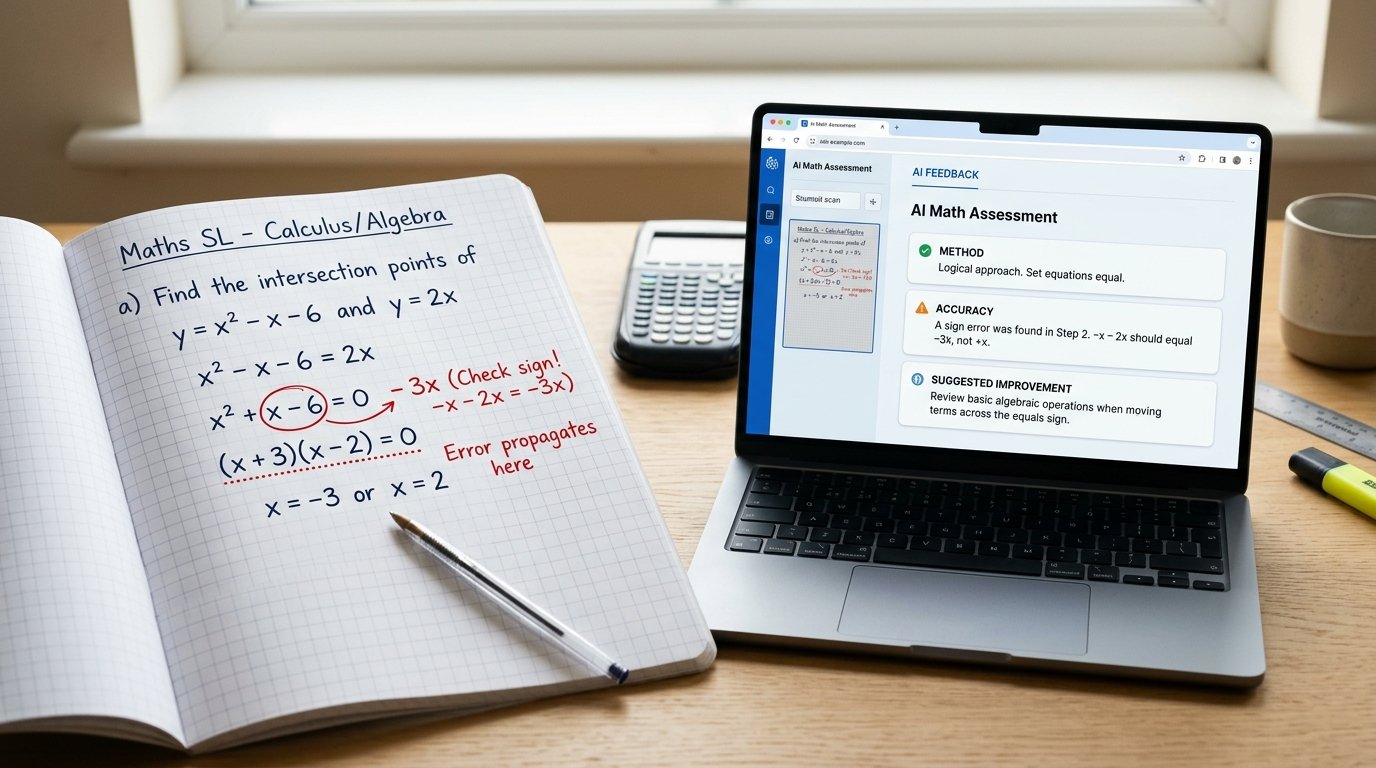
You can use the Math Skill Scanner to help identify mathematical weaknesses before deciding what to practise.
19. Use Feedback to Understand Why You Lost Marks
An answer key tells you whether the final answer is right or wrong.
It doesn’t always tell you why your solution failed.
For example, suppose your optimisation answer is incorrect.
There could be several different causes:
- You misunderstood the question.
- You defined the variable incorrectly.
- You created the wrong function.
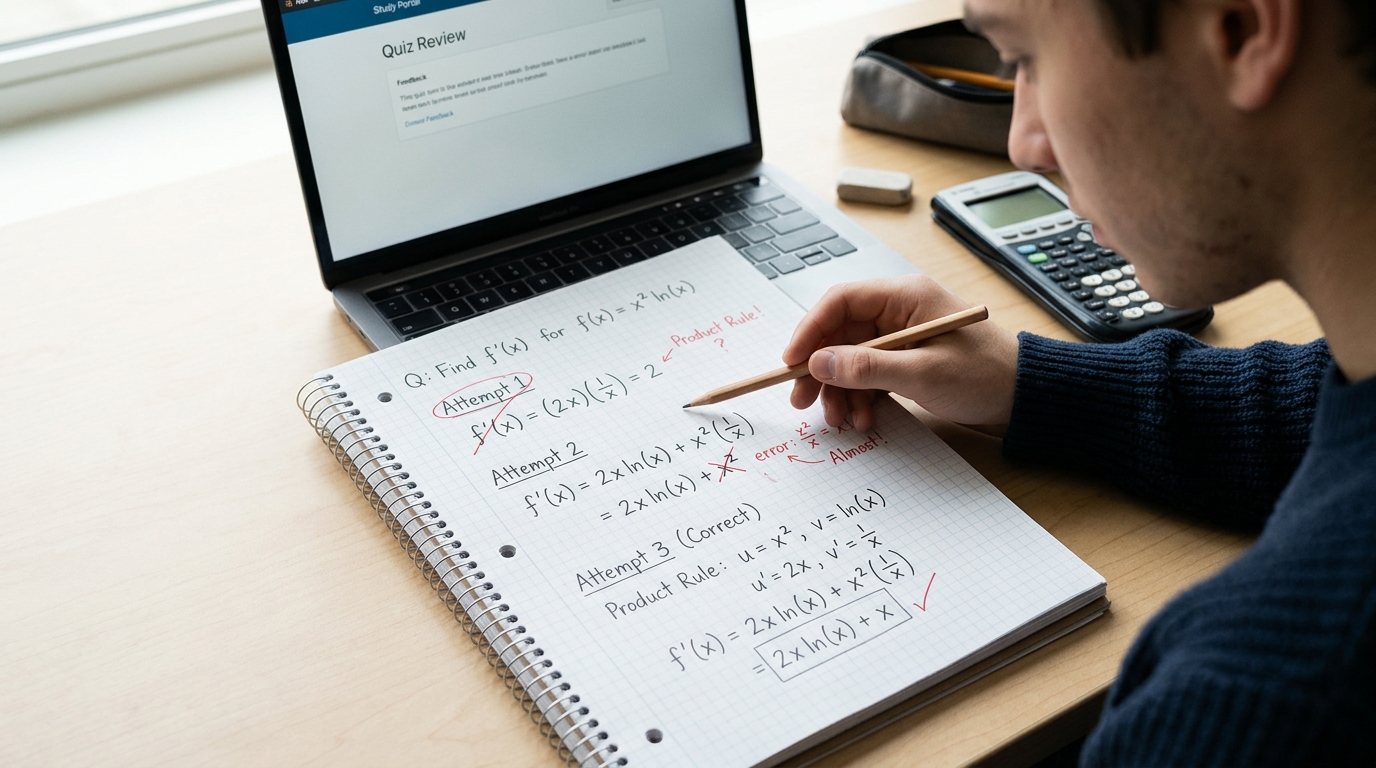
- You differentiated incorrectly.
- You solved the equation incorrectly.
- You failed to check whether the stationary point was a maximum.
- You didn’t interpret the answer correctly.
These require different types of revision.
When you practise IB Maths questions, review the entire chain of reasoning rather than only checking the final numerical answer.
20. A 90 Minute IB Maths AA SL Calculus Revision Session
Here’s a practical session structure.
15 minutes: Review
Choose one skill.
For example:
Stationary points
Review the method and one worked example.
25 minutes: Skill Practice
Complete 4 to 6 questions focused on that skill.
30 minutes: Exam Questions
Complete 2 to 4 IB style application questions.
Don’t look at the solution while working.
10 minutes: Marking
Identify every lost mark.
10 minutes: Error Analysis
For each mistake, write:
What did I do?
Why was it wrong?
What will I do differently next time?
This final stage turns practice into learning.
21. Common IB Maths AA SL Calculus Mistakes
Mistake 1: Forgetting +C
This applies to indefinite integrals.
Mistake 2: Differentiating Correctly but Solving Incorrectly
The derivative may be correct, but the resulting equation isn’t solved properly.
Mistake 3: Forgetting the Context
You calculate a value but don’t explain what it means.
Mistake 4: Rounding Too Early
Keep sufficient precision until the final stage.
Mistake 5: Assuming Every Stationary Point Is a Maximum
A stationary point can be a minimum or another type of point.
Mistake 6: Getting the Area Sign Wrong
Check where the curve lies relative to the axis.
Mistake 7: Using Technology Instead of Mathematical Reasoning
A calculator result isn’t always enough to demonstrate the required method.
Mistake 8: Practising Only Familiar Questions
Exam questions can require you to recognise the method yourself.
22. Your AA SL Calculus Revision Checklist
Before considering your calculus revision complete, check each skill.
Differentiation
□ I understand what a derivative represents.
□ I can differentiate common functions.
□ I can find gradients.
□ I can find tangent equations.
□ I can find normal equations.
Applications
□ I can find stationary points.
□ I can classify stationary points.
□ I can solve optimisation problems.
□ I can interpret derivative information.
Integration
□ I can integrate common functions.
□ I remember +C.
□ I can evaluate definite integrals.
□ I can calculate area under a curve.
□ I can calculate area between curves.
Exam Technique
□ I can recognise when differentiation is required.
□ I can recognise when integration is required.
□ I can break a long problem into stages.
□ I can use my calculator efficiently.
□ I can check whether my answer is reasonable.
□ I can explain my answer in context.
23. What Should You Do If You Keep Getting Calculus Questions Wrong?
Don’t automatically assume that you need to revise the entire calculus unit.
Look for patterns.
If you repeatedly make the same mistake, isolate it.
For example:
Problem: I keep getting stationary point coordinates wrong.
Action: Practise substituting x values back into the original function.
Or:
Problem: I can’t set up optimisation questions.
Action: Practise translating word problems into objective functions before doing any differentiation.
Or:
Problem: I calculate areas incorrectly.
Action: Practise sketching the graph and identifying which function is above the other before integrating.
This is what targeted revision looks like.
Final Thoughts
The best way to approach IB Maths AA SL calculus revision is to build your skills in stages.
Start with differentiation.
Then use differentiation for tangents, normals, stationary points, and optimisation.
Move into integration, then definite integrals and areas.
Once these individual skills are secure, practise mixed questions where you’re not told which method to use.
And don’t judge your progress only by the number of questions you complete.
Your mistakes are valuable revision information.
If you repeatedly make the same error, identify its cause and target that specific weakness.
You can use the Math Skill Scanner to identify areas that need attention, practise IB Maths questions to test your skills, and explore Mathzem membership options if you want a more structured approach to your IB Maths preparation.
The goal isn’t simply to do more calculus questions.
It’s to become better at recognising the problem, choosing the method, solving it accurately, and checking your answer.
FAQs About IB Maths AA SL Calculus Revision
1. What should I revise first for IB Maths AA SL calculus?
Start with differentiation and basic derivative rules. Then move into tangents, normals, stationary points, optimisation, integration, definite integrals, and areas.
2. Is calculus difficult in IB Maths AA SL?
Calculus can be challenging when students try to memorise procedures without understanding how they apply. Building the topics in sequence and practising application questions makes the subject easier to manage.
3. How can I improve my AA SL calculus exam marks?
Analyse your incorrect questions rather than simply completing more questions. Identify whether your errors come from calculus knowledge, algebra, method selection, calculator use, or interpretation.
4. How much calculus should I revise each day?
A focused 60 to 90 minute session is usually enough for a productive revision block. Combine concept review, practice questions, and mistake analysis.
5. Should I use my calculator when revising calculus?
Yes, but use it to support your mathematical work. Practise graphing, checking numerical answers, finding intersections, and numerical integration where appropriate, while still being able to complete required analytical methods.