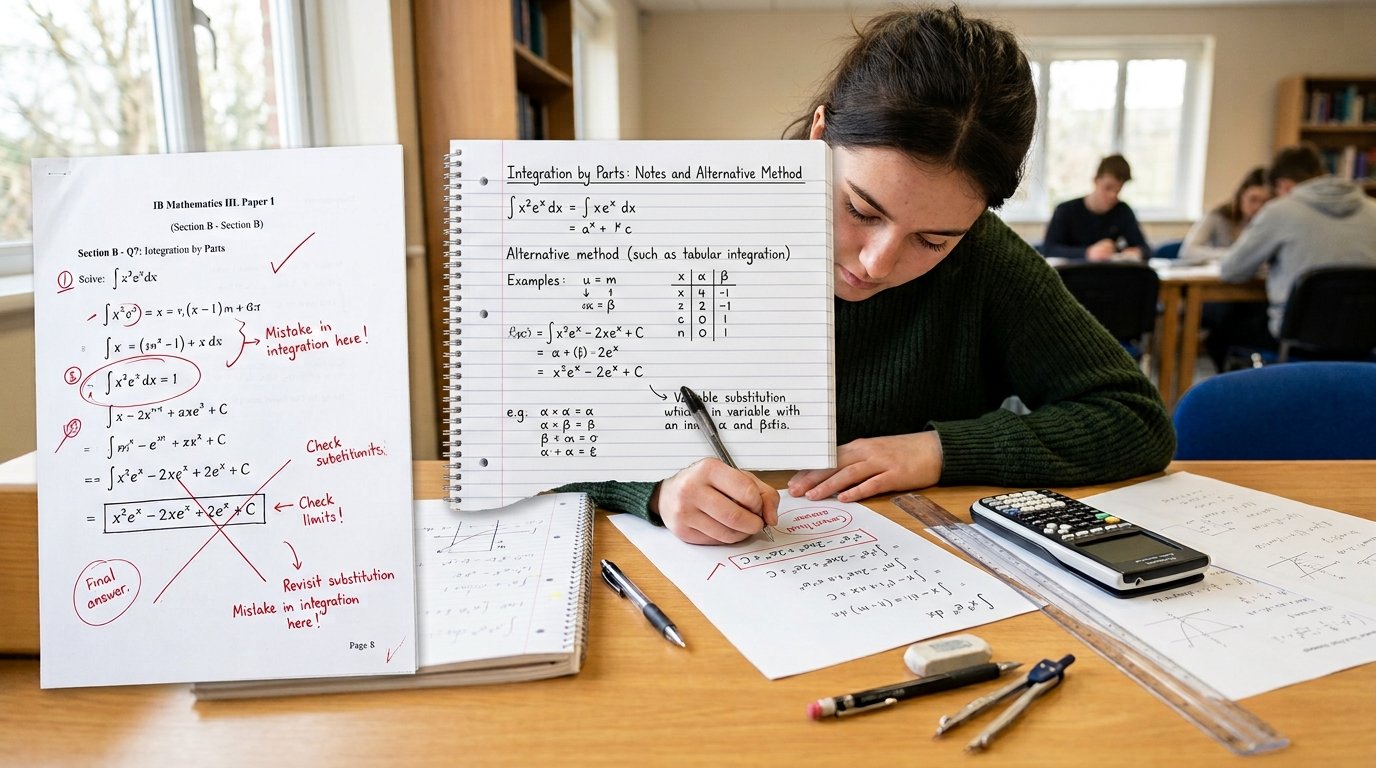
Understanding the IB Maths AA HL syllabus is the first step towards effective revision. Many students begin preparing for exams without knowing exactly what the course covers or how the different topics connect. As a result, they spend too much time on familiar concepts while overlooking areas that carry significant marks in the final examinations.
This guide breaks down every major topic in the IB Maths Analysis and Approaches higher level syllabus, explains the skills you are expected to develop, and shares practical advice for studying each section efficiently.
Whether you are starting the Diploma Programme or preparing for your final exams, this article will help you create a focused revision plan.
Table of Contents
What Is the IB Maths AA HL Syllabus?
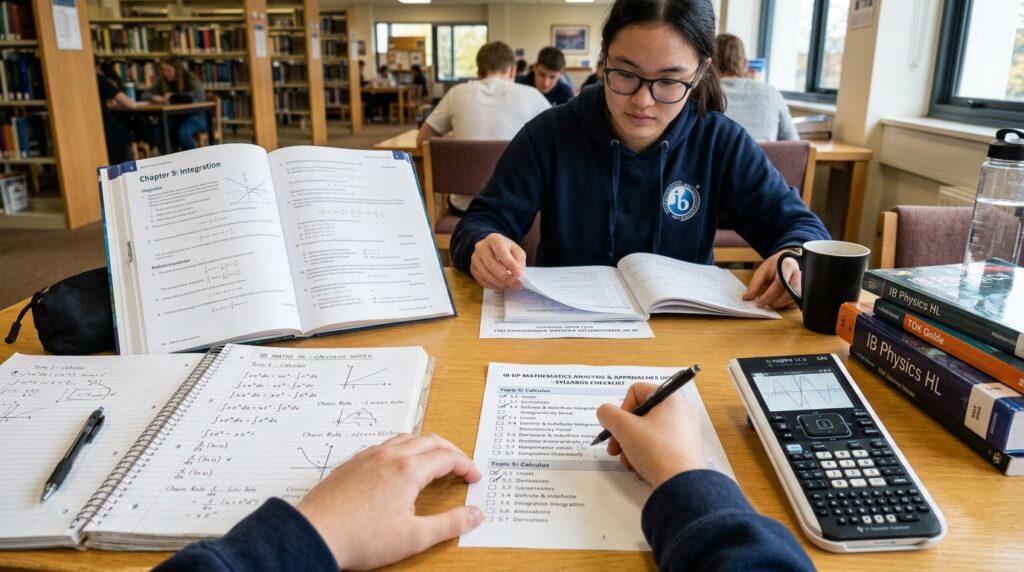
IB Maths: Analysis and Approaches Higher Level is designed for students who enjoy mathematical reasoning, abstract thinking, and solving complex problems.
Rather than focusing mainly on real-world modeling, the course emphasizes:
- Algebraic techniques
- Mathematical proof
- Analytical reasoning
- Calculus
- Functions
- Logical problem-solving
The syllabus is organized into five core content areas, with additional higher-level material that extends students’ understanding beyond the standard level.
Overview of the AA HL Syllabus
The syllabus consists of the following content areas.
| Topic | Main Focus |
|---|---|
| Number and Algebra | Algebraic manipulation, sequences, proofs, complex numbers |
| Functions | Graphs, transformations, modelling, composite and inverse functions |
| Geometry and Trigonometry | Trigonometric identities, vectors, three-dimensional geometry |
| Statistics and Probability | Statistical methods, probability distributions, hypothesis testing |
| Calculus | Differentiation, integration, differential equations, applications |
Each topic builds on previous mathematical knowledge, making consistent revision essential.
Number and Algebra
This topic develops the algebraic foundation required throughout the course.
Students study:
- Arithmetic and geometric sequences
- Binomial theorem
- Mathematical induction
- Complex numbers
- Proof techniques
- Exponential and logarithmic functions
Skills You Need
Students should be able to:
- Manipulate algebra confidently
- Recognise patterns
- Construct mathematical proofs
- Solve unfamiliar algebraic problems
Many mistakes later in the course can be traced back to weak algebra skills, making this one of the most important sections to master.
Functions
Functions appear throughout the IB Maths AA HL course and are closely linked with calculus.
Topics include:
- Polynomial functions
- Rational functions
- Exponential functions
- Logarithmic functions
- Composite functions
- Inverse functions
- Transformations
- Graph sketching
- Mathematical modelling
Students should understand both graphical behavior and algebraic properties.
Common Challenges
Students often struggle with:
- Domain and range
- Inverse functions
- Composite notation
- Graph transformations
- Linking graphs with equations
Regular practice with graph interpretation can improve confidence significantly.
Geometry and Trigonometry
This section combines geometric reasoning with advanced trigonometry.
Students learn:
- Circular functions
- Radian measure
- Trigonometric identities
- Equations
- Vectors
- Scalar product
- Vector equations
- Three dimensional geometry
These topics frequently appear in multistep examination questions.
Statistics and Probability
Statistics develops students’ ability to interpret data and apply probability concepts.
Topics include:
- Random variables
- Binomial distribution
- Normal distribution
- Conditional probability
- Probability density functions
- Hypothesis testing
- Statistical analysis
Students should be comfortable interpreting results rather than simply calculating answers.
Calculus
Calculus is generally considered the most demanding part of the syllabus and carries significant weight in examinations.
Students study:
- Limits
- Continuity
- Differentiation
- Implicit differentiation
- Integration
- Area under curves
- Differential equations
- Kinematics
- Optimisation
- Related rates
Many examination questions combine several calculus techniques into one problem, requiring strong conceptual understanding.
Higher Level Extension Topics
Compared with AA SL, higher level includes additional depth across the syllabus.
Examples include:
- Mathematical induction
- Complex numbers
- Advanced calculus applications
- Differential equations
- Proofs
- More sophisticated probability questions
These extension topics prepare students for mathematically demanding university courses.
Assessment of the Syllabus
The syllabus is assessed through both external examinations and an internal assessment.
| Assessment | Weight |
| Paper 1 | 30% |
| Paper 2 | 30% |
| Paper 3 | 20% |
| Internal Assessment | 20% |
Questions often require students to combine knowledge from multiple syllabus areas rather than treating topics independently.
How to Revise the IB Maths AA HL Syllabus
Studying topic by topic is useful, but it should not be your only revision strategy.
An effective approach includes:
Create a Topic Checklist
Break the syllabus into smaller sections and monitor your confidence in each one.
Practise Mixed Questions
Exams rarely test one isolated skill. Mixed practice develops flexibility and problem-solving ability.
Review Your Mistakes
Instead of simply checking answers, identify why an error occurred.
Ask yourself:
- Was it a conceptual misunderstanding?
- Was it an algebra mistake?
- Did I misread the question?
- Did I lose method marks?
This process helps prevent repeated mistakes.
Revise Weak Areas First
Many students repeatedly solve questions they already know because it feels productive.
Real progress comes from improving the topics you currently find most difficult.
How Mathzem Helps You Master the AA HL Syllabus
Covering the entire syllabus is only part of successful revision. You also need to understand which topics need the most attention.
Mathzem helps students study more efficiently by providing personalised AI examiner-style feedback.
After completing an IB-style question, you can upload your working and receive feedback showing the following:
- Marks awarded
- Errors in your method
- Missing working
- Weak syllabus topics
- Clear next steps for improvement
Your personalised dashboard also helps you:
- Track strengths and weaknesses across the syllabus
- Build a targeted revision plan
- Maintain a mistake journal
- Monitor progress over time
Instead of guessing what to revise next, you receive guidance based on your own performance.
Frequently Asked Questions About IB Maths AA HL Syllabus
What topics are included in the IB Maths AA HL syllabus?
The syllabus includes Number and Algebra, Functions, Geometry and Trigonometry, Statistics and Probability, and Calculus, along with additional higher-level content.
Which topic is the hardest?
Many students find calculus the most challenging because it combines multiple concepts and often appears in extended examination questions.
Is the AA HL syllabus larger than AA SL?
Yes. Higher Level covers additional content and explores several topics in greater depth.
How should I revise the syllabus?
Focus on understanding concepts first, practice IB-style questions regularly, review your mistakes, and prioritize weaker topics.
Conclusion
The IB Maths AA HL syllabus covers a wide range of advanced mathematical concepts that require consistent study and regular practice. Success comes from building a strong understanding of each topic, recognizing how different areas connect, and learning from every mistake you make.
Rather than treating revision as simply completing more questions, focus on identifying your weakest topics and improving them systematically.
Ready to find out which areas of the syllabus need the most attention? Start with the Math Skill Scanner.
Then put your knowledge into practice by uploading your solutions for AI examiner style feedback and a personalised revision plan.