IB Maths AA HL logarithms and exponentials, and equations can look very different, but they are closely connected. Once you understand how they relate, many questions become easier to recognise and solve.
The main challenge is choosing the right method. Sometimes you can rewrite both sides using the same base. In other questions, logarithms provide the quickest route to the answer. You may also need to simplify logarithmic expressions, use a change of base formula or reject a solution that is outside the domain.
This guide explains the main methods with worked examples, practical checks, and common mistakes to avoid in IB Maths AA HL.
Table of Contents
1. Understand the relationship between exponentials and logarithms
An exponential equation contains a variable in the exponent.
For example:
[
2^x=16
]
A logarithm allows you to express an exponent in a different way.
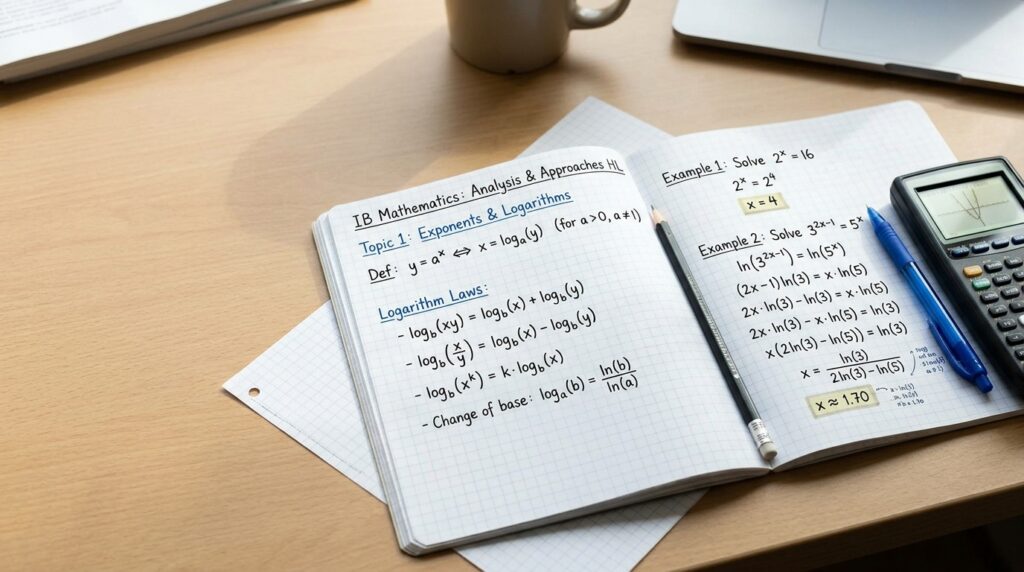
The key relationship is:
[
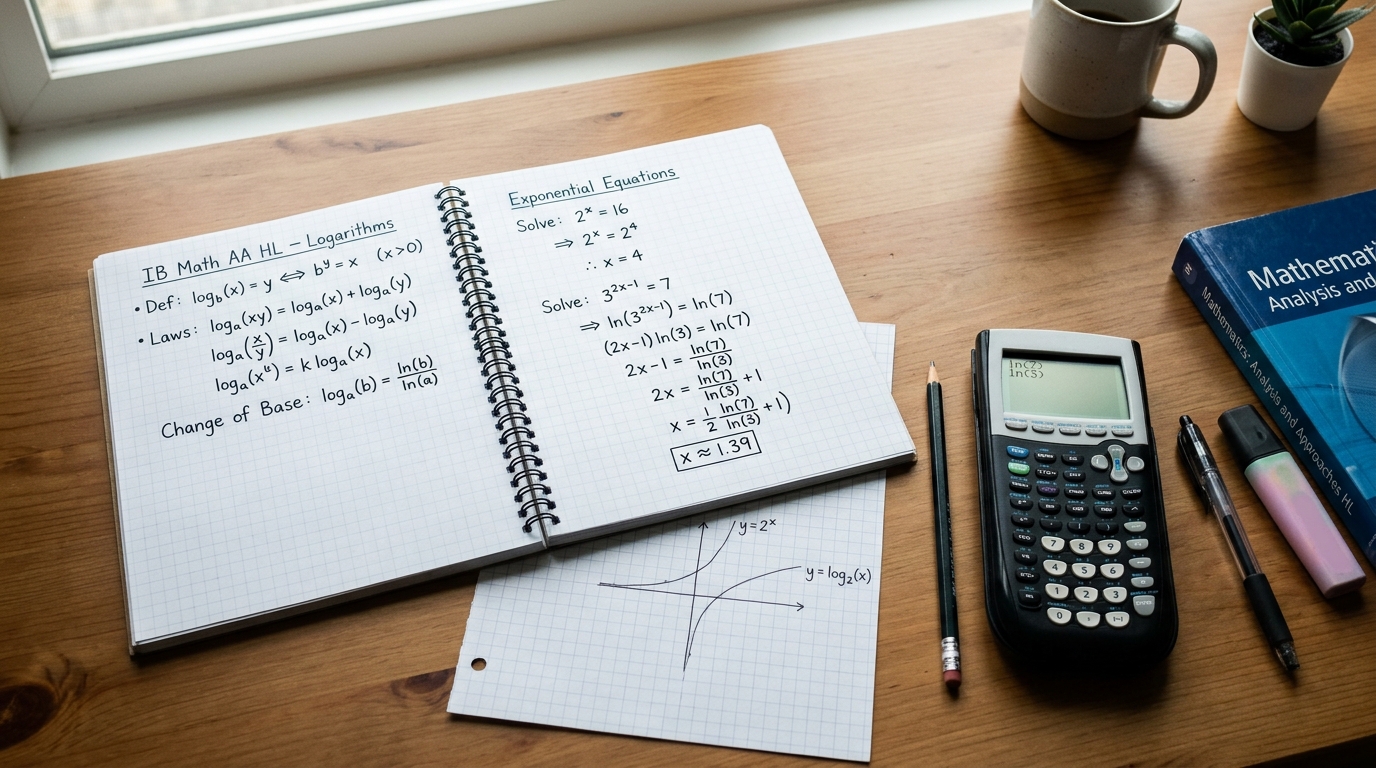
a^x=b\iff x=\log_a b
]
For real logarithms, the base must satisfy (a>0) and (a\ne1), while the argument must satisfy (b>0).
For example:
[
2^x=16
]
Since (16=2^4), we can write:
[
2^x=2^4
]
Therefore:
[
\boxed{x=4}
]
The logarithmic form gives the same result:
[
x=\log_2 16=4
]
The two approaches are equivalent. Your task is to recognise which one makes the question easier.
2. Learn the laws of logarithms
Three logarithm laws are especially useful.
Product law
[
\log_a(MN)=\log_a M+\log_a N
]
The logarithm of a product becomes the sum of two logarithms.
Quotient law
[
\log_a\left(\frac{M}{N}\right)=\log_a M-\log_a N
]
The logarithm of a quotient becomes a difference.
Power law
[
\log_a(M^k)=k\log_a M
]
The exponent moves to the front as a multiplier.
These laws are useful for simplifying expressions and solving equations. However, they only apply when the logarithms are defined. For real logarithms, their arguments must be positive.
For example:
[
\log_3 9+\log_3 27
]
Using the product law:
[
=\log_3(9\times27)
]
[
=\log_3 243
]
Since (243=3^5):
[
\boxed{5}
]
You could also evaluate the two logarithms separately:
[
2+3=5
]
Both methods work. The product law becomes especially useful when the expressions are less straightforward.
3. Solve exponential equations by matching bases
Before using logarithms, check whether both sides can be expressed using the same base.
Worked example
Solve:
[
3^{2x-1}=27
]
Step 1: Express both sides using the same base.
Since:
[
27=3^3
]
we obtain:
[
3^{2x-1}=3^3
]
Step 2: Equate the exponents.
The bases are equal and greater than one, so:
[
2x-1=3
]
Step 3: Solve the equation.
[
2x=4
]
[
\boxed{x=2}
]
This is usually the simplest method when the bases can be matched easily.
What if the bases initially look different?
Consider:
[
4^x=8
]
Rewrite both sides as powers of two:
[
(2^2)^x=2^3
]
Therefore:
[
2^{2x}=2^3
]
So:
[
2x=3
]
[
\boxed{x=\frac32}
]
Always look for a common base before reaching for a calculator.
4. Solve exponential equations using logarithms
Some equations cannot be solved easily by matching bases.
For example:
[
5^x=17
]
There is no simple integer power of five that equals 17. Taking logarithms gives a direct solution.
Step 1: Take the natural logarithm of both sides.
[
\ln(5^x)=\ln17
]
Step 2: Apply the power law.
[
x\ln5=\ln17
]
Step 3: Rearrange.
[
x=\frac{\ln17}{\ln5}
]
Therefore:
[
\boxed{x\approx1.760}
]
You could use logarithms with another valid base, such as base ten, and obtain the same result.
The important point is that the variable is in the exponent, so logarithms allow you to bring it down and solve for it.
5. Solve equations containing more than one exponential term
Some questions require an extra step before logarithms can be used.
Consider:
[
2^{2x}-5(2^x)+4=0
]
The expression contains both (2^{2x}) and (2^x). Notice that:
[
2^{2x}=(2^x)^2
]
This suggests a substitution.
Let:
[
u=2^x
]
The equation becomes:
[
u^2-5u+4=0
]
Factorise:
[
(u-1)(u-4)=0
]
Therefore:
[
u=1\quad\text{or}\quad u=4
]
Now substitute back.
Since (u=2^x):
[
2^x=1\implies x=0
]
And:
[
2^x=4\implies x=2
]
Hence:
[
\boxed{x=0\text{ or }x=2}
]
This substitution method is useful when an equation can be expressed as a quadratic in an exponential expression.
Do not take logarithms immediately if a simpler algebraic method is available.
6. Solve logarithmic equations carefully
A logarithmic equation contains the variable inside a logarithm.
Consider:
[
\log_2(x-1)=3
]
Convert the logarithmic equation into exponential form:
[
x-1=2^3
]
Therefore:
[
x-1=8
]
[
\boxed{x=9}
]
The conversion is direct because:
[
\log_a b=c\iff a^c=b
]
provided the logarithm is defined.
A more challenging example
Solve:
[
\log_3(x)+\log_3(x-2)=2
]
Step 1: Check the domain.
Both logarithmic arguments must be positive.
[
x>0,\qquad x-2>0
]
Together, these conditions require:
[
x>2
]
Step 2: Combine the logarithms.
Using the product law:
[
\log_3[x(x-2)]=2
]
Step 3: Convert to exponential form.
[
x(x-2)=3^2
]
[
x^2-2x=9
]
Rearrange:
[
x^2-2x-9=0
]
Using the quadratic formula:
[
x=\frac{2\pm\sqrt{4+36}}{2}
]
[
x=1\pm\sqrt{10}
]
Step 4: Check the domain.
The two candidates are:
[
x=1+\sqrt{10}
]
and
[
x=1-\sqrt{10}
]
The second value is less than two, so it is not allowed.
The valid solution is:
[
\boxed{x=1+\sqrt{10}}
]
This example shows why domain checks are essential. Algebra alone can produce candidates that do not satisfy the original equation.
7. Use the change of base formula
A calculator may not have a dedicated key for every logarithm base.
The change of base formula allows you to rewrite a logarithm using another base:
[
\log_a b=\frac{\ln b}{\ln a}
]
You can also use common logarithms:
[
\log_a b=\frac{\log b}{\log a}
]
For example:
[
\log_4 20
]
can be calculated as:
[
\frac{\ln20}{\ln4}
]
Therefore:
[
\boxed{\log_4 20\approx2.161}
]
This formula is particularly useful when a question requires a numerical solution or a logarithm with a base that is not directly available on your calculator.
Keep sufficient precision during intermediate calculations and round only when required.
8. Recognise exponential growth and decay
Exponential functions often model quantities that increase or decrease by a constant percentage over equal time intervals.
A common model is:
[
N(t)=N_0a^t
]
where (N_0) is the initial quantity, (a) is the multiplier for each time interval, and (t) is the number of intervals.
If the quantity increases by 8% per year, the multiplier is:
[
a=1+\frac{8}{100}=1.08
]
If it decreases by 8% per year, the multiplier is:
[
a=1-\frac{8}{100}=0.92
]
Worked example
A population is modelled by:
[
N(t)=500(1.08)^t
]
Find the time required for the population to reach 800.
Step 1: Set the model equal to 800.
[
500(1.08)^t=800
]
Step 2: Divide by 500.
[
(1.08)^t=1.6
]
Step 3: Take natural logarithms.
[
t\ln1.08=\ln1.6
]
Step 4: Solve for (t).
[
t=\frac{\ln1.6}{\ln1.08}
]
Therefore:
[
\boxed{t\approx6.12}
]
The model reaches 800 after approximately 6.12 time intervals.
If the context counts only completed years, explain how you interpret the result rather than automatically rounding to the nearest whole number.
9. Common mistakes to avoid
Applying logarithms to only one side
When solving an equation, apply the same operation to both sides.
For example, if (2^x=7), take the logarithm of both sides before rearranging.
Misusing the logarithm laws
The product law applies to multiplication inside a logarithm. It does not mean:
[
\log_a(M+N)=\log_a M+\log_a N
]
That identity is false.
Ignoring the domain
For real logarithms, every argument must be positive. Check the original equation after solving.
Confusing the base and the argument
In (\log_3 9), the base is three and the argument is nine. Since (3^2=9), the answer is two.
Rounding too early
Keep full calculator precision while solving. Early rounding can change the final result, particularly when logarithms are used to find a time or parameter.
Using a complicated method too soon
If the bases can be matched, do that first. If an exponential equation becomes a quadratic after substitution, factorise it before trying a numerical method.
10. A focused revision plan
Use this five session plan to practise the topic.
Session 1: Logarithm laws
Simplify expressions using the product, quotient and power laws. Check that each logarithm is defined.
Session 2: Exponential equations
Practise matching bases and solving equations where the variable is in the exponent.
Session 3: Logarithmic equations
Convert logarithms to exponential form and check the domain of every candidate solution.
Session 4: Mixed equations
Practise substitutions, change of base and equations requiring more than one method.
Session 5: Applied questions
Solve growth and decay problems. Explain what your answer means in the original context and round appropriately.
After each session, review every error and attempt a similar question independently. The goal is to recognise the structure of the equation rather than memorise a single worked example.
11. How Mathzem can support your practice
Knowing the rules is only the first step. You also need to choose an appropriate method when an equation is unfamiliar and show your working clearly.
Mathzem allows you to practise IB style mathematics questions, upload your handwritten working, and receive AI Examiner feedback on estimated marks, mistakes, and your method.
For logarithm and exponential questions, reviewing your working can help you identify whether you applied the correct law, selected an efficient method, and checked the validity of your solutions.
Start with Mathzem IB Practice and read how AI Examiner feedback works.
The aim is to build a consistent process: recognise the equation type, choose a method, solve carefully and verify that the answer satisfies the original conditions.
Frequently asked questions about IB Maths AA HL logarithms and exponentials
1. When should I use logarithms to solve an exponential equation?
Use logarithms when the variable is in the exponent and rewriting both sides with a common base does not give a straightforward solution.
2. What are the three main laws of logarithms?
The product law turns multiplication into addition, the quotient law turns division into subtraction, and the power law moves an exponent to the front as a multiplier.
3. Why must I check the domain of a logarithmic equation?
Real logarithms require positive arguments. Solving the transformed algebraic equation may produce values that make an original logarithm undefined.
4. What is the change of base formula?
It is (\log_a b=\frac{\ln b}{\ln a}). It lets you evaluate logarithms using a calculator that provides natural logarithms.
5. How should I practise exponential and logarithmic equations for IB Maths AA HL?
Start with the laws and basic equations, then practise equations requiring substitutions, domain checks and logarithms. Finish with applied questions and review why each method works.
Final takeaway
Exponentials and logarithms equations become easier when you identify their structure before calculating.
Try matching bases first, use logarithms when the variable is in the exponent, and check the domain whenever logarithms are involved. After solving, substitute your answer into the original equation where practical.
A correct method and a careful final check are more reliable than choosing a formula at random.