Introduction to IB Math Students Repeat
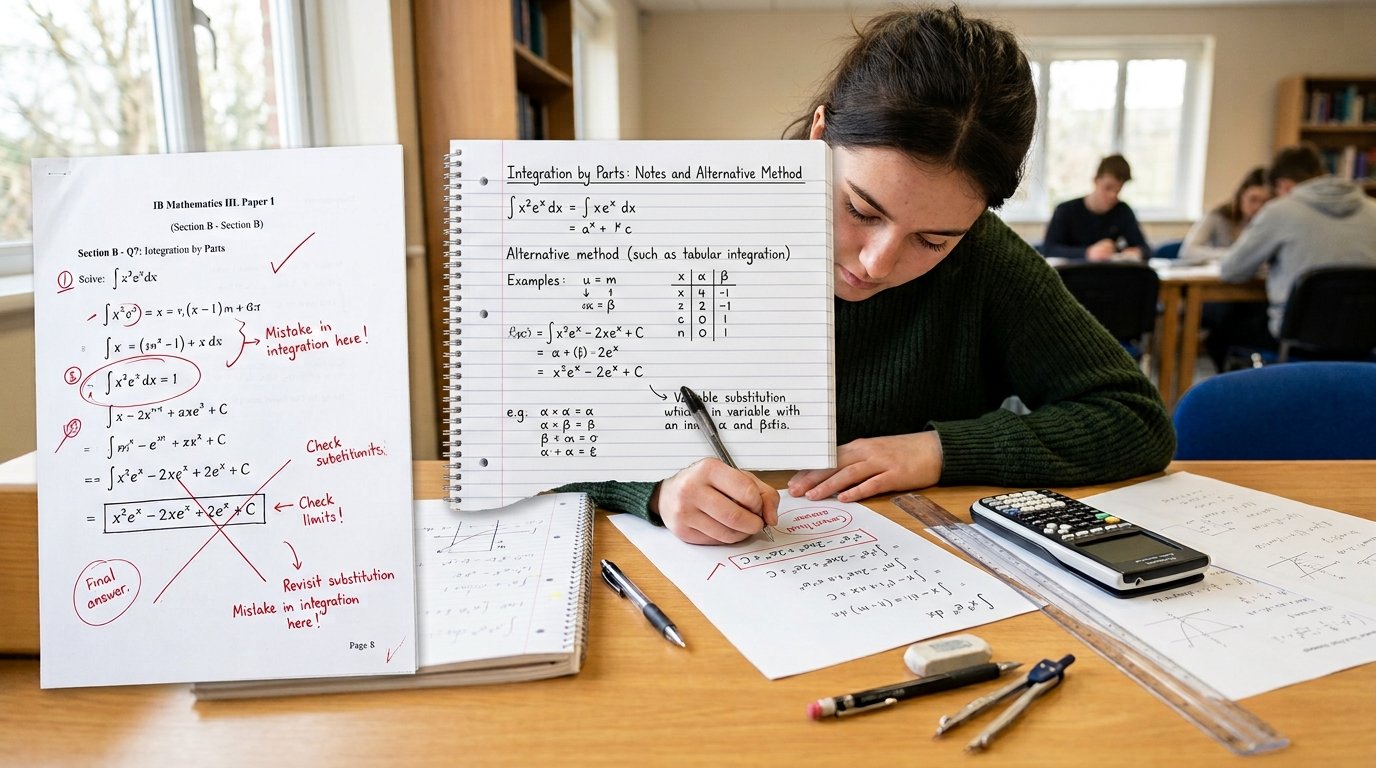
Most IB Math students have experienced this situation.
You complete a practice question, discover a mistake, understand what went wrong, and promise yourself that it will not happen again.
A week later, the same mistake appears in another question.
For many students, improvement is not limited by effort.
It is limited by repetition.
The same algebra errors, notation mistakes, calculator slips, and missing method steps continue appearing throughout the course.
Understanding why this happens is the first step towards solving the problem.
Table of Contents
Why Repeated Mistakes Are So Common
Mathematics is built on habits.
Students develop routines for:
- Solving equations
- Using formulas
- Entering values into calculators
- Writing notation
- Structuring solutions
When these habits are correct, they improve efficiency.
When they are incorrect, they create repeated mistakes.
Without active review, these habits can continue for months.
The Problem With Traditional Revision
Most revision follows a simple pattern:
- Complete a question.
- Check the answer.
- Move to the next question.
The issue is that mistakes are often forgotten quickly.
Students may recognise the error at the time but never revisit it.
As a result, the same mistake returns later in another topic or exam paper.
Not All Mistakes Are Topic Problems
Students often assume that repeated mistakes mean they do not understand the topic.
This is not always true.
For example:
A student may struggle in:
- Calculus
- Functions
- Statistics
At first glance, this appears to be three separate problems.
However, the real issue may simply be the following:
- Algebra manipulation
- Incorrect notation
- Calculator usage
- Missing units
The topic is not always the problem.
Sometimes the underlying skill is the issue.
Common Mistakes IB Math Students Repeat
Algebra Errors
Incorrect rearranging, factorisation mistakes, and sign errors appear across many topics.
Missing Method Steps
Students often jump directly to answers without showing sufficient working.
Notation Mistakes
Incorrect notation can cost marks even when the mathematics is correct.
Calculator Errors
Incorrect calculator settings and data entry mistakes are surprisingly common.
Misreading Questions
Students may solve a different problem from the one being asked.
Why Markschemes Cannot Solve This Problem
Markschemes show the expected solution.
They do not track patterns.
A mark scheme cannot tell you:
- Whether this is your fifth algebra mistake this month.
- Whether you regularly lose method marks.
- Whether notation issues occur across multiple topics.
Students need long term feedback rather than isolated corrections.
The Importance of Identifying Patterns
One mistake is usually an accident.
Ten similar mistakes often indicate a habit.
Identifying patterns allows students to:
- Focus revision more effectively.
- Improve exam technique.
- Reduce repeated errors.
- Increase confidence during assessments.
This is where structured feedback becomes valuable.
How Mathzem Helps Students Break the Cycle
Mathzem is designed to turn every mistake into useful information.
The process begins with practice.
Practise IB Style Questions
Students attempt realistic IB Mathematics questions.
Upload Your Working
Instead of checking only the final answer, students submit their complete solution.
Receive AI Examiner Feedback
The platform analyses:
- Estimated marks
- Method marks
- Missing steps
- Calculation errors
- Topic performance
This provides much deeper insights than answer checking alone.
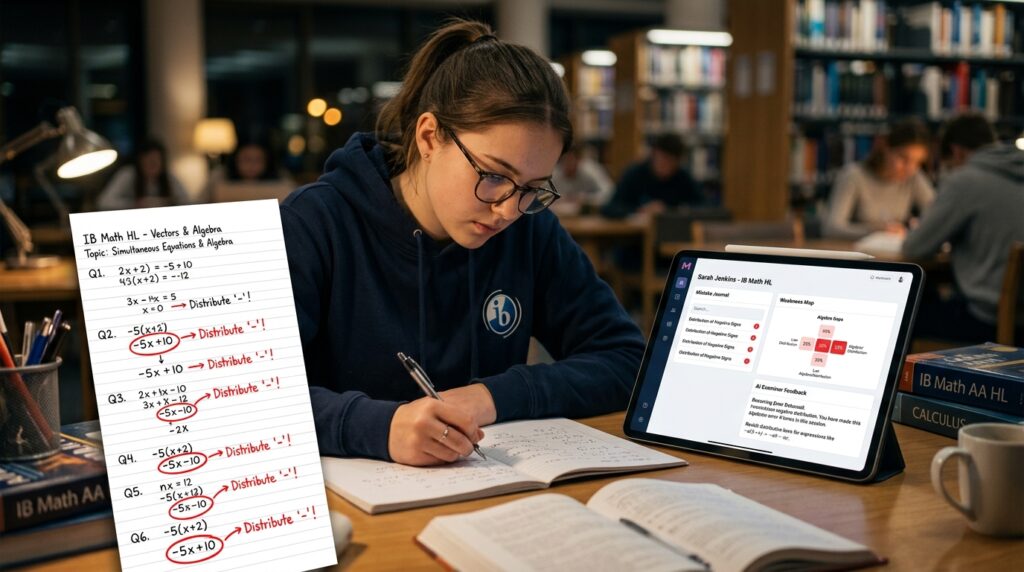
The Mistake Journal
One of the most powerful tools inside the Mathzem dashboard is the Mistake Journal.
Instead of forgetting mistakes, students build a record of recurring issues.
Examples include:
- Algebra mistakes
- Notation problems
- Calculator errors
- Missing reasoning
- Method mark losses
Over time, patterns become obvious.
Students can then focus revision on preventing these mistakes from returning.
The Weakness Map Adds Context
The Mistake Journal explains why mistakes occur.
The Weakness Map shows where they occur most often.
For example:
- Algebra errors may affect Calculus, Functions, and Probability.
- Notation mistakes may appear mainly in Statistics.
- Missing working may reduce marks across the entire syllabus.
This combination helps students target the real cause of lost marks.
From Mistakes to a Revision Plan
Every repeated mistake provides valuable information.
Instead of asking:
“Why do I keep getting this wrong?”
Students can ask:
- Which skill needs attention?
- Which topic is most affected?
- Which questions should I practise next?
This transforms mistakes into a practical revision strategy.
The Practice → Upload → Review → Improve Workflow
The Mathzem learning process follows a simple cycle.
Practise
Attempt IB-style questions.
Upload
Submit your complete mathematical working.
Review
Analyse AI examiner-style feedback and mistake patterns.
Improve
Focus revision on the skills causing repeated errors.
Repeating this process helps students make steady progress throughout the IB programme.
Conclusion
Making mistakes is a normal part of learning mathematics.
Repeating the same mistakes does not have to be.
Students improve faster when they identify patterns, understand the causes of lost marks, and use feedback to guide future revision.
Mathzem supports this process by combining IB-style practice questions, AI examiner-style feedback, Mistake Journals, Weakness Maps, and personalised revision recommendations.
Instead of simply correcting mistakes, students can begin learning from them.
Start Improving With Mathzem
Find your strongest and weakest IB Math topics
Practise IB-style questions and upload your working
Track mistakes, receive AI examiner feedback, and build smarter revision plans
FAQ About IB Math Students Repeat
Why do IB Math students repeat mistakes?
Repeated mistakes often come from habits, weak foundational skills, or a lack of structured feedback and review.
What types of mistakes are most common in IB Math?
Algebra mistakes, missing working, notation issues, calculator errors, and misreading questions are among the most common.
How does the Mistake Journal help?
The Mistake Journal tracks recurring errors over time, helping students identify patterns and focus revision more effectively.
How does AI feedback reduce repeated mistakes?
AI feedback analyses complete solutions, identifies patterns in errors, and provides recommendations for improvement.
How does Mathzem help students improve?
Mathzem helps students practise IB-style questions, upload their working, receive AI examiner-style feedback, track mistakes, identify weak topics, and create personalised revision plans.