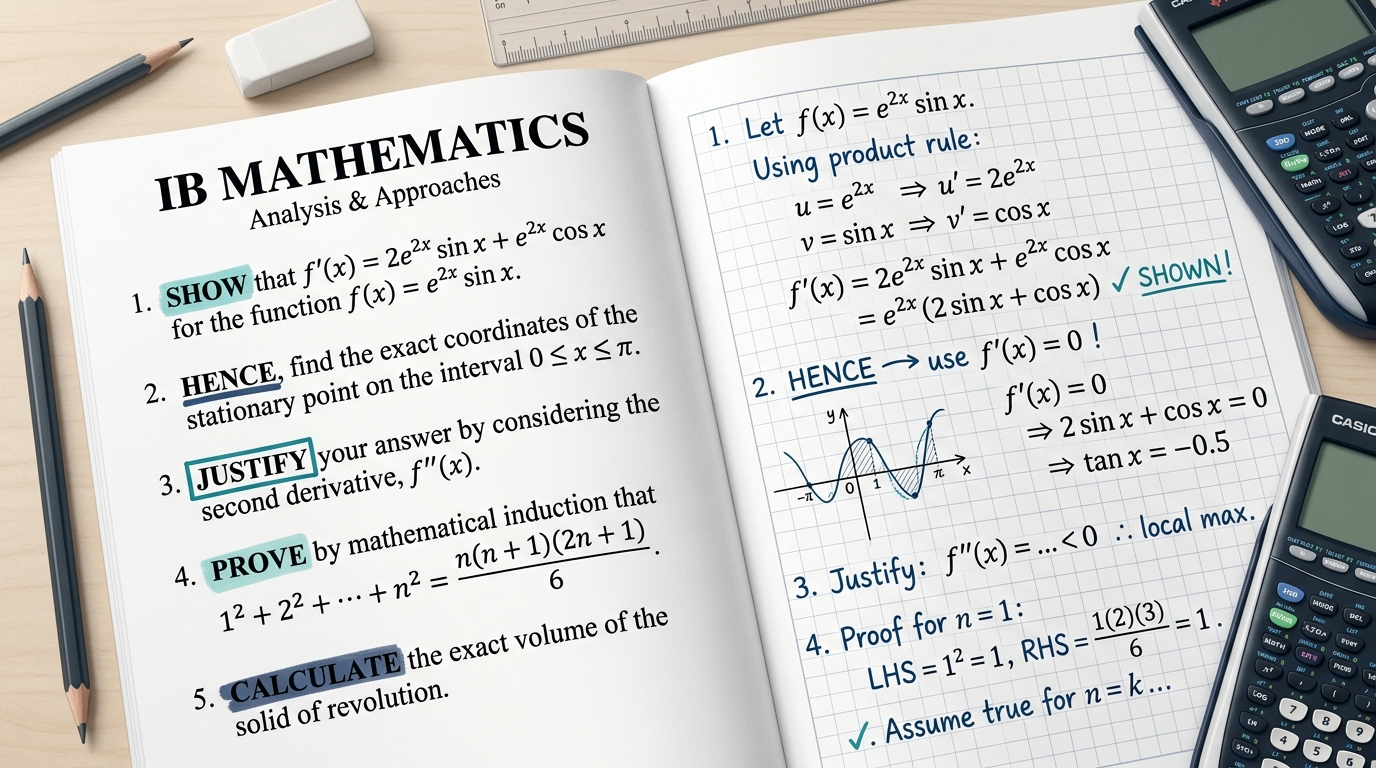
Introduction to IB Maths AA HL Taylor Maclaurin Series
Maclaurin series are an important part of the additional higher level content in IB Maths AA HL.
At first, the topic can look like a collection of expansions you need to memorise. You might know the series for (e^x), (\sin x), and (\cos x), but struggle when a question asks you to expand a different function, find a particular coefficient, or combine two series.
The real skill is understanding how the expansions work and how to adapt them.
For example, you might be asked to:
- Find a Maclaurin expansion using derivatives.
- Substitute an expression into a known series.
- Multiply or divide two expansions.
- Differentiate or integrate a series.
- Use an expansion to approximate a numerical value.
- Find an unknown coefficient.
This guide explains Taylor and Maclaurin series, works through the main techniques, and highlights common mistakes in IB Maths AA HL questions.
Syllabus note: Maclaurin series are included in the AA HL additional higher level calculus content. The syllabus covers expansions for exponential, trigonometric, logarithmic, inverse tangent, and binomial functions, alongside techniques for obtaining further series. You can check the wider IB Maths AA HL syllabus guide for the other topics you need to prepare.
Table of Contents
1. What is a Taylor series?
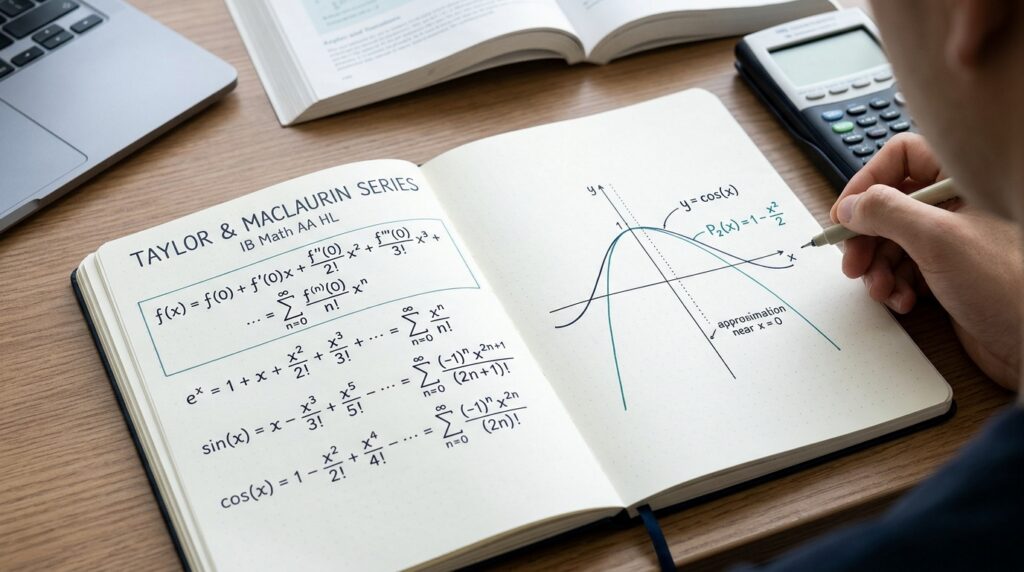
A Taylor series represents a function as an infinite sum of terms involving powers of the variable.
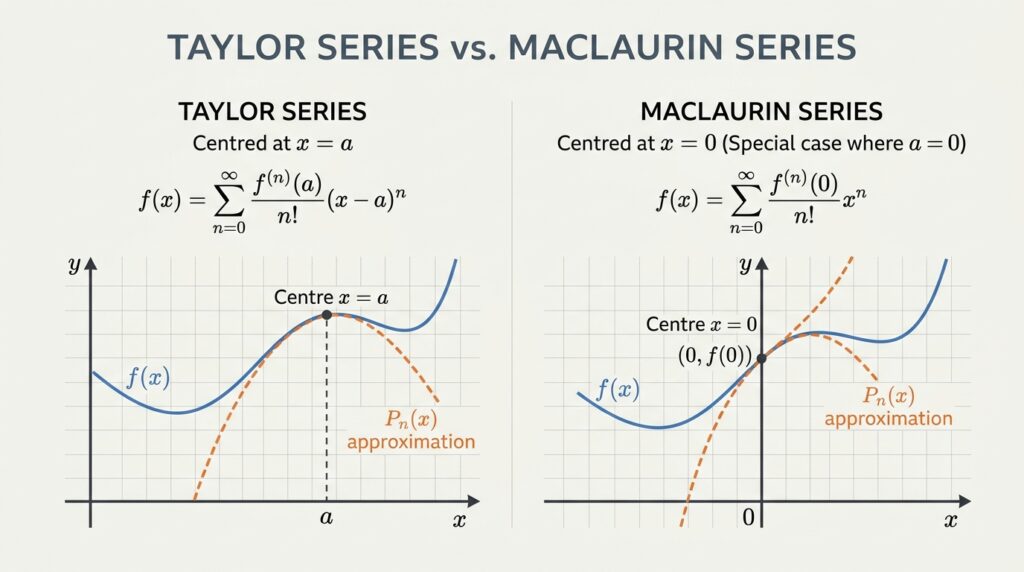
The general Taylor series for a function (f(x)), expanded about (x=a), is:
[
f(x)=f(a)+f'(a)(x-a)+\frac{f”(a)}{2!}(x-a)^2+\frac{f”'(a)}{3!}(x-a)^3+\cdots
]
Each term uses a derivative of the original function evaluated at (x=a).
The first few terms are:
[
f(x)=f(a)+f'(a)(x-a)+\frac{f”(a)}{2!}(x-a)^2+\cdots
]
The value of (a) determines the centre of the expansion.
2. What is a Maclaurin series?
A Maclaurin series is a special type of Taylor series where the expansion is centred at zero.
In other words:
[
a=0
]
Substituting zero into the general Taylor formula gives:
[
f(x)=f(0)+xf'(0)+\frac{x^2}{2!}f”(0)+\frac{x^3}{3!}f”'(0)+\cdots
]
This is the general Maclaurin formula.
The main difference is simple:
| Taylor series | Maclaurin series |
|---|---|
| Expanded about (x=a) | Expanded about (x=0) |
| Uses powers of ((x-a)) | Uses powers of (x) |
| Can be centred at different values | Always centred at zero |
For IB Maths AA HL, the Maclaurin expansions of particular functions are especially important.
3. Learn the standard Maclaurin expansions
Before attempting more complicated questions, become familiar with the standard expansions.
These are useful starting points because you can adapt them through substitution, multiplication, differentiation, and integration.
Expansion of (e^x)
The Maclaurin series for the exponential function is:
[
\boxed{
e^x=1+x+\frac{x^2}{2!}+\frac{x^3}{3!}+\frac{x^4}{4!}+\cdots
}
]
The pattern is:
[
e^x=\sum_{n=0}^{\infty}\frac{x^n}{n!}
]
Every power of (x) appears, and its coefficient is the reciprocal of the corresponding factorial.
Expansion of (\sin x)
The Maclaurin series for sine is:
[
\boxed{
\sin x=x-\frac{x^3}{3!}+\frac{x^5}{5!}-\frac{x^7}{7!}+\cdots
}
]
Notice that only odd powers appear.
The signs alternate between positive and negative.
Expansion of (\cos x)
The Maclaurin series for cosine is:
[
\boxed{
\cos x=1-\frac{x^2}{2!}+\frac{x^4}{4!}-\frac{x^6}{6!}+\cdots
}
]
Only even powers appear.
The first term is 1, which is different from the sine expansion.
Expansion of (\ln(1+x))
The Maclaurin series for the natural logarithm is:
[
\boxed{
\ln(1+x)=x-\frac{x^2}{2}+\frac{x^3}{3}-\frac{x^4}{4}+\cdots
}
]
This expansion is valid for:
[
-1<x\leq1
]
The endpoint (x=1) is included, while (x=-1) is excluded.
Expansion of (\arctan x)
The inverse tangent function has the expansion:
[
\boxed{
\arctan x=x-\frac{x^3}{3}+\frac{x^5}{5}-\frac{x^7}{7}+\cdots
}
]
This series converges for:
[
-1\leq x\leq1
]
Expansion of ((1+x)^p)
The binomial series for a rational power is:
[
\boxed{
(1+x)^p=
1+px+\frac{p(p-1)}{2!}x^2+
\frac{p(p-1)(p-2)}{3!}x^3+\cdots
}
]
For a general rational value of (p), the infinite expansion is valid for:
[
|x|<1
]
When (p) is a nonnegative integer, the binomial expansion terminates and becomes a finite polynomial.
For a closer look at binomial coefficients and general terms, read the IB Maths AA HL binomial theorem guide.
4. How to derive a Maclaurin series using derivatives
You do not always need to start by recalling a standard expansion.
You can derive a Maclaurin series directly from the derivative formula.
Consider:
[
f(x)=e^x
]
The first step is to calculate the derivatives.
[
f(x)=e^x
]
[
f'(x)=e^x
]
[
f”(x)=e^x
]
[
f”'(x)=e^x
]
Every derivative is the same function.
Now evaluate each derivative at zero:
[
f(0)=1
]
[
f'(0)=1
]
[
f”(0)=1
]
[
f”'(0)=1
]
Substitute these values into the Maclaurin formula:
[
f(x)=f(0)+xf'(0)+\frac{x^2}{2!}f”(0)+\frac{x^3}{3!}f”'(0)+\cdots
]
Therefore:
[
e^x=1+x+\frac{x^2}{2!}+\frac{x^3}{3!}+\cdots
]
This gives the required expansion.
Exam tip: If a question asks you to derive a Maclaurin series, show the derivatives and their values at zero. Do not simply write down the final expansion without explaining how you obtained it.
5. Worked example: Expand (e^{2x})
Questions often ask you to expand a function that contains a multiple of (x).
For example, find the Maclaurin expansion of:
[
e^{2x}
]
up to and including the term in (x^4).
Start with the standard expansion:
[
e^u=1+u+\frac{u^2}{2!}+\frac{u^3}{3!}+\frac{u^4}{4!}+\cdots
]
Let:
[
u=2x
]
Substitute (2x) into every occurrence of (u):
[
e^{2x}=1+2x+\frac{(2x)^2}{2!}+
\frac{(2x)^3}{3!}+\frac{(2x)^4}{4!}+\cdots
]
Simplify each term:
[
=1+2x+\frac{4x^2}{2}+
\frac{8x^3}{6}+\frac{16x^4}{24}+\cdots
]
Therefore:
[
\boxed{
e^{2x}=1+2x+2x^2+\frac{4}{3}x^3+\frac{2}{3}x^4+\cdots
}
]
The important point is that the substitution affects every power.
A common mistake is to replace (x) with (2x) in the first few terms but forget to square or cube the coefficient correctly.
6. Worked example: Expand (\sin(2x))
Find the Maclaurin expansion of:
[
\sin(2x)
]
up to and including the term in (x^5).
Start with:
[
\sin x=x-\frac{x^3}{3!}+\frac{x^5}{5!}+\cdots
]
Replace (x) with (2x):
[
\sin(2x)=2x-\frac{(2x)^3}{3!}+\frac{(2x)^5}{5!}+\cdots
]
Expand the powers:
[
=2x-\frac{8x^3}{6}+\frac{32x^5}{120}+\cdots
]
Simplify:
[
\boxed{
\sin(2x)=2x-\frac{4}{3}x^3+\frac{4}{15}x^5+\cdots
}
]
Notice that there are no (x^2) or (x^4) terms.
That is because the original sine expansion contains only odd powers.
7. Worked example: Expand ((1+x)^{1/2})
Fractional powers are another important application of Maclaurin series.
Find the expansion of:
[
(1+x)^{1/2}
]
up to and including the term in (x^4).
Use the general binomial expansion:
[
(1+x)^p=
1+px+\frac{p(p-1)}{2!}x^2+
\frac{p(p-1)(p-2)}{3!}x^3+\cdots
]
Here:
[
p=\frac12
]
Substitute this value:
[
=1+\frac12x+
\frac{\frac12(-\frac12)}{2}x^2+
\frac{\frac12(-\frac12)(-\frac32)}{6}x^3
]
Continue with the fourth power term:
[
+\frac{\frac12(-\frac12)(-\frac32)(-\frac52)}{24}x^4+\cdots
]
Simplify the coefficients:
1+\frac12x-\frac18x^2+
\frac1{16}x^3-\frac5{128}x^4+\cdots
}
]
For this infinite binomial expansion, the usual interval of convergence is:
[
|x|<1
]
This means you should check the value before using the expansion to calculate an approximation.
8. How to multiply two Maclaurin series
Sometimes a question gives you a product of two functions.
You may need to find the expansion of the combined expression.
Consider:
[
e^x\cos x
]
Find its expansion up to and including the term in (x^3).
Start with the two standard expansions:
[
e^x=1+x+\frac{x^2}{2}+\frac{x^3}{6}+\cdots
]
[
\cos x=1-\frac{x^2}{2}+\cdots
]
Multiply the two expressions:
[
e^x\cos x=
\left(1+x+\frac{x^2}{2}+\frac{x^3}{6}\right)
\left(1-\frac{x^2}{2}\right)
]
Collect terms with the same powers of (x).
Constant term:
[
1
]
Coefficient of (x):
[
x
]
Coefficient of (x^2):
[
\frac12x^2-\frac12x^2=0
]
Coefficient of (x^3):
[
\frac16x^3-\frac12x^3=-\frac13x^3
]
Therefore:
[
\boxed{
e^x\cos x=1+x-\frac13x^3+\cdots
}
]
The (x^2) term cancels completely.
Important: If you only need terms up to (x^3), you can ignore products that produce powers higher than three. This helps keep your working organised.
9. How differentiation and integration can produce new series
One of the useful features of Maclaurin series is that you can differentiate or integrate a known expansion to obtain another one.
Example using integration
Start with the geometric expansion:
[
\frac{1}{1-x}=1+x+x^2+x^3+\cdots
]
Replace (x) with (-x^2):
[
\frac{1}{1+x^2}=1-x^2+x^4-x^6+\cdots
]
Now integrate both sides with respect to (x):
\int(1-x^2+x^4-x^6+\cdots),dx
]
Integrating term by term gives:
[
\arctan x=x-\frac{x^3}{3}+\frac{x^5}{5}-\frac{x^7}{7}+\cdots
]
This produces the Maclaurin expansion for inverse tangent.
The same idea can be used to develop other expansions.
What should you remember?
When differentiating or integrating a series:
- Apply the operation to every term.
- Increase or decrease the power correctly.
- Adjust the coefficient.
- Include the constant of integration when appropriate.
- Keep track of the powers required by the question.
For more background on how differentiation and integration connect across the course, see the IB Maths AA HL calculus revision guide.
10. How to use Maclaurin series for approximations
A Maclaurin series can help you approximate values that are difficult to calculate directly.
Consider:
[
\ln(1.2)
]
We can write:
[
\ln(1.2)=\ln(1+0.2)
]
Use the expansion:
[
\ln(1+x)=x-\frac{x^2}{2}+\frac{x^3}{3}-\frac{x^4}{4}+\cdots
]
Substitute:
[
x=0.2
]
Therefore:
[
\ln(1.2)\approx
0.2-\frac{0.2^2}{2}
+\frac{0.2^3}{3}
-\frac{0.2^4}{4}
]
Calculate each term:
[
=0.2-0.02+0.0026667-0.0004
]
Hence:
[
\boxed{\ln(1.2)\approx0.1822667}
]
The actual value is approximately:
[
\ln(1.2)\approx0.1823216
]
The approximation is close to the actual value.
Adding more terms generally improves the approximation within the relevant interval of convergence.
Why does the number of terms matter?
A Maclaurin expansion is usually infinite.
In an exam question, you may be asked to use only the first few terms.
The more terms you include, the more information you use from the original function.
However, you should follow the exact instruction in the question. If it asks for an approximation using four terms, do not continue adding terms without reason.
11. How Maclaurin series connect with differential equations
Maclaurin series can also be developed using differential equations.
Consider:
[
\frac{dy}{dx}=y
]
with the initial condition:
[
y(0)=1
]
The solution is:
[
y=e^x
]
We can also see this through a Maclaurin expansion.
Let:
[
y=a_0+a_1x+a_2x^2+a_3x^3+\cdots
]
Differentiate:
[
y’=a_1+2a_2x+3a_3x^2+\cdots
]
Since (y’=y), compare the coefficients of corresponding powers.
Constant terms give:
[
a_1=a_0
]
The coefficient of (x) gives:
[
2a_2=a_1
]
Therefore:
[
a_2=\frac{a_0}{2}
]
The coefficient of (x^2) gives:
[
3a_3=a_2
]
Therefore:
[
a_3=\frac{a_0}{6}
]
From the initial condition (y(0)=1), we know:
[
a_0=1
]
So:
[
a_1=1,\qquad a_2=\frac12,\qquad a_3=\frac16
]
This produces:
[
y=1+x+\frac{x^2}{2!}+\frac{x^3}{3!}+\cdots
]
Therefore:
[
y=e^x
]
This shows how a differential equation can lead to a Maclaurin expansion.
12. Common mistakes in Taylor and Maclaurin questions
Even when you know the standard expansions, small errors can affect the final result.
Mistake 1: Confusing Taylor and Maclaurin series
A Taylor series may be centred at any value of (x).
A Maclaurin series is always centred at zero.
Check which expansion the question requires.
Mistake 2: Substituting incorrectly
When expanding (e^{3x}), you must substitute (3x) into every power.
For example:
[
(3x)^2=9x^2
]
and:
[
(3x)^3=27x^3
]
Do not forget to raise the coefficient as well as the variable.
Mistake 3: Using the wrong factorial
Remember:
[
3!=6,\qquad 4!=24,\qquad 5!=120
]
A factorial error can change several coefficients.
Mistake 4: Including unnecessary powers
If a question asks for terms up to (x^3), you should not spend time calculating the coefficient of (x^4).
Read the required order carefully.
Mistake 5: Forgetting the interval of convergence
Not every expansion works for every value of (x).
For example, the infinite binomial expansion for a general rational power has the standard interval:
[
|x|<1
]
Check the relevant conditions before using a series.
Mistake 6: Multiplying series without collecting like terms
When multiplying two expansions, several products may contribute to the same power.
Organise the terms by powers of (x) before simplifying.
Mistake 7: Rounding too early
Keep exact fractions during your working whenever possible.
Round only when the question requests a decimal approximation.
13. A practical revision plan for Maclaurin series
You can divide the topic into smaller sessions rather than trying to learn every technique at once.
| Session | Revision focus | Practice task |
|---|---|---|
| 1 | Taylor and Maclaurin basics | Derive expansions using derivatives |
| 2 | Standard expansions | Practise exponential, sine, cosine and logarithmic series |
| 3 | Binomial series | Expand fractional powers |
| 4 | Substitution | Find expansions of functions such as (e^{2x}) and (\sin(3x)) |
| 5 | Products and operations | Multiply, differentiate and integrate series |
| 6 | Approximation | Use expansions to estimate numerical values |
| 7 | Mixed questions | Solve unfamiliar AA HL questions under timed conditions |
After each session, review your working.
Ask yourself:
- Did I choose the correct standard expansion?
- Did I substitute correctly?
- Did I calculate each coefficient accurately?
- Did I include the correct powers?
- Did I follow the required order of the expansion?
- Did I check whether the expansion was valid for the value used?
For a wider revision structure, you can also use the IB Maths AA HL 30 day study plan.
14. How to practise Maclaurin series for IB exams
Reading the standard expansions is only the first step.
You need to practise recognising which technique a question requires.
Try these questions.
Question 1: Exponential expansion
Find the Maclaurin expansion of:
[
e^{3x}
]
up to and including the term in (x^3).
Question 2: Trigonometric expansion
Find the expansion of:
[
\cos(2x)
]
up to and including the term in (x^4).
Question 3: Binomial expansion
Find the first four nonzero terms of:
[
(1+x)^{1/3}
]
Question 4: Product of series
Find the expansion of:
[
e^x\sin x
]
up to and including the term in (x^3).
Question 5: Approximation
Use a Maclaurin expansion to estimate:
[
\ln(1.1)
]
using the first three nonzero terms.
Question 6: Integration
Starting with:
[
\frac{1}{1+x^2}=1-x^2+x^4-x^6+\cdots
]
obtain the Maclaurin expansion for:
[
\arctan x
]
Try each question independently before checking a worked solution.
The goal is to understand the process, not simply recognise the final expression.
15. How Mathzem can support your Maclaurin series practice
Maclaurin series questions often involve several connected steps.
You might remember the correct expansion but make an error when substituting a multiple of (x). Or you might multiply two series correctly but collect the coefficients incorrectly.
Reviewing your handwritten working can help you identify exactly where the method went wrong.
With Mathzem, you can:
- Choose your IB Mathematics course and a relevant practice topic.
- Attempt an exam style question on paper.
- Upload a picture of your handwritten solution.
- Review AI Examiner feedback on your working, method, mistakes, and estimated marks.
- Use the feedback to decide what you need to practise again.
The important part is reviewing the reasoning behind your answer, not just checking whether the final expression is correct.
Mathzem provides AI generated learning feedback and estimated marks, not official IB marking.
Frequently Asked Questions About IB Maths AA HL Taylor Maclaurin
What is the difference between a Taylor series and a Maclaurin series?
A Taylor series is centred at a chosen value (x=a). A Maclaurin series is a Taylor series centred specifically at zero.
Which Maclaurin expansions should AA HL students know?
The AA HL syllabus includes expansions for (e^x), (\sin x), (\cos x), (\arctan x), (\ln(1+x)), and ((1+x)^p), where (p) is rational.
How do you derive a Maclaurin series?
Calculate the derivatives of the function, evaluate them at zero, and substitute the results into the Maclaurin formula.
Why do some Maclaurin expansions contain only odd powers?
Some functions have symmetry that causes certain coefficients to become zero. For example, the sine expansion contains only odd powers, while the cosine expansion contains only even powers.
Can you multiply two Maclaurin series?
Yes. Multiply the terms and collect the coefficients of matching powers. Keep only the powers required by the question.
How are Maclaurin series used for approximations?
Substitute the required value into a suitable expansion and calculate using the requested number of terms. Check that the value lies within the relevant interval of convergence.
Final thoughts
Taylor and Maclaurin series become easier when you understand how the expansions are constructed.
Start with the general formula.
Learn the standard expansions.
Practise substitution, multiplication, differentiation, and integration.
Then use the series to solve approximation questions.
Most importantly, do not treat every expansion as a separate formula to memorise. Learn how one known expansion can help you construct another.
With regular practice, you will become more confident in recognising the right method and applying it to unfamiliar IB Maths AA HL questions.
Use Mathzem to practise exam style questions, review your handwritten working, and identify the exact steps that need more attention.