Sequences and series can look straightforward when you first learn them. You identify a pattern, substitute values into a formula, and calculate an answer.
In IB Maths AA HL sequences exams, however, the challenge is often deciding which formula to use. A question may describe a pattern in words, give you two terms, ask you to find the number of terms, or require you to decide whether an infinite sum exists.
The most reliable approach is to identify the pattern first, choose the appropriate formula, and check that your answer makes sense in the context of the question.
This guide explains how to solve the main types of sequence and series questions, with worked examples and common mistakes to avoid.
Table of Contents
1. Understand the difference between a sequence and a series
A sequence is an ordered list of numbers.
For example:
[
3,\ 7,\ 11,\ 15,\ 19,\ldots
]
A series is the sum of the terms in a sequence.
For the sequence above, the corresponding series begins:
[
3+7+11+15+19+\cdots
]
This distinction matters because questions about individual terms and questions about sums require different formulas.
If a question asks for the twentieth term, you need a term formula. If it asks for the sum of the first twenty terms, you need a series formula.
Before calculating anything, underline what the question is asking you to find.
2. How to solve arithmetic sequence questions

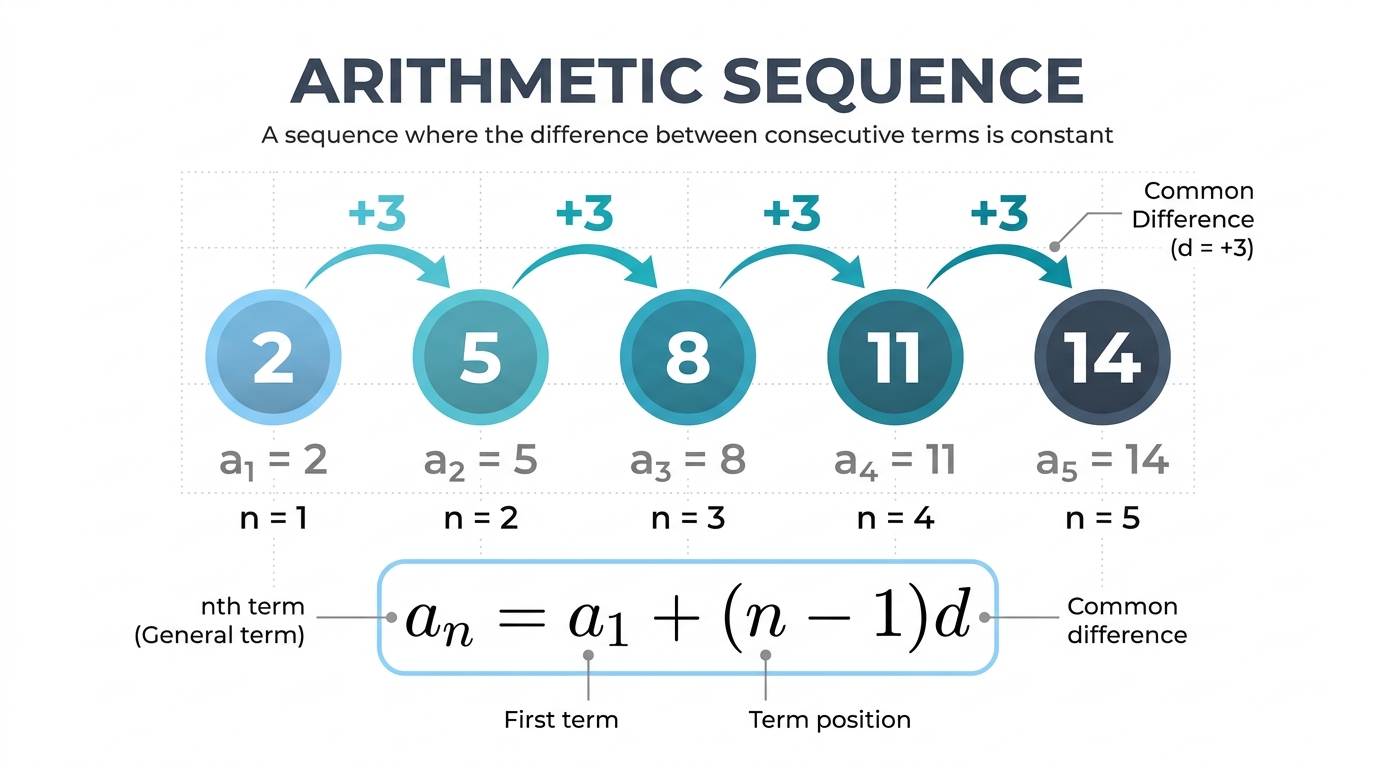
An arithmetic sequence has a constant difference between consecutive terms.
Consider:
[
5,\ 9,\ 13,\ 17,\ 21,\ldots
]
Each term increases by four. The common difference is therefore:
[
d=4
]
The formula for the (n)th term is:
[
u_n=a+(n-1)d
]
where:
(a) is the first term.
(d) is the common difference.
(n) is the term number.
Worked example
Find the twentieth term of the sequence:
[
5,\ 9,\ 13,\ 17,\ldots
]
Step 1: Identify the known values.
[
a=5,\qquad d=4,\qquad n=20
]
Step 2: Substitute into the formula.
[
u_{20}=5+(20-1)(4)
]
[
=5+76
]
[
\boxed{u_{20}=81}
]
The twentieth term is 81.
When the first term is not given directly
IB questions may provide two terms instead of the first term and common difference.
Suppose:
[
u_4=14,\qquad u_{10}=38
]
Use the general formula:
[
u_n=a+(n-1)d
]
The two known terms give:
[
a+3d=14
]
[
a+9d=38
]
Subtract the first equation from the second:
[
6d=24
]
[
d=4
]
Substitute into the first equation:
[
a+12=14
]
[
a=2
]
Therefore, the first term is 2 and the common difference is 4.
This method is useful whenever a question gives you two terms and asks you to determine the sequence.
3. How to find the sum of an arithmetic series
If you need the sum of the first (n) terms of an arithmetic sequence, use:
[
S_n=\frac{n}{2}(a+l)
]
Here, (l) is the last term included in the sum.
An equivalent formula is:
[
S_n=\frac{n}{2}[2a+(n-1)d]
]
Use the first formula when you know the first and last terms. Use the second when you know the first term, common difference and number of terms.
Worked example
Find the sum of the first 20 terms of:
[
5,\ 9,\ 13,\ 17,\ldots
]
From the previous example:
[
a=5,\qquad l=81,\qquad n=20
]
Therefore:
[
S_{20}=\frac{20}{2}(5+81)
]
[
=10(86)
]
[
\boxed{S_{20}=860}
]
A useful check is to notice that the average of the first and last terms is 43. Multiplying this average by 20 gives 860, which confirms the result.
4. How to recognise a geometric sequence
A geometric sequence has a constant ratio between consecutive terms.
For example:
[
3,\ 6,\ 12,\ 24,\ 48,\ldots
]
Each term is multiplied by two. The common ratio is:
[
r=2
]
The formula for the (n)th term is:
[
u_n=ar^{n-1}
]
where (a) is the first term and (r) is the common ratio.
Worked example
Find the eighth term of:
[
3,\ 6,\ 12,\ 24,\ldots
]
Identify the values:
[
a=3,\qquad r=2,\qquad n=8
]
Substitute:
[
u_8=3(2)^{8-1}
]
[
=3(128)
]
[
\boxed{u_8=384}
]
Notice that the exponent is (n-1), not (n). The first term corresponds to an exponent of zero because (ar^0=a).
How to distinguish arithmetic from geometric patterns
Consider these two sequences:
[
4,\ 8,\ 12,\ 16,\ldots
]
[
4,\ 8,\ 16,\ 32,\ldots
]
In the first sequence, the difference is always four. It is arithmetic.
In the second sequence, each term is multiplied by two. It is geometric.
Do not decide that a sequence is arithmetic or geometric based on the first two terms alone. Check whether the difference or ratio remains constant.
5. How to calculate the sum of a geometric series
For a geometric series with first term (a), common ratio (r), and (n) terms, the sum is:
[
S_n=\frac{a(1-r^n)}{1-r},\qquad r\ne1
]
You may also see the equivalent form:
[
S_n=\frac{a(r^n-1)}{r-1}
]
Both formulas give the same result.
Worked example
Find the sum of the first six terms of:
[
3,\ 6,\ 12,\ 24,\ldots
]
The known values are:
[
a=3,\qquad r=2,\qquad n=6
]
Substitute:
[
S_6=\frac{3(1-2^6)}{1-2}
]
[
=\frac{3(1-64)}{-1}
]
[
=\frac{-189}{-1}
]
[
\boxed{S_6=189}
]
You can check by adding the terms:
[
3+6+12+24+48+96=189
]
When working under exam conditions, use the formula to reduce unnecessary arithmetic, then check whether the result is reasonable.
6. How to solve infinite geometric series questions
An infinite geometric series continues without a final term.
For example:
[
12+6+3+1.5+\cdots
]
Each term is half the previous term, so:
[
a=12,\qquad r=\frac12
]
An infinite geometric series has a finite sum only when:
[
|r|<1
]
When this condition is satisfied, the sum to infinity is:
[
S_\infty=\frac{a}{1-r}
]
For the example:
[
S_\infty=\frac{12}{1-\frac12}
]
[
=\frac{12}{\frac12}
]
[
\boxed{S_\infty=24}
]
The terms become smaller and approach zero, allowing the total to approach a finite value.
What if the common ratio is greater than one?
Consider:
[
2+6+18+54+\cdots
]
Here:
[
r=3
]
Since (|3|) is greater than one, the series does not converge to a finite sum. You cannot use the sum to infinity formula to obtain a finite answer.
Always check the convergence condition before calculating.
7. How to find the number of terms
Some questions give you a term value or a total and ask how many terms are involved.
For a geometric sequence, begin with:
[
u_n=ar^{n-1}
]
Suppose the sequence begins at 2 and has a common ratio of 3. Find the term number for which the term equals 486.
Set up the equation:
[
2(3)^{n-1}=486
]
Divide by two:
[
3^{n-1}=243
]
Since:
[
243=3^5
]
we obtain:
[
n-1=5
]
Therefore:
[
\boxed{n=6}
]
For less obvious values, logarithms may be needed to solve for (n).
A common mistake is to solve correctly for the exponent and then forget to add one to obtain the term number.
8. How to approach sequence questions in context
Not every question presents a neat list of numbers. You may be given a real situation involving growth, repeated changes or a pattern over time.
For example, a quantity starts at 500 and increases by 6% each year.
The multiplier is:
[
1+\frac{6}{100}=1.06
]
If the initial quantity is represented by (a), the quantity after (n) yearly increases can be modelled using:
[
u_n=a(1.06)^n
]
Be careful about what the question calls the initial value and the first term. If the initial value is counted as year zero, then the value after five increases is (a(1.06)^5). If the initial value is labelled the first term, the term numbering must be interpreted accordingly.
Always identify the starting point and the number of changes before substituting values.
9. Common mistakes to avoid
Using the wrong formula
Arithmetic sequences use a common difference. Geometric sequences use a common ratio. Check the pattern before choosing a formula.
Confusing a term with a sum
The (n)th term is one value. The sum of the first (n) terms includes all terms from the first to the (n)th.
Using the wrong exponent
For a geometric sequence, the (n)th term is (ar^{n-1}). The exponent is one less than the term number.
Forgetting the convergence condition
A sum to infinity exists for a geometric series only if (|r|<1).
Rounding too early
Keep exact values or sufficient calculator precision during intermediate steps. Round only when the question requires it.
Ignoring the wording
A question may ask for a term number, a common ratio, a sum or an interpretation of a model. Make sure your final answer addresses the actual request.
10. A focused revision plan
Use the following plan to strengthen your sequence and series skills.
Session 1: Arithmetic sequences
Practice finding the common difference, the (n)th term, and unknown values from two known terms.
Session 2: Arithmetic series
Work on sums, including questions where the final term or number of terms must first be found.
Session 3: Geometric sequences and series
Practise common ratios, individual terms, and finite sums.
Session 4: Infinite series
Focus on convergence, the sum to infinity and questions involving unknown ratios.
Session 5: Mixed exam questions
Solve questions without knowing in advance which formula is needed. This trains you to recognise the structure of the problem rather than simply repeat a familiar calculation.
After each session, review your mistakes and solve a similar question independently. If you repeatedly choose the wrong formula, practise identifying the pattern before attempting the calculation.
11. How Mathzem can support your practice
Understanding the formulas is only one part of preparing for IB Maths AA HL. You also need to apply them accurately when the question is unfamiliar.
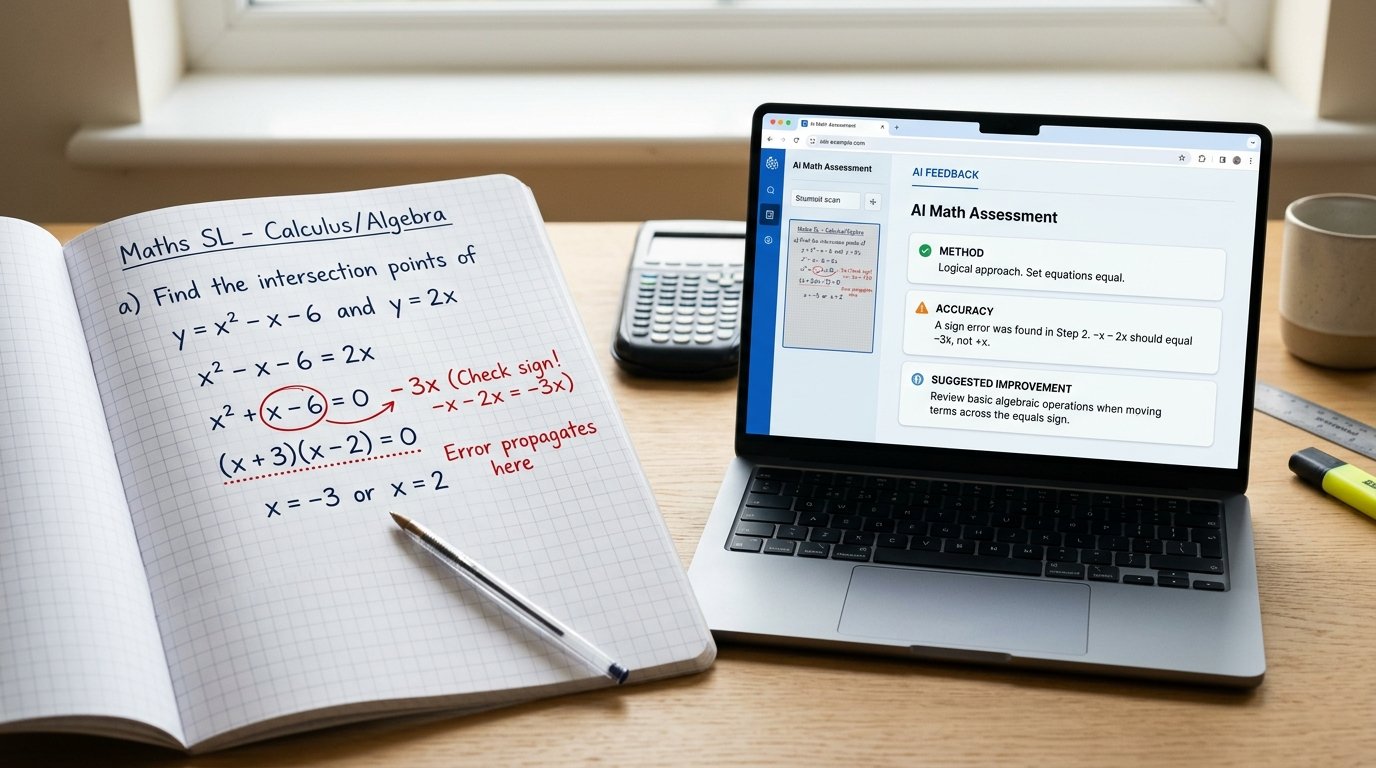
With Mathzem, you can practise IB style mathematics questions, upload your handwritten working, and receive AI Examiner feedback on estimated marks, mistakes, and your mathematical method.
For sequences and series, reviewing your working can help you identify whether you selected the right formula, substituted the correct values, and explained your reasoning clearly.
Start with Mathzem IB Practice and explore how AI Examiner feedback works.
The aim is to move beyond memorising formulas. You should be able to recognise the pattern, select the method and apply it confidently to a question you have not seen before.
Frequently asked questions about IB Maths AA HL sequences
1. What is the difference between a sequence and a series?
A sequence is an ordered list of terms. A series is the sum of those terms.
2. How can I tell whether a sequence is arithmetic or geometric?
Check consecutive differences. If they are constant, the sequence is arithmetic. If consecutive terms have a constant ratio, it is geometric.
3. What is the formula for the sum of an arithmetic series?
Use (S_n=\frac{n}{2}(a+l)), where (a) is the first term and (l) is the final term in the sum.
4. When can I use the sum to infinity formula?
For a geometric series, the sum to infinity formula applies when the absolute value of the common ratio is less than one.
5. How should I practise IB Maths AA HL sequences and series?
Practise arithmetic and geometric questions separately first. Then attempt mixed questions, review errors and repeat similar questions without referring to worked solutions.
Final takeaway
IB Maths AA HL Sequences and series become easier when you learn to identify the pattern before choosing a formula.
Remember the distinction between a term and a sum, check whether the sequence is arithmetic or geometric, and verify the convergence condition before calculating an infinite sum.
Consistent practice and careful review will help you apply these methods more reliably in IB Maths AA HL exams.