You can understand a mathematical statement and even suspect that it is true, but proving it is another matter.
This is where many IB Mathematics Analysis and Approaches Higher Level students struggle. They recognise a pattern, try a few calculations, and arrive at a result that seems convincing. However, when a question asks them to prove a statement, they are unsure how to turn their observations into a logical argument.
The key difference is that a proof must establish why a statement is true, not simply show that it works in a few examples.
To improve at IB Math AA HL proof questions, learn to identify the statement you need to establish, choose an appropriate proof method, and write each logical step clearly. This guide explains how to do that, with examples and practical revision advice.
Table of Contents
What is a mathematical proof?
A mathematical proof is a logical argument that establishes the truth of a statement using accepted facts, definitions, assumptions, and previously established results.
Consider the statement:
The sum of two even integers is always even.
You could test several pairs:
(2+4=6)
(8+10=18)
(12+16=28)
Every example supports the statement. However, no finite collection of examples proves that the statement is true for every possible pair of even integers.
For a proof, represent any even integers as (2a) and (2b), where (a) and (b) are integers.
Their sum is
(2a+2b=2(a+b))
Since (a+b) is an integer, the sum is twice an integer. Therefore, the sum is even.
This argument covers every pair of even integers, which is what makes it a proof.
Step 1: Understand exactly what you need to prove
Before writing equations, read the statement carefully.
Ask yourself three questions:
- What assumptions am I allowed to use?
- What must I establish?
- Does the statement apply to one value, several cases, or every value in a defined set?
The wording matters.
A question asking you to show that a particular equation holds may require direct algebraic manipulation. A question asking you to prove a statement for every positive integer may require mathematical induction or a general argument.
If the question contains a condition, use it. If it specifies that a variable is an integer, positive, or nonzero, do not ignore that restriction.
Many proof attempts become unnecessarily complicated because students start manipulating symbols before understanding the logical goal.
Step 2: Choose a suitable proof method
Different statements call for different approaches. The following methods are useful to recognise when studying IB Mathematics AA HL.
Direct proof
In a direct proof, begin with the given assumptions and use valid mathematical steps to reach the required conclusion.
For example, prove that the square of an odd integer is odd.
Let an odd integer be
(n=2k+1)
where (k) is an integer.
Squaring gives
(n^2=(2k+1)^2)
(n^2=4k^2+4k+1)
Factor the even part:
(n^2=2(2k^2+2k)+1)
Since (2k^2+2k) is an integer, (n^2) has the form (2m+1), where (m) is an integer.
Therefore, the square of an odd integer is odd.
Notice the structure. The proof starts with the definition of an odd integer and ends with the same defining form.
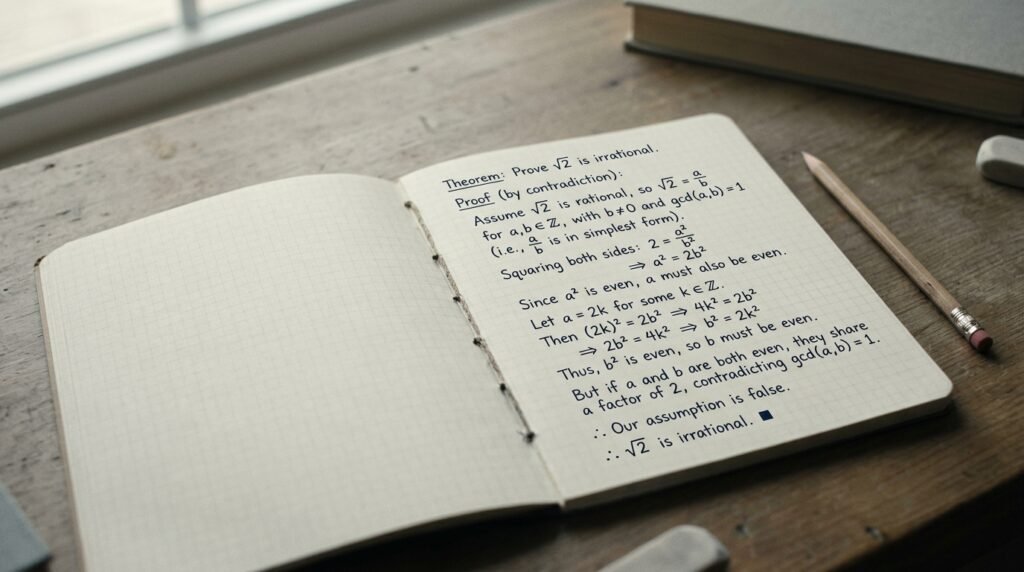
Proof by contradiction
In a proof by contradiction, assume that the statement you want to prove is false. Then show that this assumption leads to a contradiction.
This method can be useful when assuming the opposite makes the problem easier to analyse.
For example, suppose you want to prove that there is no greatest integer.
Assume that a greatest integer exists and call it N.
Because (N) is an integer, (N+1) is also an integer. But
(N+1>N)
This contradicts the assumption that (N) is the greatest integer.
Therefore, there is no greatest integer.
The essential step is identifying the contradiction. Simply writing that the opposite is impossible is not enough. You must demonstrate why it leads to an inconsistency.
Mathematical induction
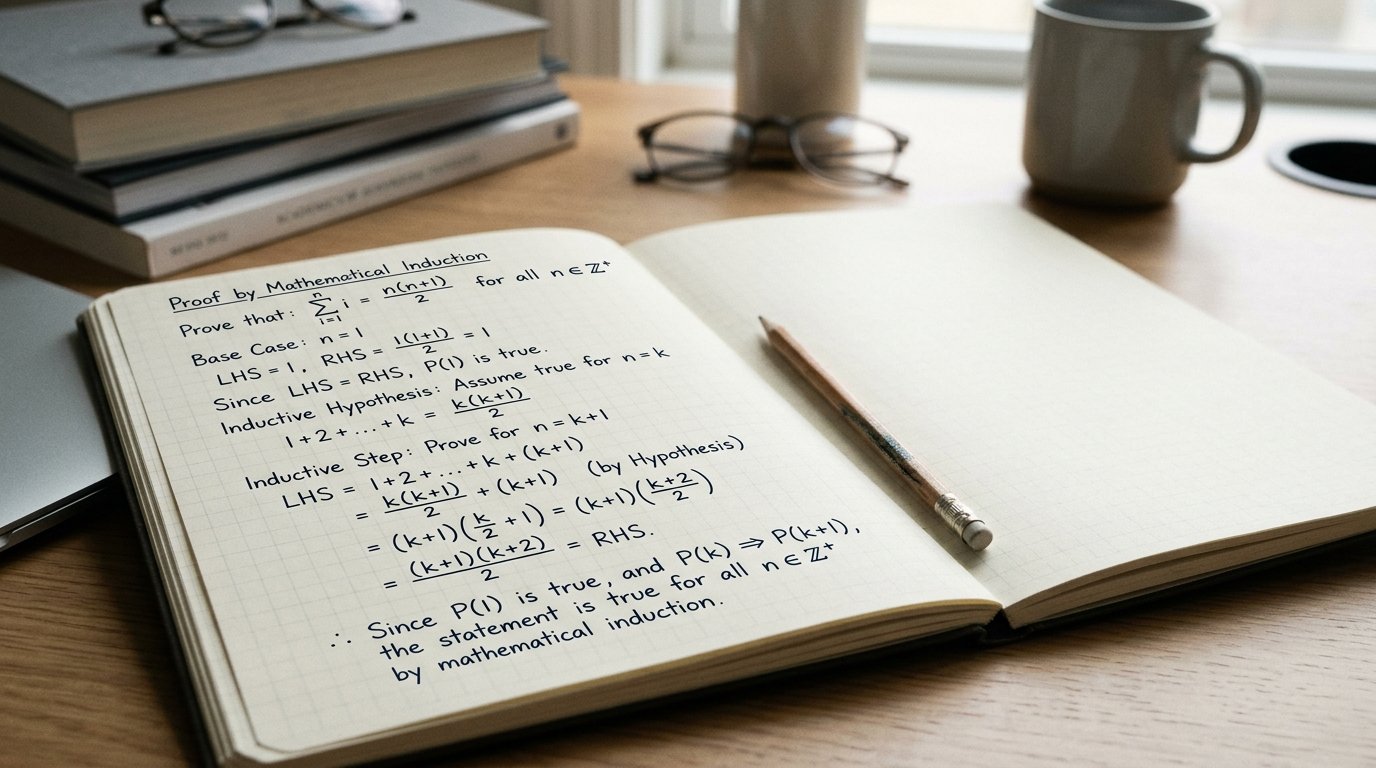
Mathematical induction is a method for proving statements about positive integers. It is especially useful when a statement follows a repeating structure, such as a formula for a sum.
A standard induction proof contains two main stages:
Base case: Show that the statement is true for the first required integer.
Inductive step: Assume that the statement is true for an integer (n=k), then use that assumption to prove it for (n=k+1).
Consider the statement.
(1+2+\cdots+n=\frac{n(n+1)}{2})
for every positive integer (n).
Base case
For n=1, the left hand side is 1.
The right hand side is
(\frac{1(1+1)}{2}=1)
Both sides agree, so the statement is true for (n=1).
Inductive assumption
Assume the statement holds for (n=k):
(1+2+\cdots+k=\frac{k(k+1)}{2})
Inductive step
For (n=k+1), consider
(1+2+\cdots+k+(k+1))
Using the inductive assumption, this becomes
(\frac{k(k+1)}{2}+(k+1))
Factor out (k+1):
(\frac{(k+1)(k+2)}{2})
This is exactly the required formula with (n=k+1).
The statement is therefore true for every positive integer (n), by mathematical induction.
A common mistake is to verify the base case and then assume that the result must hold for every integer. The inductive step is essential because it establishes the connection between one case and the next.
Using a counterexample
A counterexample is a value that demonstrates that a universal statement is false.
Suppose someone claims:
(x^2>x) for every real number (x).
Choose (x=\frac12).
Then
(x^2=\frac14)
But
(\frac14<\frac12)
The claimed inequality does not hold for this value, so the statement is false.
One counterexample is sufficient to disprove a statement that claims to hold for every value in its specified domain.
However, examples that support a statement do not usually prove a universal claim. This distinction is important when deciding whether testing values is enough.
Step 3: Make every logical step clear
A proof is not just a sequence of equations. The reader must be able to follow why one line leads to the next.
For example, avoid writing several unrelated expressions and then jumping to the conclusion. State the assumption, show the transformation, and explain the result when the logic is not immediately obvious.
Useful phrases include:
- Let (n) be an arbitrary positive integer.
- Assume the statement holds for (n=k).
- Substituting the given condition gives…
- Since (k) is an integer…
- This contradicts the original assumption.
- Therefore, the required statement is established.
These phrases should explain real mathematical reasoning, not replace it.
Also, be careful with algebraic operations. Dividing by an expression that might be zero can remove valid cases. Squaring both sides of an equation can introduce extra solutions. Changing the direction of an inequality may be necessary when multiplying or dividing by a negative quantity.
Every step must preserve the conditions of the problem.
Common mistakes in IB Math AA HL proof questions
Checking examples instead of proving the general case
Testing values is useful for finding patterns and spotting false statements. It is not sufficient to prove that a claim holds for all integers or all real numbers.
Look for a way to represent an arbitrary value and use that representation to establish the result.
Using the conclusion as an assumption
A circular argument assumes the very statement that it is supposed to prove.
Read each line carefully and ask whether it follows from the original assumptions or from a result already established. If the argument depends on the conclusion being true, it does not establish the claim independently.
Forgetting the base case in induction
An inductive step shows how truth for one integer leads to truth for the next. It does not establish the starting point by itself.
Always prove the required base case before completing the inductive argument.
Writing an incomplete conclusion
After the reasoning is complete, explicitly state what has been established.
For induction, connect the base case and inductive step to the final conclusion. For contradiction, identify the contradiction and explain what it implies. For a direct proof, state how the final expression satisfies the required definition or condition.
Ignoring restrictions on variables
A proof may depend on a variable being positive, integral, or nonzero. If you use a property that relies on one of these conditions, make sure it is justified.
Do not divide by a quantity without checking whether it could be zero, or apply an integer argument to an unrestricted real variable.
How to practice proof questions effectively
Proof writing improves when you review the reasoning, not just the final answer.
Try this routine:
- Attempt the proof independently before reading a solution.
- Identify the exact point where you became stuck.
- Compare your approach with a reliable, worked solution.
- Explain why each step is valid in your own words.
- Close the solution and reconstruct the proof from the original statement.
- Practice a related problem using the same technique.
Keep a record of the types of difficulties you encounter. You may find that you understand induction but regularly forget to connect the inductive assumption to the next case. Or you may be able to manipulate algebra but struggle to decide which definition will help establish the result.
These are different problems and require different practice.
When you review a proof, ask yourself whether the argument is complete, whether every assumption is justified, and whether the conclusion follows from the reasoning provided.
How Mathzem can help you review mathematical reasoning
Mathzem supports IB Mathematics practice by letting students attempt IB style questions and submit their written working for AI Examiner feedback.
For proof questions, the useful part of this process is reviewing the reasoning you actually wrote. A final answer alone may not reveal whether you selected an appropriate approach, justified a transformation, or completed the logical argument.
A productive routine is to attempt a question independently, review the feedback, identify the missing or unclear step, and then rewrite the proof without looking at the original solution.
Use the feedback as a learning aid rather than official IB marking. For formal assessment expectations, refer to your course materials, teacher guidance, and relevant IB resources.
Start with Mathzem IB Practice and use the guide to reviewing incorrect IB Math questions to build a more deliberate review habit.
Final thoughts
Proof questions can feel difficult because they require more than a correct calculation. You must establish why the result follows from the assumptions.
Start by identifying the exact claim. Choose a method that suits the structure of the statement, justify each step, and make the conclusion explicit. When reviewing a proof, focus on the logic behind the solution rather than memorising the final sequence of equations.
The aim is not to recognise every proof in advance. It is to develop a reliable way to reason through a statement you have not seen before.
Ready to practise? Choose an IB Mathematics question that requires justification, write your proof independently, and review whether every step is supported by a valid mathematical argument.
Frequently asked questions about IB Math aa hl proof questions
1. How do I start an IB Math AA HL proof question?
Identify what you are given and exactly what you need to establish. Look for a relevant definition, identity, assumption, or known result. Then choose a method that connects the given information to the conclusion.
2. What is the difference between direct proof and proof by contradiction?
A direct proof uses the assumptions to establish the required result through valid steps. A proof by contradiction assumes the opposite of the required statement and shows that this assumption leads to an inconsistency.
3. How does mathematical induction work in IB Math AA HL?
First, prove the statement for the required starting integer. Then assume it holds for an arbitrary integer (k) and use that assumption to prove it for (k+1). Together, these steps establish the statement for the required sequence of positive integers.
4. Can one example prove a mathematical statement?
A single example can disprove a universal statement if it violates the claim. However, one example that works cannot establish that a statement is true for every value in its domain.
5. How can I improve my proof writing?
Practise writing complete arguments, explain why each step is valid, and review exactly where your reasoning breaks down. After studying a worked solution, close it and reproduce the proof independently. Focus on understanding the logic rather than memorising the wording.